
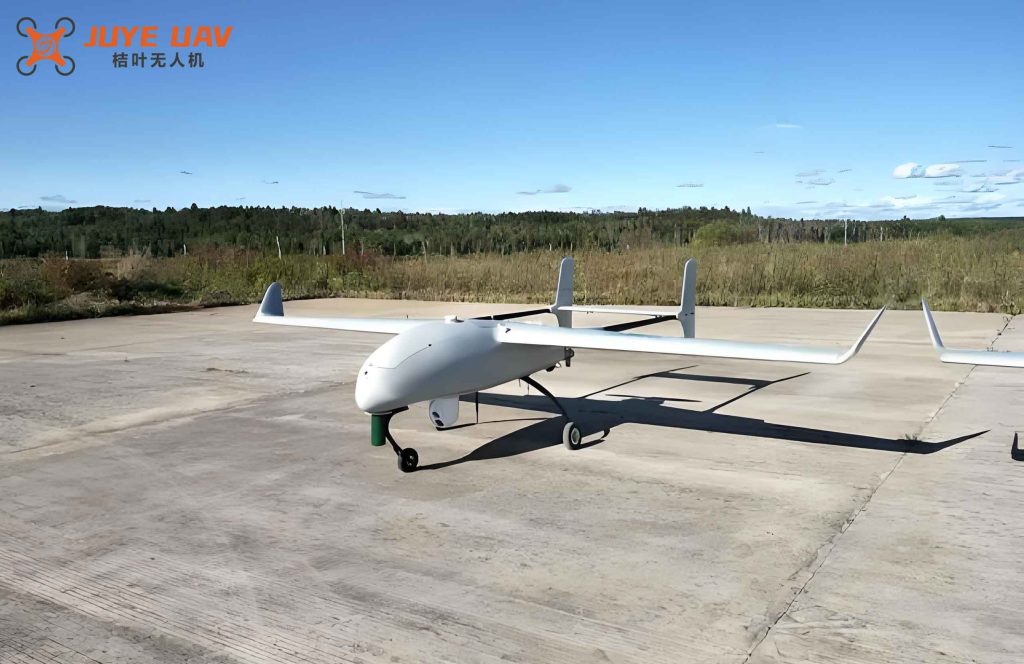
In recent years, the rapid development of unmanned aircraft systems (UAS) has led to an unprecedented expansion of operational scenarios and scale, particularly for large fixed-wing drone platforms. As these aircraft become integral to both military and civil missions, the need for safe integration into shared airspace with manned aircraft becomes critical. A core enabling technology for this integration is the Detect and Avoid (DAA) capability. This article presents a comprehensive overview of the technical standards governing DAA systems for large fixed-wing drone operations, drawing from international regulatory frameworks, technical specifications, and ongoing research. The discussion is organized around the fundamental architecture of DAA, the regulatory landscape, and the detailed technical standards that define performance requirements.
1. Introduction to Sense and Avoid Systems for Fixed-Wing Drones
The concept of Sense and Avoid (SAA) originates from the “See and Avoid” principle in manned aviation, codified in FAR 91.113. For a fixed-wing drone, the functional equivalence to manned aircraft SAA is achieved through an automated or semi-automated DAA system. The core process can be summarized as a three-step cycle: environmental situational awareness, flight conflict prediction, and conflict resolution. The typical DAA workflow is illustrated conceptually in the following steps:
- Sensing: The fixed-wing drone uses onboard transponders, ADS-B, radar, electro-optical/infrared sensors, and other devices to detect and broadcast its state (position, velocity, intent) within the airspace.
- Processing & Prediction: The DAA system fuses sensor data, evaluates potential collision threats using algorithms such as the modified tau criterion or probabilistic collision risk models, and generates alerts.
- Resolution: Based on the threat assessment, the system issues guidance commands (e.g., turn, climb, descend) to maintain safe separation. For large fixed-wing drone, a human-in-the-loop may execute the command, or the system may be fully autonomous.
The mathematical foundation of conflict detection often relies on geometric and probabilistic models. A common formulation is the well-known “closest point of approach” (CPA) calculation. Given two aircraft A and B with positions \(\vec{r}_A(t)\), \(\vec{r}_B(t)\) and velocities \(\vec{v}_A\), \(\vec{v}_B\), the relative position and velocity are:
\[
\vec{r}(t) = \vec{r}_A(t) – \vec{r}_B(t), \quad \vec{v} = \vec{v}_A – \vec{v}_B
\]
The time to closest approach \(t_{CPA}\) is found by minimizing the squared distance \(d^2(t) = \|\vec{r}(t)\|^2\):
\[
\frac{d}{dt} d^2(t) = 2\vec{r}(t)\cdot\vec{v} = 0 \quad \Rightarrow \quad t_{CPA} = -\frac{\vec{r}(0)\cdot\vec{v}}{\|\vec{v}\|^2}
\]
The distance at CPA is then:
\[
d_{CPA} = \|\vec{r}(0) + \vec{v}\,t_{CPA}\|
\]
If \(d_{CPA} < R_{safe}\) (a predefined safety radius) and \(0 < t_{CPA} < T_{lookahead}\), a conflict is declared. This simple model is extended in real systems to account for uncertainty in sensor measurements and future intent.
2. Regulatory Framework for Airspace Integration of Fixed-Wing Drones
International and national regulatory bodies have established frameworks to govern the operation of large fixed-wing drone in non-segregated airspace. The following table summarizes key documents and their relevance to DAA.
| Organization | Document | Description | Relevance to Large Fixed-Wing Drone DAA |
|---|---|---|---|
| ICAO | Annex 2 – Rules of the Air | Defines “detect and avoid” as the capability to perceive conflicts and take action. | Basis for DAA requirements in all signatory states. |
| FAA | FAR Part 91 | General operating and flight rules; mandates equivalence to “see and avoid” for UAS. | Legal requirement for DAA system performance. |
| FAA | UAS Integration Roadmap (2013) | Outlines phased integration of UAS into NAS. | Provides timeline and milestones for DAA capability maturation. |
| EASA | Regulation (EU) 2019/947 & 945 | Implementing rules for UAS operations and design. | Includes DAA requirements for specific categories of UAS including large fixed-wing drone. |
| CAAC (China) | MD-TM-2016-004 (Air Traffic Management of Civil UAS) | Requires evaluation of “perception and avoidance” capability for civil UAS. | Mandates DAA capability for large fixed-wing drone even in segregated airspace. |
Current practice for large fixed-wing drone relies on segregated airspace (temporal or spatial separation) until the DAA system can demonstrate an equivalent level of safety (ELOS) to manned aircraft. However, this approach is unsustainable as airspace congestion increases. Therefore, the development of robust DAA standards is a priority.
3. Technical Standards for Sense and Avoid Systems
3.1 Technical Standard Orders (TSO)
The U.S. Federal Aviation Administration (FAA) issues Technical Standard Orders (TSO) that define minimum performance standards for airborne equipment. For DAA-related components, the following TSOs are directly applicable to large fixed-wing drone systems.
| TSO Number | Title | Equivalent CTSO (China) |
|---|---|---|
| TSO-C118a | Airborne Traffic Alert and Collision Avoidance System (TCAS I) | CTSO-C118a |
| TSO-C119e | Airborne Traffic Alert and Collision Avoidance System (TCAS II) with Hybrid Surveillance | CTSO-C119e |
| TSO-C147a | Traffic Advisory System (TAS) | CTSO-C147a |
| TSO-C154d | Automatic Dependent Surveillance – Broadcast (ADS-B) Universal Access Transceiver (978 MHz) | CTSO-C154c |
| TSO-C166c | ADS-B and Traffic Information Service – Broadcast (TIS-B) Equipment (1090 MHz) | CTSO-C166b |
| TSO-C199 | Traffic Alert Beacon System (TABS) | CTSO-C199 |
| TSO-C211 | Detect and Avoid (DAA) System | CTSO-C211 |
| TSO-C212 | Air-to-Air Radar for Traffic Surveillance (ATAR) | CTSO-C212 |
These TSOs provide the baseline performance criteria for sensors, transponders, and processing units that constitute a DAA system. For a large fixed-wing drone, compliance with these TSOs is a prerequisite for obtaining an airworthiness approval for operations in controlled airspace.
3.2 RTCA Standards for DAA Systems
The Radio Technical Commission for Aeronautics (RTCA) develops consensus-based standards widely adopted by FAA, ICAO, and other authorities. The following RTCA documents are most relevant to fixed-wing drone DAA.
| Document | Title | Key Provisions for Large Fixed-Wing Drone |
|---|---|---|
| DO-160G | Environmental Conditions and Test Procedures for Airborne Equipment | Defines environmental qualification (vibration, temperature, EMI) for DAA hardware. |
| DO-185B | Minimum Operational Performance Standards (MOPS) for TCAS II | Specifies collision avoidance logic (RA generation) used in manned aircraft; DAA must be compatible. |
| DO-242A | Minimum Aviation System Performance Standards (MASPS) for ADS-B | Defines ADS-B message format, latency, and accuracy; essential for cooperative surveillance. |
| DO-260B | MOPS for 1090 MHz Extended Squitter ADS-B and TIS-B | Detailed performance requirements for ADS-B transceivers. |
| DO-300A | MOPS for TCAS II Hybrid Surveillance | Enables TCAS II to use ADS-B for improved tracking. |
| DO-362 | MOPS for Command and Control (C2) Data Link (Ground) | Specifies latency, security, and reliability for C2 link, which interacts with DAA. |
| DO-365C | MOPS for Detect and Avoid (DAA) Systems | Core standard for DAA; covers alerting thresholds, collision volumes, and test procedures. |
| DO-366 | MOPS for Air-to-Air Radar for Traffic Surveillance (ATAR) | Performance specifications for active radar sensors used in non-cooperative DAA. |
| DO-377 | MASPS for C2 Link Systems Supporting UAS in NAS | Link performance for DAA command transmission. |
| DO-385 | MOPS for Airborne Collision Avoidance System X (ACAS X) | Next-generation collision avoidance logic (ACAS Xa, Xo) that can be used in DAA for fixed-wing drone. |
The most comprehensive document is DO-365C, which defines the Minimum Operational Performance Standards (MOPS) for DAA systems intended for operation in Classes B, C, D, E, and G airspace. For a large fixed-wing drone, the standard specifies:
- Alert thresholds: Time to CPA (e.g., 30 to 120 seconds) and distance thresholds (e.g., 0.5 to 2 NM horizontal, 300 to 500 ft vertical).
- Collision volume: A protection zone that must not be violated.
- Sensor performance: Minimum detection range, field of regard, update rate, and accuracy.
- Latency: Maximum allowable delay from sensing to display or command.
A typical DAA well-clear threshold used in DO-365C can be expressed as:
\[
\text{Well-Clear Volume:} \quad H_{th} = 0.5\ \text{NM},\quad V_{th} = 300\ \text{ft},\quad \tau_{th} = 30\ \text{s}
\]
Where \(H_{th}\) is horizontal miss distance, \(V_{th}\) is vertical miss distance, and \(\tau_{th}\) is time to CPA. If the predicted miss distance is less than these values and the time to CPA is less than threshold, the DAA system alerts the pilot (or executes automated avoidance).
3.3 ASTM Standards for Fixed-Wing Drone DAA
The American Society for Testing and Materials (ASTM) has developed standards for small UAS, but some are also applicable to larger fixed-wing drone. The following table lists key ASTM DAA documents.
| Standard | Title | Scope and Relevance |
|---|---|---|
| F 3442M-20 | Standard Specification for Detect and Avoid System Performance Requirements | Applies to UAS with maximum dimension ≤ 25 ft and airspeed < 100 knots. Provides safety thresholds for low-altitude operations; less applicable to large fixed-wing drone but provides reference methodology. |
| F 2411-07 | Standard Specification for Design and Performance of an Airborne Sense-and-Avoid System | Defines system architecture, sensor field-of-regard (\(\pm 110^\circ\) horizontal, \(\pm 15^\circ\) vertical), and minimum separation distances (horizontal 500 ft, vertical 100 ft). Provides useful guidelines for large fixed-wing drone DAA design. |
Although ASTM F 2411-07 was originally developed for smaller aircraft, its definitions of safety zones and sensor coverage are often used as a starting point for large fixed-wing drone system requirements. For example, the requirement that the DAA system must ensure a minimum separation of 500 ft horizontal and 100 ft vertical during an avoidance maneuver is a common benchmark.
4. Mathematical Modeling of DAA Performance for Fixed-Wing Drones
Performance evaluation of a DAA system for a large fixed-wing drone relies on probabilistic models that account for sensor errors, communication latency, and aircraft dynamics. One widely used metric is the probability of midair collision \(P_{col}\) under the assumption of normally distributed errors. A simplified risk model is:
\[
P_{col} = \frac{1}{2\pi\sigma_x\sigma_y} \iint_{\text{collision area}} \exp\left(-\frac{x^2}{2\sigma_x^2} – \frac{y^2}{2\sigma_y^2}\right) dx\,dy
\]
Where \(\sigma_x, \sigma_y\) are standard deviations of position error in horizontal coordinates, and the collision area is defined by the physical dimensions of the fixed-wing drone and the intruder. For DAA system design, acceptable risk levels are typically on the order of \(10^{-9}\) per flight hour.
Another key performance parameter is the “false alert rate” and “missed detection rate.” The trade-off is often represented by a receiver operating characteristic (ROC) curve. For a given sensor with detection probability \(P_d\) and false alarm probability \(P_{fa}\), the system’s ability to correctly identify threats can be modeled using a Neyman-Pearson criterion:
\[
\max P_d \quad \text{subject to} \quad P_{fa} \leq \alpha
\]
Where \(\alpha\) is the maximum allowable false alarm rate, typically set by the regulator (e.g., one false alert per 1000 flight hours).
The latency from sensing to command execution is critical for a fixed-wing drone because of its higher speed compared to small UAS. The total latency \(L_{total}\) can be expressed as:
\[
L_{total} = L_{sensor} + L_{processing} + L_{comm} + L_{pilot\_response} + L_{aircraft\_response}
\]
For autonomous DAA, the pilot response term is replaced by autopilot command latency. Standards such as DO-365C require total latency to be less than 2 seconds for a fixed-wing drone operating at typical jet speeds.
5. Current State of DAA Standards for Fixed-Wing Drones: Gaps and Future Directions
5.1 Gaps in Existing Standards
Despite the progress in RTCA, ASTM, and TSO standards, several gaps remain for large fixed-wing drone DAA:
- Lack of specific metrics for high-speed fixed-wing drones: Most DAA MOPS are derived from manned aircraft or small UAS. Large fixed-wing drone often operate at speeds > 200 knots, requiring larger well-clear volumes and faster reaction times. Current thresholds in DO-365C are optimized for slower aircraft.
- Non-cooperative sensing: Standards for active sensors (radar, lidar) are less mature than for cooperative systems (ADS-B, TCAS). Large fixed-wing drone need robust non-cooperative DAA for airspace where intruders may not have transponders.
- Integration with C2 link: Standards for command and control data links (DO-362, DO-377) do not fully address the impact of link loss on DAA decision-making. A large fixed-wing drone may lose C2 during a critical avoidance maneuver; existing standards lack requirements for autonomous fail-safe behavior.
- Human factors for remote pilot: Most DAA standards assume a pilot in the cockpit. For large fixed-wing drone operated from a ground control station, display latency, loss of situational awareness, and decision delays are not well modeled.
5.2 Future Directions
To address these gaps, the following developments are anticipated:
- Adaptation of DO-365C for high-speed fixed-wing drones: New annexes or revisions should define scaled well-clear thresholds based on aircraft performance. For example, a formula for minimum horizontal threshold \(H_{min}\) as a function of closing speed \(V_c\):
\[
H_{min}(V_c) = H_{ref} + \frac{V_c^2}{2a_{max}}
\]
Where \(a_{max}\) is the maximum lateral acceleration of the fixed-wing drone, and \(H_{ref}\) is a baseline threshold (e.g., 0.5 NM).
- Standardization of non-cooperative sensor performance: ASTM and RTCA are working on MOPS for air-to-air radar (DO-366 already covers this) and electro-optical sensors. Future standards will specify detection range for small, non-cooperative targets.
- Autonomous DAA with degraded C2: Standards will require that a fixed-wing drone can execute a pre-defined contingency maneuver (e.g., climb to a safe altitude and loiter) if C2 link is lost during a DAA event. This is already being discussed in RTCA special committees.
- Verification and validation (V&V) methodologies: Because it is impractical to test all possible encounter geometries in flight, the industry is moving toward model-based V&V using Monte Carlo simulations. Standards will define accepted simulation frameworks and coverage metrics.
6. Comparison of International DAA Standards for Fixed-Wing Drones
The following table provides a comparative summary of the major DAA standards and their applicability to large fixed-wing drone.
| Standard | Regulatory Basis | UAS Category | Key Performance Metrics | Strengths | Weaknesses |
|---|---|---|---|---|---|
| RTCA DO-365C | FAA acceptance | All UAS (including large fixed-wing) | Well-clear thresholds: \(H_{th}=0.5\)–1.5 NM, \(V_{th}=300\)–700 ft, \(\tau_{th}=30\)–120 s | Comprehensive; covers cooperative and non-cooperative; includes test procedures. | Thresholds not optimized for high-speed; assumes typical manned aircraft closure rates. |
| ASTM F 2411-07 | Voluntary consensus | UAS under 25 ft dimension | Minimum separation: 500 ft horizontal, 100 ft vertical; sensor FOV \(\pm 110^\circ\) H, \(\pm 15^\circ\) V | Simple, easy to implement for small UAS. | Does not account for speed; inadequate for large fixed-wing drone. |
| TSO-C211 | FAA mandatory for airworthiness | Any UAS with DAA system | Functional requirements; references DO-365C for performance | Ensures interoperability with other TSO equipment. | Does not define specific alert thresholds; relies on other standards. |
| ISO/TC 20/SC 16 (draft) | International consensus | All UAS | Under development; expected to harmonize DO-365C and EU standards | Potential global harmonization. | Not yet finalized; may not address high-speed fixed-wing drone specifically. |
7. Conclusion
The integration of large fixed-wing drone into non-segregated airspace is one of the most challenging aspects of modern aviation. Sense and Avoid technology is the cornerstone of safe operations, and its standardization is progressing through bodies such as RTCA, ASTM, and FAO/ICAO. Current standards like DO-365C provide a solid foundation but require adaptation for the higher speeds, inertias, and operational profiles typical of large fixed-wing drone. Future work must focus on scaling well-clear thresholds, improving non-cooperative sensor performance standards, addressing C2 link degradation, and developing robust verification and validation methodologies. Only through continued refinement of these standards can we achieve the goal of routine, safe, and efficient integration of large fixed-wing drone into the global airspace system.
The author’s perspective, based on involvement in the development and testing of DAA systems for large fixed-wing drone, emphasizes that while significant progress has been made, the journey is far from over. The mathematical models presented in this article represent only the tip of the iceberg; real-world DAA systems must contend with complex sensor fusion, probabilistic risk assessment, and human-machine interaction. The standards community must continue to evolve these frameworks to match the rapid advancement of fixed-wing drone technology.