
Based on my firsthand experience in frontline firefighting operations with a former public security fire brigade, where I operated unmanned aerial vehicles (UAVs) to assist in fire suppression command, this article explores the application, training, and maintenance of fire UAVs in real-world firefighting scenarios. It analyzes multiple incidents of aerial emergencies, discusses lessons learned, and proposes research directions for UAVs suitable for battalion and company-level use. Through practical applications, fire UAVs have proven to enhance efficiency in fire suppression and rescue operations, enabling precise strikes on fire points, accurate personnel救援, and effective command assistance.
Currently, UAVs are increasingly widely used in the firefighting field, especially multi-rotor UAVs, due to their relatively simple operation and low requirements for takeoff and landing sites. They have been deployed in many fire departments. Literature has analyzed the advantages and application prospects of UAVs in firefighting, reconnaissance, and rescue, as well as selection, training, and management. For instance, studies have implemented UAV-based 3D modeling of building exteriors and spherical panoramic photography for key fire protection units, while others have used SketchUp to generate internal 3D structures for辅助灭火指挥,战评, and digital预案. From a实战化 training and research perspective, I share insights from实战 cases where fire UAVs participated in firefighting operations, assisting in command, combined with training and aerial emergency处置.
In one实战 case during a night fire in a four-story old building in a residential area, the fire had spread to other units, and traditional methods like elevated fire trucks were hindered by narrow roads and overhead wires. I deployed a consumer-grade fire UAV, a DJI Phantom 4 Pro+, equipped with a high-resolution camera. Due to darkness, visual obstacle avoidance systems were ineffective, and the live video feed was too dark. By adjusting camera settings such as ISO to 3200 and exposure time to 1/2 second, aerial photos were captured, but illumination was poor. To improve侦察, I improvised by attaching a tactical flashlight to the UAV’s landing gear, though it swung during flight, affecting stability. The enhanced照明 allowed for better航拍照片, revealing multiple fire points. Through radio commands, I guided water guns to precisely target these points, leading to rapid extinguishment. Post-fire, the UAV was used for spherical panoramic photography to assess damage and aid in战评.
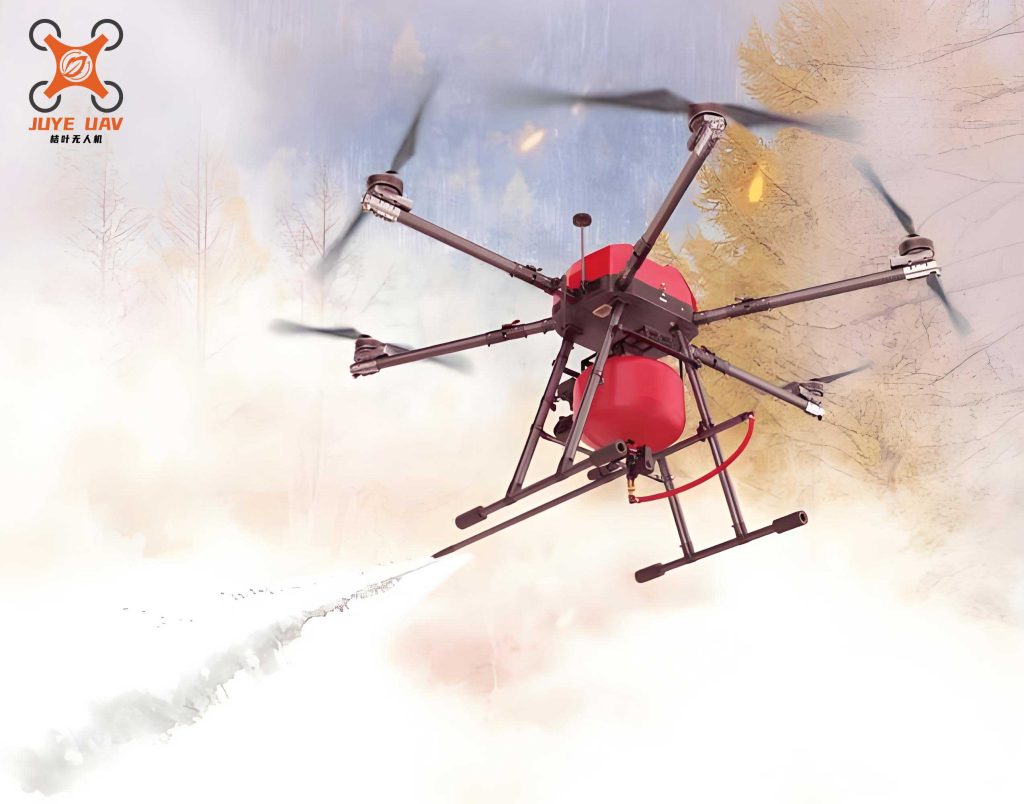
This case highlights several issues in fire UAV实战应用. First, there is often a lack of habit to carry fire UAVs on first-response vehicles, delaying their use. Second, while higher-level units have larger, multi-functional fire UAVs, they may not arrive promptly; battalion and company-level units often use consumer-grade fire UAVs, which are portable but lack专用性. For example, the absence of integrated照明 required improvised solutions. Third, payload设备 need improvement. Table 1 summarizes key机载设备 requirements for fire UAVs based on实战 needs.
| Device | Function | Specifications | Importance |
|---|---|---|---|
| 机载探照灯 | Night illumination for reconnaissance | Brightness: >1000 lumens; Beam angle: adjustable聚光 and泛光; Range: >50m | High: Enables visibility in dark environments, as seen in the case where tactical flashlight was insufficient. |
| 红外热像相机 | Thermal imaging for fire detection and rescue | Resolution: 640×480; Thermal sensitivity: <50mK | Critical: Allows detection of heat sources without visible light, enhancing侦察 accuracy. |
| 激光目标指示器 | Target designation for precise water strikes | Wavelength: 532-556nm green laser; Power: Class 3R;云台 stabilization | High: Enables multiple water guns to simultaneously target fire points without verbal guidance, improving efficiency. |
| FPV systems | First-person view for操作 in bright conditions | Video眼镜 with遮光罩; Latency: <50ms | Moderate: Addresses screen visibility issues in sunlight during daytime operations. |
From a training perspective, based on instructing over ten fire companies, common issues include reluctance to fly due to fear of damage, overconfidence leading to risky maneuvers, poor flight skills without emergency handling能力, and improper maintenance like storing batteries at full charge. To address these, I emphasize rigorous training protocols. For example, flight training should include attitude mode exercises to simulate GPS signal loss, where the fire UAV drifts and requires manual control. Trainees should practice hovering, slow rotations, and pattern flights like horizontal eights and vertical rectangles under varying wind conditions. Equation 1 can represent the stability challenge in attitude mode:
$$ \Delta P = k \cdot (W – C) $$
where $\Delta P$ is the positional drift, $k$ is a constant related to environmental factors, $W$ is wind speed, and $C$ is the control input from the operator. This highlights the need for熟练操作 to minimize drift. Additionally, night and beyond-visual-line-of-sight (BVLOS) training are essential for实战 scenarios. A pre-flight checklist is crucial for safety; Table 2 outlines a sample checklist for fire UAV operations.
| Check Item | Description | Action |
|---|---|---|
| Battery charge | Ensure batteries are at optimal charge (e.g., 50-70% for storage, 100% for immediate use). | Check voltage levels; use a battery management system to prevent over-discharge. |
| Propeller inspection | Verify propellers are securely attached and undamaged. | Tighten manually; replace if cracks or wear are present. |
| Motor function | Confirm motors rotate freely without obstruction. | Spin motors briefly; listen for abnormal noises. |
| Sensor calibration | Calibrate compass and IMU in interference-free areas. | Follow manufacturer guidelines; avoid metal-rich environments. |
| Weather assessment | Evaluate wind speed, precipitation, and visibility. | Use anemometers; avoid flights in winds >10 m/s or poor visibility. |
| Obstacle survey | Identify overhead wires, trees, and structures in flight path. | Conduct visual sweep; mark safe zones with cones if needed. |
Maintenance practices also impact fire UAV longevity. For batteries, instead of keeping them fully charged, a rotation system can be implemented: some batteries charged for standby, others discharged to storage voltage (e.g., 3.8V per cell). Equation 2 estimates battery degradation over time:
$$ D = D_0 \cdot e^{-\lambda t} \cdot (1 + \alpha \cdot V_{excess}) $$
where $D$ is degradation, $D_0$ is initial capacity, $\lambda$ is a decay constant, $t$ is time, $\alpha$ is a factor, and $V_{excess}$ represents overcharge voltage. This underscores the importance of proper storage to extend battery life. Furthermore,实战技战法 development is key; for instance, fire UAVs can measure water cannon range and height efficiently, as shown in operations where UAVs provided real-time data for射程 assessment.
Aerial emergencies are critical to address. I have encountered several incidents involving fire UAVs. First, compass interference can occur due to metallic structures. In one daytime training, a fire UAV approached a building with steel框架, triggering a compass interference alarm. By switching to attitude mode and manually controlling it away from the干扰源, the fire UAV was stabilized. In a night training case, takeoff from a rooftop near钢筋 caused immediate interference, leading to a spin and potential crash. I executed an emergency motor stop, causing the fire UAV to fall from under 1 meter, minimizing damage. This highlights the need to avoid low-altitude flights over metal-rich areas and maintain safe distances from obstacles. The risk can be quantified with Equation 3 for interference probability:
$$ P_i = \frac{A_m}{A_f} \cdot I_s $$
where $P_i$ is interference probability, $A_m$ is the area of metallic objects, $A_f$ is the flight area, and $I_s$ is the interference strength. Keeping $P_i$ low by choosing open areas reduces risks.
Second, wind-induced crashes can happen. In a training session, a sudden gust blew a hovering fire UAV into a tree, causing propeller contact and inversion. The fire UAV’s flight control system自动翻正 after a brief fall, allowing recovery. This demonstrates the importance of maintaining safe distances from obstacles and being prepared for wind shear. The force of wind on a fire UAV can be modeled as:
$$ F_w = \frac{1}{2} \cdot \rho \cdot C_d \cdot A \cdot v^2 $$
where $F_w$ is wind force, $\rho$ is air density, $C_d$ is drag coefficient, $A$ is cross-sectional area, and $v$ is wind speed. Pilots must anticipate such forces, especially in complex terrains.
Third, signal loss or weak GPS signals are common in urban canyons. If图传信号 drops due to obstruction, pilots should ascend to regain signal or use the fire UAV’s return-to-home function if programmed. In cases of battery failure, as in one incident where a fire UAV experienced power loss at 53 meters and crashed, the response should prioritize safety by avoiding人群 and attempting controlled descents to nearby roofs or trees. For battery redundancy, future fire UAV designs could incorporate dual-battery systems, with reliability given by:
$$ R_{system} = 1 – (1 – R_{battery})^n $$
where $R_{system}$ is system reliability, $R_{battery}$ is single battery reliability, and $n$ is the number of batteries. With $n=2$, reliability improves significantly.
Based on these experiences, I propose research directions for battalion and company-level fire UAVs. They should be portable for single-person carry,快速展开, and operable by one person. Given complex fireground environments, features like waterproofing, self-floating capability, obstacle avoidance, and high-temperature resistance are essential.全天候作战能力 requires robustness against various meteorological conditions. Table 3 summarizes key design parameters for such fire UAVs.
| Parameter | Target Specification | Rationale |
|---|---|---|
| Weight | < 5 kg | Enables单兵携带 and compliance with regulations for small UAVs. |
| Flight time | > 30 minutes | Ensures sufficient duration for reconnaissance and指挥 tasks in extended operations. |
| Payload capacity | > 1 kg | Accommodates essential devices like thermal cameras and lasers without compromising flight. |
| Waterproof rating | IP67 or higher | Protects against water exposure during firefighting, especially in rainy conditions or near water sources. |
| Operating temperature | -10°C to 50°C | Allows use in diverse climates, from winter冷 to fire-induced heat. |
| Obstacle avoidance | Multi-sensor (视觉, ultrasonic,红外) | Enhances safety in复杂空域, reducing collision risks as seen in cases with wires and trees. |
| Communication range | > 2 km in urban areas | Facilitates BVLOS operations for wide-area侦察, considering signal blockage in cities. |
In conclusion, fire UAVs are transformative tools in modern firefighting. Through实战应用, they boost efficiency in灭火救援, enabling precise打击 and救援. Training must focus on emergency handling and safety protocols, while maintenance should follow scientific practices to extend equipment life. Aerial emergencies, though risky, can be managed with proper procedures and design improvements. For future development, fire UAVs tailored for battalion and company levels should emphasize portability, durability, and specialized payloads. As fire UAV technology evolves, their integration into firefighting workflows will deepen, offering even greater辅助 in saving lives and property. The continuous refinement of fire UAV systems, driven by实战 insights, will ensure they meet the dynamic challenges of fire rescue operations.