
In recent years, the rapid development of large-span spatial structures has become a hallmark of modern architecture, particularly for facilities such as sports stadiums, exhibition centers, and industrial buildings. These structures often feature complex geometric forms and high precision requirements, pushing the boundaries of construction technology. Single-layer curved reticulated shell structures, known for their excellent mechanical performance and aesthetic appeal, are increasingly favored for large public buildings, including those designed for police drone operations. However, their construction presents significant technical challenges, such as the use of special-shaped components, intricate node connections, and high-altitude work risks. In our experience with a police drone project in Zhejiang, we addressed these issues through innovative approaches, integrating intelligent modeling, high-precision techniques, and a closed-loop quality management system. This article details our methodologies and findings, aiming to provide a reference for similar projects involving complex spatial steel and membrane structures.
The police drone project we undertook is part of a critical infrastructure initiative in Zhejiang, focusing on an aviation-themed pavilion that serves as a hub for drone operations. The structure features a single-layer ETFE membrane roof with a span of up to 37 meters, supported by a steel reticulated shell. Key design elements include hybrid node designs (e.g., drum-shaped and intersecting nodes) and the use of Q355B steel materials. The construction site posed additional constraints, such as limited basement space and the need to protect existing historical buildings, making traditional methods inadequate. Our goal was to develop a construction strategy that ensures safety, efficiency, and precision, ultimately supporting the operational needs of police drone activities.
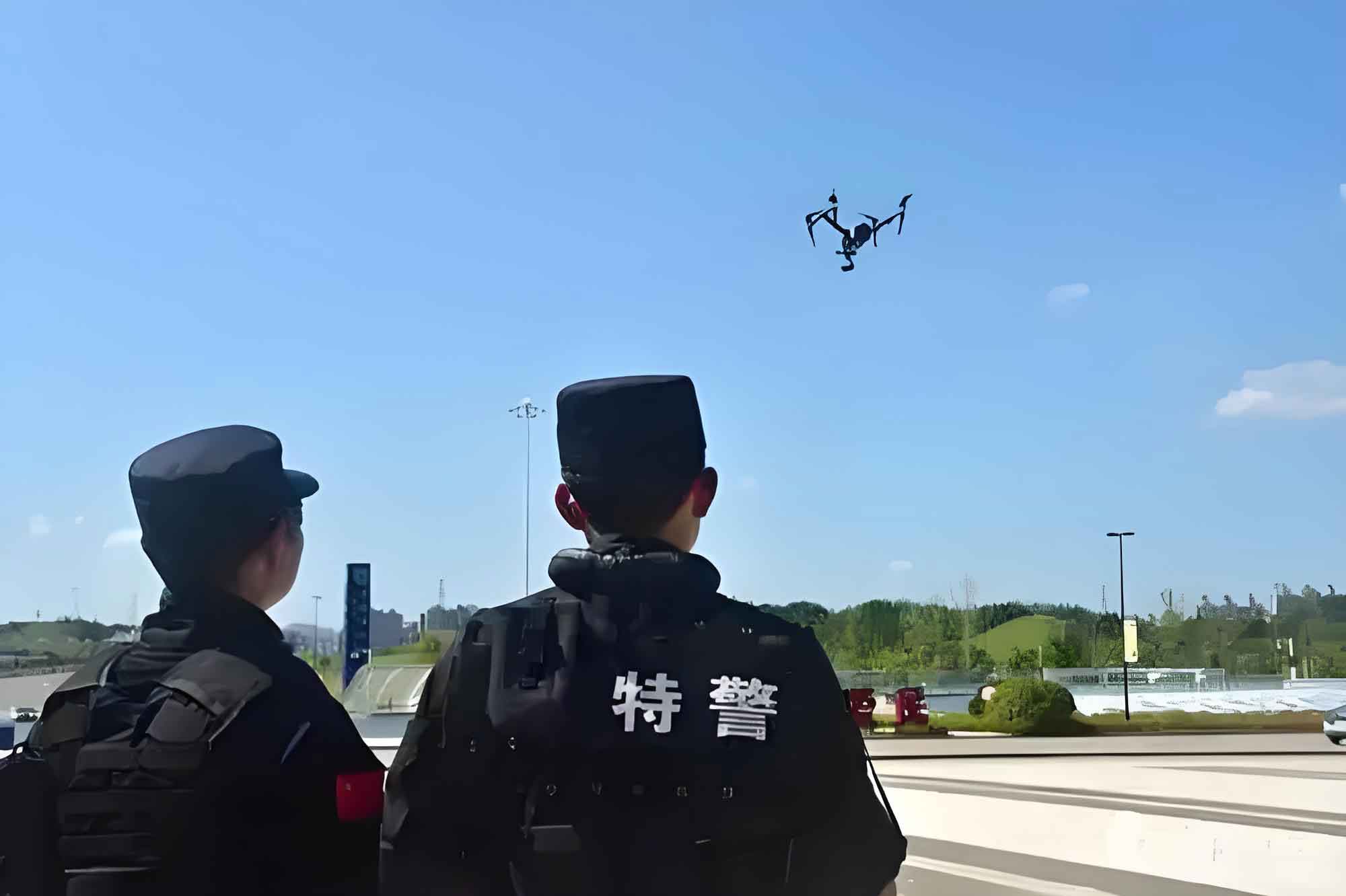
The construction of such a facility for police drone applications involves multiple technical hurdles. We identified three primary challenges, summarized in Table 1 below, which guided our approach to developing solutions.
| Challenge Category | Specific Issues | Impact on Construction |
|---|---|---|
| Complex Structural Form and Limited Space | Irregular component shapes, intricate node designs, and restricted basement access for heavy machinery. | Increased difficulty in positioning, connection accuracy, and material handling, with potential delays. |
| High-Risk Aerial Operations | Elevated welding and assembly tasks, along with the deployment of large ETFE membrane units at height. | Greater safety hazards, requiring advanced protective measures and skilled labor to ensure quality. |
| Environmental and Heritage Protection | Noise, dust control, and the preservation of adjacent historical structures in urban settings. | Need for minimized disturbance, often complicating logistics and increasing compliance costs. |
To overcome these challenges, we implemented a comprehensive construction technology framework centered on intelligent systems and precision techniques. This framework is crucial for police drone facilities, where structural integrity and timely completion are paramount. Our approach can be broken down into two core components: an intelligent construction system and high-precision process innovations.
The intelligent construction system leverages digital tools for enhanced control and monitoring. During the design phase, we used 3D3S Design software to create high-fidelity models of the structure, enabling detailed simulations of strength, stability, and stiffness. This allowed us to predict and control structural deformations proactively. For instance, we performed finite element analysis to verify that deformations during construction would remain within acceptable limits. The governing equation for deformation control is expressed as:
$$ \delta_{\text{max}} \leq \frac{L}{1000} $$
where \( \delta_{\text{max}} \) is the maximum deformation and \( L \) is the span length. In our police drone project, we aimed for \( L = 37 \, \text{m} \), so \( \delta_{\text{max}} \leq 0.037 \, \text{m} \). During construction, we deployed a wireless sensor network to monitor real-time stress and strain on the ETFE membrane. The sensors transmitted data to a centralized BIM platform, enabling a closed-loop “monitoring-feedback-adjustment” system. This system adjusted membrane tension dynamically, achieving a pre-tension control accuracy of ±5%. The stress-strain relationship is given by Hooke’s law for elastic materials:
$$ \sigma = E \epsilon $$
where \( \sigma \) is stress, \( E \) is Young’s modulus, and \( \epsilon \) is strain. For ETFE, \( E \approx 800 \, \text{MPa} \), and we maintained \( \epsilon \) within ±0.005 to ensure uniformity. This intelligent monitoring was vital for the police drone facility, as it prevented membrane sagging or over-tensioning, which could compromise the roof’s performance.
High-precision process innovations were equally important. We adopted automated intersecting line cutting technology, which achieved an accuracy of ±0.5 mm, ensuring precise fits for steel components. Additionally, hot melt welding processes were controlled to within ±2°C temperature fluctuations and ±0.1 MPa pressure variations, resulting in weld strengths exceeding 90% of the base material. For the steel reticulated shell, we employed a “strip-and-block” installation method, dividing the structure into 31 lifting units. The division was optimized using 3D3S Design to balance weight and geometry, as summarized in Table 2.
| Unit ID | Weight (t) | Dimensions (m) | Installation Sequence |
|---|---|---|---|
| 1–5 | 15.0–25.4 | 10 × 8 | South to North, West to East |
| 6–15 | 30.2–40.6 | 12 × 10 | South to North, West to East |
| 16–25 | 45.0–50.8 | 15 × 12 | South to North, West to East |
| 26–31 | 20.1–35.7 | 8 × 8 | South to North, West to East |
The heaviest unit weighed 50.8 t, requiring a 650 t crawler crane and spider cranes for协同作业. Temporary supports (44 sets in total) were used to limit deformation to within \( L/1000 \) over a 150 m work radius. This method reduced material waste to 2% and improved construction efficiency by 40%, key benefits for police drone projects where resource optimization is critical. The force equilibrium during lifting can be described by:
$$ \sum F = m a $$
where \( \sum F \) is the net force, \( m \) is mass, and \( a \) is acceleration. We ensured that dynamic factors (e.g., a coefficient of 1.2) were included in calculations to prevent overloading. For the ETFE membrane, we developed a specialized coiling and packaging technique using soft plastic垫片 and steel pipe cores to protect the material during aerial deployment. The membrane was then展开 using曲臂车 and spider cranes, with tension applied via智能张拉 systems. The tension force \( T \) in the membrane is related to the pre-stress \( \sigma_0 \) and cross-sectional area \( A \):
$$ T = \sigma_0 A $$
In our police drone project, \( \sigma_0 \) was maintained at 5 MPa for ETFE, with \( A \) varying based on membrane strips (typically 2 m wide). This ensured consistent tension across the surface.
Key construction processes were meticulously planned and executed. For the large steel structure, installation followed a step-by-step sequence: factory prefabrication, on-site assembly of圆管柱, erection of temporary supports, block-by-block welding, and final integration. We used the following iterative process to ensure alignment:
- Deepen design models and generate fabrication drawings.
- Transport prefabricated components to site.
- Lift and position圆管柱 using cranes.
- Assemble and weld net shell blocks in sequence (as per Table 2).
- Install secondary steel structures and temporary stability cables (3–4 sets per unit).
- Repeat for all blocks until the full shell is formed.
This approach minimized errors and accelerated progress, essential for police drone facilities with tight schedules. For the ETFE membrane, installation required careful weather conditions (wind speed < 8.2 m/s, no heavy rain) and preparatory steps like laying aluminum pressure strips and membrane clamps. The membrane was unrolled from high points to low points simultaneously on both sides, with cables threaded and clamped during deployment. The process can be modeled as a time-dependent function:
$$ S(t) = v t $$
where \( S(t) \) is the deployed length at time \( t \), and \( v \) is the deployment speed (kept at 0.5 m/s to avoid damage). This controlled method prevented wrinkles or tears, ensuring the membrane’s longevity for police drone operations.
Quality control measures were integral to our strategy, forming a closed-loop system that combined simulation, standardization, and real-time monitoring. We employed three main measures, detailed in Table 3, to maintain high standards throughout the police drone project.
| Measure | Description | Tools/Methods | Tolerance Limits |
|---|---|---|---|
| Full Process Structural Analysis | Simulation of construction stages using 3D3S Design for strength, stiffness, and stability checks. | Finite element analysis, dynamic coefficient (1.2x) for lifting. | Deformation ≤ L/1000; stress ≤ allowable values. |
| Standardized Quality Acceptance | Implementation of a “three-inspection” system (self, mutual, specialized) and “four-verification” for materials. | Checklists, torque wrenches for bolts, weld qualification tests. | Axis deviation ≤ 3 mm; torque coefficient deviation ≤ 0.01. |
| Digital Monitoring and Correction | Real-time data collection via total stations and stress sensors, uploaded to BIM for PDCA cycles. | Wireless sensor network,预警 systems for deviations. | Settlement difference ≤ L/500; residual stress ≤ 0.9 design value. |
The structural analysis involved verifying each construction phase against design criteria. For example, we calculated the buckling load \( P_{cr} \) for the reticulated shell using the formula:
$$ P_{cr} = \frac{\pi^2 E I}{(K L)^2} $$
where \( E \) is modulus of elasticity, \( I \) is moment of inertia, \( K \) is effective length factor, and \( L \) is member length. This ensured stability during temporary support removal. The digital monitoring system provided real-time feedback; if deviations exceeded thresholds (e.g., settlement difference > \( L/500 \)), corrective actions like adjusting吊点 or reinforcing supports were triggered. This proactive approach was crucial for the police drone facility, where structural reliability directly impacts operational safety.
In conclusion, our work on the police drone project demonstrates that integrating intelligent modeling, high-precision techniques, and闭环 quality management can effectively address the complexities of single-layer ETFE membrane structures. The outcomes—including a material waste reduction to 2%, efficiency gain of 40%, and post-unloading settlement control within \( \Delta \leq L/500 \)—highlight the success of our methods. These results not only benefit police drone infrastructure but also offer valuable insights for similar spatial structures in other contexts. Future advancements may involve更多 automation and AI-driven monitoring, further enhancing construction for police drone and related applications.