
The operational envelope of UAV drones, particularly quadcopters, has expanded dramatically into complex, dynamic, and often unstructured environments. Missions such as last-mile delivery in urban canyons, post-disaster search and rescue in cluttered rubble, and precision agricultural spraying demand not only autonomous flight but also the critical ability to land safely while dynamically avoiding obstacles. This dual requirement of precise trajectory tracking for landing and real-time reactive obstacle avoidance presents a significant control challenge. Traditional approaches often treat path planning and flight control as separate sequential modules, which can lead to inefficiencies, susceptibility to local minima, and insufficient reactivity in fast-changing scenarios.
This article presents an integrated methodology that combines a novel bio-inspired path planning algorithm with a robust, layered flight control strategy specifically designed for the landing phase of UAV drones. The core innovation lies in the fusion of Artificial Potential Field (APF) concepts with an Ant Colony Optimization (ACO) metaheuristic to generate optimal, safe landing trajectories. This planned trajectory is then executed faithfully by a dedicated Proportional-Integral-Derivative (PID) based flight controller. The performance of this integrated system is validated through comprehensive simulation and practical experimentation, demonstrating its effectiveness for reliable UAV drone operations.
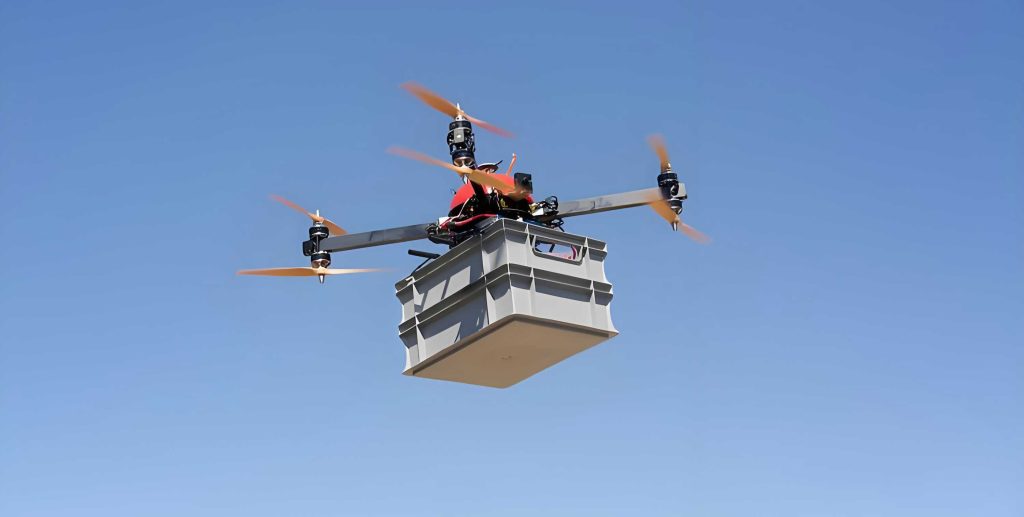
1. Hybrid Trajectory Planning: The Potential Field Ant Colony Algorithm
The first stage for autonomous UAV drones is to compute a feasible and optimal path from an initial point to a designated landing zone, circumventing all known static obstacles. We propose a hybrid planner that runs offline or in a re-planning loop, leveraging the strengths of both grid-based search, potential fields, and swarm intelligence.
1.1 Environmental Modeling and Potential Field Construction
The operational space for the UAV drones is discretized using a 3D grid map, where each cell is classified as free space or occupied by an obstacle. The landing pad is designated as the goal cell. Two virtual fields are superimposed on this grid:
- Attractive Potential Field: The goal generates an attractive force pulling the UAV drones towards it. The attraction increases as the distance decreases, ensuring a strong pull near the landing point. For a grid cell \( b \) and the goal \( o \), the attractive field value \( A_{b} \) is inversely proportional to its Manhattan distance \( MD(b,o) \), normalized by the best possible step from the current cell \( a \):
$$ A_{b} = \frac{1}{MD(b,o) + \min\{MD(a,o)\}} $$ - Repulsive Potential Field: Each obstacle generates a repulsive force that pushes the UAV drones away. This force is significant only within a defined safety radius \( R_s \) around an obstacle. For a grid cell \( b \), the total repulsive field value \( R_{b} \) is calculated from all obstacle cells \( s \) within their influence radius \( S_b \), based on the Euclidean distance \( OD(b,s) \):
$$ R_{b} = \frac{1}{1 – \sum_{s \in S_b} \frac{R_s}{OD(b,s)}} $$
This formulation creates a high, prohibitive value for cells too close to obstacles, effectively blocking them from the search.
1.2 Ant Colony Optimization with Field-Guided Heuristics
In our adapted Ant Colony Optimization, each artificial ant represents a potential path for the UAV drones from start to goal. The probability of an ant at cell \( a \) moving to a neighboring cell \( b \) is not solely based on pheromone concentration \( \tau_{ab} \) but is also biased by the artificial potential fields, serving as a dynamic heuristic.
The transition probability \( P_{ab} \) is given by:
$$ P_{ab} = \frac{[\tau_{ab}]^\alpha \cdot [\eta_{ab}]^\beta \cdot [\Phi_{ab}]^\gamma}{\sum_{l \in \text{allowed}} [\tau_{al}]^\alpha \cdot [\eta_{al}]^\beta \cdot [\Phi_{al}]^\gamma} $$
where:
- \( \tau_{ab} \): Pheromone concentration on the edge from \( a \) to \( b \).
- \( \eta_{ab} \): Standard heuristic (e.g., inverse of distance to goal).
- \( \Phi_{ab} \): Field-based heuristic, defined as \( \Phi_{ab} = \frac{1}{\epsilon + A_{b} \cdot R_{b}} \). This crucial term favors cells with high attraction (closer to goal) and low repulsion (far from obstacles). \( \epsilon \) is a small constant to prevent division by zero.
- \( \alpha, \beta, \gamma \): Parameters controlling the relative influence of pheromone, standard heuristic, and field heuristic.
After all ants complete a tour (a full path from start to landing pad for the UAV drones), the pheromone trails are updated. First, all trails evaporate globally to forget poor paths:
$$ \tau_{ab}(t+1) = (1 – \rho) \cdot \tau_{ab}(t) $$
where \( \rho \) is the evaporation rate. Then, ants deposit pheromone on the edges of their traveled path proportional to the path’s quality (e.g., inverse of its length \( L_k \) and its minimum clearance from obstacles \( C_k \)):
$$ \Delta \tau_{ab}^k = \frac{Q}{L_k + \omega / C_k} $$
where \( Q \) is a constant and \( \omega \) a weight. The pheromone update for the best path (e.g., the iteration-best or global-best) can be reinforced further.
1.3 Trajectory Smoothing with B-Splines
The path generated by the ant colony is a sequence of grid cells, which is inherently jagged. To create a trajectory that is smooth and kinematically feasible for UAV drones (respecting limits on velocity and acceleration), we approximate the path waypoints with a uniform B-spline curve.
A B-spline curve of order \( k \) (degree \( k-1 \)) offers \( C^{k-2} \) continuity, ensuring smoothness. Given \( n+1 \) control points \( P_0, P_1, …, P_n \) derived from the path, and a knot vector, the B-spline curve \( C(u) \) is defined as:
$$ C(u) = \sum_{i=0}^{n} N_{i,k}(u) P_i $$
where \( N_{i,k}(u) \) are the B-spline basis functions, calculated recursively using the Cox-de Boor formula. For a cubic B-spline (k=4), commonly used for UAV drone trajectories, the basis functions over a uniform knot vector are:
$$
\begin{aligned}
N_{0,4}(u) &= \frac{1}{6}(1-u)^3 \\
N_{1,4}(u) &= \frac{1}{6}(3u^3 – 6u^2 + 4) \\
N_{2,4}(u) &= \frac{1}{6}(-3u^3 + 3u^2 + 3u + 1) \\
N_{3,4}(u) &= \frac{1}{6}u^3
\end{aligned}
$$
This final smoothed curve \( C(u) \) becomes the reference landing and obstacle avoidance trajectory for the flight controller of the UAV drones.
| Parameter Group | Parameter | Symbol | Typical Value / Range |
|---|---|---|---|
| Potential Field | Attraction Gain | – | 1.0 – 2.0 |
| Repulsion Gain | – | 0.5 – 1.5 | |
| Obstacle Safety Radius | \( R_s \) | 0.5 m – 2.0 m | |
| Ant Colony | Number of Ants | \( m \) | 20 – 50 |
| Pheromone Influence | \( \alpha \) | 1.0 | |
| Distance Heuristic Influence | \( \beta \) | 2.0 – 5.0 | |
| Field Heuristic Influence | \( \gamma \) | 1.0 – 3.0 | |
| Pheromone Evaporation Rate | \( \rho \) | 0.3 – 0.5 | |
| Pheromone Constant | \( Q \) | 100 | |
| B-spline | B-spline Order | \( k \) | 4 (Cubic) |
| Control Point Interval | – | Adaptive to path density |
2. PID-Based Flight Control for Trajectory Tracking
With a smooth reference trajectory \( \mathbf{r}_{ref}(t) = [x_{ref}, y_{ref}, z_{ref}]^T \) and its derivatives generated, the next challenge for the UAV drones is to accurately track this path in the presence of model uncertainties and disturbances. We employ a hierarchical, nested PID control architecture, which is widely favored for its simplicity, robustness, and effectiveness in controlling UAV drones.
2.1 Control Architecture Overview
The control structure for the UAV drones is decomposed into two main loops: an outer position control loop and an inner attitude control loop. The position controller computes the desired attitude and collective thrust required to follow the trajectory. The attitude controller then generates the required motor commands to achieve this desired attitude. This separation leverages the timescale separation principle, where the attitude dynamics are much faster than the translational dynamics.
2.2 Position and Altitude PID Controller
The outer-loop controller for the UAV drones takes the position error in the inertial frame. For the horizontal (x, y) axes, it calculates desired accelerations. For the altitude (z-axis), it calculates the desired net thrust component.
Let \( \mathbf{e}_p = \mathbf{r}_{ref} – \mathbf{r} \) be the position error. The PID control law for the horizontal channels is:
$$
\begin{aligned}
a_{x,des} &= K_{P,x} e_{x} + K_{I,x} \int e_{x} dt + K_{D,x} \dot{e}_{x} \\
a_{y,des} &= K_{P,y} e_{y} + K_{I,y} \int e_{y} dt + K_{D,y} \dot{e}_{y}
\end{aligned}
$$
These desired accelerations are then converted into desired roll (\( \phi_{des} \)) and pitch (\( \theta_{des} \)) angles for the UAV drones, assuming small angles and a desired yaw angle \( \psi_{des} \) (often set to zero or a constant for landing):
$$
\begin{aligned}
\phi_{des} &= \arcsin\left( \frac{a_{x,des} \sin\psi_{des} – a_{y,des} \cos\psi_{des}}{g} \right) \\
\theta_{des} &= \arctan\left( \frac{a_{x,des} \cos\psi_{des} + a_{y,des} \sin\psi_{des}}{a_{z,des} + g} \right)
\end{aligned}
$$
where \( g \) is gravity and \( a_{z,des} \) is managed by the altitude controller.
The altitude controller for the UAV drones directly outputs the normalized total thrust command \( T \):
$$ T = K_{P,z} e_{z} + K_{I,z} \int e_{z} dt + K_{D,z} \dot{e}_{z} + \frac{g}{\cos\phi \cos\theta} $$
The last term is a gravity compensation feedforward term based on the current attitude estimates.
2.3 Attitude PID Controller
The inner loop controls the orientation of the UAV drones. It is typically implemented as a cascade PID: an outer loop controlling the Euler angles (or a quaternion error) and an inner loop controlling the body-axis angular rates. This structure provides better disturbance rejection.
Angle Control Loop (Outer): Computes desired angular rates from attitude error.
$$ \mathbf{\omega}_{des} = \mathbf{K}_{P,att} \mathbf{e}_{att} + \mathbf{K}_{I,att} \int \mathbf{e}_{att} dt + \mathbf{K}_{D,att} \dot{\mathbf{e}}_{att} $$
where \( \mathbf{e}_{att} = [\phi_{des}-\phi, \theta_{des}-\theta, \psi_{des}-\psi]^T \).
Angular Rate Control Loop (Inner): Computes the control moments \( \mathbf{M} = [M_x, M_y, M_z]^T \) from angular rate error.
$$ \mathbf{M} = \mathbf{K}_{P,rate} (\mathbf{\omega}_{des} – \mathbf{\omega}) + \mathbf{K}_{I,rate} \int (\mathbf{\omega}_{des} – \mathbf{\omega}) dt + \mathbf{K}_{D,rate} \dot{\mathbf{\omega}} $$
This inner loop must be tuned very aggressively to ensure fast and accurate tracking, which is essential for the stability of UAV drones.
Finally, the thrust command \( T \) and the moment vector \( \mathbf{M} \) are converted into individual motor speeds for the quadcopter UAV drones using its specific control allocation matrix.
| Control Loop | Input Error | Output | Main Purpose |
|---|---|---|---|
| Altitude (Z-Position) | \( z_{ref} – z \) | Total Thrust \( T \) | Control height and vertical speed |
| Horizontal Position (X,Y) | \( x_{ref} – x \), \( y_{ref} – y \) | Desired Roll \( \phi_{des} \), Pitch \( \theta_{des} \) | Guide UAV drone to target X,Y coordinates |
| Attitude (Angle) | \( \phi_{des}-\phi \), \( \theta_{des}-\theta \), \( \psi_{des}-\psi \) | Desired Angular Rates \( \mathbf{\omega}_{des} \) | Achieve the commanded orientation |
| Angular Rate | \( \mathbf{\omega}_{des} – \mathbf{\omega} \) | Control Moments \( \mathbf{M} \) | Directly govern the rotational dynamics |
3. System Integration and Experimental Validation
The proposed framework for UAV drones integrates the planning and control modules into a cohesive autonomous system. The Potential Field Ant Colony algorithm generates a B-spline trajectory. This trajectory is then fed to the flight controller, which computes position and attitude setpoints at a high frequency (e.g., 100-500 Hz). The PID controllers work to minimize the tracking error, ensuring the UAV drones follow the safe path to landing.
3.1 Simulation and Practical Setup
Initial development and tuning were performed in a high-fidelity simulation environment like Gazebo, which provides realistic physics models, sensor noise, and environmental rendering for UAV drones. Key parameters for the planner and controller were optimized iteratively (see Table 1 & 2 for examples). Subsequently, the system was deployed on a real quadcopter platform equipped with a Pixhawk-class flight computer, a visual-inertial odometry (VIO) system or motion capture for state estimation, and a companion computer for running the planning algorithm.
3.2 Performance Metrics and Results
The performance of our integrated approach for UAV drones was evaluated using several key metrics:
- Trajectory Optimality: The length and smoothness of the planned path.
- Tracking Accuracy: The Root Mean Square Error (RMSE) between the UAV drone’s actual position and the reference trajectory, especially during the final landing phase.
- Obstacle Clearance: The minimum distance maintained from all obstacles during the flight.
- Control Effort & Stability: The smoothness of actuator commands and the absence of oscillations.
In tests, the hybrid planner consistently found smooth, collision-free paths for the UAV drones in environments with multiple concave obstacles where basic APF methods would fail due to local minima. The incorporation of the field-based heuristic in the ACO significantly reduced the number of iterations needed to find a high-quality path compared to standard ACO.
The PID-based tracking controller demonstrated robust performance. During the final landing phase, the vertical and horizontal position errors for the UAV drones converged to within centimeters of the target. The table below summarizes representative results from multiple landing trials with static obstacles:
| Trial | Final Horizontal RMSE (m) | Final Vertical RMSE (m) | Min Obstacle Clearance (m) | Trajectory Length (m) |
|---|---|---|---|---|
| 1 | 0.018 | 0.008 | 0.52 | 12.4 |
| 2 | 0.022 | 0.011 | 0.61 | 14.7 |
| 3 | 0.015 | 0.006 | 0.48 | 11.8 |
| Average | 0.018 | 0.008 | 0.54 | 13.0 |
4. Discussion and Conclusion
This article has presented a complete and effective solution for the autonomous landing and obstacle avoidance problem for UAV drones. The methodology synergistically combines a high-level intelligence for path finding with a low-level, reliable control mechanism for execution.
The Potential Field Ant Colony Algorithm addresses the critical planning challenge. By embedding the reactive guidance of potential fields (attraction to goal, repulsion from obstacles) directly into the probabilistic search process of an ant colony, it overcomes the traditional pitfalls of both methods. It escapes local minima that trap pure APF methods and converges to a smoother, more optimal path faster than a pure ACO by using the field as an informed heuristic. The subsequent B-spline smoothing ensures the output is a kinematically feasible trajectory for agile UAV drones.
The hierarchical PID control strategy provides a robust and understandable framework for trajectory tracking. While more advanced techniques like Model Predictive Control (MPC) or nonlinear control exist, the PID controller’s simplicity, ease of tuning, and proven reliability make it an excellent choice for the core stabilization and tracking tasks of UAV drones, especially when paired with a well-planned reference trajectory. Its layered structure effectively manages the complex, underactuated dynamics of a quadcopter.
Future work for enhancing UAV drone autonomy could focus on several extensions of this core framework. Firstly, integrating real-time sensor data (e.g., from depth cameras or LiDAR) to handle unknown or dynamic obstacles by triggering online re-planning with the hybrid algorithm. Secondly, adapting the controller gains using gain-scheduling or adaptive techniques to maintain optimal performance across different flight regimes (e.g., high-speed transit vs. slow precision landing) for UAV drones. Finally, formal analysis of the system’s stability and robustness guarantees would strengthen the theoretical foundation of this practical approach.
In conclusion, the integration of the bio-inspired, field-guided planning algorithm with a classical yet powerful PID control architecture forms a highly competent system. It enables UAV drones to reliably and safely compute and execute complex landing maneuvers in obstructed environments, paving the way for their more widespread and dependable use in demanding real-world applications.