
The increasing frequency and scale of catastrophic events such as large-scale forest fires, industrial plant explosions, and major well blowouts have exposed significant limitations in traditional fire monitoring and emergency response methodologies. Conventional approaches often rely heavily on ground personnel and fixed infrastructure, which can be slow to deploy, dangerous to operate in volatile environments, and limited in situational awareness. In this context, Unmanned Aerial Vehicles (UAVs) have emerged as a transformative tool, offering unprecedented mobility, a broad aerial perspective, and the ability to operate in hazardous conditions without risking human lives. However, traditional fire UAV platforms primarily function as passive data collectors, transmitting raw video feeds to a ground control station for manual analysis. This process is inherently slow, prone to human error due to fatigue or information overload, and can be compromised by unstable data transmission links, leading to critical delays or missed detections in dynamic fire scenarios.
This article presents a comprehensive technical framework for an intelligent fire UAV ecosystem, designed to overcome these limitations through the integration of advanced onboard processing, big data analytics, and deep learning. I will detail the architecture of a smart fire UAV platform, the design of a hybrid big data analysis system built on Spark and Hadoop, and the implementation of cutting-edge computer vision algorithms for real-time fire and flame detection. Furthermore, I will explore the promising integration of 5G communication and edge computing paradigms to push the boundaries of real-time responsiveness and system scalability. The goal is to articulate a vision where fire UAV systems evolve from simple reconnaissance tools into autonomous, intelligent nodes within a larger decision-support network, significantly improving early warning, situational assessment, and the overall efficacy of firefighting and rescue missions.
1. The Intelligent Fire UAV Platform: From Data Acquisition to Onboard Intelligence
The foundational shift from a traditional to an intelligent fire UAV lies in endowing the aerial platform with substantial computational capability. Instead of merely carrying sensors, the intelligent platform is equipped with a robust onboard computing module, such as the DJI MANIFOLD, which serves as an embedded AI processor. This module enables the UAV to perform complex computations locally, including running deep neural networks for real-time image analysis.
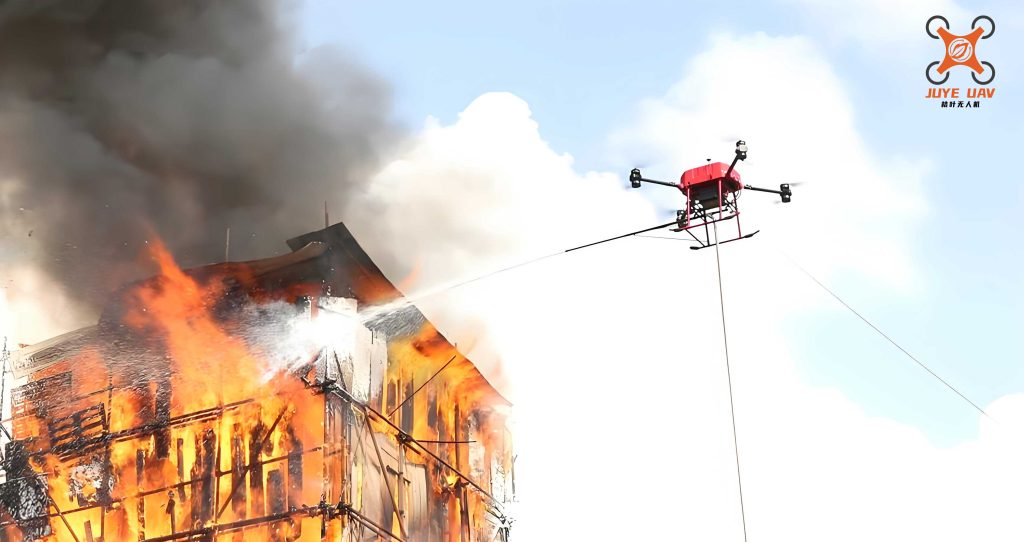
This architecture fundamentally changes the operational workflow. The UAV, equipped with visible-light and thermal imaging cameras, captures high-resolution video streams. Rather than compressing and streaming all data back to a central station, the onboard AI processor analyzes the video frames in real-time to detect signs of fire, smoke, or persons in distress. Only relevant metadata—such as geographic coordinates of a detected fire, its estimated size, boundary coordinates, or classified alerts—are transmitted. This drastically reduces bandwidth requirements, minimizes latency for critical alerts, and ensures functionality even in communication-denied environments. The core technical components of this intelligent fire UAV platform can be summarized as follows:
| Component | Traditional UAV | Intelligent Fire UAV | Key Advantage |
|---|---|---|---|
| Processing Unit | Flight controller, basic telemetry | High-performance AI computer (e.g., NVIDIA Jetson, DJI Manifold) | Enables real-time edge computing and deep learning inference. |
| Primary Function | Data acquisition and transmission | Data acquisition, real-time processing, and intelligent analysis | Shifts from passive sensing to active perception. |
| Data Output | Raw video/telemetry stream | Structured alerts, geotagged metadata, analyzed footage | Reduces bandwidth, provides actionable intelligence. |
| Operational Autonomy | Low (piloted or pre-programmed flight) | High (potential for reactive flight paths based on analysis) | Can autonomously track fire fronts or focus on hotspots. |
| Key Sensor Fusion | Camera, GPS | Multi-spectral cameras, LiDAR, gas sensors, GPS/IMU | Provides comprehensive, multi-dimensional scene understanding. |
The onboard intelligence allows the fire UAV to perform tasks such as immediate fire confirmation, preliminary assessment of fire spread direction based on smoke and flame vectors, and even initial search and rescue localization. This capability turns the UAV into a proactive first responder in the sky.
2. A Hybrid Big Data Analytics System for Fire Management
While onboard processing handles real-time alerts, the historical and aggregated data from fleets of fire UAVs, combined with other sources like weather stations, satellite imagery, and ground sensor networks, create a massive, multi-source, and heterogeneous data ecosystem. Effectively leveraging this “big data” is crucial for predictive analysis, resource planning, and post-incident analysis. To address this, I propose a hybrid big data analysis system built upon a robust integration of Hadoop and Spark.
Hadoop, with its Hadoop Distributed File System (HDFS) and MapReduce programming model, provides a fault-tolerant and scalable foundation for storing and batch-processing enormous volumes of structured and unstructured data collected by fire UAVs (e.g., terabytes of video, millions of telemetry points). Spark, operating in-memory on top of HDFS, offers significantly faster processing speeds for iterative algorithms and real-time streaming analytics. This hybrid architecture creates a powerful platform for fire science analytics.
The system ingests data from multiple channels: real-time streams from active fire UAVs (via Kafka or similar brokers), bulk uploads of mission data, and external data feeds. Spark Streaming processes the real-time data for live dashboards and immediate threat assessment. Meanwhile, larger historical datasets are processed in batches using Spark’s MLlib for machine learning tasks or Spark SQL for complex queries. The processed information feeds into visualization tools and model training pipelines, creating a continuous loop of improvement. The workflow of this hybrid fire analytics system is illustrated below:
Fire Data Processing Pipeline:
1. Data Ingestion: Multi-source data (UAV video/telemetry, weather, topography) flows into the system.
2. Storage (HDFS): Raw data is stored reliably in the distributed file system.
3. Batch Processing (Spark): Historical data analysis, model training, and large-scale simulations.
4. Stream Processing (Spark Streaming): Real-time analysis of incoming UAV feeds for live alerts.
5. Analytics & ML: Execution of fire spread prediction models, risk assessment algorithms, and resource optimization.
6. Visualization & Decision Support: Results presented through GIS interfaces and command dashboards.
Key analytical models powered by this system include:
– Fire Spread Prediction: Using cellular automata or physics-based models like Rothermel’s surface fire spread model, which can be parameterized with real-time wind, slope, and fuel moisture data provided by fire UAVs. The rate of spread (RoS) can be modeled as:
$$ R = I_R (1 + \phi_w + \phi_s) / (\rho_b \epsilon Q_{ig}) $$
where $I_R$ is the reaction intensity, $\phi_w$ and $\phi_s$ are wind and slope coefficients, $\rho_b$ is the fuel bulk density, $\epsilon$ is the effective heating number, and $Q_{ig}$ is the heat of ignition.
– Resource Allocation Optimization: Formulating the deployment of firefighting teams and airborne assets as a constraint satisfaction or linear programming problem to minimize total damage or response time.
3. Advanced Deep Learning for Visual Fire Detection
The core intelligent capability of the fire UAV is its visual perception system. Moving beyond simple color-thresholding techniques, modern approaches employ deep convolutional neural networks (CNNs) for highly accurate and robust fire and smoke detection. These models learn hierarchical features directly from data, excelling at recognizing complex patterns in varied and challenging environments.
3.1 Evolution to Faster R-CNN and Instance Segmentation
Early CNNs like AlexNet provided a breakthrough in image classification. For object detection in fire scenes, two-stage detectors like Faster R-CNN have proven highly effective. The Faster R-CNN framework introduces a Region Proposal Network (RPN) that shares convolutional features with the detection network, enabling efficient and accurate object localization.
The loss function for Faster R-CNN training is a multi-task loss combining classification and bounding box regression:
$$ L(\{p_i\}, \{t_i\}) = \frac{1}{N_{cls}} \sum_i L_{cls}(p_i, p_i^*) + \lambda \frac{1}{N_{reg}} \sum_i p_i^* L_{reg}(t_i, t_i^*) $$
where $p_i$ is the predicted probability of the object being a fire, $p_i^*$ is the ground-truth label (1 for fire, 0 for background), $t_i$ is the predicted bounding box coordinates, and $t_i^*$ is the ground-truth box coordinates. $L_{cls}$ is log loss, and $L_{reg}$ is smooth L1 loss.
For more detailed scene understanding, instance segmentation models like Mask R-CNN are superior. Mask R-CNN extends Faster R-CNN by adding a parallel branch for predicting a segmentation mask for each Region of Interest (RoI), providing pixel-level accuracy. This is crucial for a fire UAV to precisely delineate fire boundaries, separate multiple fire fronts, or segment smoke plumes from the background. The loss function is augmented with a mask loss term:
$$ L = L_{cls} + L_{box} + L_{mask} $$
The mask branch applies a small Fully Convolutional Network (FCN) to each RoI, predicting a binary mask for each class.
3.2 Optimized Model for UAV Deployment: Lightweight Architectures and Hybrid Approaches
Deploying large models like Mask R-CNN on a fire UAV‘s embedded processor requires optimization. Techniques include:
– Model Pruning and Quantization: Removing redundant network weights and reducing numerical precision to decrease model size and increase inference speed.
– Architecture Search for Lightweight Models: Utilizing MobileNet or EfficientNet backbones instead of heavier networks like ResNet-101.
– Hybrid Classical-Deep Learning: Combining deep learning with traditional computer vision can reduce computational load. For instance, a candidate fire region can be initially identified using motion detection or background subtraction (especially effective for video from a moving fire UAV), and then a lightweight CNN classifies these regions. A boosted cascade of classifiers, like an AdaBoost ensemble of weak learners trained on handcrafted features (e.g., color, texture, wavelet features), can serve as a fast, low-power pre-filter before invoking the more accurate but costly deep learning model.
The AdaBoost algorithm builds a strong classifier $H(x)$ from $T$ weak learners $h_t(x)$:
$$ H(x) = \text{sign}\left( \sum_{t=1}^{T} \alpha_t h_t(x) \right) $$
where $\alpha_t$ is the weight of the $t$-th learner, determined by its classification error. This hybrid approach ensures the fire UAV‘s processing pipeline is both efficient and accurate.
| Detection Method | Principle | Advantages | Challenges for Fire UAV |
|---|---|---|---|
| Color & Motion Thresholding | Pixel-level rules based on RGB/HSV values and frame differencing. | Very fast, low computational cost. | High false positives (sunset, artificial lights), poor robustness. |
| Machine Learning (e.g., AdaBoost+SVM) | Classifies handcrafted features (texture, shape, frequency). | More robust than simple thresholding, moderate compute. | Feature engineering is complex; performance plateaus. |
| Deep Learning (Faster R-CNN, YOLO) | End-to-end learning of features from data for object detection. | High accuracy, robust to variations, state-of-the-art. | High computational demand; requires large labeled dataset. |
| Instance Segmentation (Mask R-CNN) | Extends object detection to pixel-level classification per instance. | Provides precise fire boundary and segmentation. | Highest computational cost among visual methods. |
4. The Future: Integration of 5G, Edge Computing, and Federated Learning
The trajectory for intelligent fire UAV systems points toward deeper integration with next-generation communication and distributed computing paradigms.
5G Connectivity: The ultra-reliable low-latency communication (URLLC) and enhanced mobile broadband (eMBB) aspects of 5G are game-changers. A fire UAV can stream ultra-high-definition, multi-spectral video to command centers with minimal delay, enabling immersive remote situational awareness. Massive machine-type communications (mMTC) allow for seamless integration of a swarm of fire UAVs and IoT ground sensors into a cohesive network.
Edge-Cloud Collaboration: Pure onboard processing is limited by the Size, Weight, and Power (SWaP) constraints of the UAV. Edge computing proposes a hierarchical model:
– Device Edge (UAV): Runs lightweight models for immediate, critical detection (e.g., “fire confirmed”).
– Access Edge (Mobile Command Vehicle): Hosts more complex models. The fire UAV can offload partial computation (e.g., detailed segmentation of a confirmed fire region) to this nearby server via 5G, receiving results in milliseconds.
– Cloud Center: Handles big data analytics, long-term model training, and large-scale simulations.
This collaboration balances response time and analytical depth. The latency $L_{total}$ for an offloaded task can be modeled as:
$$ L_{total} = L_{trans} + L_{proc\_edge} $$
where $L_{trans}$ is the transmission latency (very low with 5G) and $L_{proc\_edge}$ is the processing time on the edge server, which is typically much lower than processing on the UAV ($L_{proc\_uav}$) for complex tasks, i.e., $L_{total} \ll L_{proc\_uav}$ for heavy models.
Federated Learning for Swarm Intelligence: A fleet of fire UAVs operates in diverse environments. Federated learning enables them to collaboratively learn a shared, more robust detection model without centralizing their sensitive mission data. Each fire UAV trains a local model on its own collected data. Only the model updates (gradients), not the raw data, are sent to a central aggregator (e.g., in the cloud). The aggregated global model is then redistributed to the fleet. This preserves data privacy, reduces bandwidth, and leverages the collective experience of all fire UAVs. The global model parameter $w$ at round $t+1$ is updated as:
$$ w_{t+1} = \sum_{k=1}^{K} \frac{n_k}{n} w_{t+1}^k $$
where $K$ is the number of UAVs, $n_k$ is the number of data samples on the $k$-th UAV, $n$ is the total samples, and $w_{t+1}^k$ is the locally updated model on the $k$-th UAV.
5. Conclusion
The integration of artificial intelligence, big data analytics, and advanced networking is fundamentally transforming the role of UAVs in fire management. The intelligent fire UAV presented in this framework is no longer a simple camera in the sky but an autonomous sensing and computing node. By leveraging onboard deep learning for real-time perception, contributing to a hybrid Spark-Hadoop analytics system for strategic insight, and poised to exploit 5G and edge computing, these systems offer a powerful multi-layered solution. They enhance early warning through automated detection, improve situational awareness with precise, real-time analytics, and ultimately support more effective and safer firefighting and rescue operations. The future of fire monitoring and rescue lies in networked swarms of intelligent fire UAVs, collaboratively perceiving the threat, analyzing its evolution, and guiding the response, marking a significant leap towards resilient and technology-driven disaster management.