
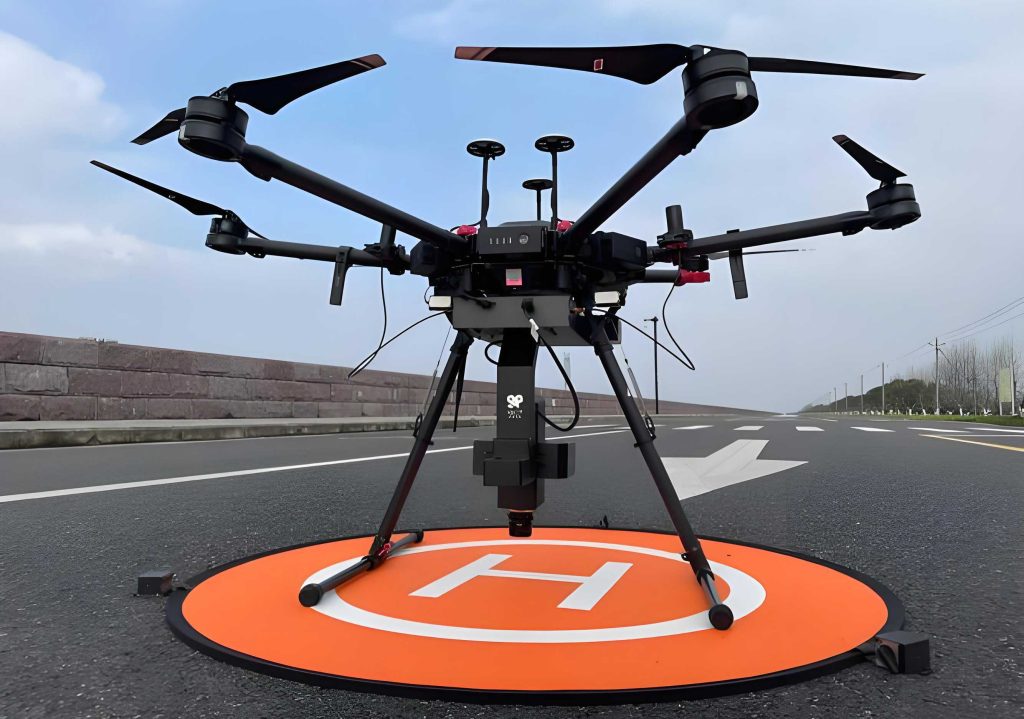
The operational landscape for unmanned drone swarms is characterized by inherent complexity and dynamism. Environmental factors such as fluctuating weather patterns, complex terrain, and electromagnetic interference, combined with evolving mission requirements, impose significant challenges on achieving precise and robust cooperative control. Traditional approaches often struggle with real-time, resource-aware target allocation and maintaining stable formations amidst dynamic disturbances. To address these limitations, we propose an intelligent cooperative control framework that synergistically integrates an optimized target allocation strategy with a novel elastic formation control model, specifically designed for multi-rotor unmanned drone systems.
Our methodology is founded on a two-stage process. The first stage addresses the fundamental challenge of task distribution within the swarm. We formulate the target allocation problem as a multi-objective optimization, simultaneously minimizing the total path cost and the average mission time for the unmanned drone collective. This model is designed to be versatile, accommodating scenarios where the number of drones exceeds, equals, or is less than the number of targets. The solution is efficiently computed using a hybrid Hungarian-Genetic Algorithm (HGA), which leverages the precision of the Hungarian method for assignment and the global search capability of a genetic algorithm to navigate complex constraint spaces and avoid local optima.
The target allocation function $F$ is defined as follows:
$$ F = \min \sum_{i=1}^{n} \sum_{j=1}^{m} L_{ij} + \min \sum_{i=1}^{n} \sum_{j=1}^{m} T_{ij} $$
where $L_{ij}$ is the distance from unmanned drone $i$ to target $j$, and $T_{ij} = U_{ij} + E_{ij}$ represents the total time for unmanned drone $i$ to execute target $j$, including operational time $U_{ij}$ and extra time $E_{ij}$.
This optimization is subject to a comprehensive set of realistic constraints for unmanned drone operations:
- Maximum Range Constraint: $ \sum_{j} L_{ij} – L_{i}^{max} \leq 0$, ensuring no unmanned drone exceeds its maximum operational range.
- Maximum Time Constraint: $ T_{ij} – T_{i}^{max} \leq 0$, preventing any single unmanned drone from exceeding its safe flight duration.
- Precedence Constraint: $ T_{ord1} – T_{ord2} \leq 0$, enforcing the required execution order for dependent tasks.
- Simultaneous Arrival Constraint: Defining a time window $[T_{i}^{min}, T_{i}^{max}]$ for each unmanned drone to promote coordinated action.
- Priority & Threat Constraints: Integrating task priority weights and a dynamic threat penalty term $C_{threat} = \sum_{k \in K} \frac{\alpha_k}{d_k + \epsilon}$ into the allocation logic.
The HGA solves this model efficiently. The population is initialized with elite solutions from the Hungarian algorithm, promoting a high-quality starting point. The fitness of each candidate allocation is directly evaluated by the function $F$. The algorithm then proceeds with selection, crossover, and a specialized mutation operator that swaps rows or columns in the allocation matrix, ultimately converging to an optimized solution $F_{best}^{(p-N)}$.
The second stage of our framework focuses on real-time, intelligent cooperative control of the unmanned drone swarm based on the assigned targets. We introduce a dual-layer control architecture. The core is an elastic system model $I_{n,m}$ that virtualizes the unmanned drone formation as a network of masses connected by adjustable elastic links, providing inherent stability and adaptability.
The high-level formation controller is designed using a sliding mode control (SMC) approach with an improved exponential reaching law to minimize chattering. Defining the sliding surface $r$ and its derivative based on tracking error $e$:
$$ r = \dot{e} + \beta e $$
$$ \dot{r} = \ddot{e} + \beta \dot{e} $$
The control law $\dot{w}$ for the reaching phase is:
$$ \dot{w} = -\chi r – \rho \frac{E_r}{|r|^\alpha} \text{sgn}(r \cdot I_{n,m}) $$
where $\chi, \rho, \alpha$ are control parameters and $E_r$ is the resultant force magnitude. This yields the final formation control law $z_i$ for each unmanned drone $i$:
$$ z_i = \ddot{P}^d – \beta \dot{e} – \chi r – \rho \frac{E_r}{|r|^\alpha} \text{sgn}(r \cdot I_{n,m}) – \frac{K_f}{m} $$
Stability is guaranteed via Lyapunov analysis, confirming that $r \dot{r} < 0$.
The low-level desired position controller translates the formation-level commands into individual unmanned drone actuation. The resultant force $G_i$ on unmanned drone $i$ and its desired position $Q_i^d$ are calculated as:
$$ G_i = m r_i + G_1 $$
$$ Q_i^d = Q_i – \frac{1}{z_i} \left( \frac{m r_i}{K_f} + \sum_{a=1}^{A} G_{ia} \right) $$
This hierarchical design ensures that the unmanned drone swarm maintains the desired formation geometry while accurately tracking assigned trajectories, even under external disturbances.
To validate the efficacy of our proposed method, we conducted extensive simulations in a MATLAB/Simulink and Gazebo co-simulation environment. The test area was a 1000m x 1000m x 100m space with static obstacles and dynamic threat zones. We utilized a quadrotor unmanned drone model with parameters representative of commercial systems, as summarized below:
| Parameter | Value |
|---|---|
| Max Flight Speed (m/s) | 50.0 |
| Max Payload (kg) | 5.0 |
| Battery Endurance (min) | 60.0 |
| Communication Range (m) | 1000.0 |
| Cruise Speed (m/s) | 30.0 |
| Data Transmission Rate (Mbps) | 12.0 |
The performance of our target allocation strategy was first evaluated. The results, shown in the comparative table below, demonstrate that our method significantly optimizes resource utilization for the unmanned drone swarm. It reduces both the maximum energy expenditure per drone and the average cumulative flight distance across the swarm, leading to a marked improvement in overall energy efficiency. Furthermore, the average remaining battery state of charge (SoC) shows a stable, gradual decline over multiple allocation cycles, confirming effective load balancing and enhanced mission sustainability for the unmanned drone collective.
| Performance Metric | Before Optimization | After Our Method |
|---|---|---|
| Max. Energy Consumption (kW·h) | 8.5 | 6.1 |
| Avg. Cumulative Distance (km) | 15.2 | 11.8 |
| Energy Efficiency Index | 1.00 (Baseline) | 0.72 |
The core intelligent cooperative control performance was tested against several state-of-the-art methods. In a scenario involving hazardous zones, our controller successfully guided all unmanned drones in a three-cluster swarm to avoid threats and reach their destinations precisely. In contrast, other methods resulted in some unmanned drone clusters traversing danger areas or failing to coordinate arrival. Quantitative analysis revealed that our method achieves a 20.35% improvement in trajectory tracking precision and reduces the total mission completion time by 15.42% compared to the best-performing benchmark, validating the superior coordination capability of our approach for unmanned drone swarms.
Robustness is critical for real-world unmanned drone operations. We subjected the swarm to simulated disturbances, including localized strong turbulence and intermittent communication failures. The results, summarized in the following table, highlight the resilience of our integrated framework. Under both types of disruption, the unmanned drone swarm controlled by our method maintained a significantly higher mission completion rate, preserved more operational energy reserve, and suffered fewer failures than swarms using other control strategies.
| Disturbance | Method | Mission Success Rate (%) | Avg. Remaining SoC (%) | Failed Unmanned Drones |
|---|---|---|---|---|
| Strong Turbulence | Our Method | 88 | 36 | 2 |
| Method A [5] | 70 | 28 | 5 | |
| Method B [6] | 73 | 30 | 4 | |
| Method C [7] | 68 | 27 | 6 | |
| Comm. Link Failure | Our Method | 85 | 34 | 3 |
| Method A [5] | 65 | 25 | 6 | |
| Method B [6] | 68 | 27 | 5 |
In conclusion, we have presented a comprehensive and intelligent cooperative control framework for multi-rotor unmanned drone swarms. By integrating an optimized, constraint-aware target allocation solver with a robust, dual-layer formation control system based on an elastic model and improved sliding mode control, our method addresses the key challenges of dynamic tasking and precise coordination. The experimental results consistently demonstrate its superiority in terms of control accuracy, mission efficiency, energy economy, and, crucially, operational robustness under adverse conditions. This work provides a viable and advanced technical pathway for enhancing the autonomy and collaborative effectiveness of unmanned drone swarms in complex, real-world scenarios.