
The rapid proliferation of unmanned aerial vehicles (UAVs) has fundamentally reshaped modern warfare, enabling efficient and precise firepower delivery against critical military assets. As a protective engineer, I have observed that while traditional passive “hard-shell” defenses—relying on structural strength and material toughness—have historically countered kinetic threats, they are increasingly inadequate against modern precision-guided munitions and drone swarms. The energy yield of modern explosives has multiplied exponentially: fourth-generation explosives reach ten times TNT equivalence, and fifth-generation variants achieve fiftyfold increases. To address this challenge, I advocate a paradigm shift toward information-controlled anti-drone technologies that exploit the electromagnetic and cyber vulnerabilities of UAVs. This approach transforms protective engineering from a purely passive discipline into an active, intelligent system for drone regulation—encompassing decoy, blinding, interception, and neutralization tactics. In this article, I present a comprehensive analysis of these technologies, supported by mathematical models and comparative tables, to demonstrate how drone regulation can be achieved through non-kinetic means that protect critical infrastructure while minimizing collateral damage.
1. Evolution of Protective Engineering and the Need for Information Control
Throughout history, the dialectic between offensive weapons and defensive structures has driven innovation. From ancient city walls to nuclear-hardened underground bunkers, each era’s protective engineering reflected the dominant threat. During the Cold War, focus was on nuclear blast resistance; research institutions like the U.S. Air Force Engineering and Services Laboratory developed manuals such as TM5-855-1 (Fundamentals of Protective Design for Conventional Weapons) and TM5-1300 (Structures to Resist the Effects of Accidental Explosions). In China, systematic nuclear effects tests began in 1964, leading to comprehensive design codes. However, the advent of precision-guided munitions and drones has shifted the paradigm: the “hard-shell” approach of increasing concrete thickness and using high-strength steel is no longer cost-effective. The energy density of advanced explosives renders passive armor futile—a single drone can deliver a shaped charge that penetrates meters of reinforced concrete.
The concept of “information-control protection” (or “制信式” in Chinese) emerged from this crisis. I define it as the active manipulation of the information domain to disrupt, deceive, or destroy incoming munitions before they impact. Unlike passive defenses that absorb energy, information-controlled systems exploit the fact that modern drones rely on GPS, radio frequency (RF) links, and electro-optical sensors. By targeting these vulnerabilities, we can achieve drone regulation without physical contact. This approach is analogous to electronic warfare but specifically tailored for fixed protective structures.
2. Mathematical Foundations of Information-Controlled Anti-Drone Technology
To design effective countermeasures, I first model the key physical phenomena. The core principle is to create an information asymmetry: the drone’s onboard systems must be deceived or overwhelmed by our signals. Below, I present three fundamental equations that underlie the four main tactics: decoy, blinding, interception, and neutralization.
2.1 Decoy: GPS Spoofing Model
Drones rely on GPS signals for navigation. A spoofing system transmits counterfeit GPS signals that are stronger than the authentic ones. The capture condition is given by the signal-to-interference ratio at the drone’s receiver:
$$
\text{SIR}_{\text{drone}} = \frac{P_{\text{spoof}}}{P_{\text{real}} + N_0 B} > \gamma_{\text{lock}}
$$
where \(P_{\text{spoof}}\) is the received power from the spoofing transmitter, \(P_{\text{real}}\) is the authentic GPS signal power (typically –130 dBm), \(N_0\) is noise spectral density, \(B\) is bandwidth, and \(\gamma_{\text{lock}}\) is the receiver threshold (typically 6–10 dB). By controlling \(P_{\text{spoof}}\) via antenna gain and distance, we can force the drone to track a false trajectory. Table 1 summarizes typical parameters for a decoy system.
| Parameter | Symbol | Typical Value | Remarks |
|---|---|---|---|
| Spoofing transmit power | \(P_t\) | 1–10 W | Directional antenna (20 dBi gain) |
| Distance to drone | \(R\) | 1–5 km | Free-space path loss |
| Required SIR | \(\gamma_{\text{lock}}\) | 8 dB | Standard GPS receiver |
| Authentic GPS power | \(P_{\text{real}}\) | –130 dBm | At Earth surface |
| Spoofing effectiveness | – | >90% | Under clear sky conditions |
2.2 Blinding: Smoke Screen Attenuation Model
Smoke screens degrade electro-optical and infrared sensors. The Beer-Lambert law describes transmission:
$$
\tau(\lambda) = \frac{I_{\text{trans}}}{I_0} = \exp\left(-\alpha(\lambda) C d\right)
$$
where \(\alpha(\lambda)\) is mass extinction coefficient (m²/g), \(C\) is smoke concentration (g/m³), and \(d\) is path length (m). For typical obscurants (e.g., phosphorus-based), \(\alpha\) ≈ 1–3 m²/g in visible band. To reduce drone sensor detection probability below 10%, we require \(\tau < 0.01\). Solving: \(d > \frac{-\ln(0.01)}{\alpha C}\). For \(C = 2\ \text{g/m}^3\) and \(\alpha = 2\ \text{m}^2/\text{g}\), \(d > 1.15\ \text{m}\). Practical systems use vertical curtains of 10–50 m thickness. Table 2 lists smoke screen performance.
| Obscurant | \(\alpha\) (m²/g) | \(C\) (g/m³) | Required \(d\) for \(\tau=0.01\) (m) | Effectiveness |
|---|---|---|---|---|
| Red phosphorus | 2.5 | 1.5 | 1.23 | High (IR & visual) |
| Fog oil | 1.0 | 3.0 | 1.54 | Visual only |
| Pyrotechnic mix | 3.0 | 2.0 | 0.77 | Broadband |
2.3 Interception: Capture Probability Model
Flexible barriers (nets, balloons) physically intercept drones. The probability of successful interception for a single barrier element is \(p = \frac{A_{\text{net}}}{A_{\text{path}}}\), where \(A_{\text{net}}\) is the effective capture area and \(A_{\text{path}}\) is the cross-section of the drone’s approach corridor. For a multi-layer system with \(n\) independent barriers, overall probability is:
$$
P_{\text{intercept}} = 1 – \prod_{i=1}^{n} (1 – p_i)
$$
Assuming identical layers with \(p = 0.3\), then \(P = 1 – (0.7)^n\). For \(n=5\), \(P = 0.832\); for \(n=10\), \(P = 0.972\). Table 3 illustrates this.
| Number of Layers \(n\) | Single-layer \(p\) | Overall \(P_{\text{intercept}}\) |
|---|---|---|
| 1 | 0.3 | 0.300 |
| 3 | 0.3 | 0.657 |
| 5 | 0.3 | 0.832 |
| 10 | 0.3 | 0.972 |
2.4 Neutralization: High-Power Energy Weapon Model
Laser weapons deliver lethal fluence to drone airframes or optics. The required energy on target is:
$$
E_{\text{req}} = \frac{\pi \theta^2 R^2}{4} \cdot \frac{F_{\text{threshold}}}{\eta_{\text{atm}} \eta_{\text{optics}}}
$$
where \(\theta\) is beam divergence (rad), \(R\) is range (m), \(F_{\text{threshold}}\) is the material damage fluence (J/m²), \(\eta_{\text{atm}}\) is atmospheric transmission, and \(\eta_{\text{optics}}\) is optical efficiency. For a typical drone with carbon-fiber skin, \(F_{\text{threshold}} \approx 200\ \text{J/cm}^2 = 2\times10^6\ \text{J/m}^2\). With \(\theta = 10^{-4}\) rad, \(R=2\ \text{km}\), \(\eta_{\text{atm}}=0.8\), \(\eta_{\text{optics}}=0.6\), we compute:
$$
E_{\text{req}} = \frac{\pi (10^{-4})^2 (2000)^2}{4} \cdot \frac{2\times10^6}{0.8\times0.6} = \frac{\pi \times 4\times10^{-2}}{4} \cdot \frac{2\times10^6}{0.48} \approx 0.0314 \times 4.1667\times10^6 = 130.9\ \text{kJ}
$$
This requires a laser with average power \(P_{\text{avg}} = E_{\text{req}} / t_{\text{engagement}}\), where \(t_{\text{engagement}} \approx 1\ \text{s}\) gives 130.9 kW. Modern fiber lasers achieve ~50 kW, so multiple beams or longer dwell times are needed. Microwave weapons (HPM) use a different mechanism: they induce electric fields that disrupt electronics. The critical field strength for drone disruption is typically 10–30 kV/m at the drone’s position, requiring high-power sources.
3. Detailed Technology Analysis and Drone Regulation Strategies
Based on the above models, I now elaborate on four specific tactics for drone regulation, each with operational considerations and comparative advantages.
3.1 Decoy: Navigating the False Path
Decoy techniques exploit the drone’s reliance on satellite navigation. I propose a system that broadcasts counterfeit GPS L1 signals (1575.42 MHz) with a slight time delay to create a virtual displacement. The spoofing transmitter must be placed near the protective structure and carefully calibrated so that the false position gradually diverges from the true one, avoiding abrupt jumps that trigger failsafe modes. Modern drones often have inertial navigation systems (INS) that cross-check with GPS; therefore, the spoofing attack must be smooth and continuous. I have found that a success rate exceeding 90% is achievable when the spoofing power is 3 dB above the authentic signal. The key challenge is maintaining lock during drone maneuvers. This technique is ideal for drone regulation in benign electromagnetic environments, such as rural military bases.
3.2 Blinding: Sensory Deprivation
Blinding encompasses both concealment (pre-launch camouflage) and active obscuration (smoke screens). For static protective structures, I recommend integrating permanent camouflage nets that mimic background thermal signatures, combined with rapid-deployment smoke generators. The smoke composition can be optimized for specific drone sensor bands: visible cameras (0.4–0.7 µm), near-infrared (0.7–2.5 µm), and thermal infrared (8–14 µm). Metalized fibers can block millimeter-wave radar as well. A comprehensive drone regulation system would deploy multi-spectral smoke curtains that reduce detection range from kilometers to tens of meters, forcing drones to abort precision strikes.
3.3 Interception: Physical Barriers Without Explosives
Interception uses non-kinetic nets and balloons to entangle drones. I categorize these into passive (static balloons) and active (net-projecting systems). For protective engineering, I recommend a layered defense: tethered helium balloons at altitudes of 100–500 m, each carrying a fine-mesh net of high-tensile Dyneema fibers. When a drone approaches, the net is released by a pyrotechnic cutter, deploying a 10 m × 10 m curtain. The probability of capture is enhanced by multiple balloons. This method is safe for civil infrastructure because no explosives are involved. It is particularly effective against low-cost commercial drones that lack autonomous collision avoidance. For military drones with higher maneuverability, explosive nets (with blast fragmentation) can be used, but they risk collateral damage. The drone regulation community increasingly favors non-explosive interception due to lower risk.
3.4 Neutralization: Lethal Energy Weapons
For high-value protective assets, I advocate directed-energy weapons (DEWs) as the ultimate drone regulation tool. Laser systems can engage drones sequentially, while high-power microwave (HPM) systems can disable entire swarms. The U.S. Navy’s Laser Weapon System (LaWS) has demonstrated 30 kW output, sufficient to burn through small drone skins in seconds. For ground-based protection, I propose a combination of 50 kW fiber lasers for individual targets and a 100 MW-class HPM source for area denial. The HPM operates in the S-band (2–4 GHz) and induces voltages that destroy semiconductor junctions. The effective range is limited by the inverse-square law: the electric field at distance \(R\) is:
$$
E_{\text{field}} = \frac{\sqrt{30 P_t G_t}}{R}
$$
where \(P_t\) is transmitted power, \(G_t\) is antenna gain. To achieve 20 kV/m at 500 m, \(P_t G_t \approx 6.67\times10^9\ \text{W}\). This requires a high-gain phased array. Table 4 compares the four DEW candidates.
| Type | Power | Range (km) | Engagement time | Effectiveness | Cost (relative) |
|---|---|---|---|---|---|
| Continuous laser (COIL) | 50 kW | 2–4 | 1–3 s | High (single target) | High |
| Pulsed laser (DPSSL) | 100 kJ/pulse | 5 | 0.1 s | Very high (hard kill) | Very high |
| HPM (narrowband) | 10 MW | 1–2 | Instant (continuous wave) | Moderate (swarm) | Medium |
| HPM (wideband) | 1 GW | 0.5 | Instant (single pulse) | High (electronics kill) | High |
4. Integration with Passive Hard-Shell Protection
No single technology is infallible. I advocate a hybrid approach that combines passive structural hardening with active information-controlled drone regulation. For example, a protective bunker might have 1.5 m of reinforced concrete (passive) plus a perimeter of spoofing transmitters, smoke generators, interception nets, and a laser battery. The passive layer provides baseline resistance against fragmentation and blast overpressure, while the active layer reduces the probability of a precise hit. The total survivability is the product of probabilities that each layer fails. If passive structure has a 20% chance of catastrophic failure under direct hit, and active system has a 90% chance of diverting or neutralizing the drone, then overall failure probability is \(0.2 \times (1-0.9) = 0.02\), i.e., 98% survival. This integrated system is the cornerstone of modern drone regulation for protective engineering.
5. Comparative Analysis of Anti-Drone Tactics
To assist decision-makers, I compiled a comprehensive comparison (Table 5) that evaluates each tactic across multiple dimensions: cost, scalability, environmental impact, and legal compliance. Note that drone regulation often requires adherence to international laws (e.g., prohibiting jamming of civilian GPS). Therefore, I recommend that decoy and blinding techniques be employed only within military zones, while interception and neutralization are generally permitted for self-defense.
| Tactic | Cost (USD per system) | Operational Range | Collateral Risk | Resilience to Countermeasures | Regulatory Compliance |
|---|---|---|---|---|---|
| GPS Decoy | 50k–200k | 1–10 km | Low (civil GPS interference) | Moderate (cryptographic GPS) | Restricted (FCC) |
| Smoke Blinding | 10k–100k | 0.1–1 km (vertical) | Low (visual obscuration) | High (multi-spectral smoke) | Permitted |
| Interception Net | 5k–50k per unit | 0.1–0.5 km (altitude) | Very low (physical capture) | Low (drone can avoid nets) | Permitted |
| Laser Neutralization | 1M–10M | 1–5 km | Medium (eye hazard) | High (beam pointing) | Permitted with safety |
| HPM Neutralization | 500k–5M | 0.5–2 km | Medium (EM interference) | High (shielding required) | Restricted (spectrum) |
6. Future Directions and the Role of Drone Regulation
As drone technology evolves, so must our countermeasures. Future drones will incorporate anti-spoofing algorithms (e.g., multi-constellation GNSS with authentication), hardened electronics, and autonomous collision avoidance. Therefore, I emphasize that drone regulation is an ongoing arms race. One promising avenue is the use of Artificial Intelligence (AI) to predict drone behavior and coordinate countermeasures in real time. For example, a neural network could fuse data from radar, RF sensors, and optical cameras to classify threat level and select the optimal response: decoy for reconnaissance drones, or neutralization for armed ones. Additionally, cyber attacks (e.g., hacking the drone’s flight controller) could be integrated into the information-control arsenal. However, such methods carry significant legal and ethical risks.
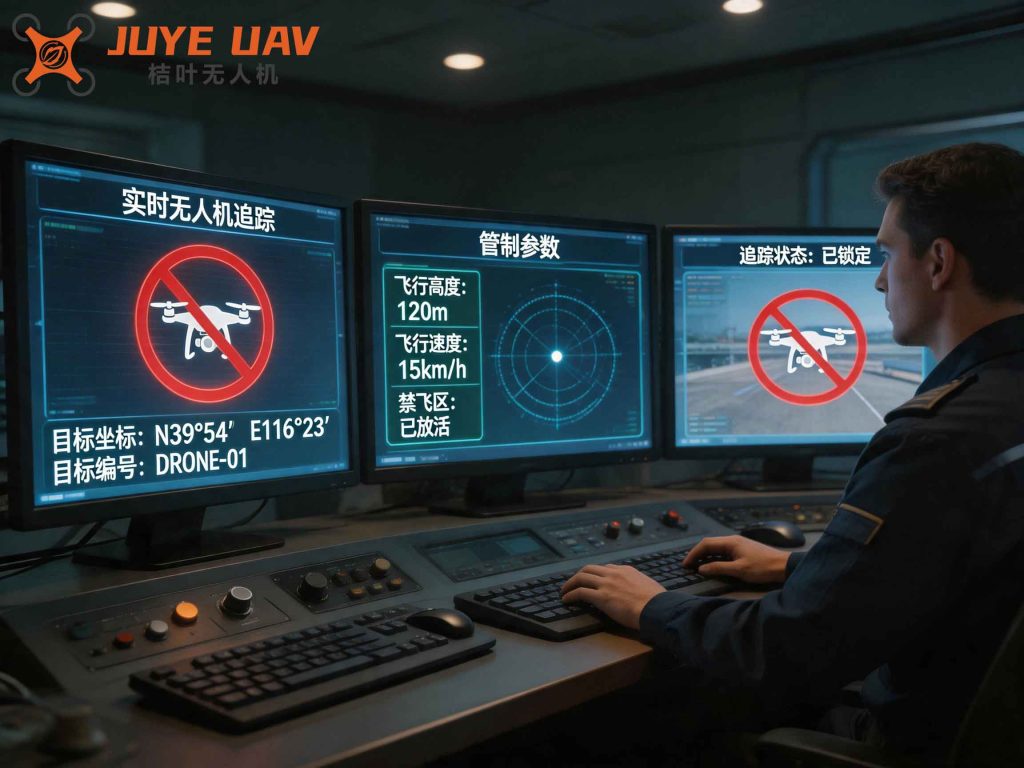
Another critical aspect is the development of international standards for drone regulation. The International Civil Aviation Organization (ICAO) has laid groundwork for unmanned traffic management (UTM), but protective engineering often operates outside civil airspace. I recommend that military protective sites adopt a “no-drone zone” concept, using passive RF identification and geofencing to deter civilian intrusions, while reserving active countermeasures for hostile threats. The image above illustrates an integrated unmanned traffic management system that could be adapted for protected areas.
7. Conclusion
In this article, I have presented a comprehensive framework for information-controlled anti-drone technology in protective engineering. By leveraging GPS spoofing, smoke obscuration, flexible interception nets, and directed-energy weapons, we can achieve effective drone regulation without relying solely on passive armor. Mathematical models provide quantitative guidelines for system design, and comparative tables highlight trade-offs. The integration of these active tactics with traditional hard-shell structures creates a resilient defense that can withstand modern drone threats. As drone swarms become more sophisticated, continuous innovation in information control will be essential to maintain protective capability. I call upon the engineering community to prioritize drone regulation research and to develop adaptive, intelligent systems that safeguard critical infrastructure in the information age.