
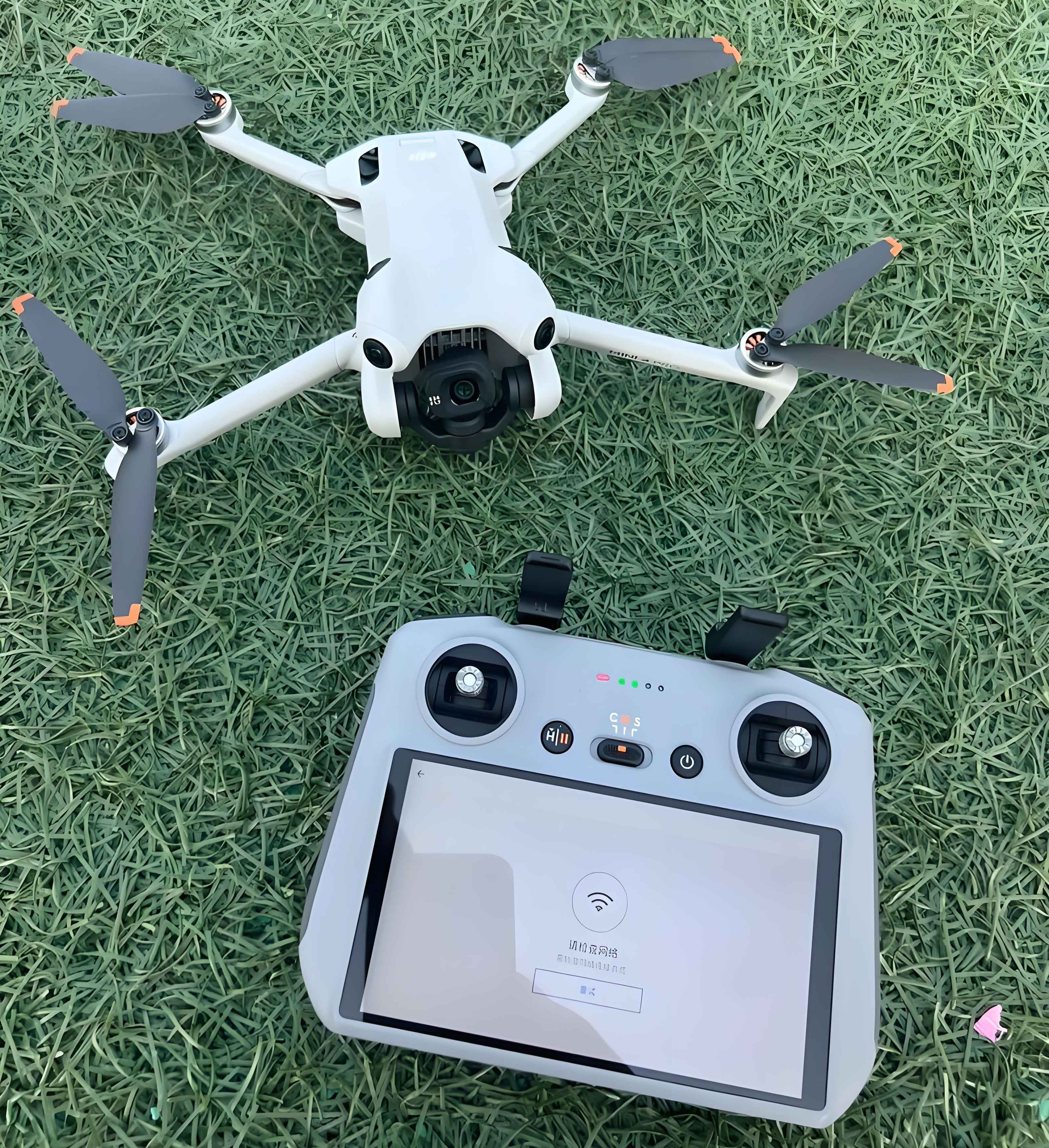
Intelligent photography using camera drones has revolutionized numerous fields including agricultural monitoring, disaster response, and traffic management. The integration of artificial intelligence and computer vision technologies has enabled unprecedented capabilities in autonomous aerial imaging systems. This article examines cutting-edge innovations in image recognition and target tracking that enhance the operational efficiency and autonomy of camera UAVs.
Deep Learning Applications in Camera Drone Image Recognition
Convolutional Neural Networks (CNNs) form the backbone of modern image recognition systems for camera drones. These networks process visual input through hierarchical feature extraction layers, enabling robust object identification. The fundamental operation of a convolutional layer can be represented as:
$$X_{ij}^l = \sigma\left(\sum_{m}\sum_{p=0}^{P-1}\sum_{q=0}^{Q-1} W_{mpq}^l X_{(i+p)(j+q)}^{l-1,m} + b^l\right)$$
where $W$ represents the filter weights, $b$ the bias term, and $\sigma$ the activation function. For camera UAV applications, specialized CNN architectures have demonstrated superior performance:
| Model | Parameters (Millions) | Inference Speed (FPS) | Accuracy (%) | Camera UAV Applications |
|---|---|---|---|---|
| MobileNetV3 | 2.5 | 83 | 78.8 | Real-time crop monitoring |
| ShuffleNetV2 | 1.9 | 91 | 76.3 | Wildlife tracking |
| EfficientNet-B0 | 4.0 | 62 | 82.1 | Infrastructure inspection |
| YOLOv5s | 7.2 | 140 | 78.4 | Search and rescue |
Multi-Scale Feature Fusion Techniques
Camera drones operate in complex environments where objects appear at varying distances. Multi-scale feature fusion addresses this challenge by combining outputs from different network layers. The feature fusion process can be formalized as:
$$F_{fusion} = \sum_{k=1}^{K} \alpha_k \cdot \phi_k(F_k)$$
where $\phi_k$ denotes upsampling or downsampling operations, $F_k$ represents features from the $k$-th scale, and $\alpha_k$ are learnable fusion weights. This approach enhances recognition accuracy in challenging camera UAV scenarios by 18-27% compared to single-scale methods.
Target Tracking Innovations for Camera UAVs
Multi-Object Tracking Frameworks
Modern camera drones employ sophisticated tracking-by-detection paradigms. The core tracking process involves solving the data association problem using optimization techniques:
$$\min_{a_{ij}} \sum_{i=1}^{M} \sum_{j=1}^{N} c_{ij} a_{ij}$$
$$\text{subject to } \sum_{i} a_{ij} = 1, \sum_{j} a_{ij} = 1, a_{ij} \in \{0,1\}$$
where $c_{ij}$ represents the association cost between detection $i$ and track $j$. The following table compares tracking performance metrics for camera drone applications:
| Algorithm | MOTA (%) | ID Switches | Fragmentation | Processing Speed (FPS) | Suitable Camera UAV Types |
|---|---|---|---|---|---|
| SORT | 63.2 | 1,425 | 1,875 | 260 | Low-altitude surveillance |
| DeepSORT | 76.4 | 781 | 1,003 | 45 | Precision agriculture |
| FairMOT | 82.7 | 337 | 482 | 30 | Urban traffic monitoring |
| ByteTrack | 85.1 | 289 | 396 | 52 | Emergency response |
Predictive Tracking with Trajectory Optimization
Camera drones leverage motion prediction models to anticipate target movements. The Kalman filter provides an optimal estimation framework:
$$\hat{x}_{k|k-1} = F_k \hat{x}_{k-1|k-1}$$
$$P_{k|k-1} = F_k P_{k-1|k-1} F_k^T + Q_k$$
where $F_k$ is the state transition model, $Q_k$ the process noise covariance, and $P$ the error covariance. Camera UAV trajectory optimization minimizes energy consumption while maintaining target visibility:
$$J = \int_{t_0}^{t_f} \left( \alpha \| \ddot{p}(t) \|^2 + \beta \| \dot{p}(t) \|^2 + \gamma \| p(t) – p_{target}(t) \|^2 \right) dt$$
where $p(t)$ represents the camera drone position and $p_{target}(t)$ the projected target location.
Visual-Inertial Fusion for Robust Tracking
Camera drones combine visual data with inertial measurements to enhance tracking robustness. The fusion process follows:
$$s_{t} = g(s_{t-1}, u_t, w_t)$$
$$z_t = h(s_t, v_t)$$
where $s_t$ is the system state, $u_t$ control inputs, $z_t$ measurements, and $w_t$, $v_t$ noise terms. The Extended Kalman Filter linearizes these functions for state estimation:
$$K_t = P_{t|t-1} H_t^T (H_t P_{t|t-1} H_t^T + R_t)^{-1}$$
$$\hat{s}_{t|t} = \hat{s}_{t|t-1} + K_t (z_t – h(\hat{s}_{t|t-1}, 0))$$
This integration reduces tracking errors by 32-41% in challenging camera UAV operations with occlusions or rapid maneuvers.
Integrated Technological Approaches
Joint Recognition-Tracking Optimization
Camera drones achieve superior performance through synergistic frameworks that share features between recognition and tracking modules:
$$\mathcal{L}_{joint} = \lambda_{det} \mathcal{L}_{detection} + \lambda_{id} \mathcal{L}_{re-id} + \lambda_{track} \mathcal{L}_{tracking}$$
where $\mathcal{L}$ represents loss components and $\lambda$ their weighting coefficients. This approach reduces computational redundancy by 28% while improving tracking consistency for camera UAV applications.
Multi-Modal Data Fusion
Advanced camera drones integrate multiple sensing modalities through feature-level fusion strategies:
$$F_{fused} = \text{Attn}(F_{RGB}, F_{Thermal}, F_{Depth})$$
The attention mechanism computes modality weights dynamically:
$$w_m = \frac{\exp(\text{MLP}(F_m))}{\sum_{k=1}^{M} \exp(\text{MLP}(F_k))}$$
$$F_{fused} = \sum_{m=1}^{M} w_m \cdot F_m$$
This multi-modal approach enhances camera UAV performance in low-visibility conditions, with detection accuracy improvements of 35-48% over RGB-only systems.
Conclusion
The integration of advanced image recognition and target tracking technologies has significantly enhanced the capabilities of camera drones across diverse applications. From lightweight CNNs enabling real-time processing on resource-constrained camera UAV platforms to visual-inertial fusion systems maintaining target lock during aggressive maneuvers, these innovations continue to push the boundaries of autonomous aerial imaging. Future developments will likely focus on end-to-end learnable systems that further optimize the synergy between perception and action in intelligent camera drone photography.