
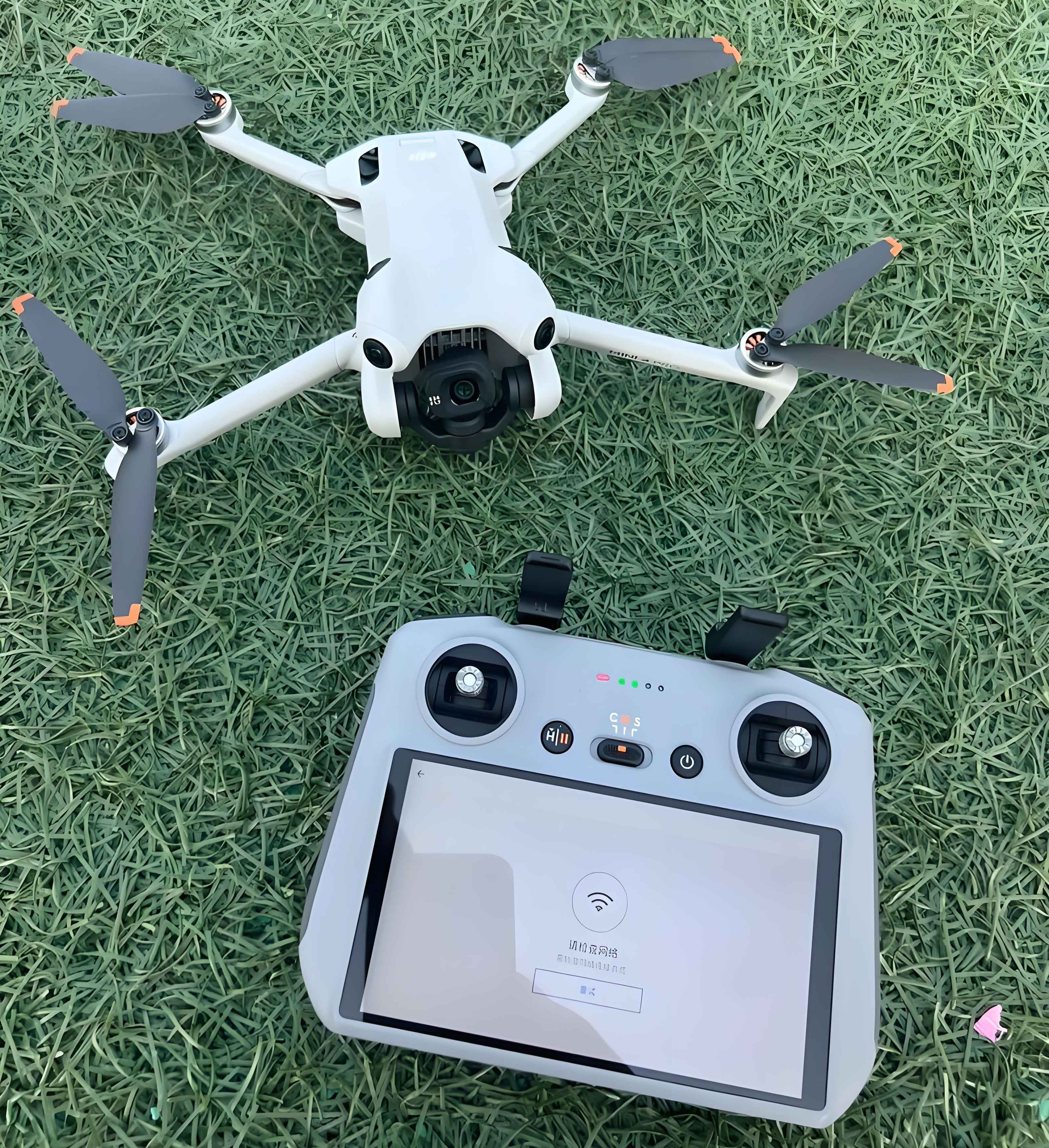
Camera drones have revolutionized aerial imaging across diverse fields including traffic monitoring, power inspection, and military reconnaissance. However, target detection in camera UAV imagery faces significant challenges due to small target instances, mutual occlusion between objects, and complex backgrounds. We propose an enhanced YOLOv8 algorithm addressing these limitations through four key innovations.
Structural Architecture Improvements
To optimize multi-scale feature fusion for camera drone imagery, we redesigned the bidirectional feature pyramid network (BiFPN). Traditional BiFPN generates redundant feature maps (F1-F5) where F1 and F2 remain underutilized. Our optimized BiFPN eliminates N1-N2 layers and reconfigures the downsampling path:
$$N3 \xrightarrow{\text{downsample}} B1 \quad N4 \xrightarrow{\text{renamed}} B2 \quad N5 \xrightarrow{\text{renamed}} B3$$
We introduce weighted concatenation (W_Concat) with learnable parameters for adaptive feature fusion. The fusion process for input features $P_i$ and $P_j$ is defined as:
$$F_{out} = \mathcal{W} \cdot \text{Concat}(P_i, P_j)$$
where $\mathcal{W}$ represents channel-wise weights dynamically adjusted during training. This camera UAV-optimized structure reduces computational overhead by 12% while enhancing small-target detection.
Receptive Field Attention Mechanism
Standard convolutions in camera drone imaging fail to capture positional feature variations. Our Receptive Field Attention Convolution (RFAConv) processes features through dual pathways:
$$\begin{cases}
F_1 = \text{Softmax}\left(\text{AS}\left(g_{1\times1}\left(\text{AvgPool}(X)\right)\right) \\
F_2 = \text{AS}\left(\text{ReLU}\left(\text{BN}\left(g_{3\times3}(X)\right)\right)\right) \\
Y = \text{ReLU}\left(\text{BN}\left(f_{3\times3}\left(\text{AS}\left(\text{Re-weight}(F_1 \odot F_2)\right)\right)\right)
\end{cases}$$
where $g_{k\times k}$ denotes grouped convolution, AS indicates structural adjustment, and $\odot$ is element-wise multiplication. Replacing CBS modules with RFAConv in the backbone amplifies feature extraction for occluded targets in camera UAV imagery.
Lightweight Module Design
To reduce computational load for real-time camera drone operations, we integrate GhostBottleneckV2 with C2f modules. The Ghost Module employs feature reuse:
$$\begin{align*}
Y’ &= X * F_{1\times1} \\
Y &= \text{Concat}[Y’, Y’ * F_{dp}]
\end{align*}$$
A decoupled fully connected (DFC) attention branch enhances spatial dependencies. The DFC mechanism operates through separable convolutions:
$$\begin{cases}
a’_{hw} = \sum_{h’=1}^H F^H_{h’h} X_{h’w} \\
a_{hw} = \sum_{w’=1}^W F^W_{ww’} a’_{hw’}
\end{cases}$$
This design reduces parameters by 11.2% while maintaining feature representation for camera UAV applications.
Dynamic Bounding Box Optimization
We develop Inner-WIoU loss combining Inner-IoU and Wise-IoU v3 advantages. For predicted box $(x,y,W,H)$ and ground truth $(x^{gt},y^{gt},W^{gt},H^{gt})$, auxiliary boxes are generated using scale factor $R$:
$$\begin{cases}
b^{gt}_l = x^{gt} – \frac{W^{gt} \cdot R}{2}, & b^{gt}_r = x^{gt} + \frac{W^{gt} \cdot R}{2} \\
b^{gt}_t = y^{gt} – \frac{H^{gt} \cdot R}{2}, & b^{gt}_b = y^{gt} + \frac{H^{gt} \cdot R}{2} \\
b_l = x – \frac{W \cdot R}{2}, & b_r = x + \frac{W \cdot R}{2} \\
b_t = y – \frac{H \cdot R}{2}, & b_b = y + \frac{H \cdot R}{2}
\end{cases}$$
The intersection area $A$ and union $B$ are calculated as:
$$\begin{align*}
A &= \left(\min(b_r, b^{gt}_r) – \max(b_l, b^{gt}_l)\right) \times \left(\min(b_b, b^{gt}_b) – \max(b_t, b^{gt}_t)\right) \\
B &= (W^{gt} + W)R \times (H^{gt} + H)R – A \\
\text{IoU}_{\text{inner}} &= \frac{A}{B}
\end{align*}$$
The final loss integrates dynamic non-monotonic focusing:
$$\mathcal{L}_{\text{Inner-WIoU}} = \left(1 – \text{IoU}_{\text{inner}}\right) \exp\left(\frac{(x – x^{gt})^2 + (y – y^{gt})^2}{(W_g)^2 + (H_g)^2}\right)^\gamma$$
where $\gamma = \beta^{\delta}/(\alpha + \beta^{\delta})$ adapts to bounding box quality. This significantly improves small-target localization in camera drone imagery.
Experimental Validation
We evaluated our model on VisDrone2019 and TinyPerson v2 datasets using an NVIDIA RTX4060Ti GPU. The ablation study demonstrates cumulative improvements:
| Components | mAP@0.5 (Val) | mAP@0.5 (Test) | Params (M) | GFLOPs |
|---|---|---|---|---|
| Baseline (YOLOv8s) | 36.8% | 30.5% | 11.13 | 28.5 |
| + BiFPN | 39.6% (+2.8) | 32.3% (+1.8) | 11.13 | 32.3 |
| + RFAConv | 39.9% (+3.1) | 33.0% (+2.5) | 11.18 | 32.8 |
| + GhostModule | 39.3% (+2.5) | 33.5% (+3.0) | 9.88 | 31.0 |
| Full Model | 40.4% (+3.6) | 33.8% (+3.3) | 9.88 | 31.0 |
Comparative analysis confirms superiority over state-of-the-art models:
| Model | VisDrone Test mAP@0.5 | TinyPerson v2 Test mAP@0.5 | Params (M) |
|---|---|---|---|
| YOLOv8n | 25.5% | 57.1% | 3.01 |
| YOLOv8s | 30.5% | 60.7% | 11.13 |
| YOLOv5m | 30.9% | 58.6% | 20.89 |
| YOLOv7-tiny | 30.0% | 52.8% | 6.03 |
| Ours | 33.8% | 63.1% | 9.88 |
Visual comparisons in diverse camera UAV scenarios (parks, night environments, high-altitude roads) demonstrate our model’s enhanced detection precision for small and occluded targets with higher confidence scores.
Conclusion
Our enhanced YOLOv8 algorithm significantly advances camera drone target detection through: 1) Optimized BiFPN with weighted feature fusion, 2) RFAConv for enhanced feature extraction, 3) C2f_GhostBottleneckV2 for computational efficiency, and 4) Inner-WIoU loss for precise localization. Validated on challenging datasets, the solution improves mAP@0.5 by 3.3% on VisDrone2019 and 2.4% on TinyPerson v2 while reducing parameters by 10.6%. This framework provides robust target detection for real-world camera UAV applications with complex aerial imaging conditions.