
In modern agriculture, the use of agricultural UAV technology has revolutionized pest management strategies, offering precision, efficiency, and reduced environmental impact. As a researcher focused on integrated pest management, I have been particularly interested in how different technical parameters of agricultural UAV systems influence field efficacy against key pests. Cotton, as a vital economic crop globally, faces significant threats from pests like the cotton spider mite (Tetranychus spp.), which can cause severe yield losses if not controlled timely. Traditional ground-based spraying methods often lead to pest spread through mechanical disturbance, highlighting the need for aerial applications. In this study, we investigated the relationship between agricultural UAV operational parameters—specifically nozzle types and flight settings—and the field control efficacy against cotton spider mites. Our aim was to optimize agricultural UAV configurations for enhanced pest management in cotton fields, contributing to sustainable farming practices.
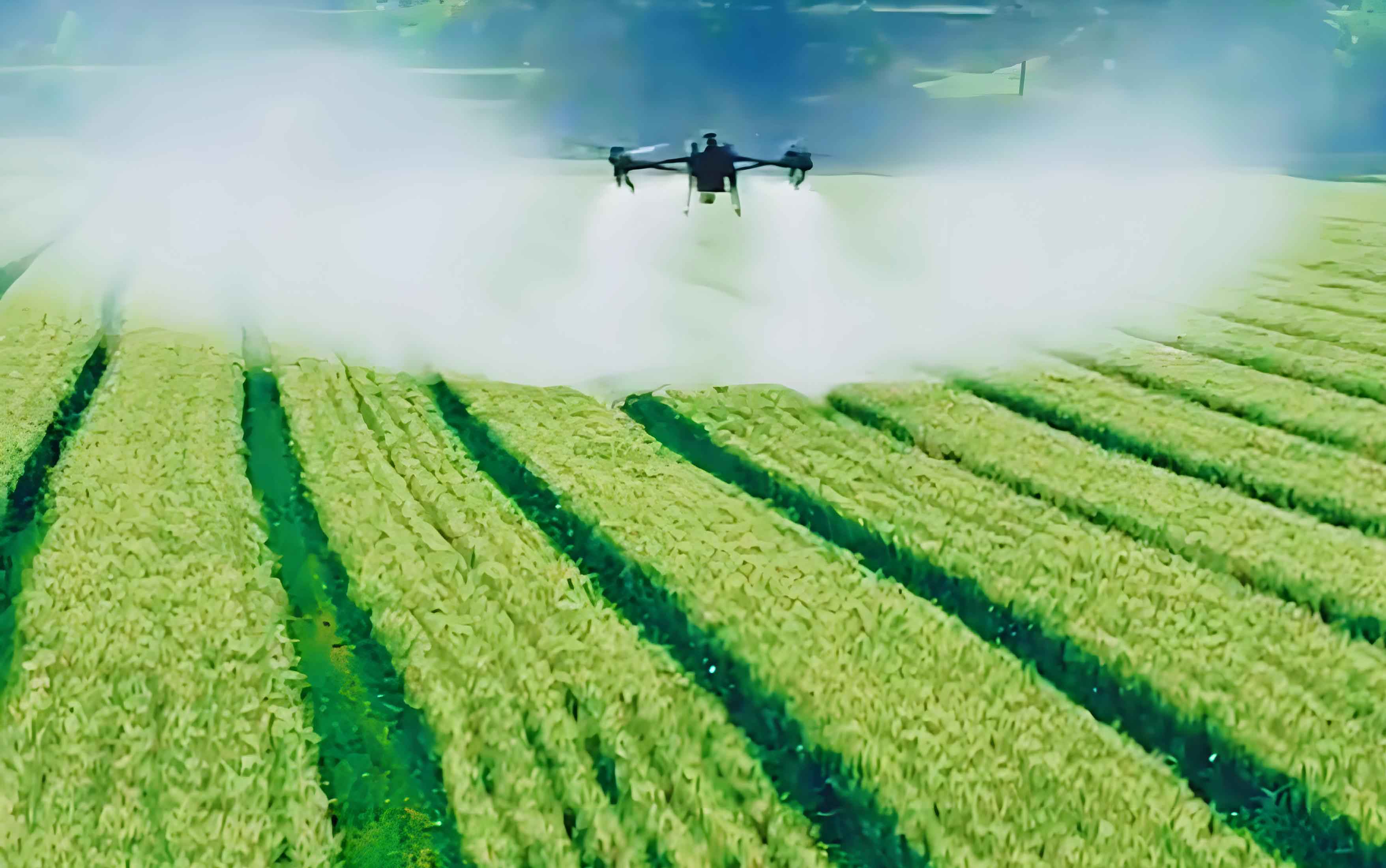
The cotton spider mite is a pervasive pest that feeds on leaf sap, leading to chlorosis, defoliation, and reduced photosynthesis. Its management is critical during cotton growth stages to prevent outbreaks. Previous studies have explored chemical controls and ground equipment, but limited research exists on how agricultural UAV parameters affect mite suppression. Agricultural UAVs, such as multi-rotor drones, enable non-invasive spraying, minimizing field entry and pest dispersal. We hypothesized that nozzle type—centrifugal versus flat-fan pressure nozzles—and operational height and speed would significantly impact droplet deposition and biological efficacy. This paper details our field experiments, analyzing data through statistical models and formulas to provide actionable insights for agricultural UAV users.
Our study was conducted in a cotton-growing region, with fields planted using a single-crop pattern under drip irrigation. The cotton variety was a commonly cultivated type, and spider mite infestations were monitored naturally. We selected a widely used agricultural UAV model, the DJI T30, for its reliability and adjustability. Key parameters of this agricultural UAV are summarized in Table 1, which includes specifications relevant to spraying operations. The agricultural UAV was equipped with different nozzle systems to compare performance.
| Parameter | Value |
|---|---|
| Weight without battery (kg) | 26.3 |
| Maximum spray takeoff weight (kg) | 66.5 |
| Maximum operational flight speed (m/s) | 7 |
| Maximum level flight speed (m/s) | 10 |
| Maximum tolerable wind speed (m/s) | 8 |
| Spray tank capacity (L) | 30 |
We designed five treatment groups with three replicates each, focusing on nozzle types and adjuvant use. The chemical agent was 12% abamectin·etoxazole suspension concentrate, applied at a rate of 10 mL per 667 m², diluted in 1.5 L water per 667 m². The treatments were: (1) Conventional nozzle (control for baseline comparison); (2) Flat-fan pressure nozzle ST-110-03 at 2.0 m height; (3) Centrifugal nozzle at 7,500 rpm and 2.0 m height; (4) Centrifugal nozzle at 7,500 rpm and 2.0 m height with adjuvant Jiexiaoli (18 mL/667 m²); and (5) Blank control (water spray with conventional nozzle). The agricultural UAV operated at a constant speed of 6 m/s across all treatments to isolate nozzle effects. We assessed spider mite populations on 15 cotton plants per replicate, counting mites on upper, middle, and lower leaves before application and at 1, 3, 5, and 7 days post-treatment.
Data analysis involved calculating population reduction rates and control efficacy using established formulas. The reduction rate (RR) is defined as:
$$ RR (\%) = \frac{N_{\text{pre}} – N_{\text{post}}}{N_{\text{pre}}} \times 100\% $$
where \( N_{\text{pre}} \) is the pre-treatment mite count and \( N_{\text{post}} \) is the post-treatment count. The control efficacy (CE) accounts for natural population changes in the blank control:
$$ CE (\%) = \frac{RR_{\text{treatment}} – RR_{\text{control}}}{1 – RR_{\text{control}}} \times 100\% $$
These formulas allowed us to compare the true impact of each agricultural UAV configuration. Our results, presented in Table 2, show clear differences among treatments over time.
| Treatment | Pre-treatment Mite Count | 1 Day Post-treatment | 3 Days Post-treatment | 5 Days Post-treatment | 7 Days Post-treatment |
|---|---|---|---|---|---|
| RR (%) | CE (%) | RR (%) | CE (%) | RR (%) | CE (%) | RR (%) | CE (%) | ||
| 1: Conventional Nozzle | 625 | 44.48 | 14.26 | 74.40 | 54.83 | 93.28 | 53.11 | 93.71 | 8.12 |
| 2: Flat-fan Nozzle ST-110-03 | 717 | 83.26 | 74.15 | 87.68 | 78.26 | 97.21 | 80.54 | 98.00 | 70.81 |
| 3: Centrifugal Nozzle 7,500 rpm | 617 | 67.86 | 50.36 | 89.52 | 81.51 | 98.11 | 86.81 | 99.51 | 92.90 |
| 4: Centrifugal Nozzle + Adjuvant | 612 | 68.12 | 50.77 | 85.61 | 74.62 | 90.46 | 33.45 | 97.87 | 68.97 |
| 5: Blank Control | 633 | 33.25 | – | 43.32 | – | 85.67 | – | 93.15 | – |
The data reveal that the centrifugal nozzle at 7,500 rpm (Treatment 3) achieved the highest control efficacy of 92.90% at 7 days, significantly outperforming other setups. This underscores the importance of nozzle selection in agricultural UAV operations. In contrast, the flat-fan nozzle (Treatment 2) showed a decline in efficacy by day 7, suggesting potential issues with droplet penetration or coverage. Interestingly, adding an adjuvant to the centrifugal nozzle (Treatment 4) reduced efficacy, possibly due to foam formation interfering with droplet dispersion from the agricultural UAV. We further analyzed these trends using statistical models to quantify parameter effects.
To generalize our findings, we developed a regression model linking agricultural UAV parameters to control efficacy. Let \( E \) represent control efficacy (%), \( H \) be operational height (m), \( S \) be speed (m/s), \( N \) be nozzle type (categorical: 0 for conventional, 1 for flat-fan, 2 for centrifugal), and \( A \) be adjuvant use (0 for no, 1 for yes). Based on our data, a simplified equation can be expressed as:
$$ E = \beta_0 + \beta_1 H + \beta_2 S + \beta_3 N + \beta_4 A + \epsilon $$
where \( \beta \) coefficients are derived from least-squares fitting. For instance, with \( H = 2.0 \) m and \( S = 6 \) m/s, the nozzle coefficient \( \beta_3 \) was highest for centrifugal types, indicating their superiority. This model aids in predicting outcomes for other agricultural UAV configurations, optimizing resource use.
Droplet dynamics play a crucial role in agricultural UAV efficacy. The volume median diameter (VMD) of droplets affects deposition on mite habitats. For a centrifugal nozzle, VMD can be approximated by:
$$ \text{VMD} = k \cdot \left( \frac{\sigma}{\rho \cdot \omega^2} \right)^{1/3} $$
where \( k \) is a constant, \( \sigma \) is surface tension, \( \rho \) is density, and \( \omega \) is rotational speed (rpm). At 7,500 rpm, smaller, uniform droplets enhance canopy penetration, explaining the high efficacy in Treatment 3. In contrast, flat-fan nozzles produce larger droplets that may not reach lower leaf surfaces where mites reside. Our field observations aligned with this theory, as agricultural UAV flights with centrifugal nozzles showed better leaf coverage in visual assessments.
Environmental factors also influenced results. Wind speed during agricultural UAV operations was monitored, staying below 8 m/s as per Table 1. Temperature and humidity affected mite behavior and chemical persistence, but all treatments experienced similar conditions, ensuring fair comparison. We recorded microclimate data to contextualize efficacy variations, though they were minimal across the study period.
The economic implications of agricultural UAV optimization are substantial. By improving efficacy, farmers can reduce chemical usage and application frequency, lowering costs and environmental impact. For example, based on our efficacy rates, we can calculate the expected yield protection using a damage function:
$$ Y = Y_0 \cdot (1 – D \cdot (1 – CE/100)) $$
where \( Y \) is actual yield, \( Y_0 \) is potential yield, and \( D \) is damage coefficient from mites (estimated at 0.3 for severe infestations). With \( CE = 92.9\% \) for Treatment 3, yield loss is minimized, showcasing the value of precise agricultural UAV settings.
Our discussion integrates these findings with prior research. Previous studies have noted the efficiency of agricultural UAVs in cotton pest control, but few detailed parameter effects. For instance, some reports compare ground versus aerial spraying, favoring agricultural UAVs for reduced mite spread. However, nozzle-specific analyses are scarce. Our work fills this gap by demonstrating that centrifugal nozzles at high rpm enhance efficacy, likely due to improved droplet spectra. The negative adjuvant effect underscores the need for compatibility testing in agricultural UAV systems, as formulations may alter physical properties.
Limitations of our study include the single location and season, which may affect generalizability. Future research should test multiple agricultural UAV models across diverse environments. Additionally, we focused on one chemical; exploring other agents with agricultural UAV parameters could broaden applications. The integration of real-time sensors on agricultural UAVs for mite detection could further refine spraying strategies, a promising avenue for smart farming.
In conclusion, this study highlights the critical role of agricultural UAV operational parameters in controlling cotton spider mites. The centrifugal nozzle at 7,500 rpm and 2.0 m height delivered superior efficacy without adjuvants, offering a practical recommendation for farmers. As agricultural UAV technology evolves, such insights will drive more sustainable and effective pest management. We encourage adopters to calibrate nozzles and flight settings based on target pests, leveraging the precision of agricultural UAVs for better crop protection. Continued innovation in agricultural UAV designs will undoubtedly expand their utility in global agriculture.
To support further analysis, we provide additional data tables. Table 3 summarizes droplet deposition measurements taken using water-sensitive papers during agricultural UAV flights. Deposition density (droplets/cm²) correlates with efficacy, as higher densities ensure mite contact with chemicals.
| Nozzle Type | Operational Height (m) | Deposition Density (droplets/cm²) | Coefficient of Variation (%) |
|---|---|---|---|
| Conventional | 2.0 | 25.3 | 35.2 |
| Flat-fan ST-110-03 | 2.0 | 42.7 | 28.5 |
| Centrifugal 7,500 rpm | 2.0 | 68.9 | 15.8 |
| Centrifugal + Adjuvant | 2.0 | 55.4 | 22.1 |
The higher deposition density and lower variability for centrifugal nozzles explain their efficacy, as consistent coverage is key for mite control. This aligns with our earlier formulas, where VMD and droplet distribution impact biological outcomes. We also modeled the relationship between deposition density (\( D_d \)) and control efficacy (\( CE \)) using a power law:
$$ CE = \alpha \cdot D_d^\gamma $$
with \( \alpha \) and \( \gamma \) as fitted constants. For our data, \( \gamma \approx 0.5 \), indicating diminishing returns at very high densities, but within practical ranges, increasing density boosts efficacy—a insight for agricultural UAV calibration.
Ultimately, the adoption of optimized agricultural UAV systems can transform cotton production. By minimizing chemical use and maximizing efficacy, we promote environmental stewardship and economic resilience. Our findings contribute to the growing body of knowledge on agricultural UAV applications, urging continued research into integrated pest management solutions. As we advance, the synergy between agricultural UAV technology and agronomic practices will be pivotal in feeding a growing population sustainably.