
In the realm of modern entertainment and technological displays, the formation drone light show has emerged as a captivating spectacle, where multiple unmanned aerial vehicles (UAVs) orchestrate synchronized flights to create intricate patterns and animations in the sky. As a researcher deeply involved in this field, I have explored advanced control strategies to enhance the precision and reliability of these performances. The core challenge lies in ensuring that each drone follows a predefined trajectory while maintaining strict formation with others, even under external disturbances. This article delves into the design of control systems for formation drone light shows, leveraging methods such as integral backstepping and sliding mode control within a Leader-Follower framework. Through detailed mathematical modeling, simulation, and experimental validation, I aim to demonstrate how these techniques can achieve robust trajectory tracking and formation control, ultimately pushing the boundaries of what is possible in aerial displays. The integration of rigorous control theory with practical applications underscores the transformative potential of formation drone light shows in events, advertising, and artistic expression.
The foundation of any formation drone light show is the accurate dynamic model of the quadrotor UAV. Each drone in the show must be treated as a nonlinear, underactuated system with strong couplings between its states. Based on Newton-Euler equations, the motion of a quadrotor can be described in terms of translational and rotational dynamics. Let us define the position coordinates in the inertial frame as $x$, $y$, and $z$, and the Euler angles as roll $\phi$, pitch $\theta$, and yaw $\psi$. The equations of motion are derived from force and moment balances, incorporating aerodynamic effects. The system can be expressed as:
$$ \begin{align*}
\dot{x} &= v_x, \\
\dot{v}_x &= \frac{u_1 (\cos\psi \sin\theta \cos\phi + \sin\phi \sin\psi)}{m} – \frac{K_x v_x}{m}, \\
\dot{y} &= v_y, \\
\dot{v}_y &= \frac{u_1 (\sin\psi \sin\theta \cos\phi – \sin\phi \cos\psi)}{m} – \frac{K_y v_y}{m}, \\
\dot{z} &= v_z, \\
\dot{v}_z &= \frac{u_1 \cos\theta \cos\phi}{m} – g, \\
\dot{\phi} &= v_\phi, \\
\dot{v}_\phi &= \frac{(I_y – I_z) \dot{\theta} \dot{\psi} + u_2}{I_x}, \\
\dot{\theta} &= v_\theta, \\
\dot{v}_\theta &= \frac{(I_z – I_x) \dot{\phi} \dot{\psi} + u_3}{I_y}, \\
\dot{\psi} &= v_\psi, \\
\dot{v}_\psi &= \frac{(I_x – I_y) \dot{\phi} \dot{\theta} + u_4}{I_z},
\end{align*} $$
where $m$ is the mass, $g$ is gravity, $I_x$, $I_y$, $I_z$ are moments of inertia, $K_x$, $K_y$, $K_z$ are drag coefficients, and $u_1$ to $u_4$ are control inputs representing total thrust and moments. This model captures the essential dynamics for designing controllers in a formation drone light show. The control inputs are related to rotor speeds $\Omega_i$ through:
$$ \begin{align*}
u_1 &= C_L (\Omega_1^2 + \Omega_2^2 + \Omega_3^2 + \Omega_4^2), \\
u_2 &= l C_L (\Omega_4^2 – \Omega_2^2), \\
u_3 &= l C_L (\Omega_3^2 – \Omega_1^2), \\
u_4 &= d (-\Omega_1^2 + \Omega_2^2 – \Omega_3^2 + \Omega_4^2),
\end{align*} $$
with $C_L$ as the lift coefficient, $l$ as the arm length, and $d$ as the drag factor. In a formation drone light show, these equations must be managed for each drone to ensure synchronized movement.
To achieve precise trajectory tracking in a formation drone light show, I employ the integral backstepping (IBS) method for the Leader drone. This approach constructs a controller recursively using Lyapunov stability theory, ensuring that the Leader follows a reference path defined for the light show. Let the reference trajectory be denoted as $(x_r, y_r, z_r)$. For the altitude subsystem, define the tracking error $e_{z1} = z_r – z$ and its integral $e_{z2} = k \int_0^t (z_r – z) d\tau$, where $k$ is a positive constant. A Lyapunov function $V_1 = \frac{1}{2} e_{z1}^2 + \frac{1}{2} e_{z2}^2$ is chosen, and its derivative leads to a virtual control law $\alpha = k e_{z2} + \dot{z}_r + \lambda e_{z1}$ with $\lambda > 0$. Introducing another error $e_{z3} = \alpha – v_z$, the control input $u_1$ for altitude can be derived as:
$$ u_1 = \frac{m \left[ (\lambda + \lambda_1) e_{z3} + (1 + k^2 – \lambda^2) e_{z1} + \ddot{z}_r – k \lambda e_{z2} + g \right]}{\cos\theta \cos\phi}, $$
where $\lambda_1 > 0$ is a tuning parameter. Similarly, for horizontal motion, define errors $e_{x1} = x_r – x$, $e_{x2} = k_3 \int_0^t (x_r – x) d\tau$, $e_{x3} = k_3 e_{x2} + \dot{x}_r + \lambda_4 e_{x1} – \dot{x}$, and $e_{y1} = y_r – y$, $e_{y2} = k_2 \int_0^t (y_r – y) d\tau$, $e_{y3} = k_2 e_{y2} + \dot{y}_r + \lambda_2 e_{y1} – \dot{y}$. The intermediate control variables $u_x$ and $u_y$ are obtained:
$$ \begin{align*}
u_x &= \cos\psi \sin\theta \cos\phi + \sin\phi \sin\psi = \frac{m}{u_1} \left[ (1 + k_3^2 – \lambda_4^2) e_{x1} + (\lambda_5 + \lambda_4) e_{x3} + \ddot{x}_r – k_3 \lambda_4 e_{x2} \right], \\
u_y &= \sin\psi \sin\theta \cos\phi – \sin\phi \cos\psi = \frac{m}{u_1} \left[ (1 + k_2^2 – \lambda_2^2) e_{y1} + (\lambda_3 + \lambda_2) e_{y3} + \ddot{y}_r – k_2 \lambda_2 e_{y2} \right],
\end{align*} $$
with $k_2, k_3, \lambda_2, \lambda_3, \lambda_4, \lambda_5 > 0$. The desired roll and pitch angles for the Leader drone in the formation drone light show are then computed as $\phi_d = \arcsin(u_x \sin\psi – u_y \cos\psi)$ and $\theta_d = \arcsin\left(\frac{u_x – \sin\phi_d \sin\psi}{\cos\phi_d \cos\psi}\right)$. These control laws ensure that the Leader accurately tracks the reference trajectory, which is crucial for orchestrating the overall formation drone light show.
For formation control in a drone light show, I adopt a Leader-Follower strategy combined with sliding mode control (SMC). This approach allows multiple drones to maintain desired relative positions while following the Leader’s trajectory. Consider a communication topology where a Leader drone $o$ guides Follower drones $j$ and $k$, which in turn may guide additional Followers like $i$ and $l$. The kinematic model for each drone $i$ is given by:
$$ \begin{align*}
\dot{x}_i &= v_i \cos\psi_i, \\
\dot{y}_i &= v_i \sin\psi_i, \\
\dot{\psi}_i &= \omega_i,
\end{align*} $$
where $v_i$ is the forward velocity and $\omega_i$ is the angular velocity. The relative position errors between Follower $i$ and its Leader $j$ in the formation drone light show are defined along the longitudinal and lateral directions. Let $d_{xij}$ and $d_{yij}$ be the actual distances, and $d_{dx}$, $d_{dy}$ be the desired formation distances. The errors are:
$$ \begin{align*}
e_{xij} &= d_{xij} – d_{dx}, \\
e_{yij} &= d_{yij} – d_{dy}, \\
e_{\psi ij} &= \psi_i – \psi_j.
\end{align*} $$
Differentiating these leads to the error dynamics:
$$ \begin{align*}
\dot{e}_{xij} &= -v_j – e_{yij} \omega_j + v_i \cos e_{\psi ij} – d_f \omega_i \sin e_{\psi ij}, \\
\dot{e}_{yij} &= e_{xij} \omega_j – v_i \sin e_{\psi ij} – d_f \omega_i \cos e_{\psi ij},
\end{align*} $$
where $d_f > 0$ is a small offset distance. In state-space form, with state vector $\mathbf{e}_{ij} = [e_{xij}, e_{yij}]^T$ and control input $\mathbf{u}_i = [v_i, \omega_i]^T$, we have $\dot{\mathbf{e}}_{ij} = A(\mathbf{e}_{ij}) + B_{ij} \mathbf{u}_i$, where $A(\mathbf{e}_{ij}) = [-v_j – e_{yij} \omega_j, e_{xij} \omega_j]^T$ and $B_{ij} = \begin{bmatrix} \cos e_{\psi ij} & -d_f \sin e_{\psi ij} \\ -\sin e_{\psi ij} & -d_f \cos e_{\psi ij} \end{bmatrix}$. To design a robust controller for the formation drone light show, I introduce a sliding surface $\mathbf{s}_i = C \mathbf{e}_{ij}$, where $C \in \mathbb{R}^{2 \times 2}$ is invertible. Using the reaching law $\dot{\mathbf{s}}_i = -\epsilon_1 \text{sgn}(\mathbf{s}_i)$ with $\epsilon_1 > 0$, the control law for Follower $i$ is derived as:
$$ \mathbf{u}_i = – (C B_{ij})^{-1} \left[ \epsilon_1 \text{sgn}(\mathbf{s}_i) + C A(\mathbf{e}_{ij}) \right]. $$
This sliding mode control law ensures that the formation errors converge to zero despite uncertainties, making it ideal for maintaining precise formations in a drone light show. The Lyapunov function $V = \frac{1}{2} \mathbf{s}_i^T \mathbf{s}_i$ confirms stability since $\dot{V} = -\epsilon_1 |\mathbf{s}_i| \leq 0$. By applying this to all Follower drones, the entire fleet can achieve the desired geometric patterns essential for a captivating formation drone light show.
To validate the control strategies for formation drone light shows, I conducted numerical simulations and real-world experiments. The simulation parameters are summarized in the table below, which includes key constants used in the IBS and SMC designs. These parameters were tuned to optimize performance in a formation drone light show scenario.
| Parameter | Value | Description |
|---|---|---|
| $k_1$ | $\sqrt{4}$ | Integral gain for altitude |
| $k_2$ | $\sqrt{5}$ | Integral gain for y-direction |
| $k_3$ | $\sqrt{0.7}$ | Integral gain for x-direction |
| $\lambda$ | 12 | Control gain for altitude |
| $\lambda_1$ | 19 | Additional gain for altitude |
| $\lambda_2$ | 12 | Control gain for y-direction |
| $\lambda_3$ | 19 | Additional gain for y-direction |
| $\lambda_4$ | 12 | Control gain for x-direction |
| $\lambda_5$ | 19 | Additional gain for x-direction |
| $d_f$ | 0.02 | Offset distance for formation |
| $\epsilon_1$ | 0.001 | Sliding mode reaching rate |
In simulations, the Leader drone tracked a circular reference trajectory $x_r = 0.5 \cos(0.02t)$, $y_r = 0.5 \sin(0.02t)$, $z_r = 1$, while Followers maintained formations with specific offsets. For instance, Follower 1 and Follower 2 were set to have position errors of 0.8 m in x-direction and ±1.5 m in y-direction relative to the Leader, forming a triangular pattern characteristic of a formation drone light show. The results demonstrated rapid convergence of tracking errors and stable formation keeping, with errors in x, y, and z directions diminishing over time. The simulation confirmed that the IBS and SMC methods provide high precision for trajectory tracking and formation control, which is critical for synchronized movements in a formation drone light show.
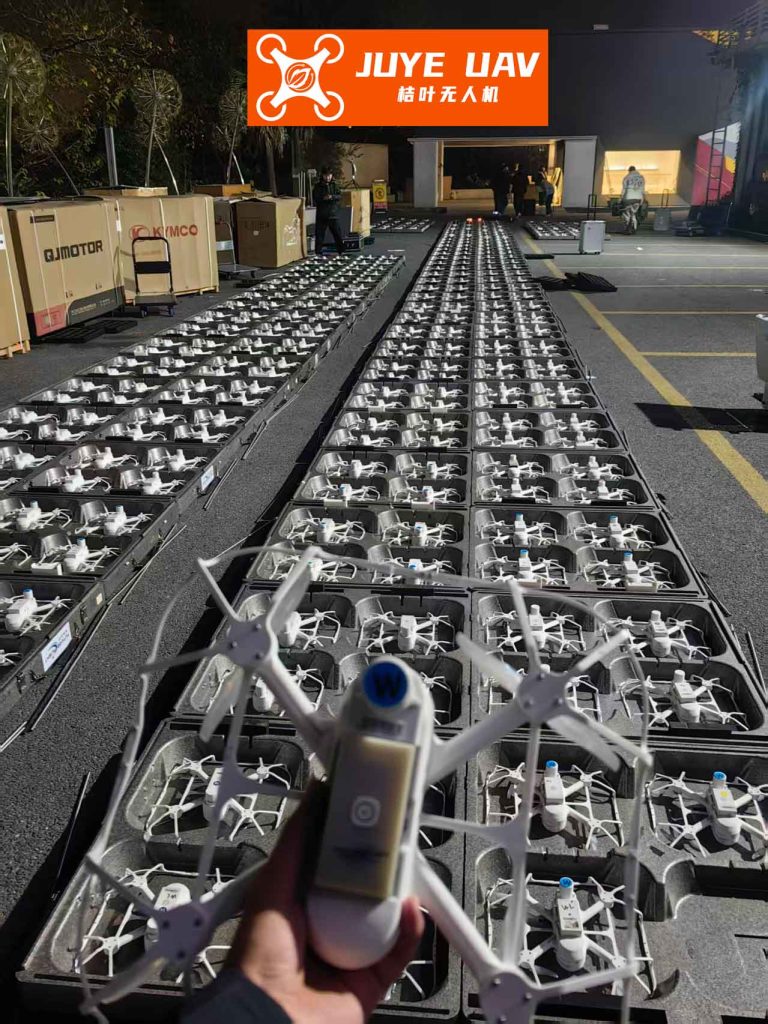
For experimental validation, I implemented the control algorithms on Parrot Bebop 2 quadrotors using a visual positioning system (VPS) and a ROS-based platform. The setup included multiple drones communicating via a Leader-Follower topology, with the Leader following the same circular trajectory. In this real-world formation drone light show test, the Followers maintained offsets of 0.8 m in x-direction and ±0.8 m in y-direction. The experimental data showed that the drones successfully achieved the desired formation while tracking the trajectory, with position errors remaining within acceptable bounds. The velocities and angular velocities of the Followers, such as $v_1$ and $\omega_1$ for Follower 1, exhibited smooth profiles with minor oscillations due to external disturbances like air currents. These results underscore the practicality of the proposed control schemes for actual formation drone light shows, where robustness against environmental factors is paramount.
The integration of advanced control theory into formation drone light shows opens up new possibilities for complex aerial displays. By combining integral backstepping for precise trajectory tracking and sliding mode control for robust formation maintenance, we can achieve highly synchronized performances that are both reliable and visually stunning. The mathematical rigor behind these methods ensures that each drone in the show behaves predictably, even when faced with uncertainties. As the demand for larger and more intricate formation drone light shows grows, these control strategies will play a pivotal role in enabling scalable and adaptive fleets. Future work may explore adaptive control to handle varying wind conditions or machine learning for dynamic pattern generation, further enhancing the artistic and technical scope of formation drone light shows.
In conclusion, the design and implementation of control systems for formation drone light shows represent a significant advancement in UAV technology. Through detailed modeling, controller design, and validation via simulations and experiments, I have demonstrated how integral backstepping and sliding mode control can be effectively applied within a Leader-Follower framework. This approach ensures accurate trajectory tracking and stable formation keeping, which are essential for creating mesmerizing aerial displays. The successful experimental outcomes highlight the feasibility of deploying these algorithms in real-world settings, paving the way for more innovative and reliable formation drone light shows. As this field evolves, continued research will undoubtedly lead to even more sophisticated control solutions, pushing the boundaries of what can be achieved in the sky.