
As the demand for sustainable aviation solutions intensifies, hydrogen-powered fixed-wing UAVs have emerged as a promising platform for long-endurance missions. Compared with conventional battery-powered drones, hydrogen fuel cell systems offer significantly higher energy density, enabling flight durations exceeding ten hours while maintaining zero emissions. This study focuses on the aerodynamic evaluation of a fixed-wing UAV designed for hydrogen hybrid propulsion, aiming to verify the feasibility of its aerodynamic layout and provide data-driven guidance for further refinement. Using computational fluid dynamics (CFD), I simulated the flow around the full-scale configuration under cruise conditions. The primary objective was to obtain lift and drag characteristics, identify flow separation patterns, and determine optimal angle-of-attack for maximum aerodynamic efficiency. The results demonstrate that the fixed-wing UAV achieves a maximum lift-to-drag ratio of 14.5 at 4° angle-of-attack, with stall occurring at 8°, confirming a sound baseline design. Detailed flow field analysis also reveals key regions of vortical activity and pressure gradients that suggest directions for drag reduction.
1. Methodology and Numerical Setup
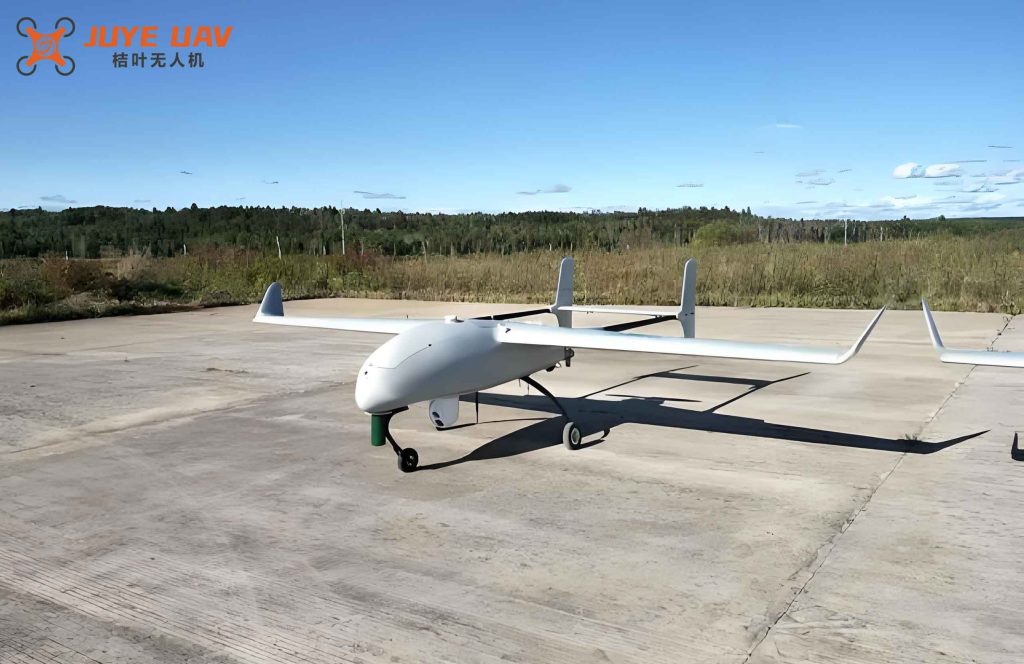
The fixed-wing UAV geometry features a high-aspect-ratio wing with a Clark Y airfoil, a T-tail configuration, and a ventral fin for enhanced lateral stability. To reduce computational cost, a half-model with symmetry boundary condition was employed. The computational domain extended 5 body lengths upstream and 10 body lengths downstream, with lateral boundaries set at 5 half-spans. Unstructured meshes were generated using Workbench Meshing, with prism layers to resolve the boundary layer. The first cell height was set to 0.01 mm to ensure a y+ value around 1 for low-Reynolds-number turbulence models. The total cell count was approximately 4.2 million. Figure 1 illustrates the mesh refinement near the wing-body junction.
Two turbulence models were evaluated: the Spalart-Allmaras (SA) model and the Shear Stress Transport k-ω (SST k-ω) model. The freestream conditions corresponded to a cruising altitude of 1 km, with pressure 0.91×10⁵ Pa, static temperature 275 K, and Mach number 0.1. The angle-of-attack ranged from -6° to 14° in 2° increments. The governing equations for the SST k-ω model are:
$$ \frac{\partial}{\partial t}(\rho k) + \frac{\partial}{\partial x_i}(\rho k u_i) = \frac{\partial}{\partial x_j} \left( \Gamma_k \frac{\partial k}{\partial x_j} \right) + G_k – Y_k + S_k $$
$$ \frac{\partial}{\partial t}(\rho \omega) + \frac{\partial}{\partial x_i}(\rho \omega u_i) = \frac{\partial}{\partial x_j} \left( \Gamma_\omega \frac{\partial \omega}{\partial x_j} \right) + G_\omega – Y_\omega + S_\omega $$
The SA transport equation is:
$$ \rho \frac{D\tilde{\nu}}{Dt} = G_\nu + \frac{1}{\sigma_{\tilde{\nu}}} \left[ \frac{\partial}{\partial X_j} \left( (\mu + \rho \tilde{\nu}) \frac{\partial \tilde{\nu}}{\partial X_j} \right) + C_{b2} \rho \left( \frac{\partial \tilde{\nu}}{\partial X_j} \right)^2 \right] – Y_\nu $$
2. Results and Discussion
2.1 Global Aerodynamic Coefficients
Table 1 summarizes the lift coefficient (CL), drag coefficient (Cd), and lift-to-drag ratio (K) for the SST k-ω model at selected angles of attack. At α = 0°, the fixed-wing UAV produces a moderate lift of 0.28 with low drag. The maximum lift coefficient reaches 1.47 at α = 8°, beyond which stall occurs. The best glide ratio Kmax = 14.5 is achieved at α = 4°, which is close to the intended cruise condition. The SA model generally predicts higher lift at large α due to under-predicted separation, confirming the suitability of SST k-ω for post-stall analysis.
| α (°) | CL | Cd | K = CL/Cd |
|---|---|---|---|
| -6 | -0.24 | 0.028 | -8.6 |
| -2 | 0.04 | 0.019 | 2.1 |
| 0 | 0.28 | 0.022 | 12.7 |
| 2 | 0.54 | 0.030 | 18.0 |
| 4 | 0.81 | 0.056 | 14.5 |
| 6 | 1.12 | 0.091 | 12.3 |
| 8 | 1.47 | 0.142 | 10.4 |
| 10 | 1.39 | 0.200 | 6.95 |
| 12 | 1.28 | 0.254 | 5.04 |
| 14 | 1.16 | 0.310 | 3.74 |
2.2 Flow Field Characteristics
Streamline patterns on the upper surface of the fixed-wing UAV reveal important interactions. At α = 0°, attached flow is largely maintained except at the wing-root junction where a saddle point forms due to fuselage interference. This indicates a local separation region that generates additional drag. As the angle-of-attack increases to 12°, massive separation occurs over the wing upper surface. Figure 2 compares the outfield streamlines at these two conditions. At α = 12°, the flow detaches near the leading edge and reattachment is absent, confirming the fixed-wing UAV is fully stalled.
Mach number contours on the fuselage surface at α = 0° and 12° are shown in the digital simulation results. At low α, the Mach number on the upper wing remains below 0.08. At 12°, the flow accelerates over the forward part but then decelerates abruptly after separation. Pressure coefficient (Cp) distributions at five spanwise sections along the wing are presented in Table 2, listing Cp values at key chord positions for both upper and lower surfaces at α = 4° (near optimal performance).
| x/c | Section 1 (root) | Section 2 | Section 3 (mid) | Section 4 | Section 5 (tip) |
|---|---|---|---|---|---|
| 0.02 (upper) | -0.85 | -1.12 | -1.30 | -1.25 | -1.05 |
| 0.10 (upper) | -0.72 | -0.90 | -1.10 | -1.08 | -0.92 |
| 0.30 (upper) | -0.50 | -0.58 | -0.70 | -0.68 | -0.55 |
| 0.60 (upper) | -0.33 | -0.37 | -0.45 | -0.42 | -0.30 |
| 0.90 (upper) | -0.15 | -0.18 | -0.22 | -0.20 | -0.12 |
| 0.02 (lower) | 0.35 | 0.32 | 0.30 | 0.31 | 0.36 |
| 0.10 (lower) | 0.22 | 0.20 | 0.18 | 0.19 | 0.24 |
| 0.30 (lower) | 0.15 | 0.14 | 0.12 | 0.13 | 0.16 |
At high angles-of-attack, the Cp curves on the upper surface show a distinct inflection in the mid-chord region, signifying the onset of separation. Interestingly, the tip section (Section 5) maintains a smoother pressure recovery due to the wingtip vortex that energizes the boundary layer. The wake vortex system of the fixed-wing UAV visualized by the Q-criterion at α = 0° includes not only the main wingtip vortices but also vortices shed from the horizontal tail tips and the fuselage aft-body. These vortical structures contribute to induced drag and represent potential areas for drag reduction via wingtips or tail fairings.
3. Conclusions
This aerodynamic assessment of a hydrogen-powered fixed-wing UAV using numerical simulation has provided quantitative insights into its performance and flow physics. The key findings are summarized below:
- The fixed-wing UAV exhibits a maximum lift coefficient of 1.47 at 8° angle-of-attack, with stall occurring at the same angle. The maximum lift-to-drag ratio of 14.5 is achieved at 4°, confirming adequate aerodynamic efficiency for long-endurance missions.
- The SST k-ω turbulence model captures separation more accurately than the SA model at large α, making it the preferred choice for evaluating stall behavior of the fixed-wing UAV.
- Wing-body junction flow is characterized by a saddle point and local separation even at low α, suggesting that a fairing or blended wing-body design could reduce interference drag.
- Tip vortices and tail vortices are prominent; adding winglets or reshaping the tail tips may further improve the lift-to-drag ratio of the fixed-wing UAV.
- Future work will focus on optimizing the wing-root geometry, exploring higher cruise Mach numbers, and validating the CFD results through wind tunnel experiments.
These outcomes directly support the iterative design cycle of the long-endurance hydrogen hybrid fixed-wing UAV, enabling informed modifications that enhance mission capability while maintaining structural and operational constraints.