
With the rapid advancement of drone technology, quadrotor Unmanned Aerial Vehicles (UAVs) have gained widespread adoption in various fields such as surveying, communication, industrial inspection, and military applications due to their simplicity, reliability, low maintenance, vertical take-off and landing capabilities, and high maneuverability. However, the control system of quadrotor UAVs must address significant nonlinearities and multiple disturbances. Although traditional PID control based on linear principles is widely used in industry, its performance in handling external disturbances is insufficient to meet the high-precision control requirements of UAV systems. To overcome these limitations, researchers have explored various advanced control strategies, including backstepping, sliding mode control, and model predictive control. Among these, Active Disturbance Rejection Control (ADRC) has emerged as a promising nonlinear control method that does not require an accurate mathematical model of the system. ADRC utilizes an Extended State Observer (ESO) to estimate and compensate for internal and external disturbances in real-time, combined with a Nonlinear State Error Feedback (NLSEF) law to achieve disturbance suppression. Despite its advantages, such as fast tracking and strong anti-interference capabilities, ADRC faces challenges in balancing response speed and overshoot. Sliding Mode Control (SMC) offers robustness against model uncertainties but suffers from chattering issues. This paper proposes a novel attitude control strategy that integrates ADRC with global integral SMC to enhance the performance of quadrotor UAVs under various disturbances and uncertainties. The design includes an improved ESO using a smooth nonlinear function to replace the traditional fal function, reducing chattering and improving disturbance estimation. Additionally, a global integral sliding mode surface is introduced to eliminate steady-state error and enhance robustness throughout the system response. The stability of the proposed controller is analyzed using Lyapunov theory, and simulation results under different operating conditions demonstrate its effectiveness in terms of fast response, strong anti-interference ability, and reduced chattering.
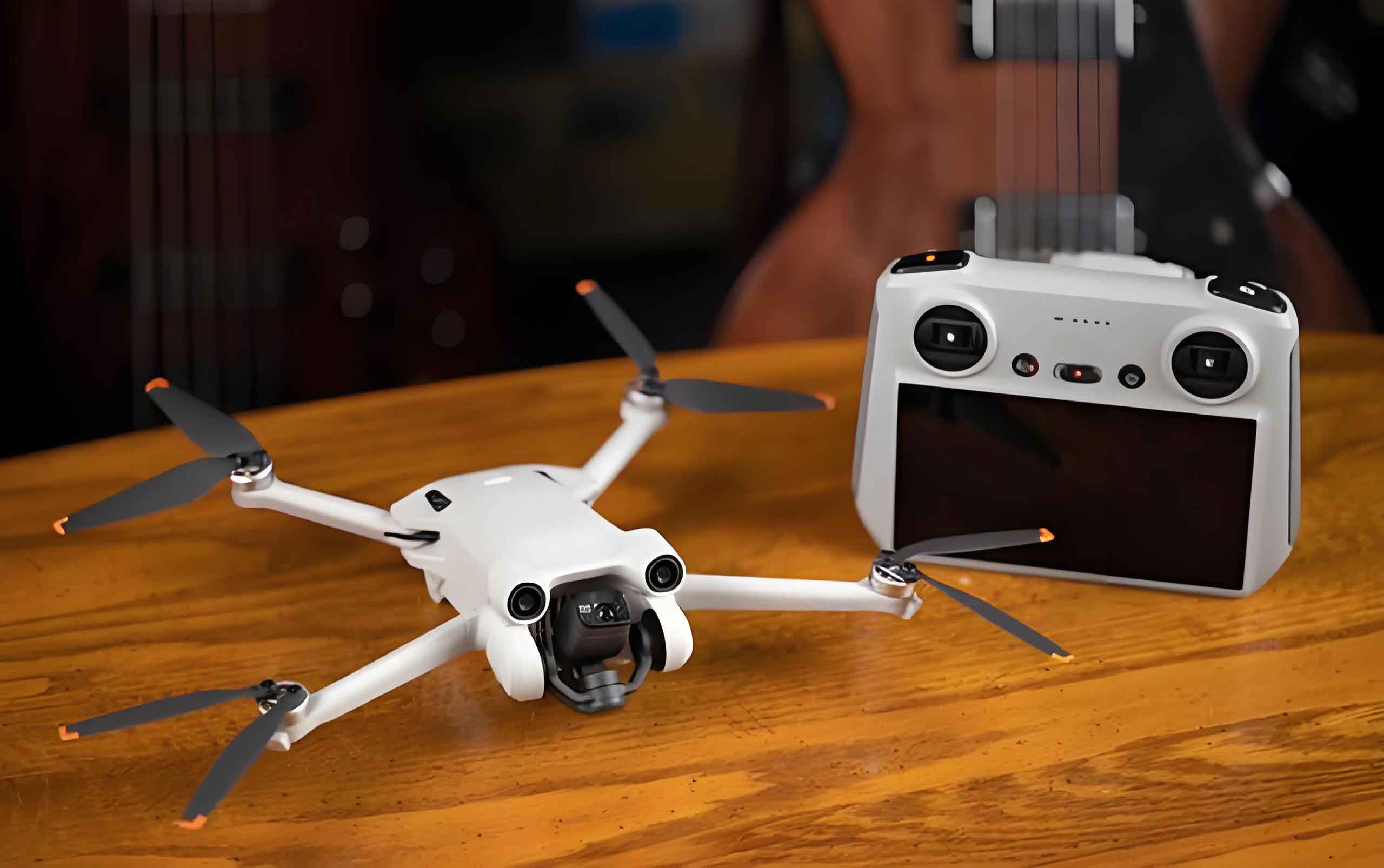
The dynamics of a quadrotor UAV are derived using the Newton-Euler equations, neglecting gyroscopic moments and aerodynamic friction for simplification. The nonlinear model is expressed as follows:
$$ \begin{cases} \ddot{x} = \frac{1}{m} (\cos \phi \sin \theta \cos \psi + \sin \phi \sin \psi) U_1 \\ \ddot{y} = \frac{1}{m} (\cos \phi \sin \theta \sin \psi – \sin \phi \cos \psi) U_1 \\ \ddot{z} = \frac{1}{m} (\cos \phi \cos \theta) U_1 – g \\ \ddot{\phi} = \frac{I_y – I_z}{I_x} \dot{\theta} \dot{\psi} + \frac{1}{I_x} U_2 \\ \ddot{\theta} = \frac{I_z – I_x}{I_y} \dot{\phi} \dot{\psi} + \frac{1}{I_y} U_3 \\ \ddot{\psi} = \frac{I_x – I_y}{I_z} \dot{\phi} \dot{\theta} + \frac{1}{I_z} U_4 \end{cases} $$
where \( m \) is the mass of the UAV, \( g \) is the gravitational acceleration, \( [\phi, \theta, \psi]^T \) represents the roll, pitch, and yaw angles, \( I_x, I_y, I_z \) are the moments of inertia about the respective axes, and \( U_1, U_2, U_3, U_4 \) are the control inputs defined as:
$$ \begin{cases} U_1 = f \\ U_2 = \tau_x \\ U_3 = \tau_y \\ U_4 = \tau_z \end{cases} $$
Here, \( f \) is the total thrust generated by the rotors, and \( \tau_x, \tau_y, \tau_z \) are the moments along the body axes. The control design focuses on the attitude channels (roll, pitch, yaw) for stability and tracking. The proposed Global Integral SMC-ADRC controller is applied to each attitude channel independently. For instance, the roll channel dynamics with disturbances can be written as:
$$ \ddot{\phi} = \frac{I_y – I_z}{I_x} \dot{\theta} \dot{\psi} + \frac{1}{I_x} U_2 + \omega $$
where \( \omega \) represents external disturbances. By defining state variables \( x_1 = \phi \), \( x_2 = \dot{\phi} \), the system is reformulated as:
$$ \begin{cases} \dot{x}_1 = x_2 \\ \dot{x}_2 = f(\phi, \dot{\phi}, \theta, \psi, \omega) + b U_2 \end{cases} $$
where \( b \) is the control gain, and \( f(\cdot) \) encapsulates the total disturbance including couplings and external effects. In ADRC, an ESO is designed to estimate this total disturbance. The classical ADRC structure consists of a Tracking Differentiator (TD), an ESO, and a NLSEF. The TD provides a smooth reference signal and its derivative, reducing noise amplification. For a second-order nonlinear discrete TD, the update law is:
$$ \begin{cases} v_1(k+1) = v_1(k) + h v_2(k) \\ v_2(k+1) = v_2(k) + h \cdot \text{fhan}(v_1(k) – v_{\text{ref}}(k), v_2(k), r_0, h_0) \end{cases} $$
where \( v_1 \) and \( v_2 \) are the tracked signal and its derivative, \( h \) is the sampling period, \( v_{\text{ref}} \) is the desired value, and \( \text{fhan}(\cdot) \) is the optimal control synthesis function defined as:
$$ \text{fhan}(x_1, x_2, r, h) = \begin{cases} d = r h^2 \\ a_0 = h x_2 \\ y = x_1 + a_0 \\ a_1 = \sqrt{d(d+8|y|)} \\ a_2 = a_0 + \frac{\text{sign}(y)(a_1 – d)}{2} \\ a = (\text{sign}(y+d) – \text{sign}(y-d)) \frac{a_2}{2} + (\text{sign}(y-d) – 1) \frac{a_2}{2} \\ \text{fhan} = -r \left( \frac{a}{d} – \text{sign}(a) \right) – r \text{sign}(a) \end{cases} $$
The ESO expands the total disturbance into a new state variable \( x_3 = f \), and estimates it using:
$$ \begin{cases} e = z_1 – y \\ \dot{z}_1 = z_2 – \beta_{01} \cdot \text{tfal}(e, \alpha_1, k) \\ \dot{z}_2 = z_3 – \beta_{02} \cdot \text{tfal}(e, \alpha_2, k) + b_0 U_2 \\ \dot{z}_3 = – \beta_{03} \cdot \text{tfal}(e, \alpha_3, k) \end{cases} $$
where \( z_1, z_2, z_3 \) are the estimated states, \( \beta_{01}, \beta_{02}, \beta_{03} \) are observer gains, \( b_0 \) is the controller gain, and \( \text{tfal}(\cdot) \) is the improved nonlinear function designed to replace the traditional fal function for smoother performance. The tfal function is based on the hyperbolic tangent function and defined as:
$$ \text{tfal}(x, a, k) = a \cdot \frac{e^{x/k} – e^{-x/k}}{e^{x/k} + e^{-x/k}} $$
This function is odd, smooth, and saturating, which enhances the ESO’s estimation accuracy and reduces chattering. The convergence conditions for the improved ESO are derived using Lyapunov theory, ensuring that the observer gains satisfy:
$$ \beta_{01} \beta_{02} \beta_{03} – \frac{a_1 a_2}{k^2} > 0 $$
The NLSEF in ADRC is replaced by a global integral sliding mode controller to improve response speed and robustness. The sliding surface for the roll channel is designed as:
$$ S = e + k_P \dot{e} + k_I \int_0^t e \, d\tau – (e(0) + k_P \dot{e}(0)) e^{-t} $$
where \( e = \phi_d – \phi \) is the tracking error, \( \phi_d \) is the desired roll angle, and \( k_P, k_I \) are controller parameters. This surface ensures global robustness by including an exponential term that decays over time. The derivative of the sliding surface is:
$$ \dot{S} = \dot{e} + k_P \ddot{e} + k_I e + (e(0) + k_P \dot{e}(0)) e^{-t} $$
Using an exponential reaching law:
$$ \dot{S} = -\epsilon \cdot \text{sat}(S) – k S $$
where \( \epsilon > 0 \), \( k > 0 \), and \( \text{sat}(S) \) is a saturation function defined as:
$$ \text{sat}(S) = \frac{S}{1 + S^2} $$
This continuous function replaces the sign function to reduce chattering. The control law for the roll channel is derived as:
$$ U_2 = \frac{1}{b_0} \left[ \ddot{\phi}_d + k_P \dot{e} + k_I e + (e(0) + k_P \dot{e}(0)) e^{-t} + \epsilon \cdot \text{sat}(S) + k S \right] – \frac{z_3}{b_0} $$
where \( z_3 \) is the estimated disturbance from the ESO. The stability of the controller is proven using Lyapunov analysis. Define a Lyapunov function:
$$ V = \frac{1}{2} S^2 $$
Its derivative is:
$$ \dot{V} = S \dot{S} = S \left( -\epsilon \cdot \text{sat}(S) – k S \right) \leq 0 $$
ensuring asymptotic stability. Similar designs are applied to the pitch and yaw channels. The parameters for the SMC-ADRC controller are listed in the following table:
| Parameter | Roll Channel | Pitch Channel | Yaw Channel |
|---|---|---|---|
| TD \( r_0 \) | 0.1 | 0.1 | 0.1 |
| TD \( h_0 \) | 0.016 | 0.016 | 0.016 |
| ESO \( \beta_{01} \) | 250 | 250 | 250 |
| ESO \( \beta_{02} \) | 2000 | 2000 | 2000 |
| ESO \( \beta_{03} \) | 3000 | 3000 | 3000 |
| tfal \( a \) | 1 | 1 | 1 |
| tfal \( k \) | 0.2 | 0.2 | 0.2 |
| Controller \( b_0 \) | 45 | 45 | 1 |
| SMC \( \epsilon \) | 2 | 2 | 2 |
| SMC \( k \) | 3 | 3 | 3 |
| SMC \( k_P \) | -16 | -16 | -16 |
| SMC \( k_I \) | -12 | -12 | -12 |
Simulations are conducted to evaluate the performance of the proposed controller under various disturbances. The quadrotor UAV parameters used in simulations are:
| Parameter | Value |
|---|---|
| Mass \( m \) (kg) | 2 |
| Distance from rotor center to CG \( l \) (m) | 0.2 |
| Moment of inertia \( I_x \) (kg·m²) | 0.02 |
| Moment of inertia \( I_y \) (kg·m²) | 0.02 |
| Moment of inertia \( I_z \) (kg·m²) | 0.03 |
| Thrust coefficient \( c_T \) | 1.1e-05 |
| Drag coefficient \( c_M \) | 1.8e-07 |
| Gravitational acceleration \( g \) (m/s²) | 9.8 |
The desired attitude angles are set to \( [10^\circ, 20^\circ, 30^\circ] \) for roll, pitch, and yaw, respectively. The performance of the proposed Global Integral SMC-ADRC is compared with traditional ADRC and improved ADRC (using tfal function) under no disturbance, continuous disturbance (simulating wind gusts), sudden disturbance (pulse wind), white noise (internal disturbances), and combined disturbances. In the absence of disturbances, all controllers achieve stable tracking, but SMC-ADRC shows smaller overshoot and faster convergence. Under continuous disturbances, such as sinusoidal wind with amplitude 0.5 rad and frequency 5 rad/s, SMC-ADRC exhibits superior disturbance rejection with minimal deviation. For sudden disturbances, like a rectangular pulse of amplitude 0.1 rad and width 1.5 s, the improved ADRC has the smallest fluctuation, but SMC-ADRC recovers quickly. With white noise of 10 W/Hz and sampling time 0.1 s, SMC-ADRC maintains robustness with reduced error. In combined disturbance scenarios, SMC-ADRC outperforms others in terms of stability and response speed. The estimation error of the ESO using tfal is significantly lower than that using fal, confirming the improvement in disturbance observation. The use of the saturation function in SMC effectively reduces chattering compared to the sign function, as seen in the control input plots. Overall, the Global Integral SMC-ADRC controller demonstrates enhanced anti-interference capability, fast response, and strong robustness, making it suitable for practical applications in drone technology.
In conclusion, this paper presents a robust attitude control strategy for quadrotor Unmanned Aerial Vehicles by integrating Active Disturbance Rejection Control with global integral Sliding Mode Control. The improved ESO with tfal function enhances disturbance estimation, while the global integral sliding mode surface ensures robustness and eliminates steady-state error. The saturation function mitigates chattering, and Lyapunov stability analysis confirms system convergence. Simulation results under various disturbances validate the controller’s effectiveness in achieving fast response, high precision, and strong anti-interference performance. Future work will focus on experimental validation and optimization for real-world scenarios in advancing drone technology.