
The rapid evolution of Unmanned Aerial Vehicle (UAV) technology has ushered in a transformative era for law enforcement operations globally. As an observer and analyst deeply embedded in the discourse of modern policing methodologies, I contend that the police UAV has ceased to be a mere technological novelty and has firmly established itself as a critical force multiplier. Its inherent advantages—operational efficiency, aerial perspective, deployment flexibility, and relative stealth—provide unparalleled support across a vast spectrum of public safety missions. From routine patrol and traffic management to complex scenarios like counter-terrorism, search and rescue, crime scene investigation, and large-scale event security, the police UAV delivers actionable intelligence and enhances officer safety, thereby significantly boosting overall policing efficacy. Consequently, the imperative to cultivate a highly skilled, adaptable, and ethically grounded cadre of police UAV operators and analysts has never been more pressing.
Educational institutions, particularly police academies and universities with law enforcement programs, bear the primary responsibility for molding this new generation of specialists. However, my analysis reveals a significant and growing disconnect between the dynamic requirements of field operations and the current state of police UAV education. The prevailing model often suffers from a pronounced theory-practice imbalance. Curricula tend to overemphasize generic UAV aerodynamics and basic flight mechanics while critically under-developing the tactical, analytical, and legal competencies specific to law enforcement contexts. This gap results in graduates who may understand how to fly a drone but are ill-equipped to integrate it seamlessly into a tactical operation, process forensic imagery, or navigate the complex airspace and privacy regulations governing its use. This paper, therefore, aims to systematically explore and propose a comprehensive, future-proof framework for police UAV talent cultivation, focusing on educational reform, robust practical training, and strategic partnerships.
I. Critical Analysis of the Current Educational Landscape
A comparative examination highlights systemic shortcomings. In several countries with mature programs, police UAV training is deeply integrated with operational doctrine. It extends beyond piloting to encompass mission planning, legal authority, real-time intelligence analysis, and inter-agency coordination. This produces operators who are not just pilots but tactical decision-makers. In contrast, the prevalent approach within many academies remains fragmented. The police UAV curriculum is frequently dispersed as isolated modules within broader majors like criminal investigation or emergency management, lacking a cohesive, standalone program structure.
The core deficiencies can be summarized as follows:
- Curriculum Fragmentation: Courses are often introductory (e.g., Introduction to UAVs, Basic UAV Operation), lacking advanced, application-specific subjects like Tactical UAV Deployment, Forensic Photogrammetry, or Electronic Countermeasure Awareness.
- Practical Training Deficits: Hands-on sessions are hampered by limited access to diverse UAV platforms (often restricted to common multi-rotor types), inadequate student-to-device ratios reducing actual stick time, and a scarcity of realistic, scenario-based training environments that simulate high-pressure, complex police operations.
- Logistical and Sustainment Challenges: Maintaining a training fleet involves significant costs for battery replacement, component repairs, and software updates. The lack of dedicated maintenance pipelines and budgets leads to equipment downtime, disrupting the continuity and quality of training.
The consequence is an unsustainable model that fails to close the burgeoning skills gap. Industry forecasts suggest a demand for tens of thousands of specialized UAV operators in public safety roles over the next decade, a demand the current educational output is unlikely to meet.
II Foundational Principles for a Modern Police UAV Training System
Building an effective training paradigm requires adherence to several core principles. These principles must guide every aspect of curriculum design, delivery, and evaluation.
| Principle | Core Tenet | Operational Implication |
|---|---|---|
| Demand-Driven | Training must originate from and be validated against real-world policing needs. | Curriculum is built around specific mission profiles: surveillance, traffic accident reconstruction, crowd monitoring, search patterns in varied terrain, crime scene mapping. |
| Systematic & Holistic | Develops complete professional competence, not just isolated skills. | Integrates knowledge blocks: Theory, Law, Flight Skills, Data Analysis, Tactics, Maintenance, and Ethics into a unified program. |
| Practice-Centric | Emphasizes experiential learning and operational problem-solving. | Majority of program hours dedicated to simulated and live exercises in realistic environments, including night, adverse weather, and confined space operations. |
| Innovation-Forward | Anticipates and adapts to technological and tactical evolution. | Mechanisms for continuous curriculum updates, instructor re-training, and incorporation of emerging tech (e.g., AI-based analytics, swarm tactics, counter-UAV systems). |
The ultimate objective is to produce a police UAV professional who is technically proficient, tactically astute, legally informed, and ethically sound. This specialist must function not in isolation but as a node within a broader command, control, and intelligence network.
III. Architectural Blueprint for the Training Ecosystem
1. Defining the Target Competency Profile
The graduate must embody a triad of core competencies: Technical Mastery (platform operation, sensor payload management, data link integrity), Tactical Acumen (mission planning, situational awareness, force multiplication strategies), and Legal-Ethical Foundation (regulatory compliance, privacy law, use-of-force guidelines for related systems). Crucially, soft skills like team coordination, communication under stress, and creative problem-solving are integral to this profile.
2. Curriculum Architecture: Theory and Practice
A modular curriculum structure ensures comprehensive coverage. The theoretical foundation is non-negotiable but must be tightly coupled to application.
| Module | Key Content Areas | Suggested Weight |
|---|---|---|
| Fundamental Theory | Aerodynamics, Flight Control Systems, Propulsion, UAS Architecture | 25-30% |
| Law & Regulation | National Airspace Regulations, Criminal Procedure Law, Privacy & Data Protection Laws, Case Law | 20-25% |
| Technology & Data | Sensor Systems (EO/IR, LiDAR, Multispectral), Data Link & Comms, Mission Planning Software, Basic Photogrammetry & GIS | 30-35% |
| Safety & Security | Risk Assessment, Emergency Procedures, Cybersecurity for UAS, Physical & Electronic Security | 15-20% |
Practical training must be progressive and immersive:
- Basic Proficiency: Fundamental flight maneuvers, pre-flight checks, basic maintenance, manual and GPS-assisted navigation.
- Applied Skills: Operating advanced payloads (thermal, multispectral), executing structured search grids, conducting photogrammetric surveys for mapping.
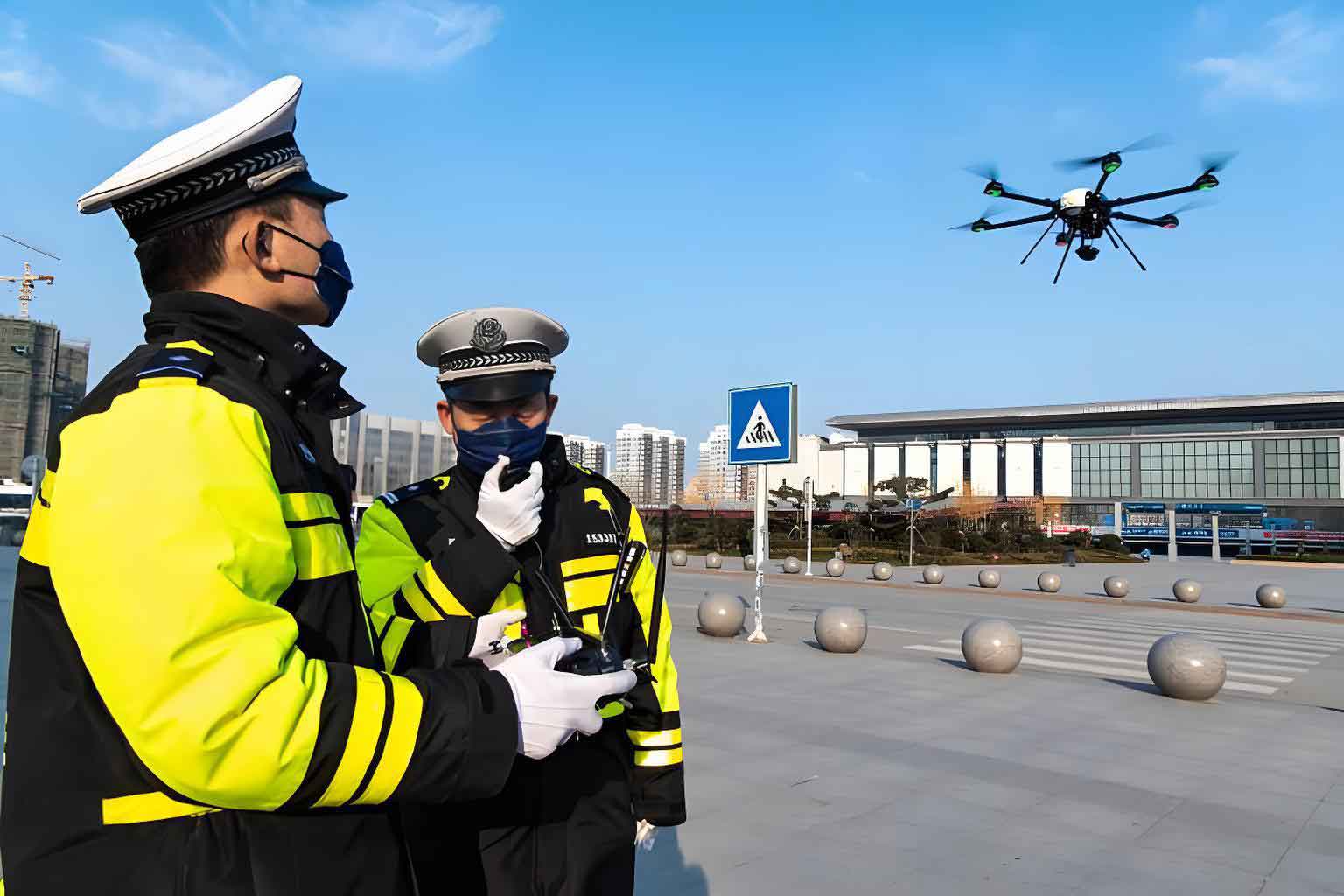
- Tactical Integration: Multi-unit exercises simulating real incidents—a barricaded suspect, a missing person in woodland, evidence collection post-incident. This is where the police UAV transitions from a camera-in-the-sky to a tactical asset.
3. Performance Metrics and Assessment
Evaluation must move beyond simple flight tests to measure operational readiness. We can conceptualize mission effectiveness using a simplified model where the success probability (P_success) of a police UAV mission is a function of multiple factors:
$$
P_{\text{success}} = f(T, E, C, D) \approx \alpha \cdot T + \beta \cdot E + \gamma \cdot C + \delta \cdot D
$$
Where:
- $T$ represents Technical Reliability (platform & system readiness).
- $E$ represents Environmental Adaptability (performance in weather, terrain).
- $C$ represents Operator Competence (skill, decision-making).
- $D$ represents Data Utility (quality, timeliness, and relevance of intelligence gathered).
- $\alpha, \beta, \gamma, \delta$ are weighting coefficients specific to the mission type.
Training aims to maximize $C$ and the operator’s ability to positively influence $T$, $E$, and $D$. Assessment should therefore gauge these dimensions through graded, scenario-based exercises.
IV. Strategic Implementation Pathways
1. Building Immersive Training Infrastructure
A dedicated, well-resourced training center is essential. It requires not only a fleet of varied police UAV platforms (multi-rotor, fixed-wing, hybrid VTOL) but also:
- Simulation Suites: High-fidelity simulators for risk-free mission rehearsal and emergency procedure training.
- Live Training Areas: Controlled airspace with configurable urban, rural, and indoor mock-ups to simulate diverse operational environments.
- Sustainment Workshop: On-site repair and maintenance capability to ensure equipment availability and teach basic technical troubleshooting.
2. Forging Academia-Industry-Force (AIF) Partnerships
Closing the theory-practice loop necessitates tripartite collaboration. Industry partners provide cutting-edge technology and real-world engineering constraints. Law enforcement agencies provide authentic operational requirements and veteran instructor input. The academy provides pedagogical structure and scientific rigor. Joint initiatives can include co-developed certification standards, adjunct faculty from industry/agencies, and internship programs where students support real (supervised) police UAV operations.
3. Project-Based and Scenario-Driven Learning
The core pedagogical method should be anchored in realistic projects: “Map the post-collision traffic scene for court evidence,” “Locate a simulated missing hiker in a 50-acre park before nightfall,” “Provide persistent surveillance overwatch for a high-risk warrant service.” These projects require students to plan, brief, execute, and debrief, developing not just skill but judgment. The complexity of scenarios can be modeled to incrementally challenge competency, akin to increasing a difficulty parameter in a training algorithm.
4. Leveraging Digital and Distance Learning Tools
Advanced learning management systems can host interactive content—3D models of UAV systems, virtual tours of sensor payloads, annotated case studies. More powerfully, Virtual Reality (VR) and Augmented Reality (AR) can create potent synthetic training environments for complex, expensive, or dangerous scenarios. A digital platform also allows for continuous learning and knowledge updates for graduated operators in the field, creating a lifelong learning loop essential for the fast-evolving police UAV domain.
V. Quantifying Impact and Future Horizons
The return on investment in a sophisticated police UAV training program can be measured through Key Performance Indicators (KPIs) that matter to law enforcement agencies.
| KPI Category | Specific Metric | Formula / Description |
|---|---|---|
| Operational Efficiency | Mission Success Rate | $\frac{\text{# Missions Achieving Stated Objectives}}{\text{Total # Missions Flown}} \times 100\%$ |
| Resource Optimization | Reduction in Ground Unit Deployment Time | Average time saved in searches, reconnaissance, or scene assessments due to UAV deployment. |
| Data & Intelligence Quality | Actionable Intelligence Yield | $\frac{\text{# Operations where UAV Intel led to Arrest/Prevention/Recovery}}{\text{Total # Intel-Gathering Missions}}$ |
| Safety Enhancement | Officer Risk Exposure Reduction | Qualitative and quantitative assessment of high-risk situations where UAVs replaced or preceded officer entry. |
| Educational Outcome | Graduate Operational Readiness Score | Composite score from final capstone scenario, evaluating T, E, C, D competencies from Eq. (1). |
The future trajectory of police UAV operations points towards increased autonomy, swarm capabilities, AI-powered real-time analytics, and sophisticated counter-UAV measures. The training framework must, therefore, be inherently adaptive. It must teach fundamental principles that transcend specific hardware, foster a mindset of continuous technological learning, and instill strong ethical frameworks to govern the use of increasingly autonomous systems. The convergence of these elements—rigorous education, immersive practice, strategic partnerships, and an agile, forward-looking curriculum—will define the quality of the next generation of police UAV professionals. Their expertise will be pivotal in realizing the full potential of aerial technology as a tool for justice, public safety, and community protection, ensuring that the police UAV remains a trusted and effective guardian of the peace.