
The concept of coordinated flight, where multiple aircraft follow precise geometric patterns, has long fascinated engineers. Initially inspired by the fluid formations of migratory birds, this discipline has found profound applications in modern aerospace, most spectacularly in the synchronized choreography of formation drone light shows. These dazzling displays represent the ultimate expression of precision formation control, demanding not just stable flight but also artistic coordination. In this article, I will explore the fundamental mathematical models for multi-agent formation flight, detail the design of an advanced fuzzy PID controller for robust performance, and discuss its critical implications for the burgeoning industry of formation drone light shows. The journey from a simple kinematic model to a sky-canvas of light underscores the beautiful synergy between control theory and creative technology.
1. Mathematical Foundation of Formation Flight
The core challenge in formation flight, whether for autonomous UAVs or for a formation drone light show, is defining and maintaining precise relative positions between agents. We begin by considering a leader-follower configuration, a fundamental building block for more complex patterns.
1.1 Individual Agent Dynamics: The Autopilot Model
Each drone or aircraft is typically governed by simplified autopilot models for its primary channels. A common representation uses a first-order model for speed (Mach-hold) and heading, and a second-order model for altitude. For an agent \(i\), these dynamics can be expressed as:
$$ \dot{V}_i = -\frac{1}{\tau_V} V_i + \frac{1}{\tau_V} V_{i_c} $$
$$ \dot{\psi}_i = -\frac{1}{\tau_{\psi}} \psi_i + \frac{1}{\tau_{\psi}} \psi_{i_c} $$
$$ \ddot{h}_i = -\left( \frac{1}{\tau_{h_a}} + \frac{1}{\tau_{h_b}} \right) \dot{h}_i – \frac{1}{\tau_{h_a} \tau_{h_b}} h_i + \frac{1}{\tau_{h_a} \tau_{h_b}} h_{i_c} $$
Here, \(V_i\), \(\psi_i\), and \(h_i\) represent the agent’s velocity, heading angle, and altitude, respectively. The terms \(V_{i_c}\), \(\psi_{i_c}\), and \(h_{i_c}\) are the commanded inputs to the autopilot, and \(\tau\) parameters are the respective time constants characterizing the response of each channel. This model provides a tractable basis for designing high-level formation controllers.
1.2 The Geometry of Formation and Kinematic Derivation
The formation is defined by desired relative geometries. Consider a leader (L) and a wingman or follower (W). The objective is for (W) to maintain a specific offset \((x_0, y_0, z_0)\) relative to (L), defined in a frame attached to the leader’s velocity vector. The relative position errors in the horizontal plane \((x, y)\) and vertical axis \((z)\) are derived from basic kinematics, assuming small angles.
The derivatives of the relative position errors become:
$$ \dot{x} = V_L – V_W + \dot{\psi}_W y_0 $$
$$ \dot{y} = V_0 (\psi_L – \psi_W) – \dot{\psi}_W x_0 $$
$$ z = h_W – h_L $$
Substituting the autopilot dynamics from equations (1-3) for the follower’s states linearizes the model. For instance, the \(\dot{x}\) channel becomes:
$$ \dot{x} = -\frac{y_0}{\tau_{\psi}} \psi_W – V_W + V_L + \frac{y_0}{\tau_{\psi}} \psi_{W_c} $$
Similarly, for the altitude difference, defining \(\xi = \dot{z}\), we get:
$$ \dot{\xi} = \ddot{z} = \ddot{h}_W – \ddot{h}_L = -\left( \frac{1}{\tau_{h_a}} + \frac{1}{\tau_{h_b}} \right) \xi – \frac{1}{\tau_{h_a} \tau_{h_b}} z + \frac{1}{\tau_{h_a} \tau_{h_b}} (h_{W_c} – h_{L_c}) $$
This set of equations forms the foundational state-space model for designing the formation flight controller. It explicitly shows how the follower’s autopilot commands \((V_{W_c}, \psi_{W_c}, h_{W_c})\) influence the relative geometry, which is the state we wish to control. This precise geometric control is the bedrock of any reliable formation drone light show.
2. Controller Architecture: Integrating Linear Mixers and Fuzzy PID
The control objective is to drive the relative position errors \((x_e = x_0 – x, y_e = y_0 – y, z_e = z_0 – z)\) to zero. A robust architecture employs a two-stage strategy: a linear mixer to synthesize appropriate error signals for each channel, and an adaptive Fuzzy PID controller to generate the final actuator commands.
2.1 The Linear Error Mixer
To improve tracking performance and stability, the error signal for each control channel is a blend of the relative position error and the corresponding state error between leader and follower. This provides both tight geometric control and smoother response to leader maneuvers.
The mixed error signals \(e_x\), \(e_y\), and \(e_z\) are computed as follows:
$$ e_x = k_v (V_L – V_W) + k_x (x_0 – x) $$
$$ e_y = k_{\psi} (\psi_L – \psi_W) + k_y (y_0 – y) $$
$$ e_z = k_z (z_0 – z) $$
Here, \(k_v, k_x, k_{\psi}, k_y, k_z\) are constant gains that weight the contribution of the state difference versus the geometric error. For a formation drone light show, where absolute positional accuracy is paramount, the geometric error terms \((k_x, k_y, k_z)\) are of critical importance.
2.2 Fuzzy PID Controller Design
A conventional PID controller, while simple, may struggle with the nonlinearities and disturbances inherent in outdoor flight (e.g., wind gusts). For a formation drone light show performed in varying atmospheric conditions, adaptability is key. A Fuzzy PID controller online adjusts the PID gains \((K_p, K_i, K_d)\) based on the current error \((e)\) and its derivative \((\dot{e})\), enhancing robustness.
For each channel (x, y, z), a separate fuzzy inference system (FIS) is designed. Let’s detail the design for the x-channel controller. The inputs to the FIS are the mixed error \(e_x\) and its derivative \(\dot{e}_x\). The outputs are the adjustments \(\Delta K_{px}\), \(\Delta K_{ix}\), \(\Delta K_{dx}\). The final PID gains are the sum of nominal gains and these fuzzy adjustments.
Fuzzification: Input and output variables are defined with linguistic terms (Negative Big (NB), Negative Medium (NM), Zero (Z), etc.). Gaussian membership functions are often used for smooth control. For example:
$$ \mu_{A}(e) = \exp\left(-\frac{(e – c)^2}{2\sigma^2}\right) $$
where \(c\) is the center and \(\sigma\) the width of the membership function for fuzzy set \(A\).
Fuzzy Rule Base: The controller’s intelligence resides in its rule base. A typical rule format is: “IF \(e_x\) is NB AND \(\dot{e}_x\) is NM, THEN \(\Delta K_{px}\) is PB, \(\Delta K_{ix}\) is NB, \(\Delta K_{dx}\) is PS.” The rules are crafted from an understanding of PID tuning: large error needs high \(K_p\) to reduce it quickly; increasing error (\(\dot{e} > 0\)) needs higher \(K_d\) to dampen the change; steady-state error needs integral action.
The following table summarizes a sample rule base for the proportional gain adjustment \(\Delta K_p\):
| \(e \setminus \dot{e}\) | NB | NM | NS | Z | PS | PM | PB |
|---|---|---|---|---|---|---|---|
| NB | PB | PB | PM | PM | PS | Z | Z |
| NM | PB | PB | PM | PS | PS | Z | NS |
| NS | PM | PM | PM | PS | Z | NS | NS |
| Z | PM | PM | PS | Z | NS | NM | NM |
| PS | PS | PS | Z | NS | NS | NM | NM |
| PM | PS | Z | NS | NM | NM | NB | NB |
| PB | Z | Z | NM | NM | NM | NB | NB |
Inference and Defuzzification: Using the rule base, the fuzzy system maps the crisp inputs \((e, \dot{e})\) to fuzzy outputs for the gain adjustments. The center of gravity (COG) method is commonly used for defuzzification to convert the fuzzy output back to a crisp value \(\Delta K\):
$$ \Delta K = \frac{\sum_{j=1}^{N} \mu_j \cdot c_j}{\sum_{j=1}^{N} \mu_j} $$
where \(\mu_j\) is the firing strength of rule \(j\) and \(c_j\) is the center of the output membership function for that rule.
The final control commands for the follower’s autopilot are then generated by the PID law with adapted gains:
$$ V_{W_c}(t) = K_{px} e_x + K_{ix} \int e_x \, dt + K_{dx} \dot{e}_x $$
$$ \psi_{W_c}(t) = K_{py} e_y + K_{iy} \int e_y \, dt + K_{dy} \dot{e}_y $$
$$ h_{W_c}(t) = K_{pz} e_z + K_{iz} \int e_z \, dt + K_{dz} \dot{e}_z $$
This architecture ensures that the formation drone light show fleet can maintain its pattern accurately even under perturbed conditions.
3. Formation Keeping and Reconfiguration
The true power of this control framework is demonstrated in two key scenarios: maintaining formation during aggressive maneuvers and dynamically reconfiguring into a new pattern. Both are essential for a dynamic formation drone light show narrative.
3.1 Formation Keeping Under Leader Maneuvers
Consider the leader executing a combined maneuver: a speed increase, a heading change, and a climb. The follower, using the described fuzzy PID controller with linear mixing, must adjust its own velocity, heading, and altitude to maintain the preset geometric offset \((x_0, y_0, z_0)\).
Simulation results typically show that the relative position errors \((x_e, y_e, z_e)\) experience a transient deviation but are driven back to near zero within a short settling time (e.g., ~10 seconds). The fuzzy PID controller exhibits superior performance compared to a fixed-gain PID: it generally has a smaller overshoot, a faster settling time, and negligible steady-state error. This precision is non-negotiable for a high-quality formation drone light show, where any visible jitter or drift would break the illusion.
3.2 Dynamic Formation Reconfiguration
Beyond keeping a shape, a compelling formation drone light show requires seamless transitions between shapes. This is achieved by treating the desired offsets \((x_0, y_0, z_0)\) as time-varying command signals. For example, to transition from a “left diamond” to a “right diamond,” the y-offset command \(y_0\) is smoothly changed from a positive value (e.g., +30m) to a negative one (e.g., -30m), while \(x_0\) and \(z_0\) remain constant.
The controller interprets the sudden change in the commanded offset \(y_c\) as a large error \(e_y\). The fuzzy PID system then commands the necessary heading and velocity adjustments for the follower to “slide” laterally across the formation while keeping pace with the leader. The trajectory plots show a smooth, coordinated transition where the follower reforms its position relative to the leader, culminating in the new, mirror-image diamond pattern. This capability to execute pre-programmed or real-time reconfiguration sequences is what transforms a static display into a captivating formation drone light show story.
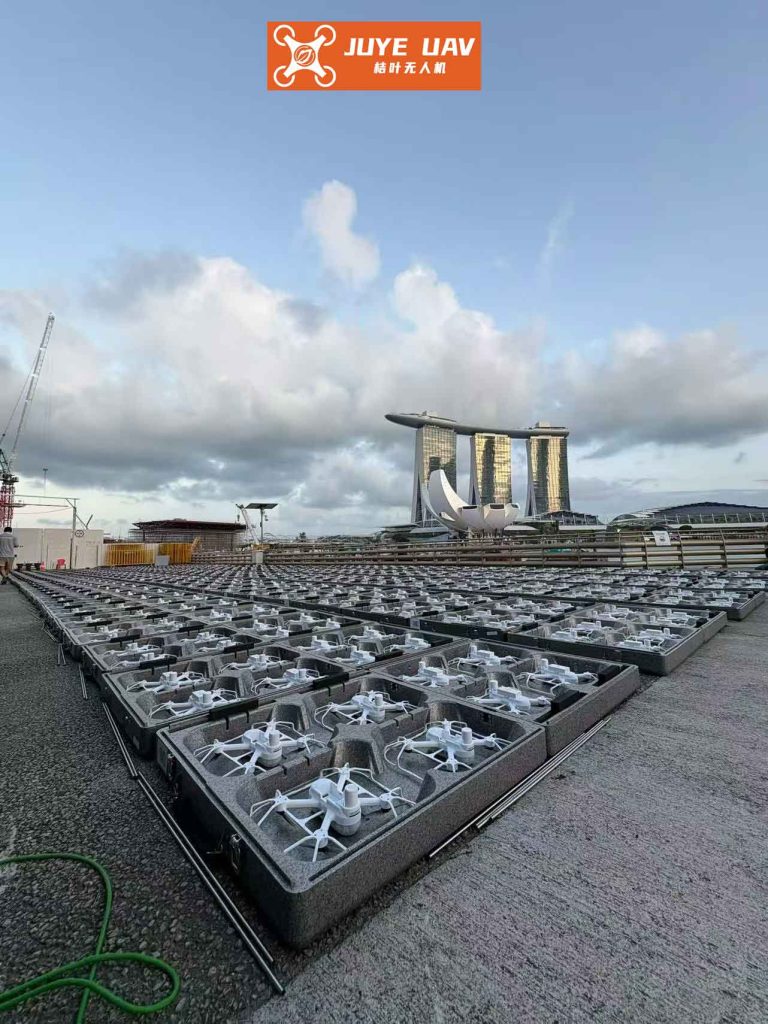
4. Implications for Formation Drone Light Show Technology
The theoretical framework of leader-follower control with fuzzy PID adaptation scales directly to the domain of formation drone light shows. In this application, the “leader” may be a virtual reference point in a global choreography, and each drone is a “follower” assigned to a specific, time-varying offset relative to that point.
The mathematical model becomes a distributed control problem. The state vector for each drone includes its global position, and the error \(e\) for each drone is computed relative to its target waypoint in the pre-programmed show path, which is essentially a dynamic formation. The linear mixer concept can be extended to blend trajectory tracking error with inter-drone collision avoidance terms.
The robustness provided by the fuzzy PID component is particularly valuable. Outdoor shows face unpredictable wind conditions and aerodynamic downwash from neighboring drones. A fixed-gain controller might oscillate or drift under such disturbances. The adaptive fuzzy PID can tighten gains when errors are large to correct quickly and soften them when errors are small to prevent high-frequency jitter, ensuring the visual integrity of the formation drone light show under real-world conditions.
Furthermore, the reconfiguration capability is the essence of the show. By scripting the commanded offsets \((x_c(t), y_c(t), z_c(t))\) for hundreds of drones, producers can create complex, flowing 3D animations in the sky. The control system’s ability to accurately track these commanded offsets with minimal overshoot and smooth transitions is what makes complex shapes and rapid morphing possible in a formation drone light show.
5. Conclusion
The journey from the fundamental kinematics of relative motion to the awe-inspiring spectacle of a formation drone light show underscores a powerful engineering narrative. The development of a precise mathematical model, incorporating both individual agent dynamics and formation geometry, provides the essential foundation. Augmenting this model with a robust control architecture—combining error-linearizing mixers and adaptive fuzzy PID control—delivers the performance required for stability, accuracy, and smooth reconfiguration.
This approach offers significant advantages over simpler controllers: reduced overshoot, faster settling times, and enhanced disturbance rejection. These qualities are not merely academic metrics; they are the critical factors that determine the visual quality and reliability of a large-scale formation drone light show. As the technology progresses, these control strategies will continue to evolve, enabling even more complex, resilient, and breathtaking aerial displays, firmly establishing the formation drone light show as a premier medium for artistic and technological expression.