
As a military technology analyst, I have observed the rapid proliferation of unmanned aerial vehicles (UAVs) over the past decade, which has fundamentally altered modern warfare and security paradigms. The affordability, versatility, and evolving autonomy of UAVs, ranging from small commercial drones to sophisticated swarm systems, pose significant threats to military operations, critical infrastructure, and public safety. Consequently, the development of robust anti-UAV capabilities has become a paramount priority for defense forces worldwide. In this article, I will delve into the technological landscape of anti-UAV systems, focusing on their principles, current advancements, and future trajectories. The term “anti-UAV” will be frequently emphasized, as it encapsulates the integrated approach required to counter these pervasive threats.
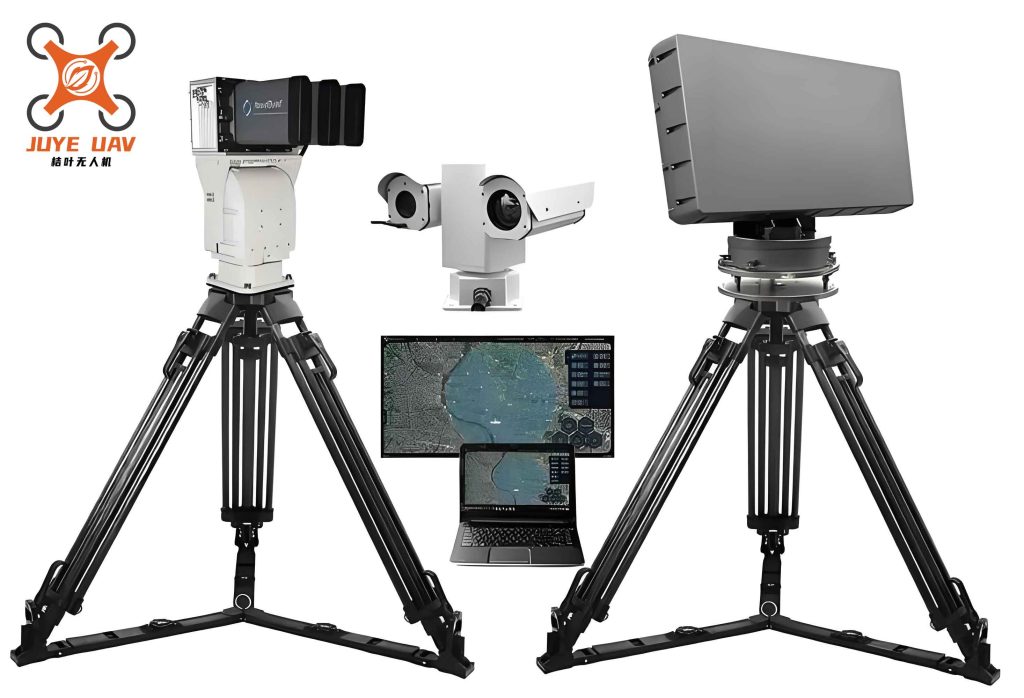
The core challenge in anti-UAV operations lies in the “low, slow, and small” characteristics of many UAVs, which enable them to evade traditional air defense systems. Effective anti-UAV strategies typically involve a layered approach: detection, identification, tracking, and neutralization. Detection leverages various sensor modalities. Visual, thermal, and acoustic signatures can be captured using electro-optical, infrared, and acoustic sensors, respectively. However, these methods may be limited by environmental conditions and sensor range. Radar systems offer broader coverage, but their effectiveness against small UAVs is constrained by the radar cross-section (RCS), which for miniaturized drones can be extremely low. The radar range equation illustrates this challenge:
$$R_{max} = \left[ \frac{P_t G_t G_r \lambda^2 \sigma}{(4\pi)^3 S_{min}} \right]^{1/4}$$
Here, \(R_{max}\) is the maximum detection range, \(P_t\) is transmitted power, \(G_t\) and \(G_r\) are antenna gains, \(\lambda\) is wavelength, \(\sigma\) is the target’s RCS (which is minimal for small UAVs), and \(S_{min}\) is the minimum detectable signal. For anti-UAV applications, enhancing radar sensitivity or employing complementary sensors is crucial. Radio frequency (RF) sensors detect communication links between UAVs and operators, providing a non-kinetic means of detection. The following table summarizes primary anti-UAV detection technologies:
| Sensor Type | Principle | Advantages | Limitations | Typical Range |
|---|---|---|---|---|
| Electro-Optical/Infrared (EO/IR) | Captures visual/thermal imagery | High resolution, good for identification | Weather-dependent, line-of-sight | 1-5 km |
| Radar | Emits radio waves and analyzes echoes | Long-range, all-weather capability | Low RCS of small UAVs reduces efficacy | 5-20 km |
| Acoustic | Detects sound signatures from UAV motors | Passive, low cost | Short range, ambient noise interference | 0.5-1 km |
| RF Sensor | Monitors UAV control and data links | Can detect covert UAVs, non-kinetic | May not work against autonomous UAVs |
Once detected, anti-UAV systems must classify and track threats before employing countermeasures. Neutralization methods span kinetic and non-kinetic domains. Electronic warfare (EW) techniques, such as jamming or spoofing, disrupt the UAV’s command and control links or GPS navigation. The jamming effectiveness can be modeled by the signal-to-interference ratio (SIR):
$$SIR = \frac{P_{signal}}{P_{jamming} + N}$$
where \(P_{signal}\) is the power of the legitimate signal, \(P_{jamming}\) is the jamming power, and \(N\) is noise. High-power jammers can overwhelm UAV receivers, forcing a landing or return-to-home. Kinetic solutions include projectiles, nets, directed energy weapons (DEWs), and trained birds. DEWs, particularly high-energy lasers (HELs) and high-power microwaves (HPMs), offer precision engagement with low cost per shot and deep magazines. The energy required for laser-based anti-UAV neutralization depends on target material and dwell time, often described by:
$$E_{required} = \frac{\rho \cdot d \cdot A \cdot (T_{melt} – T_{initial})}{C_p}$$
Assuming simplified thermal modeling, where \(\rho\) is density, \(d\) is thickness, \(A\) is area, \(T_{melt}\) is melting temperature, \(T_{initial}\) is initial temperature, and \(C_p\) is specific heat capacity. Advancements in solid-state lasers have enabled compact, scalable anti-UAV systems.
My analysis of military developments reveals concerted efforts to field integrated anti-UAV solutions. For aerial forces, testing of mobile laser systems is underway. A notable example is the High-Energy Laser Weapon System (HELWS), mounted on an all-terrain vehicle. This anti-UAV system employs EO/IR sensors and a high-power microwave subsystem for detection and tracking, followed by laser engagement to disable UAVs within seconds. Its effectiveness hinges on continuous power supply, allowing near-unlimited engagements. Airborne anti-UAV platforms are also being explored to extend interception ranges.
Maritime services have prioritized ship-based anti-UAV capabilities. Incremental deployment of laser weapons has occurred, starting with a 30-kW Laser Weapon System (LaWS) tested on amphibious ships. Subsequent systems, like the Optical Dazzling Interdictor (ODIN) and the more potent 60-kW High-Energy Laser with Integrated Optical-dazzler and Surveillance (HELIOS), are slated for installation on destroyers. These anti-UAV systems aim to counter surveillance drones and potentially missiles. The maritime environment adds complexities, such as sea spray and platform motion, which anti-UAV designs must mitigate through robust stabilization and atmospheric compensation algorithms.
Ground forces have articulated comprehensive anti-UAV strategies, emphasizing layered defense. The concept of a “six-tier air and missile defense shield” incorporates various anti-UAV technologies. For instance, the Blast Low Altitude UAV Defense System (BLASTER) integrates with remote weapon stations for kinetic engagement. The Multi-Mission High Energy Laser (MMHEL) program seeks to mount solid-state lasers on Stryker vehicles, providing mobile, precise anti-UAV firepower. The energy output for such systems is critical; power scaling follows empirical relationships like:
$$P_{out} \propto \eta \cdot P_{in} \cdot f_{rep}$$
where \(P_{out}\) is laser output power, \(\eta\) is efficiency, \(P_{in}\) is input power, and \(f_{rep}\) is repetition rate for pulsed systems. Additionally, programs like the Lower Cost and Extended Range Air Defense (LOWERAD) focus on developing cheaper interceptors to defeat UAV swarms cost-effectively. Portable anti-UAV systems, including jammers and net guns, are already deployed for point defense.
Marine units have fielded systems such as the Marine Air Defense Integrated System (MADIS), which combines jamming and machine guns on light vehicles. The Compact Laser Weapon System (CLaWS), with power variants from 2 kW to 10 kW, represents a deployable ground-based anti-UAV laser. However, power and weight constraints limit the practicality of man-portable anti-UAV directed energy weapons for dismounted operations.
At the departmental level, coordination of anti-UAV initiatives is intensifying. Designated offices now oversee the testing and standardization of anti-UAV systems across services, aiming to select a handful of interoperable solutions for procurement. Research agencies fund projects like “Counter Swarm AI” to address autonomous UAV clusters, underscoring the need for adaptive anti-UAV algorithms. The investment in anti-UAV technologies reflects their strategic importance; budgets have allocated hundreds of millions for development and acquisition.
The technological evolution of anti-UAV systems is also driven by counter-countermeasures. As UAVs incorporate anti-jamming techniques, such as frequency hopping or encrypted links, anti-UAV EW systems must evolve with cognitive jamming capabilities. Similarly, stealth coatings on UAVs reduce radar detectability, necessitating multi-static radar networks or passive sensing for anti-UAV applications. The following table compares neutralization methods in anti-UAV contexts:
| Neutralization Method | Mechanism | Pros | Cons | Typical Engagement Range |
|---|---|---|---|---|
| Kinetic (guns, missiles) | Physical destruction via projectiles | High lethality, proven technology | Limited ammunition, collateral risk | 1-10 km |
| Directed Energy (Laser) | Thermal damage through focused light | Speed-of-light engagement, low cost per shot | Atmospheric attenuation, power demands | 1-5 km |
| Directed Energy (Microwave) | Disruption of electronics via EMP | Area effect, good against swarms | Potential fratricide, large power needs | 0.5-2 km |
| Electronic Jamming | RF interference with control links | Non-kinetic, reversible | Ineffective vs. autonomous UAVs | 2-10 km |
| Net Capture | Physical entrapment using launched nets | Minimal collateral, allows forensic analysis | Very short range, single-use | 0.1-0.5 km |
Integration of sensors and effectors is key to effective anti-UAV architectures. Sensor fusion algorithms combine data from radar, EO/IR, and RF sensors to improve detection probability (\(P_d\)) and reduce false alarms. For a fused system, the combined \(P_d\) can be approximated as:
$$P_{d,fused} = 1 – \prod_{i=1}^{n} (1 – P_{d,i})$$
where \(P_{d,i}\) is the detection probability of the i-th sensor. This is particularly vital for anti-UAV operations in cluttered environments. Command and control (C2) systems then prioritize threats based on factors like velocity, trajectory, and identity, enabling automated or operator-in-the-loop engagements. The kill chain for anti-UAV systems—detect, identify, decide, engage, assess—must be compressed to counter fast-moving drone swarms.
Looking ahead, anti-UAV technology trends include increased autonomy, network-centric warfare, and counter-swarm tactics. Artificial intelligence (AI) will enhance threat classification and prediction; for example, machine learning models can analyze UAV flight patterns to distinguish malicious intent. Swarm defeat requires scalable anti-UAV solutions, such as distributed laser networks or microwave systems that can engage multiple targets simultaneously. The energy requirements for defeating a swarm of \(N\) UAVs with lasers might scale as:
$$E_{total} \approx N \cdot \left( \frac{E_{per\_UAV}}{\eta_{tracking}} \right)$$
where \(E_{per\_UAV}\) is energy needed per drone and \(\eta_{tracking}\) accounts for tracking efficiency. Research into non-traditional methods, like cyber-takeovers or geo-fencing, also expands the anti-UAV toolkit.
In conclusion, the anti-UAV domain is dynamic and critical for modern defense. My assessment underscores that successful anti-UAV strategies require a mix of technologies tailored to operational scenarios. From portable jammers to ship-based lasers, the anti-UAV landscape is diversifying. Standardization efforts will likely streamline procurement and interoperability. As UAV threats evolve—becoming faster, stealthier, or more autonomous—anti-UAV systems must continuously innovate. The formula for success lies in layered sensing, rapid decision-making, and cost-effective neutralization. Ultimately, dominance in the anti-UAV arena will significantly influence future battlefield outcomes and homeland security.
The economic aspects cannot be ignored; the cost balance between UAVs and anti-UAV systems is pivotal. A simple cost-exchange ratio can be formulated:
$$R_{cost} = \frac{C_{anti-UAV}}{C_{UAV}}$$
where \(C_{anti-UAV}\) is the cost of intercepting a UAV (including system depreciation and ammunition) and \(C_{UAV}\) is the UAV cost. For anti-UAV systems to be sustainable, \(R_{cost}\) should be less than or equal to 1, especially when facing massed cheap drones. This drives development of low-cost interceptors and reusable directed energy weapons.
Ethical and legal considerations also surround anti-UAV operations, particularly in civilian airspace. Rules of engagement must be clearly defined to avoid unintended consequences. Jamming, for instance, might disrupt legitimate communications, while kinetic methods pose risks to bystanders. Thus, anti-UAV deployments require robust policy frameworks alongside technological prowess.
In my view, the future of anti-UAV technology will see greater integration with broader air defense networks. Interoperable data links will allow anti-UAV sensors to cue long-range missile systems or airborne platforms. Moreover, commercial off-the-shelf (COTS) components will accelerate anti-UAV system development, though military-grade hardening remains essential. As I reflect on these advancements, the imperative for continuous investment in anti-UAV research and training is clear. The drone genie is out of the bottle, and our anti-UAV capabilities must evolve to keep pace.
Finally, international collaboration will shape anti-UAV standards and tactics. Sharing lessons learned from conflicts where UAVs have been prevalent can inform better anti-UAV designs. Joint exercises and technology demonstrations will hone interoperability among allied forces. The anti-UAV mission is not just a technical challenge but a strategic one, demanding holistic approaches encompassing technology, doctrine, and cooperation. As we advance, the term “anti-UAV” will remain at the forefront of defense dialogues, symbolizing the ongoing battle for airspace control.