
The traditional paradigm of environmental monitoring often relies on sparse, ground-based stations or labor-intensive manual sampling campaigns. These methods struggle to provide the high-resolution, real-time spatial data required for understanding complex environmental phenomena, particularly in dynamic or hard-to-reach areas. My work addresses this gap by conceptualizing and implementing a sophisticated environmental monitoring system that draws its core operational metaphor from a coordinated formation drone light show. In this system, a fleet of multi-rotor Unmanned Aerial Vehicles (UAVs) does not perform visual artistry but executes a precisely choreographed data-acquisition ballet over a target region. Each drone in the formation drone light show acts as a mobile sensing node, autonomously navigating a pre-defined flight path while continuously collecting multi-parameter environmental data. This approach transforms a large geographical area into a dynamic, airborne sensor network, enabling simultaneous multi-point measurement that was previously impractical or prohibitively expensive.
The choice of multi-rotor platforms over fixed-wing alternatives is fundamental to this formation drone light show methodology. While fixed-wing UAVs excel in large-scale, high-speed coverage, their inability to hover or fly at very low speeds limits their utility for detailed, static-point data collection. Environmental parameter sampling, especially of air quality metrics, benefits from low-altitude, slow-moving, or stationary measurement points to capture localized gradients and plumes accurately. Multi-rotor drones provide this essential capability for point-specific and transect-based monitoring, making them the ideal actors in our environmental data formation drone light show. By dividing a large monitoring region into sub-sectors, a fleet can be deployed where each vehicle is responsible for a specific block, creating a synchronized and comprehensive data-collection performance.
The entire system architecture is built upon this distributed, collaborative principle. It consists of four primary components: the UAV platforms with their flight control systems, the custom-designed wireless sensor pods carried by each drone, the Flight Control Ground Station (FCGS) for mission planning and vehicle control, and the central Communication Ground Station (CGS) for data aggregation, visualization, and fleet management. The FCGS software is used to plan and upload flight routes for each member of the formation drone light show, ensuring they cover their assigned sectors without conflict. The core innovation lies in the sensor pods and the communication protocol that binds the fleet into a cohesive network. Each pod is assigned a unique identity (ID), akin to a performer’s number in a show. A robust, custom communication protocol based on Modbus RTU standard is implemented to manage these IDs and to reliably retrieve the collected sensor data from each drone in the fleet, turning the chaotic potential of multiple UAVs into a orderly, information-generating formation drone light show.
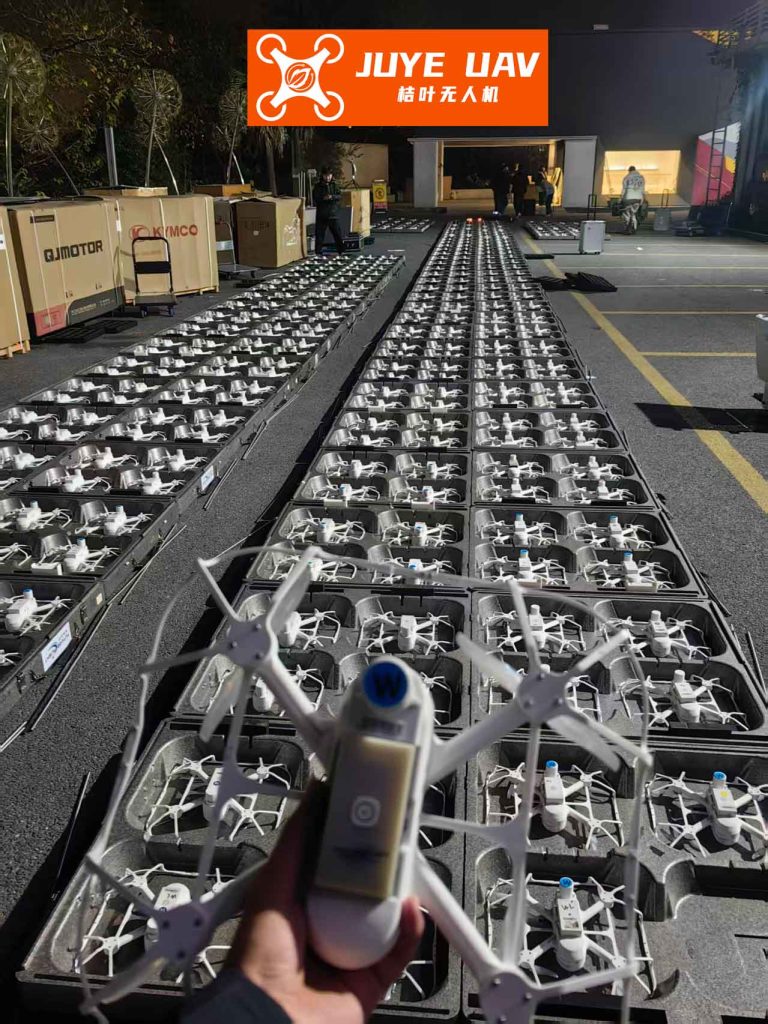
The hardware design is bifurcated into the aerial vehicle system and the environmental sensing payload. For reliable and stable autonomous flight, the drone platform utilizes the ArduPilot Mega (APM) open-source autopilot system. This is complemented by a suite of carefully selected components to ensure endurance, stability, and precise navigation. A typical vehicle in our formation drone light show employs a frame capable of carrying the sensor payload, brushless motors paired with electronic speed controllers (ESCs), high-capacity lithium polymer batteries, long-range 915MHz telemetry modules for communication with the FCGS, and a high-sensitivity external GPS/Compass module (e.g., u-blox M8N) to provide accurate positioning and heading data, crucial for maintaining formation integrity and precise geo-tagging of sensor readings.
The heart of the data acquisition is the custom Wireless Measurement Node (WMN). This embedded device is responsible for managing sensor data collection, preliminary processing, and wireless transmission back to the CGS. Its design centers on a main processing unit, a wireless communication module, and an array of environmental sensors.
- Main Processor: A Freescale MC9S12XS128 16-bit microcontroller (MCU) serves as the computational core. It was chosen for its robust peripheral set, including multiple Serial Communication Interfaces (SCI), Serial Peripheral Interface (SPI), and a 16-channel Analog-to-Digital Converter (ADC), which are essential for interfacing with various sensors and communication modules.
- Wireless Communication Module: A Texas Instruments CC2530 System-on-Chip is employed to create a low-power, mesh-capable Zigbee network. This forms the data link between the drones in the formation drone light show and the central CGS. Its low power consumption is critical for preserving drone flight time.
- Sensor Suite: The node integrates multiple sensors to create a comprehensive environmental profile:
- Temperature: A Dallas Semiconductor DS18B20 digital temperature sensor provides measurements from -55°C to +125°C with ±0.5°C accuracy in the relevant range. It communicates via a simple 1-Wire bus.
- Relative Humidity: An ATME2001 capacitive humidity sensor module outputs a linear voltage (0-3V) corresponding to 0-100% Relative Humidity (RH). The relationship is given by: $$ Humidity (\%RH) = \frac{V_{out}}{0.03} $$ where \( V_{out} \) is the sensor output voltage.
- Particulate Matter (PM): A laser scattering sensor, the HLPPM025K3, measures PM2.5 and PM10 concentrations. It outputs data via a UART serial protocol at 9600 baud. The data frame structure is detailed in Table 1, and the concentration is calculated as: $$ PM2.5 = (PM2.5_{High} \times 256 + PM2.5_{Low}) \times 0.1 \quad (\mu g/m^3) $$ $$ PM10 = (PM10_{High} \times 256 + PM10_{Low}) \times 0.1 \quad (\mu g/m^3) $$
| Start Byte | PM2.5 High | PM2.5 Low | PM10 High | PM10 Low | Checksum | End Byte |
|---|---|---|---|---|---|---|
| 0xAA | e.g., 0x01 | e.g., 0xE0 | e.g., 0x01 | e.g., 0xFA | Sum of bytes 2-5 | 0xFF |
The software architecture orchestrates the complex tasks of sensor polling, data filtering, and communication within the constraints of the MCU. The main program flow is interrupt-driven to ensure responsiveness. A timer interrupt triggers periodic sampling of the temperature and humidity sensors. To ensure data quality, a moving window filter is applied to these analog readings. For a window size of \( N = 9 \), the filtered value \( \bar{x}_k \) at step \( k \) is calculated as: $$ \bar{x}_k = \frac{1}{N} \sum_{i=k-N+1}^{k} x_i $$ where \( x_i \) are the raw samples. This effectively smooths out high-frequency noise and mitigates the impact of occasional erroneous readings.
Simultaneously, the UART connected to the PM sensor operates asynchronously. When a complete data frame (as per Table 1) is received, an interrupt is triggered, and the PM concentrations are parsed and calculated using the formulas above. The highest priority is given to the communication UART connected to the Zigbee module. This is where the CGS sends commands and requests data, driving the management of the entire formation drone light show network.
The communication protocol is the nervous system of the formation drone light show. It is essential for reliably identifying and querying each drone amidst a potentially large fleet. We implemented a lightweight yet robust protocol based on the industry-standard Modbus RTU, adapted for this specific application. The protocol allows three key operations, each initiated by the CGS (Master):
- Read Node ID: Query a device to report its assigned identity number.
- Set Node ID: Assign a new identity number to a device. This is crucial for configuring the fleet before a mission, ensuring each drone in the formation drone light show knows its role.
- Read Sensor Data: Request the latest processed sensor readings from a specific node.
Every command frame includes the target node’s ID, a function code specifying the action, data bytes (if any), and a 16-bit Cyclic Redundancy Check (CRC) for error detection. The CRC, sent low-byte first, is computed on the preceding bytes. Upon receiving a valid command, the WMN responds with a corresponding data frame. For example, the response to a “Read Sensor Data” command for a drone with ID=1 might be: 01 08 15 07 08 06 05 07 09 3A 0A, where the bytes after the ID represent temperature, humidity, PM2.5 low/high, PM10 low/high, a checksum, and a termination byte. This structured dialogue ensures that the CGS can seamlessly manage and collect data from every participant in the synchronized formation drone light show.
The Communication Ground Station (CGS) software is the conductor’s podium for this formation drone light show. It provides a real-time graphical user interface for mission operators. Its core functions are data visualization and fleet status monitoring. The main dashboard typically displays a grid or map view showing all active drones (identified by their ID), their current location (if GPS data is integrated), and most importantly, their latest sensor readings. Key parameters like Temperature, Humidity, PM2.5, and PM10 are displayed numerically for each node. Furthermore, the CGS can plot real-time trend graphs for any parameter from any selected drone, allowing operators to observe spatial gradients and temporal changes as the formation drone light show progresses over the area.
Beyond mere display, the CGS incorporates logic for environmental assessment. Using the real-time PM2.5 data streamed from each drone in the formation drone light show, it can automatically classify the air quality in each sub-sector according to a standard index. This immediate processing transforms raw data into actionable information. Table 2 illustrates a simplified air quality index based on PM2.5 concentration, allowing for rapid situational awareness across the entire monitored region.
| PM2.5 Concentration (μg/m³) | Air Quality Level | General Guidance |
|---|---|---|
| 0 – 20 | Excellent | Suitable for outdoor activities. |
| 21 – 40 | Good | Acceptable for most people. |
| 41 – 60 | Lightly Polluted | Sensitive groups may experience effects. |
| 61 – 80 | Moderately Polluted | Reduce prolonged outdoor exertion. |
| 81 – 100 | Heavily Polluted | Avoid outdoor activities. |
The integration and field deployment of this system validate the formation drone light show concept for environmental monitoring. The development process followed a structured path: initial unit testing of each hardware module (sensors, MCU, radio), followed by integration testing of the complete WMN using serial terminal software to verify data acquisition and protocol responses. Finally, the fully assembled system—comprising multiple drones equipped with WMNs, the FCGS for flight control, and the CGS for data reception—underwent extensive outdoor field trials. These tests confirmed several key performance metrics: the reliability of the low-power Zigbee communication link over operational distances, the accuracy and stability of the sensor data post-filtering, the flawless execution of autonomous flight plans by the drone fleet, and, most importantly, the seamless, synchronized data harvesting from multiple points in space. The system successfully demonstrated its ability to create a dynamic, high-resolution picture of environmental conditions, proving that a technologically coordinated formation drone light show is far more than a visual spectacle; it is a powerful and pragmatic tool for modern environmental science and management.
In conclusion, this work presents a holistic and implementable system for regional environmental monitoring using a fleet of multi-rotor UAVs. By adopting the operational principles of a formation drone light show—emphasizing precise coordination, individual identification, and synchronized task execution—the system overcomes the limitations of traditional monitoring methods. The integration of robust hardware (APM flight controllers, custom sensor pods), intelligent software (filtering algorithms, Modbus-based communication protocol), and an intuitive ground station interface results in a scalable solution. Future enhancements could include the integration of additional gas sensors (e.g., for NO2, O3, SO2), more advanced inter-drone communication for adaptive formation flying, and the use of machine learning algorithms on the CGS side for predictive pollution modeling based on the rich spatial-temporal data provided by the formation drone light show. The paradigm shift from single, static sensors to a dynamic, intelligent network of airborne probes opens new frontiers in our ability to observe, understand, and protect our environment.