
In recent years, the concept of formation drone light show has emerged as a captivating application of unmanned aerial vehicle (UAV) technology, combining artistic displays with advanced control systems. As a researcher in this field, I have explored the intricate dynamics of coordinating multiple drones to create synchronized light patterns in the sky. This article delves into the control structures, mathematical models, and simulation frameworks essential for executing flawless formation drone light show performances. The integration of agent-based architectures, relative motion analysis, and ground control station visualization forms the backbone of these systems, enabling precise formation drone light show operations that dazzle audiences worldwide.
The allure of formation drone light show lies in its ability to transform UAVs into dynamic, luminous entities that move in harmony. From entertainment events to public celebrations, formation drone light show has revolutionized visual spectacles, requiring robust control algorithms to maintain formation drone light show integrity under varying environmental conditions. In this discussion, I will share insights from my research, emphasizing the use of tables and formulas to summarize key concepts. The goal is to provide a comprehensive guide that highlights the engineering behind formation drone light show, ensuring reliability and scalability for large-scale displays.
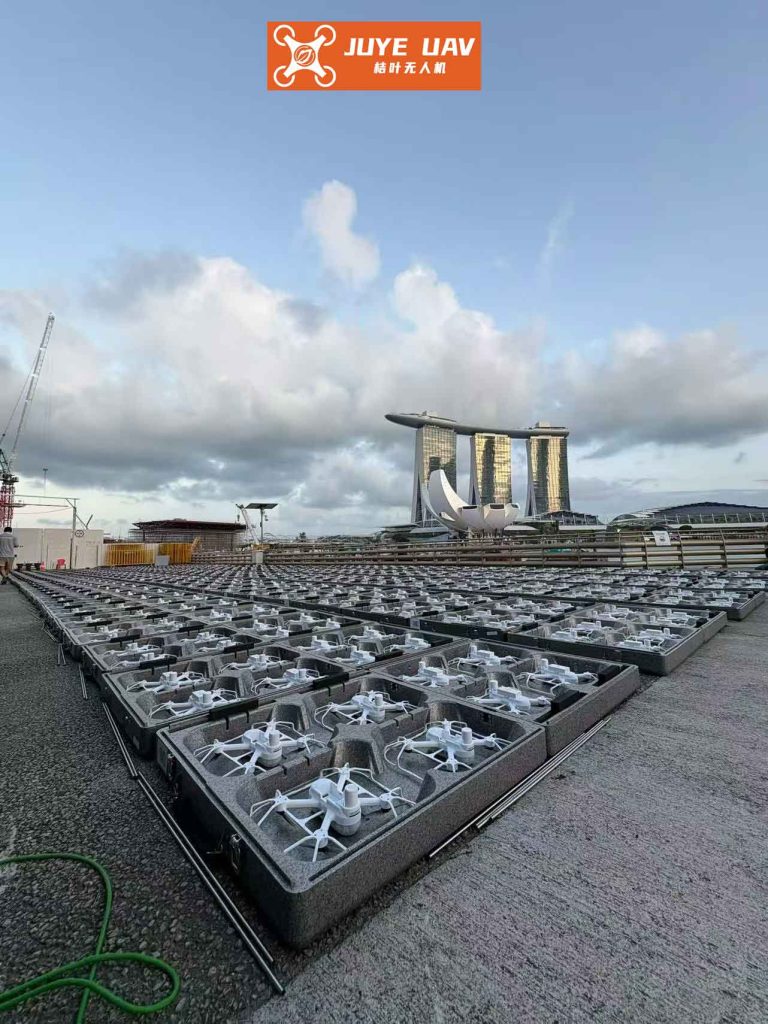
To begin, let’s consider the overall system design for a formation drone light show. A typical setup involves a fleet of drones equipped with LED lights, controlled via a centralized or distributed architecture. Drawing from agent-based systems, I often adopt a hierarchical control structure to balance efficiency and flexibility. For instance, in a formation drone light show, a leader drone may guide followers, or all drones may collaborate equally. The choice depends on the complexity of the formation drone light show pattern. Below is a table summarizing common control structures used in formation drone light show applications:
| Control Structure | Description | Advantages for Formation Drone Light Show |
|---|---|---|
| Centralized | A single leader drone dictates movements | Simplified coordination, ideal for simple formation drone light show patterns |
| Distributed | All drones communicate peer-to-peer | Robust to failures, suitable for complex formation drone light show displays |
| Hierarchical | Combines leader-follower with group autonomy | Balances control and adaptability for large formation drone light show fleets |
In my work, I focus on fixed formations for formation drone light show, such as geometric shapes or animated sequences, where drones maintain specific relative positions. The relative motion between drones is crucial for formation drone light show accuracy. Let’s derive the relative motion model in the path coordinate frame of a follower drone, which I denote as the wing UAV. Assume a leader drone (Leader UAV) and a wing drone (Wing UAV) in a formation drone light show. The ground coordinate system is $O_gX_gY_gZ_g$, while the wing’s path coordinate system is $O_{wk}X_{wk}Y_{wk}Z_{wk}$. The relative distance vector $\mathbf{R}$ between them can be expressed as:
$$\mathbf{R} = \mathbf{R}_w – \mathbf{R}_l,$$
where $\mathbf{R}_w$ and $\mathbf{R}_l$ are position vectors of the wing and leader, respectively. In the wing’s path coordinate frame, the relative motion equations are derived from coordinate transformations. For a formation drone light show, we consider assumptions like negligible aerodynamic interference and ideal sensors. The velocity components in this frame lead to the following differential equations for relative position $(x, y, z)$:
$$
\begin{aligned}
\dot{x} &= r_w y – q_w z – V_w + V_l (\cos \mu_w \cos \mu_l \cos \phi_e + \sin \mu_w \sin \mu_l), \\
\dot{y} &= p_w z – r_w x + V_l \cos \mu_l \sin \phi_e, \\
\dot{z} &= q_w x – p_w y + V_l (\sin \mu_w \cos \mu_l \cos \phi_e – \cos \mu_w \sin \mu_l),
\end{aligned}
$$
where $V_w$ and $V_l$ are velocities, $\mu_w$ and $\mu_l$ are flight path angles, $\phi_e = \phi_l – \phi_w$ is the azimuth difference, and $p_w, q_w, r_w$ are angular rates related to forces. For a formation drone light show, these equations help simulate drone movements. The forces involve lift $L$, drag $D$, and side force $C$, which are functions of speed $V$, angle of attack $\alpha$, and sideslip angle $\beta$. In formation drone light show control, we often assume zero sideslip to simplify computations. The state vector for the formation drone light show system is:
$$\mathbf{X} = [x, y, z, V_w, \mu_w, \Phi_w, \phi_w, V_l, \mu_l, \phi_l]^T,$$
and the control inputs for the wing drone in a formation drone light show are:
$$\mathbf{U}_w = [\alpha_w, \beta_w, T_w, \Phi_w]^T,$$
where $\alpha_w$ is angle of attack, $T_w$ is thrust, and $\Phi_w$ is roll angle. For formation drone light show precision, we focus on maintaining desired relative distances $(x_c, y_c, z_c)$. The error vector $\mathbf{E}$ is defined as:
$$
\mathbf{E} =
\begin{bmatrix}
e_x \\
e_y \\
e_z \\
e_V \\
e_\mu \\
e_\phi \\
e_\Phi
\end{bmatrix}
=
\begin{bmatrix}
x_d – x_c \\
y_d – y_c \\
z_d – z_c \\
V_l – V_w \\
\mu_l – \mu_w \\
\phi_l – \phi_w \\
\Phi_l – \Phi_w
\end{bmatrix},
$$
where $x_d, y_d, z_d$ are actual distances. The goal in formation drone light show is to minimize these errors, especially $e_x, e_y, e_z$. To achieve this, I employ PID control strategies tailored for formation drone light show. The control law for the wing drone adjusts $\alpha_w, T_w, \Phi_w$ based on error integrals and proportions. For example:
$$
\begin{aligned}
\Delta \alpha_w &= K_{PZ} e_z + K_{IZ} \int e_z + K_{P\mu} e_\mu + K_{I\mu} \int e_\mu, \\
\Delta T_w &= K_{PX} e_x + K_{IX} \int e_x + K_{PV} e_V + K_{IV} \int e_V, \\
\Delta \Phi_w &= K_{PY} e_y + K_{IY} \int e_y + K_{P\Phi} e_\Phi + K_{I\Phi} \int e_\Phi.
\end{aligned}
$$
These PID gains are tuned through simulation to ensure stable formation drone light show performances. Below is a table summarizing typical PID parameters for a formation drone light show scenario:
| Control Variable | Proportional Gain (K_P) | Integral Gain (K_I) | Error Components |
|---|---|---|---|
| Angle of Attack ($\alpha$) | 0.5 | 0.1 | $e_z, e_\mu$ |
| Thrust ($T$) | 0.8 | 0.2 | $e_x, e_V$ |
| Roll Angle ($\Phi$) | 0.6 | 0.15 | $e_y, e_\Phi$ |
In a simulation of formation drone light show, initial conditions might be altitude $H_0 = 3000 \, \text{m}$, speed $V_0 = 200 \, \text{m/s}$, and relative distances $X_d = 20 \, \text{m}$, $Y_d = 20 \, \text{m}$, $Z_d = 20 \, \text{m}$. For a formation drone light show pattern, desired distances could be $X_e = 10 \, \text{m}$, $Y_e = 10 \, \text{m}$, $Z_e = 0 \, \text{m}$. Applying the PID control, the relative distance converges smoothly, demonstrating the efficacy for formation drone light show applications. The dynamics can be modeled with differential equations, and I often use software tools to visualize these in real-time.
Moving to the ground control station (GCS), it serves as the nerve center for any formation drone light show. My approach integrates 3D visual simulation with monitoring tools to oversee formation drone light show operations. Using Creator and Vega Prime, I develop immersive 3D environments that depict drone movements in a formation drone light show. This allows operators to monitor formation drone light show patterns from a virtual perspective, enhancing situational awareness. Concurrently, 2D digital maps and virtual instruments, built with MapX and GMS, display real-time data such as position, speed, and battery levels for each drone in the formation drone light show. The GCS also handles task planning for formation drone light show, from pre-flight route generation to real-time adjustments. A hierarchical planning system is employed: high-level planning defines the formation drone light show sequence, while low-level control handles immediate corrections. This dual-layer approach ensures that formation drone light show performances adapt to unexpected changes, like wind gusts or drone failures.
For network communication in a formation drone light show, I implement a client-server architecture to manage data flow. Critical commands, such as start signals or emergency stops, use TCP for reliability, while continuous telemetry data for formation drone light show monitoring uses UDP for low latency. This setup supports scalable formation drone light show fleets, with a central server processing data from all drones. Below is a table outlining data interfaces in a formation drone light show system:
| Component | Received Data | Sent Data | Protocol |
|---|---|---|---|
| GCS Monitor | Drone flight parameters | Task plans and commands | TCP/UDP |
| 3D Visualizer | Drone positions and attitudes | None | UDP |
| Drone Simulator | Initialization data | Flight parameters | TCP |
The mathematical underpinnings of formation drone light show extend to optimization problems. For instance, to minimize energy consumption during a formation drone light show, I formulate a cost function $J$ that accounts for control efforts and tracking errors:
$$
J = \int_{0}^{T} \left( \mathbf{E}^T \mathbf{Q} \mathbf{E} + \mathbf{U}^T \mathbf{R} \mathbf{U} \right) dt,
$$
where $\mathbf{Q}$ and $\mathbf{R}$ are weighting matrices. Solving this via optimal control techniques, such as Linear Quadratic Regulator (LQR), can enhance formation drone light show efficiency. Additionally, for complex formation drone light show patterns involving hundreds of drones, swarm algorithms inspired by flocking behavior are valuable. These algorithms use local rules to maintain formation drone light show cohesion without central coordination, akin to bird flocks. The governing equations might include attraction-repulsion forces:
$$
\mathbf{F}_i = \sum_{j \neq i} \left( A e^{-||\mathbf{r}_{ij}||/B} – C e^{-||\mathbf{r}_{ij}||/D} \right) \hat{\mathbf{r}}_{ij},
$$
where $\mathbf{F}_i$ is the force on drone $i$, $\mathbf{r}_{ij}$ is the vector to drone $j$, and $A, B, C, D$ are constants tuned for formation drone light show smoothness. Such models enable emergent patterns in formation drone light show, making performances more dynamic.
In terms of simulation, I rely on software-in-the-loop setups to test formation drone light show algorithms. Each drone is modeled with dynamics equations, such as:
$$
\dot{V} = \frac{T – D}{m} – g \sin \mu, \quad \dot{\mu} = \frac{L \cos \Phi – mg \cos \mu}{mV},
$$
where $m$ is mass, $g$ is gravity, and $L$ and $D$ are lift and drag forces. Integrating these with the relative motion equations allows for high-fidelity formation drone light show simulations. I often run scenarios where drones transition between formations, testing the robustness of control laws. For example, shifting from a circular to a linear formation drone light show pattern requires precise timing and coordination. The results inform improvements for real-world formation drone light show deployments.
Another critical aspect is fault tolerance in formation drone light show. Drones may malfunction or lose communication, so I incorporate redundancy mechanisms. Using distributed consensus protocols, drones in a formation drone light show can reallocate roles dynamically. For instance, if a leader fails, a wing drone can assume leadership based on pre-defined rules, ensuring the formation drone light show continues uninterrupted. This resilience is vital for large-scale formation drone light show events where reliability is paramount.
To illustrate the practical application, consider a formation drone light show for a public event. The GCS operator uploads a choreography script specifying waypoints and light colors for each drone. During execution, the control system adjusts trajectories in real-time to maintain formation drone light show synchronicity. The 3D visualizer renders this as an animated display, while monitors show status metrics. This integrated approach has been used in successful formation drone light show performances globally, showcasing the fusion of art and engineering.
In conclusion, the formation drone light show represents a cutting-edge domain where control theory meets creative expression. Through detailed modeling, PID control, and advanced simulation tools, we can achieve stunning formation drone light show displays. The use of tables and formulas, as highlighted here, aids in summarizing complex concepts for formation drone light show design. As technology advances, future formation drone light show systems will likely incorporate AI for adaptive patterns and larger fleets, pushing the boundaries of what’s possible. My research continues to explore these frontiers, aiming to make formation drone light show more accessible and spectacular for audiences everywhere.
Ultimately, the key to a successful formation drone light show lies in seamless integration of hardware, software, and control algorithms. By leveraging the principles discussed—from relative motion equations to ground station visualization—we can orchestrate formation drone light show performances that captivate and inspire. The journey of perfecting formation drone light show is ongoing, and I am excited to contribute to this evolving field, where drones become pixels in the sky, painting luminous masterpieces through precise formation drone light show choreography.