
In recent years, the rapid advancement of modern science and technology has led to the widespread development and application of unmanned aerial vehicles (UAVs), infiltrating various sectors of society. Among these, the use of fire drones in fields such as traffic management, emergency rescue, media recording, and firefighting has become increasingly significant. The application of fire drones in the firefighting sector, particularly in liquefied natural gas (LNG) terminals, holds immense potential and broad prospects. This article, from my perspective as a researcher and practitioner in safety and environmental engineering, delves into the concept of fire drones, explores the characteristics of fire accidents at LNG terminals, and analyzes the advantages of fire drones in firefighting and rescue operations. I will focus on their practical application pathways in灭火 and rescue, aiming to provide a reference for innovative research in LNG terminal firefighting and rescue. Throughout this discussion, I will emphasize the role of fire drones, incorporating tables and formulas to summarize key points.
The growth of the LNG industry has been exponential, with the number and scale of LNG terminals expanding rapidly. As a critical component of our energy structure and a strategic resource, the safe and reliable operation of LNG facilities is paramount. With continuous technological progress, the application research of advanced technologies like fire drones in firefighting and rescue has gained momentum. Integrating fire drones into the firefighting and rescue operations at LNG terminals is poised to become a future trend. Fire drones, with their flexibility, mobility, safety, and speed, can significantly address the shortcomings of existing firefighting and rescue techniques, enhancing efficiency and reducing costs.
To begin, let me define what a fire drone is. A fire drone, or unmanned aerial vehicle (UAV), is an aircraft operated without a human pilot onboard, controlled either remotely via wireless devices or autonomously through programmed systems. Its flight is entirely managed by electronic equipment, eliminating the need for an in-cockpit pilot. A typical fire drone consists of several key components: the airframe, flight control system, power system, data link system, and launch/recovery system. Based on design, fire drones can be categorized into various types, as summarized in Table 1.
| Type | Description | Common Applications in Firefighting |
|---|---|---|
| Unmanned Helicopter | Vertical take-off and landing (VTOL), hover capability | Precision灭火剂 delivery, close-range inspection |
| Fixed-Wing UAV | Long endurance, high speed | Large-area surveillance, rapid response over distances |
| Multi-rotor UAV | High maneuverability, stable hover | 火情侦查, payload delivery in confined spaces |
| Unmanned Airship | Long loiter time, low speed | Persistent monitoring, communication relay |
| Unmanned Parafoil | Glide capability, simple design | Emergency物资投放 in inaccessible areas |
Fire drones exhibit several distinctive features that make them ideal for firefighting and rescue. First, they have low manufacturing and operational costs, with simple maintenance requirements. Second, they are easy to operate, reducing training costs and technical barriers. Third, their compact size eliminates the need for large parking areas. Moreover, fire drones can execute紧急任务 even in hazardous火灾 zones or under adverse weather conditions, thereby ensuring the safety of rescue personnel. These attributes underscore the广阔的应用前景 of fire drones in enhancing the efficiency and cost-effectiveness of firefighting and rescue operations, ultimately protecting public property and lives.
Now, turning to the specific context of LNG terminals, it is crucial to understand the characteristics of fire accidents there. LNG, with its physical properties, presents unique challenges when泄漏 and火灾 occur. Key characteristics include a high mass burning rate, rapid flame propagation, elevated flame temperature, intense thermal radiation, tendency to form large-area fires and pool fires, potential for re-ignition and re-explosion, and difficulty in extinguishment. These can be quantified using formulas. For instance, the mass burning rate $\dot{m}$ for LNG pool fires can be estimated using the following empirical formula:
$$ \dot{m} = C \cdot \rho \cdot \sqrt{g \cdot D} $$
where $C$ is a constant dependent on the fuel, $\rho$ is the density of LNG, $g$ is gravitational acceleration, and $D$ is the pool diameter. The thermal radiation intensity $I$ at a distance $r$ from the fire can be modeled as:
$$ I = \frac{\tau \cdot E \cdot F}{4 \pi r^2} $$
where $\tau$ is the atmospheric transmissivity, $E$ is the emissive power of the flame, and $F$ is the view factor. These formulas highlight the intense hazards posed by LNG fires.
Additionally, LNG terminals feature密集布置 of process equipment and pipelines, where火灾-induced thermal radiation can easily affect adjacent units. Conventional fixed firefighting systems may have盲点 in coverage when dealing with complex fire scenarios, while manual灭火 using mobile equipment entails significant risks. Furthermore, LNG is stored and transported at cryogenic temperatures (around -160°C), and upon leakage, it rapidly vaporizes, condensing atmospheric moisture into white vapor clouds that obstruct visibility, complicating on-site handling and rescue efforts.
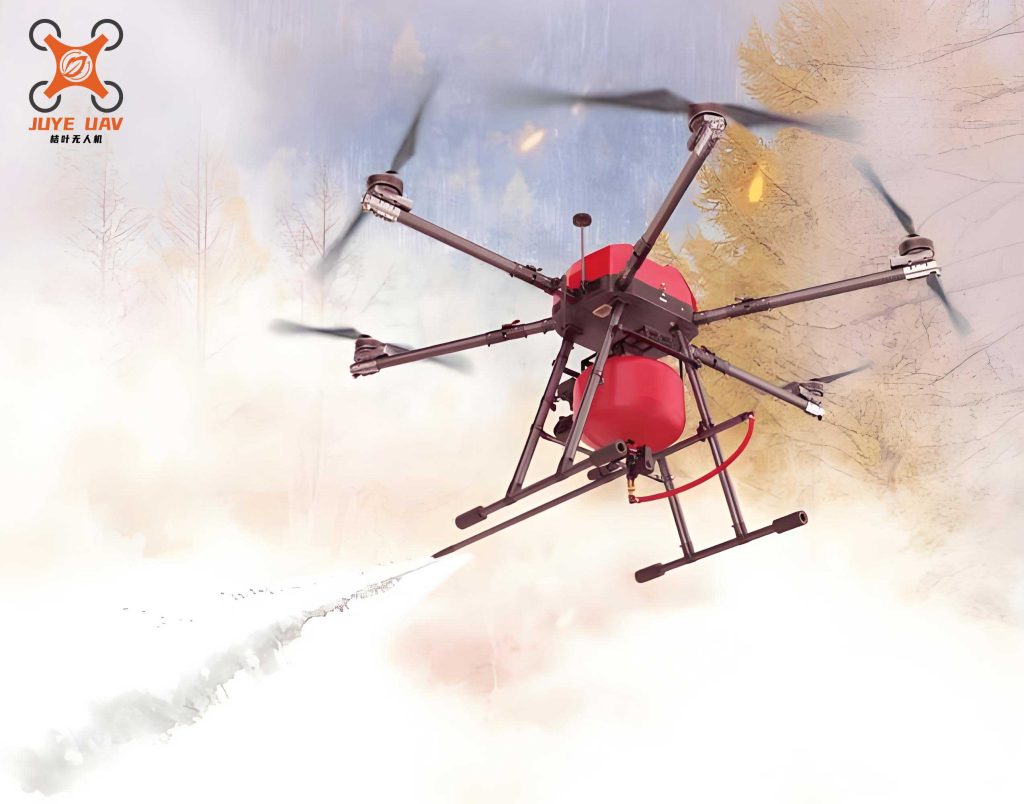
In light of these challenges, fire drones offer substantial advantages in firefighting and rescue operations. Their机动灵活性和便捷可靠性 are paramount. Fire drones are small and highly maneuverable, capable of taking off and landing in confined spaces and navigating狭窄区域 for侦查. They are minimally affected by external environmental干扰, allowing them to operate swiftly under extreme conditions such as high winds, smoke, temperature variations, and harmful gas environments. Moreover, fire drones are easy to operate with rapid response capabilities, enabling quick adjustments based on指令 to change救援 locations and strategies. The simplicity of operation reduces training costs and technical难度, facilitating widespread adoption of fire drones.
Another key advantage is the全面视野和便捷数据传输 capability of fire drones. With advancements in信息化,智能化, and数字化 technologies, fire drones can be controlled beyond visual line of sight (BVLOS) via broadband networks and data links. This allows for全局性监控 and aerial拍摄 from high altitudes. Fire drones are less constrained by飞行 and停放空间, enabling effective inspection of various perspectives, distances, and even confined spaces inaccessible to humans. This ensures a clear understanding of the overall火灾现场 environment and critical positions, making救援部署 more targeted and efficient. Fire drones can rapidly capture and transmit影像, providing real-time feedback on火灾情况 to inform further救援 actions. By remotely controlling fire drones and cameras,消防人员 can collect images as needed, report and broadcast real-time disaster situations, and formulate more effective救援方案, thereby enhancing抢险救援能力.
To elaborate on the specific applications of fire drones in firefighting and rescue, I will break them down into several areas, supported by tables and formulas. First, in火情侦查, fire drones serve as空中侦察兵, overcoming limitations of traditional methods. In complex environments like LNG tank tops,码头, and密集工艺装置 areas, fire drones can无视地形和空间限制 to侦察现场火情, identify泄漏点 and起火点, and assess周边环境, wind direction, and消防设施 status. This information aids in消防救援力量部署. For hazardous zones with high thermal radiation and受限视野, fire drones can quickly reach any part of the火场 for close-range侦查, monitoring燃烧状态 and temperature in核心区域. The data collected can be used to calculate critical parameters. For example, the temperature distribution $T(x,y,z,t)$ in a fire can be approximated using heat transfer equations:
$$ \rho c_p \frac{\partial T}{\partial t} = \nabla \cdot (k \nabla T) + \dot{q} $$
where $\rho$ is density, $c_p$ is specific heat, $k$ is thermal conductivity, and $\dot{q}$ is heat generation rate per unit volume. Fire drones equipped with thermal cameras can provide input for such models, informing灭火策略 and ensuring safe evacuation.
Second, in指挥调度, fire drones facilitate communication and coordination. In uncertain火灾现场 where basic通信 may be compromised, fire drones can搭载通信中继器 to establish communication links swiftly, enabling real-time audio and video transmission for effective部署 and adjustments. Multiple fire drones can定位火场人员位置 and share信息 via algorithms like triangulation:
$$ \text{Position} = \arg \min \sum_{i=1}^{n} (d_i – \sqrt{(x-x_i)^2 + (y-y_i)^2 + (z-z_i)^2})^2 $$
where $d_i$ is the distance measured from drone $i$ at coordinates $(x_i, y_i, z_i)$. This supports人员调度 and力量部署, maximizing safety.
Third, in辅助救援, fire drones play a multifaceted role. They can搭载语音设备 to transmit避灾指令 and安抚被困者情绪 in environments without wireless communication or with damaged devices. This helps keep individuals calm, aiding in self-rescue and reducing casualties. Additionally, fire drones can搭载灭火救援物资 for scenarios where救援人员 cannot approach safely, such as electrical fires, confined space fires, or大面积LNG泄漏起火. For instance, fire drones can carry灭火剂 and喷洒装置 for定点喷洒 or覆盖性释放. The required灭火剂量 $V_{\text{agent}}$ can be estimated based on fire size and extinguishment criteria:
$$ V_{\text{agent}} = A_{\text{fire}} \cdot d_{\text{application}} \cdot \eta $$
where $A_{\text{fire}}$ is the fire area, $d_{\text{application}}$ is the application density, and $\eta$ is an efficiency factor. Fire drones can also deliver simple救援装备 like air respirators, safety ropes,折叠担架, and急救药品 to assist trapped individuals, improving救援成功率. Table 2 summarizes these applications with key parameters.
| Application | Fire Drone Role | Key Parameters/Formulas | Benefits |
|---|---|---|---|
| Fire Reconnaissance | Aerial inspection and data collection | Thermal imaging, $T(x,y,z,t)$ models | Enhanced situational awareness, reduced risk to personnel |
| Command and Dispatch | Communication relay and定位 | Triangulation公式, real-time data link | Improved coordination, efficient resource allocation |
| Auxiliary Rescue | Payload delivery (extinguishers, supplies) | $V_{\text{agent}}$ calculation, payload capacity | Direct火势 control, support for trapped individuals |
From my experience, the integration of fire drones into LNG terminal firefighting requires careful consideration of operational protocols. For example, the flight path of a fire drone can be optimized using path planning algorithms. Let $P(t)$ represent the drone’s position over time, and the objective is to minimize exposure to hazards while maximizing coverage. A simplified cost function $J$ might be:
$$ J = \int_{0}^{T} \left( \alpha \| \dot{P}(t) \|^2 + \beta \cdot H(P(t)) \right) dt $$
where $\alpha$ and $\beta$ are weights, $\dot{P}(t)$ is velocity, and $H(P(t))$ represents hazard intensity at position $P(t)$. Such mathematical models can enhance the effectiveness of fire drone operations.
Moreover, the灭火效率 of fire drones can be analyzed through simulation.假设 a fire drone sprays灭火剂 onto an LNG pool fire. The extinction mechanism can be modeled by reducing the heat release rate $\dot{Q}$ over time:
$$ \dot{Q}(t) = \dot{Q}_0 \cdot e^{-k \cdot V_{\text{agent}} \cdot t} $$
where $\dot{Q}_0$ is the initial heat release rate, $k$ is an extinction coefficient, and $V_{\text{agent}}$ is the灭火剂 volume applied per unit time. This formula helps in designing fire drone payloads and mission profiles.
In terms of future developments, I believe that fire drones will become increasingly autonomous and intelligent. With advancements in artificial intelligence, fire drones can incorporate machine learning algorithms for real-time decision-making. For instance, they can use convolutional neural networks (CNNs) to analyze thermal images and identify fire hotspots autonomously. The integration of Internet of Things (IoT) sensors with fire drones could enable a networked response system, where multiple fire drones collaborate in swarms. The coordination can be described by swarm dynamics equations:
$$ \frac{d \mathbf{x}_i}{dt} = \mathbf{v}_i, \quad \frac{d \mathbf{v}_i}{dt} = \sum_{j \neq i} \mathbf{F}_{ij} + \mathbf{u}_i $$
where $\mathbf{x}_i$ and $\mathbf{v}_i$ are the position and velocity of drone $i$, $\mathbf{F}_{ij}$ represents interaction forces, and $\mathbf{u}_i$ is control input. This could revolutionize large-scale firefighting at LNG terminals.
However, challenges remain. The operational environment of LNG terminals poses risks such as explosive atmospheres and cryogenic temperatures, requiring fire drones to be specially designed with防爆 and耐寒 features. Additionally, regulatory frameworks for fire drone operations need完善, including training, certification, and airspace management. From my perspective, ongoing research should focus on enhancing the payload capacity, endurance, and resilience of fire drones. For example, developing lightweight composite materials can increase payload without compromising maneuverability. The endurance $E_{\text{flight}}$ of a fire drone is given by:
$$ E_{\text{flight}} = \frac{E_{\text{battery}}}{\dot{E}_{\text{consumption}}} $$
where $E_{\text{battery}}$ is battery energy and $\dot{E}_{\text{consumption}}$ is power consumption rate. Innovations in battery technology or hybrid power systems can extend $E_{\text{flight}}$ for longer missions.
To summarize, the application of fire drones in LNG terminal firefighting and rescue is a promising field that leverages technological advancements to address complex challenges. Fire drones offer unmatched flexibility, safety, and efficiency, making them invaluable tools for火情侦查,指挥调度, and辅助救援. As we continue to refine their design, integration, and operation, fire drones will undoubtedly play a more prominent role in safeguarding critical infrastructure. I am optimistic that with continued innovation and collaboration, fire drones will become a standard component of firefighting strategies at LNG terminals and beyond, ultimately contributing to a safer and more resilient society.
In conclusion, this discussion has highlighted the multifaceted benefits of fire drones, supported by technical details, formulas, and tables. From the burning dynamics of LNG fires to the operational models of fire drones, the integration of these technologies holds the key to transforming firefighting and rescue efforts. As I reflect on the potential, it is clear that fire drones are not just auxiliary tools but pivotal assets in modern emergency response. Their ability to operate in hazardous environments, provide real-time data, and deliver precise interventions makes them indispensable for the future of LNG terminal safety. I encourage further research and development in this area to unlock the full potential of fire drones in saving lives and protecting property.