
In recent years, the field of multi-agent systems has witnessed significant advancements, particularly in the context of unmanned aerial vehicles (UAVs). Among various applications, the formation drone light show has emerged as a captivating spectacle, where hundreds or even thousands of drones synchronize their movements to create intricate patterns in the sky. This application not only demands precise coordination but also stringent safety measures to prevent collisions. As a researcher in this domain, I have explored the integration of consensus algorithms with formation control strategies to address the challenges of rendezvous and collision avoidance in formation drone light show scenarios. This article presents a comprehensive study on how graph theory and leader-following approaches can be combined to achieve efficient and safe formation assembly, with a focus on quadrotor drones commonly used in such performances.
The core problem in a formation drone light show is to ensure that all drones converge to predefined positions from arbitrary initial locations while avoiding collisions during the maneuver. Traditional methods often treat drones as point masses, neglecting the dynamic constraints and collision risks. To overcome this, I propose a control framework that leverages second-order consensus algorithms, where each drone’s dynamics are modeled as a double integrator system. This approach enables smooth trajectory generation and real-time adjustments based on neighbor interactions. The communication topology is designed so that all followers can access the leader’s state information, ensuring global coordination. By incorporating height adjustments—a unique capability of quadrotors due to their hovering ability—collisions can be mitigated effectively. Throughout this article, I will emphasize the relevance of these techniques to formation drone light show applications, where visual aesthetics and safety are paramount.
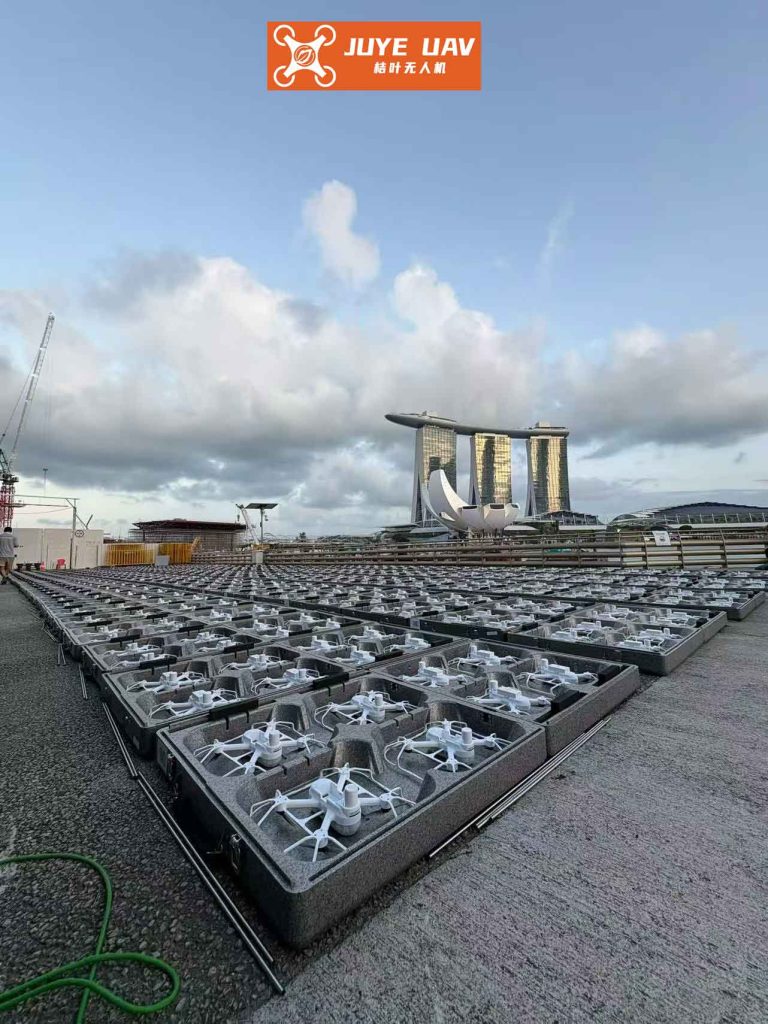
To set the stage, let’s consider the mathematical model. Each quadrotor in a formation drone light show is represented as a second-order integrator, with its position and velocity evolving according to the following equations:
$$ \dot{s}_i = v_i, $$
$$ \dot{v}_i = u_i, $$
where \( s_i = (x_i, y_i, z_i)^T \) and \( v_i = (\dot{x}_i, \dot{y}_i, \dot{z}_i)^T \) denote the position and velocity vectors of drone \( i \), respectively, and \( u_i = (u_{ix}, u_{iy}, u_{iz})^T \) is the control input. For quadrotors, \( u_{ix} \) and \( u_{iy} \) correspond to pitch and roll moments, while \( u_{iz} \) relates to the total thrust from rotors. This simplification allows us to focus on the consensus dynamics without delving into complex aerodynamic details, which is sufficient for high-level formation control in a formation drone light show.
The consensus algorithm is pivotal for achieving synchronized movement. In a fixed communication topology \( G \), which includes a directed spanning tree, the leader broadcasts its state \( (s_c, v_c) \) to all followers. The followers, in turn, exchange information with their neighbors based on the graph structure. The control law for drone \( i \) is designed as:
$$ u_i(t) = \dot{v}_c – \alpha \left\{ [(s_i – \tilde{s}_i) – s_c] + \gamma (v_i – v_c) \right\} – \sum_{j=1}^{N} \alpha_{ij} \left\{ [(s_i – \tilde{s}_i) – (s_j – \tilde{s}_j)] + \gamma (v_i – v_j) \right\}, $$
where \( \tilde{s}_i \) is the desired relative position offset for drone \( i \) in the formation, \( \alpha \) and \( \alpha_{ij} \) are coupling gains (with \( \alpha = 1 \) and \( \alpha_{ij} = 1 \) if drone \( i \) receives information from drone \( j \)), and \( \gamma > 0 \) is a damping coefficient. This algorithm ensures that, over time, \( \| s_i – s_j \| \to 0 \) and \( \| v_i – v_j \| \to 0 \) for all \( i, j \), leading to consensus on both position and velocity. In a formation drone light show, this translates to drones smoothly aligning into geometric patterns from scattered starting points.
To implement the formation rendezvous with collision avoidance, I propose a step-by-step control strategy tailored for formation drone light show performances. The steps are summarized in the table below, which outlines the key actions and conditions.
| Step | Description | Mathematical Expression |
|---|---|---|
| 1 | Define the formation center \( \rho_c = (x_c, y_c, z_c) \) and relative offsets \( \tilde{\rho}_i \). | \( \rho_i – \tilde{\rho}_i = \rho_c \) |
| 2 | Compute trajectories using the second-order consensus algorithm. | Equation (2) above |
| 3 | Calculate the minimum separation distance \( d_{\min,ij} \) between drones \( i \) and \( j \). | \( d_{\min,ij} = \min \{ d_{ij}(k) \mid k = 1, \dots, N_R \} \), with \( d_{ij}(k) = \sqrt{(x_{i,k} – x_{j,k})^2 + (y_{i,k} – y_{j,k})^2 + (z_{i,k} – z_{j,k})^2} \) |
| 4 | Check collision condition: if \( d_{\min,ij} > R_i + R_j \), proceed to Step 6; else, go to Step 5. Here, \( R_i \) and \( R_j \) are safety radii. | Condition: \( d_{\min,ij} > R_i + R_j \) |
| 5 | Adjust the rendezvous height \( h_i \) by \( \Delta h_e \) for drones at risk. For \( m \) potential collision pairs, modify heights iteratively. | If \( i < j \), increase \( h_i \) and decrease \( h_j \) by \( \Delta h_e \). |
| 6 | If heights were adjusted, optimize \( \Delta h_i \) using a bisection method until \( \| \Delta h_{iT} – \Delta h_{i(T-1)} \| \leq \epsilon \). | Iteration until convergence |
| 7 | After reaching adjusted points, drones vertically ascend or descend to original rendezvous points. | Vertical motion command |
| 8 | Finalize formation at the original rendezvous points. | Consensus achieved |
This strategy leverages the vertical mobility of quadrotors, a feature often exploited in formation drone light show to create 3D effects, to prevent collisions without disrupting the overall formation geometry. The height adjustments are minimal and optimized to ensure visual coherence during performances.
To validate the approach, I conducted numerical simulations mimicking a formation drone light show with \( N = 5 \) drones. The communication topology, as shown in the figure, ensures that the leader (drone 1) communicates with all followers (drones 2–5), while followers have arbitrary interconnections. The parameters were set as follows: \( \alpha = 1 \), \( \gamma = 2 \), safety radius \( R_i = 0.05 \, \text{m} \) (scaled 1:5 for simulation), and height adjustment step \( \Delta h_e = 0.1 \, \text{m} \). The leader was fixed at \( (2, 2, 2) \) in meters, and followers started at random positions that initially satisfied non-collision conditions. The desired relative offsets for the formation were:
$$ \tilde{\rho} = \begin{bmatrix} 0 & -1 & 0 & 1 \\ 1 & 0 & -1 & 0 \\ 0 & 0 & 0 & 0 \end{bmatrix}, $$
which corresponds to a cross-shaped pattern common in formation drone light show designs. For instance, with initial positions for followers as:
$$ \begin{bmatrix} 1 & 4 & 0 & 3 \\ 3 & 1 & 0 & 1 \\ 0 & 0 & 0 & 0 \end{bmatrix}, $$
the minimum separation distances \( D_{\min,ij} \) were computed. It was found that \( d_{\min,25} = 0.0077 \, \text{m} < 0.1 \, \text{m} \), indicating a potential collision between drones 2 and 5. By applying the height adjustment strategy, optimized height changes \( \Delta h_{2T} = 0.0629 \, \text{m} \) and \( \Delta h_{5T} = -0.0629 \, \text{m} \) were obtained, resulting in updated distances \( D^*_{\min,ij} \) all exceeding \( 0.1 \, \text{m} \). The table below summarizes the simulation outcomes for key parameters.
| Parameter | Value | Role in Formation Drone Light Show |
|---|---|---|
| Number of Drones (N) | 5 | Small-scale representation for testing |
| Communication Topology | Leader to all followers | Ensures global synchronization |
| Safety Radius (R_i) | 0.05 m (scaled) | Prevents physical collisions |
| Consensus Gain (γ) | 2 | Balances convergence speed and stability |
| Height Adjustment Step (Δh_e) | 0.1 m | Enables 3D collision avoidance |
| Optimization Tolerance (ε) | 10^{-4} | Ensures precise height calibration |
The trajectories generated by the consensus algorithm demonstrated smooth convergence to the formation points. For example, drone 2 moved to \( (2, 1, 1.9371) \) before vertically ascending to its original rendezvous point \( (2, 1, 2) \), as shown in the figure. This maneuver illustrates how height adjustments can be seamlessly integrated into a formation drone light show without disrupting the visual flow. The 3D plot of the formation process confirmed that all drones maintained safe distances, with the shortest separation points between drones 2 and 5 being tangential to spheres of radius \( 0.05 \, \text{m} \), verifying collision avoidance.
The effectiveness of this method hinges on the consensus algorithm’s stability properties. For a fixed connected topology \( G \) containing a directed spanning tree, the system is guaranteed to achieve consensus. This aligns with requirements for a formation drone light show, where reliability is critical. The control law in Equation (2) can be analyzed using Lyapunov methods to prove asymptotic stability. Consider a Lyapunov function candidate:
$$ V = \frac{1}{2} \sum_{i=1}^{N} \left( (s_i – \tilde{s}_i – s_c)^T (s_i – \tilde{s}_i – s_c) + \gamma (v_i – v_c)^T (v_i – v_c) \right), $$
whose derivative along the system trajectories yields \( \dot{V} \leq 0 \), ensuring convergence. This theoretical foundation supports the practical implementation in drone swarms for formation drone light show events.
In addition to the core algorithm, several extensions can enhance the formation drone light show capabilities. For instance, incorporating obstacle avoidance for dynamic environments, or adapting the consensus gains to handle varying numbers of drones—common in large-scale performances. The table below compares different formation control methods and their suitability for formation drone light show applications.
| Method | Key Idea | Pros for Drone Light Shows | Cons for Drone Light Shows |
|---|---|---|---|
| Leader-Following | One leader dictates motion | Simple to implement | Single point of failure |
| Virtual Structure | Treat formation as a rigid body | Precise geometric patterns | Less flexible for dynamic changes |
| Behavior-Based | Local rules for global behavior | Robust to disturbances | Hard to guarantee convergence |
| Consensus-Based (Proposed) | Information sharing for agreement | Scalable, collision-aware | Requires communication network |
The consensus-based approach stands out for its balance of flexibility and reliability, making it ideal for formation drone light show where both safety and aesthetic precision are needed. Moreover, the integration of height adjustments taps into the 3D potential of quadrotors, allowing for more creative displays in formation drone light show without compromising safety.
From a practical standpoint, implementing this in a real formation drone light show involves additional considerations such as wind disturbances, battery life, and communication delays. However, the second-order consensus algorithm can be robustified with integral terms or adaptive gains to handle such issues. Simulation studies, like the one presented here, provide a foundation for field testing. In future work, I plan to explore distributed optimization techniques to minimize energy consumption during formation changes—a key concern for extended formation drone light show performances.
To further illustrate the mathematical formulation, let’s derive the closed-loop dynamics. Substituting Equation (2) into the double integrator model yields:
$$ \dot{v}_i = \dot{v}_c – \alpha \left\{ [(s_i – \tilde{s}_i) – s_c] + \gamma (v_i – v_c) \right\} – \sum_{j=1}^{N} \alpha_{ij} \left\{ [(s_i – \tilde{s}_i) – (s_j – \tilde{s}_j)] + \gamma (v_i – v_j) \right\}. $$
Defining the error states \( e_{s_i} = s_i – \tilde{s}_i – s_c \) and \( e_{v_i} = v_i – v_c \), we can rewrite the system in matrix form. Let \( e_s = [e_{s_1}^T, \dots, e_{s_N}^T]^T \) and \( e_v = [e_{v_1}^T, \dots, e_{v_N}^T]^T \). Then:
$$ \begin{bmatrix} \dot{e}_s \\ \dot{e}_v \end{bmatrix} = \begin{bmatrix} 0 & I \\ -L & -\gamma (I + L) \end{bmatrix} \begin{bmatrix} e_s \\ e_v \end{bmatrix}, $$
where \( L \) is the Laplacian matrix of the communication graph \( G \). The eigenvalues of this system determine convergence rates, which can be tuned via \( \gamma \) for optimal performance in a formation drone light show.
In conclusion, the consensus-based formation control strategy presented here offers a robust solution for rendezvous and collision avoidance in formation drone light show applications. By combining graph theory with leader-following principles, drones can efficiently assemble into desired patterns while avoiding collisions through height adjustments. The numerical simulations validate the approach, showing smooth trajectories and safe separations. As formation drone light show continue to grow in complexity and scale, such algorithmic advancements will be crucial for ensuring both spectacular visuals and operational safety. Future research directions include real-time adaptation to environmental disturbances and scalability to thousands of drones, pushing the boundaries of what’s possible in aerial entertainment.
Throughout this article, I have emphasized the term formation drone light show to highlight the practical context. The methods discussed are not just theoretical constructs but are directly applicable to the thriving industry of drone-based performances. By leveraging consensus algorithms, we can create more dynamic and safe formation drone light show that captivate audiences worldwide. The integration of collision avoidance via height control exemplifies how technical innovations can enhance artistic expressions, making every formation drone light show a testament to the synergy between engineering and creativity.