
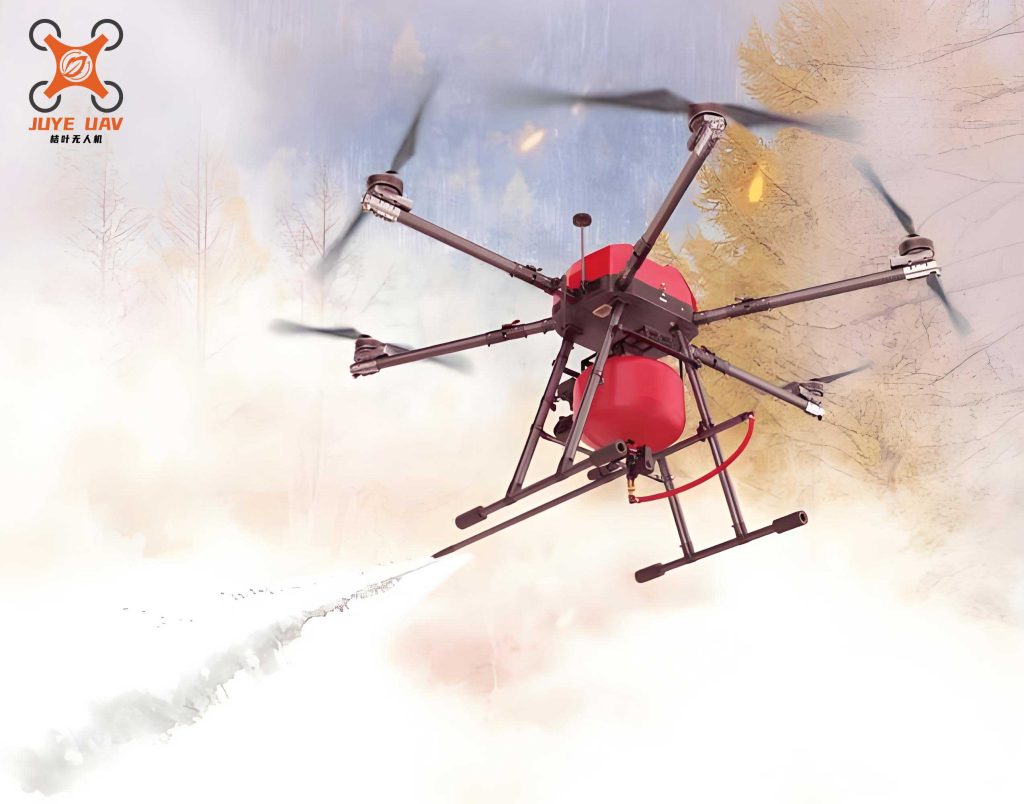
The evolution of urban landscapes, characterized by soaring high-rise buildings, complex industrial facilities, and densely populated areas, has dramatically escalated the challenges faced by fire and rescue services. Traditional firefighting methodologies, predominantly reliant on ground-based operations and human entry, are increasingly strained by the inherent dangers and informational deficits of modern fire scenarios. In this context, the integration of Unmanned Aerial Vehicles (UAVs), specifically designed and deployed as fire UAV platforms, represents a paradigm shift. I will explore how the fire UAV transitions from a novel reconnaissance tool to a central pillar in intelligent firefighting, examining its technological advantages, multifaceted applications, and the future trajectory of this transformative technology.
The limitations of conventional firefighting are multifaceted and critically impact operational safety and efficacy. Firegrounds are inherently chaotic environments where high temperatures, toxic smoke, and poor visibility severely impair situational awareness. Information flow is often delayed and fragmented, hindering command decisions. The physical risks to firefighters are extreme, including structural collapse, flashover, and exposure to hazardous materials. Furthermore, the reach and versatility of traditional equipment are constrained; aerial ladders have height limits, and ground monitors cannot navigate complex interiors. The table below summarizes these key challenges contrasted with the capabilities introduced by the fire UAV.
| Aspect | Traditional Firefighting Challenges | Capabilities Enabled by Fire UAV |
|---|---|---|
| Situational Awareness | Limited by ground-level perspective, smoke obscuration, and hazardous entry conditions. Relies on reports from personnel inside danger zones. | Provides an immediate, overhead, and interior (via navigation) perspective. Penetrates smoke using thermal sensors to reveal the true fire situation. |
| Personnel Safety | Firefighters must enter immediately dangerous to life and health (IDLH) atmospheres for reconnaissance and attack. | Acts as a remote sensor, reducing the need for initial and ongoing interior reconnaissance by personnel, thereby minimizing exposure. |
| Operational Reach | Limited by the physical reach of ladders (typically ≤ 100 ft) and hose streams. Difficult access to rear or confined spaces of a structure. | Can access heights and spaces unreachable by ground teams, providing direct visual or thermal assessment and potential direct intervention. |
| Decision Support | Command decisions based on incomplete, delayed, or subjective information from the front lines. | Feeds real-time, objective data (video, thermal maps, gas readings) directly to the command post, enabling data-driven strategy formulation. |
| Search & Rescue Efficiency | Labor-intensive, slow, and high-risk process of searching large or complex structures room-by-room. | Rapidly scans large areas and cavities using thermal imaging to identify heat signatures of potential victims, prioritizing rescue efforts. |
The technological foundation of the modern fire UAV lies in its sophisticated payload and data processing systems. These are not merely flying cameras but integrated sensor platforms. The core sensing modalities include visible-light cameras for general overview, thermal/infrared cameras for heat signature detection, and multi-spectral or hyperspectral imagers for material and gas identification. Advanced models incorporate Light Detection and Ranging (LiDAR) for 3D mapping and gas sensors for detecting combustible or toxic atmospheres. The data from a fire UAV is telemetried in real-time to a ground control station, where it can be fused, analyzed, and visualized.
A critical application is thermal assessment. The thermal camera on a fire UAV detects infrared radiation, allowing it to see through smoke and visualize temperature gradients. This is governed by the Stefan-Boltzmann law, which relates the power radiated from a surface to its temperature:
$$ P = \epsilon \sigma A T^4 $$
where \( P \) is the radiated power, \( \epsilon \) is the emissivity of the material, \( \sigma \) is the Stefan-Boltzmann constant, \( A \) is the area, and \( T \) is the absolute temperature. By analyzing the thermal radiation pattern, a fire UAV can pinpoint the seat of the fire, identify hidden hot spots within walls or attics, and assess the thermal load on structural members to predict potential collapse zones.
| Sensor Type | Primary Function | Key Application in Firefighting |
|---|---|---|
| Visible Light Camera | High-definition video and photography | Documenting fire progression, assessing structural damage, planning access routes, public information. |
| Thermal/Infrared Camera | Detects heat signatures (infrared radiation) | Seeing through smoke, locating fire origin and spread, searching for victims, identifying overheating equipment. |
| Multi-spectral Imager | Captures data at specific electromagnetic wavelengths | Identifying chemical compositions, detecting specific toxic gases (e.g., CO, HCN), assessing vegetation moisture for wildfire risk. |
| LiDAR | Measures distance with laser pulses to create 3D point clouds | Creating precise 3D models of the fire scene for volume calculation, collapse simulation, and post-incident analysis. |
| Gas Sensor Suite | Detects concentration of specific gases | Monitoring for flammable (LEL) or toxic gas levels, ensuring scene safety for responders, tracking plume dispersion. |
The operational deployment of a fire UAV follows a logical sequence that maximizes its impact throughout the incident lifecycle. Upon arrival, the fire UAV is rapidly deployed for initial size-up, providing an immediate overhead view that surpasses the perspective from the command vehicle. This “first look” is invaluable for understanding the fire’s location, extent, and involvement of exposures. As operations progress, the role of the fire UAV becomes more specialized. In structural firefighting, it can guide interior attack teams by identifying the main body of fire behind smoke, revealing alternative access points, or warning of impending flashover conditions indicated by a rapidly heating smoke layer. The thermal data can be used to calculate fire intensity and rate of spread.
For example, the energy release rate can be related to the observed thermal plume and temperature data. While complex, a simplified relationship considering convective heat flux measured by the fire UAV‘s sensors can be conceptualized. The heat transfer from the fire plume involves convection and radiation. The convective component sensed by the fire UAV can be part of an energy balance analysis for the compartment.
$$ \dot{Q}_{total} = \dot{Q}_{conv} + \dot{Q}_{rad} + \dot{Q}_{loss} $$
where \( \dot{Q}_{total} \) is the total heat release rate, and the other terms represent convective, radiative, and heat loss components, respectively. Data from the fire UAV helps estimate these parameters, informing tactical decisions on flow rate and application.
In wilderness firefighting, the fire UAV becomes an indispensable tool for mapping fire perimeters, identifying spot fires ahead of the main front, and monitoring the effectiveness of containment lines. Its ability to cover vast, inaccessible terrain quickly provides commanders with a strategic overview impossible to achieve with ground patrols alone. The endurance and range of the fire UAV are critical here. The operational flight time \( T_{flight} \) is a function of battery capacity \( C \), power draw \( P_{draw} \), and environmental factors like wind \( w \):
$$ T_{flight} = \eta \cdot \frac{C}{P_{draw} + f(w)} $$
where \( \eta \) is the system efficiency and \( f(w) \) is an additional power factor due to wind resistance. Advancements in battery technology and hybrid power systems are directly extending the mission capability of the fire UAV in these large-scale events.
Perhaps the most profound impact of the fire UAV is in the realm of search and rescue (SAR) and technical rescue. Equipped with thermal cameras, a fire UAV can systematically scan a collapsed structure or a large open area for human heat signatures. The probability of detection \( P_d \) by a fire UAV in SAR mode depends on the sensor resolution \( R \), altitude \( h \), and the contrast \( \Delta T \) between the victim’s temperature and the background:
$$ P_d \propto \frac{R \cdot \Delta T}{h^2} $$
This formula highlights why low-altitude, high-resolution thermal imaging is so effective. The fire UAV can also be equipped with loudspeakers to communicate with trapped victims or with payload release mechanisms to deliver essential survival supplies like bottled water, radios, or thermal blankets, sustaining lives until ground rescuers can effect a physical extraction.
The concept of operations evolves further with the integration of the fire UAV into a broader “Internet of Life-Saving Things” ecosystem. The future lies in seamless collaboration between aerial and ground assets. A fire UAV can act as the eyes and commander for unmanned ground vehicles (UGVs), providing a map and identifying points of interest while the UGV handles tasks requiring physical interaction, like breaching doors or shutting off valves. This multi-domain teaming creates a force multiplier. Data fusion from a fire UAV, ground sensors, and wearables on firefighters creates a Common Operational Picture (COP) in the command post. Artificial Intelligence (AI) algorithms can analyze the fire UAV video feed in real-time to automatically detect anomalies, track the movement of personnel, or predict fire spread patterns using computational fluid dynamics models.
| Development Axis | Specific Goals | Expected Impact |
|---|---|---|
| Propulsion & Endurance | Hybrid gas-electric systems, hydrogen fuel cells, automated in-field charging/swapping. | Mission durations extending to several hours, enabling persistent overwatch for large-scale incidents. |
| Autonomy & AI | Fully autonomous indoor navigation, real-time video analytics for hazard detection (e.g., flashover, collapse), predictive fire modeling. | Reduced operator cognitive load, faster threat identification, and proactive tactical suggestions from the AI co-pilot. |
| Swarm Technology | Coordinated fleets of heterogeneous fire UAV (scout, communication relay, suppression). | Simultaneous 3D mapping, communication network establishment over the scene, and distributed suppression agent delivery. |
| Advanced Payloads | More compact and powerful suppression systems (e.g., condensed aerosol, cutting lasers), integrated spectroscopic gas analyzers. | Direct and effective offensive firefighting from the air, precise hazardous material identification. |
| Interoperability | Standardized data links and protocols for integration with existing CAD, BIM, and other emergency service systems. | Seamless flow of fire UAV data into the overall incident management framework, enhancing decision-making at all levels. |
The path forward requires a holistic approach. Technological advancement of the fire UAV platform itself must be matched by robust training programs for pilots and incident commanders, the development of standardized tactical procedures, and thoughtful policy frameworks addressing airspace coordination and privacy concerns. The ultimate objective is to embed the fire UAV not as a standalone gadget, but as a fundamental component of the next-generation firefighter’s toolkit. The data generated by a fire UAV, when properly analyzed and acted upon, transforms reactive firefighting into proactive incident management. This shift enhances not only the effectiveness of fire suppression and rescue but, more importantly, the safety of both the public and the firefighters who serve them. The continuous feedback loop from operational use will drive further innovation, ensuring that the fire UAV remains at the leading edge of emergency response technology. The quantitative benefits in terms of reduced property loss, accelerated rescue times, and most significantly, prevented firefighter fatalities and injuries, will solidify the role of the fire UAV as an indispensable asset in modern rescue operations.
The integration of a fire UAV also revolutionizes post-incident analysis and training. The high-resolution data, including orthomosaic maps, 3D models, and synchronized thermal video, provides an immutable record of the event. This allows for detailed forensic analysis to determine the origin and cause of the fire, evaluate the performance of building materials and systems, and assess the effectiveness of the firefighting tactics employed. The 3D model generated by a fire UAV‘s LiDAR or photogrammetry can be represented as a point cloud or mesh, with the data volume \( V_{data} \) being a function of the area covered \( A \) and the resolution \( \rho \):
$$ V_{data} \propto A \cdot \rho^2 $$
This rich dataset serves as a powerful training tool, allowing crews to virtually revisit the incident, explore “what-if” scenarios, and refine their standard operating procedures based on empirical data rather than anecdote.
In conclusion, the advent of the specialized fire UAV marks a decisive turning point for fire and rescue services worldwide. By overcoming the traditional constraints of ground-bound perception and high-risk entry, the fire UAV delivers unprecedented situational awareness, enhances operational safety, and expands tactical options. From its role in initial reconnaissance and fire attack to its life-saving function in search and rescue and its strategic value in large-scale disaster management, the fire UAV has proven its multifaceted utility. The future trajectory points towards greater autonomy, longer endurance, deeper integration with other robotic systems, and more intelligent on-board data processing. As these technologies mature and become more deeply institutionalized within fire department operations, the fire UAV will cease to be considered advanced technology and will instead become a standard, essential piece of fireground equipment—a permanent eye in the sky dedicated to saving lives and protecting property.