
As technology rapidly普及, daily life has become increasingly automated, offering overall convenience but also introducing numerous safety hazards. Statistical surveys indicate that the incidence of fires in my country has been growing annually. In the past, firefighters often relied on satellite tablets for on-site analysis during rescue operations, a method with low reliability that adversely affected the effectiveness of firefighting efforts, revealing significant shortcomings. Driven by these needs, fire UAV (unmanned aerial vehicle) has emerged as a valuable tool in firefighting and rescue due to its technical advantages. Based on my personal experience and relevant data, I will explore the specific applications of fire UAV in消防灭火救援.
Fire UAV, also known as an unmanned aircraft, is a remote-controlled飞行器 that does not require an onboard pilot. It is equipped with an autonomous flight system, allowing ground operators to control it for tasks such as positioning, telemetry, digital transmission, tracking, and photography. Typically, a fire UAV consists of four main components: the airframe, power system, flight management system, and control system. The flight management system is the core for managing UAV flight, determining正常飞行, while the control system dictates飞行水平. Compared to other technological devices, fire UAV offers high flexibility and simple operation across various industries, often incorporating digital camera systems and GPS for tailored functionality. In recent years, due to frequent disasters, the precise positioning, wide拍摄面积, and地点 versatility of fire UAV have led to its growing use in firefighting, with expanding applications and capabilities.
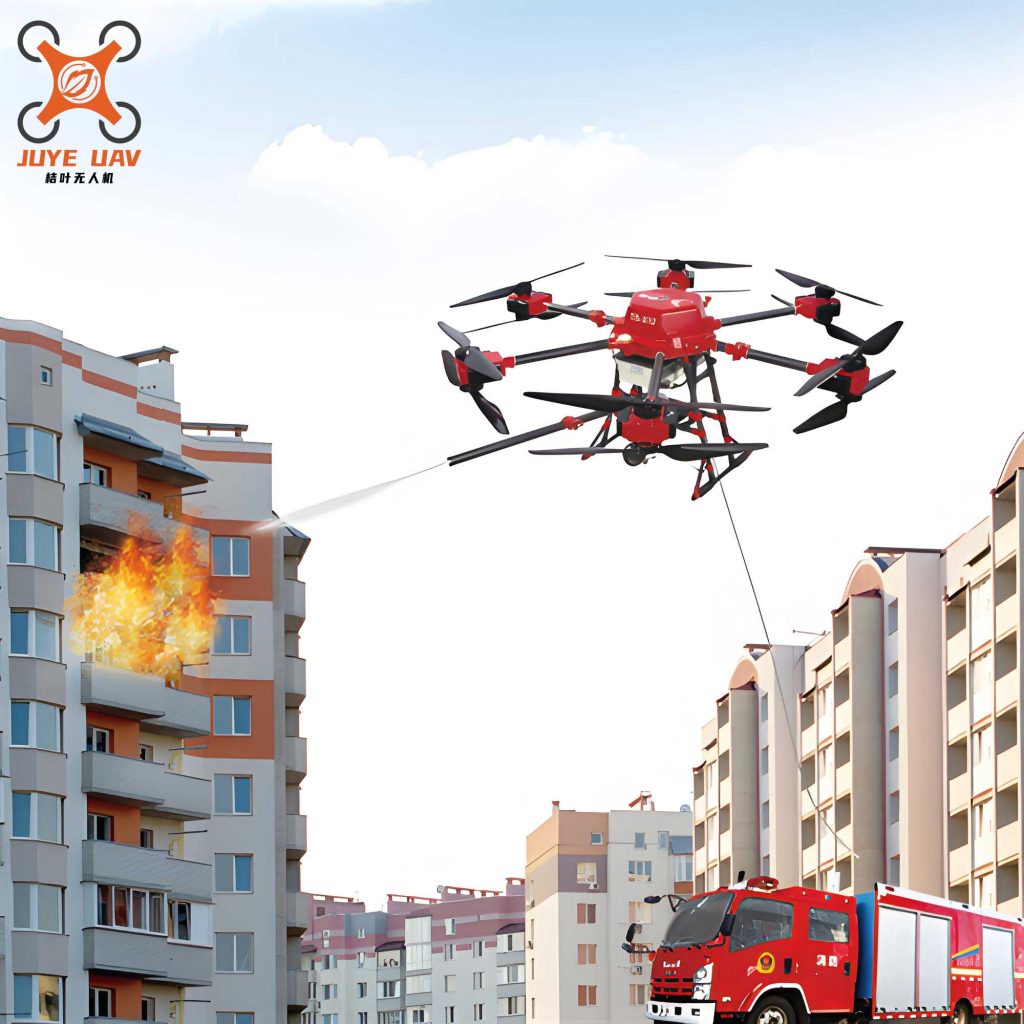
In消防灭火救援, fire UAV demonstrates several key advantages. Firstly, its flexibility is notable—unlike large aircraft, fire UAV requires minimal起飞和降落地点, such as flat ground, and can be easily rotated for multi-angle photography, aiding in pre-fire assessment. Secondly, fire UAV is cost-effective; whether油动 or电动, its overall造价 is low, and摄影器材 can be attached without complex integration, saving costs. These benefits make fire UAV a practical choice for enhancing救援水平.
To better understand the components of a typical fire UAV, consider the following table:
| Component | Description | Function in Fire UAV |
|---|---|---|
| Airframe | Physical structure of the UAV | Provides stability and houses other systems |
| Power System | Battery or fuel-based power source | Supplies energy for flight and operations |
| Flight Management System | Autonomous control unit | Manages flight paths and stability |
| Control System | Remote operation interface | Allows manual control and adjustments |
| Camera/GPS | Digital imaging and定位 systems | Enables data collection and precise navigation |
The effectiveness of fire UAV can be quantified through various metrics. For example, the area coverage for reconnaissance can be expressed using the formula for circular coverage based on altitude and camera angle. If a fire UAV flies at an altitude \( h \) with a camera field of view angle \( \theta \), the ground coverage radius \( r \) is given by:
$$ r = h \cdot \tan\left(\frac{\theta}{2}\right) $$
Thus, the total area \( A \) covered is:
$$ A = \pi r^2 = \pi \left( h \cdot \tan\left(\frac{\theta}{2}\right) \right)^2 $$
This allows消防人员 to estimate how much terrain can be surveyed quickly, aiding in rapid assessment. In practice, multiple fire UAV units may be deployed to maximize coverage, and their协同 can be modeled using swarm algorithms.
In消防灭火救援工作, the applications of fire UAV are diverse and impactful. One primary use is勘察灾情 and data collection. Small fire UAV, weighing under tens of kilograms, can be deployed swiftly by a few operators with portable computers and遥控器. Unlike satellite tablets, fire UAV requires minimal setup and can operate in complex地形, providing real-time data on chemical presence, temperature variations, and hazard locations. Through communication satellites and ground stations, data such as高清数码图片 and地形数据图 are transmitted同步ly, enabling informed decision-making. Additionally, with 4G image transmission, fire UAV can relay information directly to消防人员’可视化头盔, enhancing situational awareness. This real-time data flow is crucial for制定合理的灭火救援措施.
Another key application is指挥调度. Fire UAV’s ability to rapidly acquire and transmit high-definition imagery allows it to support command centers. By capturing live feeds of火势, temperature, and spatial conditions, fire UAV helps消防人员 monitor evolving灾情 and adjust strategies accordingly. For instance, the rate of fire spread can be estimated using differential equations. If the fire front expands at a velocity \( v(t) \) depending on factors like wind and fuel, the area affected over time \( t \) can be modeled as:
$$ \frac{dA}{dt} = \int v(t) \, dL $$
where \( dL \) represents the perimeter. Fire UAV data feeds into such models for accurate predictions, facilitating正确的灭火措施.
Fire UAV also plays a role in辅助调援, such as delivering supplies to trapped individuals. In hazardous environments with有害烟尘, fire UAV can transport items like防护面罩 or急救包, reducing risks to消防人员. Its small size enables navigation through cluttered areas, and with attached扩音器, it can broadcast instructions to victims. The payload capacity of a fire UAV can be calculated based on its lift force. Using Newton’s second law, the maximum payload mass \( m_p \) is:
$$ m_p = \frac{T – W_u}{g} $$
where \( T \) is the thrust, \( W_u \) is the UAV’s weight, and \( g \) is gravitational acceleration. This ensures efficient resource allocation during救援.
Furthermore, fire UAV offers扩展应用, including post-rescue monitoring. It can provide 24-hour surveillance, offering后续资料 for analysis and future preparedness. In inaccessible areas, fire UAV’s multi-angle photography enables comprehensive assessment without endangering消防人员. The versatility of fire UAV is summarized in the table below:
| Application Area | Specific Use of Fire UAV | Benefits |
|---|---|---|
| Reconnaissance | Real-time imaging and data collection | Rapid assessment, reduced risk |
| Command Support | Live feed transmission to指挥中心 | Enhanced decision-making |
| Logistics | Supply delivery and communication | Increased safety and efficiency |
| Monitoring | Continuous surveillance post-rescue | Data for analysis and planning |
| Hazard Detection | Identifying chemicals and hot spots | Preventive measures and safety |
The cost-effectiveness of fire UAV can be analyzed through a simple formula. Let \( C_i \) be the initial cost of a fire UAV, \( O_m \) the annual operating cost, and \( B \) the annual benefits in terms of reduced damage or improved救援水平. The net benefit \( NB \) over \( n \) years is:
$$ NB = \sum_{t=1}^{n} \frac{B_t – O_m}{(1 + r)^t} – C_i $$
where \( r \) is the discount rate. This highlights why fire UAV is a viable investment for消防部门.
From a technical perspective, the flight control of fire UAV involves complex algorithms. For stable hovering and navigation, PID controllers are often used, described by the equation:
$$ u(t) = K_p e(t) + K_i \int_0^t e(\tau) d\tau + K_d \frac{de(t)}{dt} $$
where \( u(t) \) is the control output, \( e(t) \) is the error signal, and \( K_p, K_i, K_d \) are gains. This ensures precise maneuvering in火灾现场, which is critical for avoiding obstacles and capturing accurate data.
Data transmission from fire UAV relies on wireless technologies like 4G or 5G. The data rate \( R \) can be expressed using the Shannon-Hartley theorem:
$$ R = B \log_2 \left(1 + \frac{S}{N}\right) $$
where \( B \) is bandwidth, \( S \) is signal power, and \( N \) is noise power. High data rates enable the streaming of高清视频, essential for real-time analysis. Fire UAV systems often incorporate redundant links to ensure reliability, with multiple fire UAV units forming a network for robust communication.
In terms of operational deployment, fire UAV can be integrated into existing消防 protocols. For example, during a large-scale fire, a swarm of fire UAV units can be coordinated to cover vast areas. The coordination can be modeled using graph theory, where each fire UAV is a node in a network, and edges represent communication links. The overall efficiency \( E \) of the swarm might be quantified as:
$$ E = \frac{\sum_{i=1}^{N} A_i}{T \cdot N} $$
where \( A_i \) is the area covered by fire UAV \( i \), \( T \) is time, and \( N \) is the number of units. This emphasizes the scalability of fire UAV solutions.
Looking ahead, the potential of fire UAV in消防灭火救援 is vast. Advances in AI could enable autonomous decision-making, such as identifying trapped individuals through image recognition. Thermal imaging cameras on fire UAV can detect heat signatures, with temperature readings used to model fire dynamics. For instance, the heat transfer from a fire can be described by the heat equation:
$$ \frac{\partial T}{\partial t} = \alpha \nabla^2 T $$
where \( T \) is temperature, \( t \) is time, and \( \alpha \) is thermal diffusivity. Fire UAV data can feed into such models for predicting fire behavior, enhancing救援 strategies.
To summarize, fire UAV represents a high-tech tool with extensive functionality that requires ongoing exploration to fully leverage in消防灭火救援. By understanding its operational norms and advantages, and aligning with specific fire scenarios,消防人员 can utilize fire UAV for effective information勘察 and analysis. This maximizes the benefits of fire UAV, ensuring improved overall灭火救援水平. The integration of fire UAV into standard practices will likely evolve, driven by technological innovations and实战需求.
In conclusion, the use of fire UAV in firefighting and rescue operations is transformative, offering flexibility, cost savings, and enhanced capabilities. Through continued research and practical application, fire UAV can further elevate safety and efficiency, making it an indispensable asset in modern消防 efforts. As I reflect on my experiences, the adoption of fire UAV is not just a trend but a necessary advancement to address growing火灾 challenges, and its role will only expand with time.