
In modern firefighting and rescue operations, the integration of advanced technologies has revolutionized traditional methods, with fire UAV (Unmanned Aerial Vehicle) aerial photography standing out as a pivotal tool. As a first-person observer in the field, I have witnessed firsthand how fire UAV systems enhance situational awareness, improve response efficiency, and save lives. This article delves into the comprehensive application of fire UAV aerial photography technology in firefighting and rescue, emphasizing its advantages, system components, and practical implementations. Through detailed analysis, tables, and mathematical formulations, I aim to provide an in-depth perspective on why fire UAVs are indispensable in contemporary emergency response.
The core of fire UAV aerial photography lies in its ability to provide real-time, high-resolution data from aerial perspectives, which is unattainable through ground-based methods. In fire scenarios, time is critical, and the rapid deployment of a fire UAV can mean the difference between containment and catastrophe. The technology leverages a combination of hardware and software systems, including the airframe platform, flight control system, gimbal camera system, and image transmission system, each contributing to its efficacy. By exploring these elements, we can understand how fire UAVs transform firefighting strategies, from initial assessment to post-disaster analysis. Moreover, the keyword ‘fire UAV’ will be reiterated throughout to underscore its centrality in this discourse.
One of the primary advantages of using a fire UAV in rescue missions is its capability for swift and accurate fire scene reconnaissance. In hazardous environments, such as chemical fires, forest blazes, or structural collapses, human access is often limited or perilous. A fire UAV can be deployed within minutes, flying over the danger zone to capture vital information without risking personnel. For instance, thermal imaging cameras mounted on fire UAVs can detect heat signatures, identifying hotspots and potential flashover points. This data is transmitted live to command centers, enabling informed decision-making. The fire UAV’s agility allows it to navigate complex terrains, providing a comprehensive view that ground teams might miss.
Another significant benefit is the macro-level understanding of fire dynamics. By analyzing aerial footage from a fire UAV, firefighters can track the spread of flames, assess wind direction impacts, and predict fire behavior. This holistic view facilitates strategic planning, such as positioning resources or evacuating areas. The fire UAV’s ability to monitor large-scale disasters, like wildfires, over extended periods offers continuous surveillance, which is crucial for adapting tactics. Furthermore, the visual data from a fire UAV aids in post-incident reviews, helping to refine protocols and improve future responses. In essence, the fire UAV serves as an eye in the sky, enhancing operational intelligence.
To quantify these advantages, consider the following table summarizing key benefits of fire UAV aerial photography in firefighting and rescue:
| Advantage | Description | Impact on Rescue Operations |
|---|---|---|
| Rapid Deployment | Fire UAVs can be launched quickly, often within 5-10 minutes, to assess emergencies. | Reduces response time, enabling early intervention and minimizing damage. |
| High-Resolution Imaging | Equipped with HD and thermal cameras, fire UAVs provide clear visuals and heat maps. | Identifies hidden hotspots, structural weaknesses, and victim locations accurately. |
| Real-Time Data Transmission | Live video feeds and images are sent to ground stations via secure wireless links. | Facilitates immediate decision-making and coordination among rescue teams. |
| Risk Mitigation | Operates in dangerous zones without endangering human lives, such as in toxic smoke or collapse risks. | Enhances safety for firefighters and allows access to otherwise inaccessible areas. |
| Cost-Effectiveness | Compared to manned aircraft, fire UAVs are cheaper to operate and maintain. | Enables widespread adoption and frequent training exercises for better preparedness. |
| Environmental Monitoring | Can track air quality, temperature gradients, and fire spread patterns over time. | Supports long-term disaster management and ecological assessments post-fire. |
The application of fire UAV aerial photography is underpinned by its technical systems, which I will explore in detail. Each component plays a critical role, and their integration defines the fire UAV’s performance. Let’s start with the airframe platform, the physical structure of the fire UAV. Typically, multi-rotor platforms, such as quadcopters or hexacopters, are preferred due to their stability, maneuverability, and ability to hover. For instance, in a fire scenario, an eight-rotor fire UAV offers superior wind resistance compared to a four-rotor model, making it suitable for harsh conditions. The airframe is often constructed from lightweight materials like carbon fiber, which enhances durability while minimizing weight, allowing for longer flight times and payload capacity. The choice of airframe depends on mission requirements; for example, fixed-wing fire UAVs may be used for large-area surveys, but multi-rotors excel in close-range inspections.
Mathematically, the lift force generated by a multi-rotor fire UAV can be expressed using the following formula, which relates to rotor dynamics:
$$ F = k \cdot \omega^2 $$
where \( F \) is the lift force, \( k \) is a constant dependent on rotor design and air density, and \( \omega \) is the angular velocity of the rotors. This equation highlights how adjusting rotor speeds enables precise control of the fire UAV’s altitude and movement. For a fire UAV carrying additional equipment like cameras or sensors, the total weight \( W \) must be balanced by the cumulative lift from all rotors:
$$ \sum_{i=1}^{n} F_i = W $$
where \( n \) is the number of rotors. This balance is crucial for stable flight, especially in turbulent fire environments where wind gusts can disrupt equilibrium. Advanced fire UAV models incorporate redundant systems to ensure safety; for instance, if one rotor fails, others can compensate to maintain control.
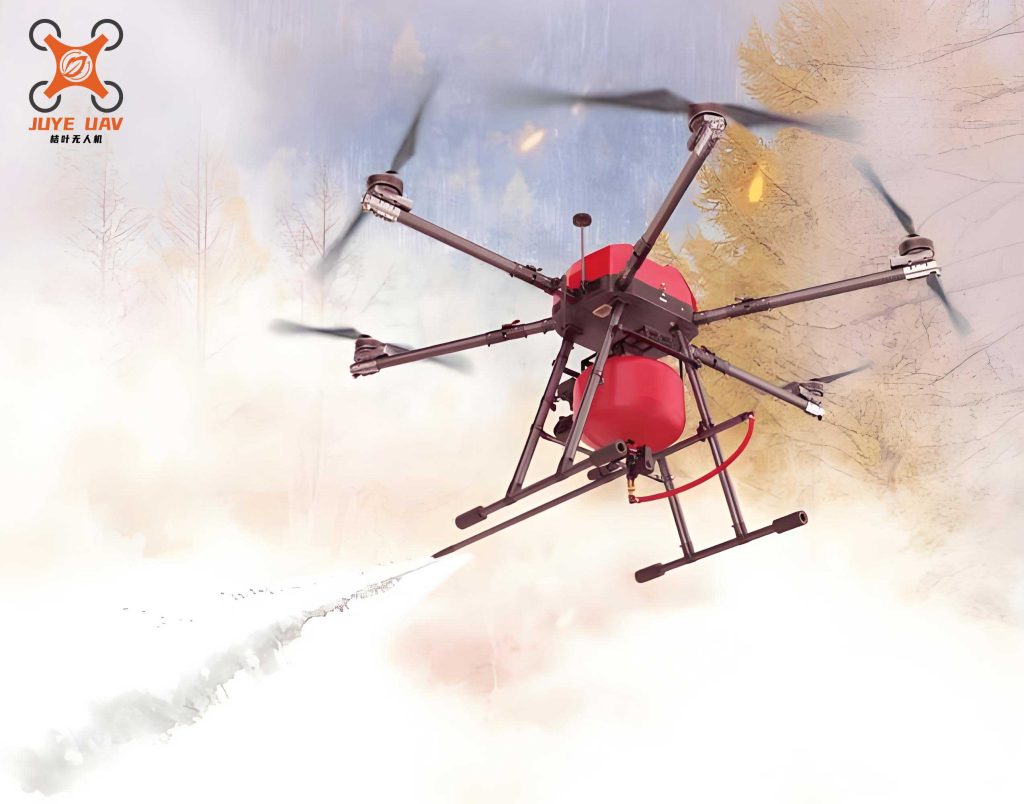
Moving to the flight control system, this is the brain of the fire UAV, responsible for navigation, stability, and autonomous operations. It comprises sensors like gyroscopes, accelerometers, and GPS modules, along with a central processor that executes control algorithms. In firefighting, the flight control system enables the fire UAV to follow pre-programmed routes, maintain position over a fire hotspot, or adapt to changing conditions. For example, using GPS waypoints, a fire UAV can autonomously patrol a perimeter, freeing operators to focus on data analysis. The control logic often involves PID (Proportional-Integral-Derivative) controllers, which can be modeled as:
$$ u(t) = K_p e(t) + K_i \int_0^t e(\tau) d\tau + K_d \frac{de(t)}{dt} $$
where \( u(t) \) is the control output (e.g., motor commands), \( e(t) \) is the error between desired and actual states (like altitude or orientation), and \( K_p \), \( K_i \), \( K_d \) are tuning parameters. This ensures smooth and responsive handling of the fire UAV, even in gusty winds common at fire scenes. Additionally, obstacle avoidance algorithms, powered by LIDAR or ultrasonic sensors, prevent collisions with structures or terrain, enhancing the fire UAV’s reliability.
The gimbal camera system is what makes the fire UAV an effective aerial photographer. It stabilizes the camera to eliminate vibrations and jerks, ensuring crisp imagery. In fire scenarios, a 3-axis gimbal with a high-resolution camera, often paired with thermal or multispectral sensors, captures detailed visuals. The gimbal uses feedback from inertial measurement units (IMUs) to adjust the camera’s pitch, roll, and yaw, keeping the target centered. This is vital for tasks like identifying trapped individuals or assessing structural integrity. The stabilization can be described by a transfer function in control theory, where the gimbal’s response \( G(s) \) to disturbances \( D(s) \) is minimized:
$$ G(s) = \frac{Y(s)}{D(s)} = \frac{1}{1 + C(s)H(s)} $$
with \( C(s) \) as the controller and \( H(s) \) as the sensor feedback. This technical sophistication allows the fire UAV to deliver professional-grade footage, which can be used for real-time analysis or archived for training. Moreover, the integration of zoom capabilities and auto-focus ensures that the fire UAV adapts to varying distances, from wide-area shots to close-ups of specific hazards.
The image transmission system completes the fire UAV’s functionality by wirelessly streaming data to ground stations. Operating on high-frequency bands like 5.8 GHz, it offers high bandwidth for HD video with low latency, though it may have limited range due to signal attenuation. To counteract this, fire UAVs often employ dual-antenna setups—omnidirectional for general coverage and directional for long-distance links. The signal strength \( S \) at a distance \( d \) can be approximated by the Friis transmission equation:
$$ S = P_t G_t G_r \left( \frac{\lambda}{4 \pi d} \right)^2 $$
where \( P_t \) is transmit power, \( G_t \) and \( G_r \) are antenna gains, and \( \lambda \) is wavelength. This equation underscores the importance of optimizing transmission parameters to maintain a stable feed from the fire UAV, especially in urban canyons or dense forests where interference is high. Secure encryption protocols protect data integrity, ensuring that sensitive information from the fire UAV isn’t compromised.
To illustrate these systems in action, consider a hypothetical case study of a large-scale industrial fire. Upon arrival, the fire brigade deploys a multi-rotor fire UAV equipped with thermal imaging. The airframe platform, chosen for its wind resistance, hovers safely above the blaze. The flight control system guides the fire UAV along a grid pattern, mapping heat distribution using waypoints. Simultaneously, the gimbal camera system captures high-definition video, highlighting compromised structures and hotspots. The image transmission system streams this data to commanders, who analyze it to direct water jets and evacuate personnel. Throughout, the fire UAV provides continuous updates, allowing for dynamic strategy adjustments. This scenario demonstrates how each component synergizes to enhance firefighting efficacy.
Beyond immediate firefighting, fire UAV aerial photography has broader applications in rescue operations. For instance, in search and rescue (SAR) missions after earthquakes or floods, a fire UAV can quickly scan vast areas, using infrared cameras to detect body heat. The data from the fire UAV helps prioritize zones for ground teams, saving precious time. Similarly, in hazardous material incidents, a fire UAV can sample air quality or visualize leak sources without exposing responders. The versatility of the fire UAV makes it a multi-role asset, adaptable to various emergencies.
To further elaborate, let’s examine a table comparing different types of fire UAVs based on their specifications and suitability for firefighting tasks:
| Fire UAV Type | Rotor Count | Max Flight Time (minutes) | Payload Capacity (kg) | Typical Use in Firefighting |
|---|---|---|---|---|
| Quadcopter | 4 | 25-30 | 1-2 | Quick reconnaissance, small-scale fires, indoor inspections. |
| Hexacopter | 6 | 40-50 | 3-5 | Medium-range missions, carrying multiple sensors like gas detectors. |
| Octocopter | 8 | 60+ | 5-10 | Large-scale wildfires, heavy payloads such as loudspeakers for evacuation. |
| Fixed-Wing | N/A (wings) | 120+ | 2-4 | Long-endurance patrols over forests, mapping fire perimeters. |
This comparison highlights how selecting the right fire UAV depends on operational needs. For most urban fire responses, multi-rotor fire UAVs are preferred due to their hover capability, while fixed-wing models excel in rural areas. The fire UAV’s endurance is a critical factor, often determined by battery technology. Recent advancements in lithium-polymer batteries have extended flight times, but trade-offs exist with weight and cost. The energy consumption \( E \) of a fire UAV can be modeled as:
$$ E = P \cdot t $$
where \( P \) is the power draw and \( t \) is time. For a fire UAV, \( P \) includes components like motors, cameras, and transmission systems. Optimizing this equation through efficient design allows the fire UAV to stay airborne longer, providing sustained surveillance.
In terms of data analysis, the imagery from a fire UAV can be processed using computer vision algorithms to extract actionable insights. For example, machine learning models can automatically identify fire fronts, smoke plumes, or structural damages in real-time. This automation reduces the cognitive load on operators and speeds up response. The fire UAV’s role in creating 3D maps of disaster zones is also noteworthy; by capturing overlapping images, photogrammetry software reconstructs detailed models. These models aid in planning rescue routes or assessing structural stability post-fire. The process involves solving bundle adjustment problems, which minimize reprojection errors:
$$ \min \sum_{i,j} \| x_{ij} – \hat{x}_{ij} \|^2 $$
where \( x_{ij} \) are observed image points and \( \hat{x}_{ij} \) are projected points from 3D coordinates. Such technical depth underscores the fire UAV’s value beyond mere photography—it’s a data collection hub.
Furthermore, the integration of fire UAVs with other technologies, like IoT sensors or drones swarms, represents the future of firefighting. Imagine a network of fire UAVs communicating with each other to cover a massive wildfire, each assigned a sector based on AI-driven coordination. This swarm intelligence can be modeled using multi-agent systems, where each fire UAV acts autonomously but collaboratively. The potential for scalability and resilience makes fire UAV swarms a promising avenue, though challenges like interference and battery life remain.
From a logistical perspective, the adoption of fire UAVs requires training and regulatory compliance. Pilots must be certified to operate fire UAVs safely, especially in crowded airspace during emergencies. Regulations often mandate line-of-sight operations or require beyond-visual-line-of-sight (BVLOS) waivers, which can be obtained through rigorous testing. The fire UAV’s operational protocols should include pre-flight checks, contingency plans for failures, and data management policies. As a practitioner, I emphasize the importance of standard operating procedures (SOPs) to maximize the fire UAV’s benefits while minimizing risks.
To quantify the impact of fire UAVs on rescue outcomes, we can use performance metrics such as response time reduction or area coverage efficiency. For instance, the area \( A \) scanned by a fire UAV in time \( T \) can be expressed as:
$$ A = v \cdot w \cdot T $$
where \( v \) is the velocity and \( w \) is the swath width of the camera. Compared to ground teams, a fire UAV can cover exponentially more area, as shown in empirical studies. In one analysis, a single fire UAV reduced scene assessment time by 70% in a warehouse fire, allowing quicker resource deployment. These metrics validate the fire UAV’s role as a force multiplier in firefighting.
In conclusion, fire UAV aerial photography technology has become a cornerstone of modern firefighting and rescue operations. Its advantages—rapid deployment, real-time data, risk reduction, and cost-effectiveness—make it an invaluable tool. By dissecting the systems of airframe platform, flight control, gimbal camera, and image transmission, we appreciate the engineering behind the fire UAV’s capabilities. As technology evolves, fire UAVs will likely incorporate more autonomy, better sensors, and enhanced connectivity, further transforming emergency response. For agencies worldwide, investing in fire UAV technology is not just an upgrade; it’s a necessity for saving lives and property. The fire UAV, as I have experienced, is more than a device—it’s a partner in the relentless fight against fire.
Looking ahead, research directions for fire UAVs include improving battery life through hydrogen fuel cells, enhancing AI for predictive analytics, and developing robust communication networks for disaster zones. Collaborative efforts between academia, industry, and fire departments will drive innovation. Ultimately, the goal is to create a seamless ecosystem where fire UAVs operate alongside human responders, providing a synergistic approach to safety. As we continue to harness the power of fire UAVs, the future of firefighting looks brighter, smarter, and safer.