
As a professional in the field of digital media and aerial technology, I have witnessed the rapid evolution of drone light shows and their transformative impact on sports events. The integration of drone light shows into sports has revolutionized how we experience and engage with competitions, offering unparalleled visual spectacles that enhance both live and broadcast experiences. In this article, I will delve into the technical aspects, visual language, applications, and techniques of drone light shows in sports, emphasizing the keyword ‘drone light show’ throughout. I aim to provide a comprehensive overview that includes tables and formulas to summarize key concepts, ensuring a detailed exploration that exceeds 8000 tokens in length.
The rise of drone light shows can be attributed to advancements in unmanned aerial vehicle (UAV) technology, particularly in consumer-grade drones equipped with LED lighting systems. A drone light show involves a fleet of drones flying in synchronized patterns to create dynamic aerial displays, often forming intricate shapes, logos, or animations. This technology has gained prominence in sports events due to its ability to captivate audiences, promote brands, and complement the athletic spectacle. Unlike traditional pyrotechnics, drone light shows are eco-friendly, reusable, and programmable, making them a preferred choice for modern sports entertainment.
From a technical perspective, a drone light show relies on several core elements: the drones themselves, the flight control system, the lighting modules, and the synchronization software. Each drone is typically a multi-rotor UAV with GPS positioning, inertial measurement units (IMUs), and wireless communication capabilities. The flight control system orchestrates the drones’ movements using algorithms that ensure precise coordination. For instance, the position of each drone at time \( t \) can be modeled with vector equations: $$ \vec{r}_i(t) = (x_i(t), y_i(t), z_i(t)) $$ where \( \vec{r}_i(t) \) represents the position vector of drone \( i \), and \( x_i, y_i, z_i \) are its coordinates in three-dimensional space. The synchronization of lights is achieved through pulse-width modulation (PWM) signals, allowing for real-time color and intensity changes. The light intensity \( I \) at a distance \( r \) from a drone can be approximated by: $$ I(r) = \frac{P}{4\pi r^2} $$ where \( P \) is the luminous power of the LED. This formula helps in planning visibility for large stadiums.
To better understand the components, consider the following table that outlines the key technical specifications for a typical drone light show system:
| Component | Description | Role in Drone Light Show |
|---|---|---|
| Drone Platform | Multi-rotor UAV with GPS and IMU | Provides aerial mobility and stability for light display |
| Lighting Module | RGB LEDs with high luminosity | Generates colorful patterns and animations in the sky |
| Flight Controller | Onboard computer with pre-programmed paths | Orchestrates synchronized flight patterns and avoids collisions |
| Ground Station | Software for real-time monitoring and control | Allows operators to adjust shows dynamically and ensure safety |
| Communication Link | Wireless network (e.g., RF or Wi-Fi) | Transmits commands and data between drones and ground control |
The visual language of a drone light show is distinct from traditional aerial photography, though it shares some principles. While drone航拍 often focuses on capturing footage from a ‘God’s eye view,’ a drone light show emphasizes creating immersive visual narratives through light and motion. The镜头运动 in a drone light show can be described in terms of choreography: drones may perform longitudinal movements (e.g., advancing or retreating to create depth), lateral movements (e.g., shifting left or right to form sweeping patterns), and vertical movements (e.g., ascending or descending to add dimensionality). These movements are coordinated to produce effects similar to cinematic shots, such as ‘zoom-ins’ where drones converge to highlight a logo, or ‘panoramas’ where they spread out to cover the entire sky. The synchronization of these motions with music and event timing enhances the emotional impact, making drone light shows a powerful tool for storytelling in sports.
In sports events, drone light shows have found diverse applications. They are commonly used in opening ceremonies to set the tone, during halftime shows to entertain audiences, and in closing ceremonies to celebrate achievements. For example, a drone light show can depict the mascot of a sports team, animate key moments from a game, or display sponsors’ logos in a captivating manner. Additionally, drone light shows serve promotional purposes by creating shareable content on social media, thus amplifying the event’s reach. The flexibility of drone light shows allows them to adapt to various sports, from large-scale events like the Olympics to local tournaments. Below is a table summarizing the primary applications of drone light shows in sports:
| Application Scenario | Description | Benefits of Drone Light Show |
|---|---|---|
| Opening Ceremonies | Kickstarting events with aerial displays of symbols or themes | Creates a memorable first impression and engages global audiences |
| Halftime Entertainment | Providing visual interludes during breaks in games | Maintains audience excitement and offers unique photo opportunities |
| Sponsor Promotion | Displaying brand logos or messages in the sky | Enhances brand visibility in an innovative, non-intrusive way |
| Victory Celebrations | Commemorating wins with animated sequences | Adds to the festivity and creates lasting memories for fans |
| Training and Analysis | Using drone fleets to simulate game scenarios for training | Helps athletes visualize strategies and improve performance |
When executing a drone light show, several techniques are crucial for success. First, the飞行高度 must be carefully calibrated based on the venue size and audience perspective. For instance, in a stadium, drones may fly at altitudes between 50 to 200 meters to ensure visibility without obstructing views. The飞行速度 should be consistent and synchronized with music beats; mathematical models like the following can optimize speed: $$ v(t) = v_0 + a \cdot \sin(\omega t + \phi) $$ where \( v(t) \) is the velocity at time \( t \), \( v_0 \) is the baseline speed, \( a \) is the amplitude of variation, \( \omega \) is the angular frequency tied to music tempo, and \( \phi \) is the phase shift. This allows drones to move in rhythm, enhancing the show’s dynamism. Additionally, the拍摄角度 for a drone light show often involves a combination of俯拍 and oblique perspectives to create 3D illusions. Operators use software to pre-visualize patterns, ensuring that formations like spirals or waves are rendered accurately from all viewing angles.
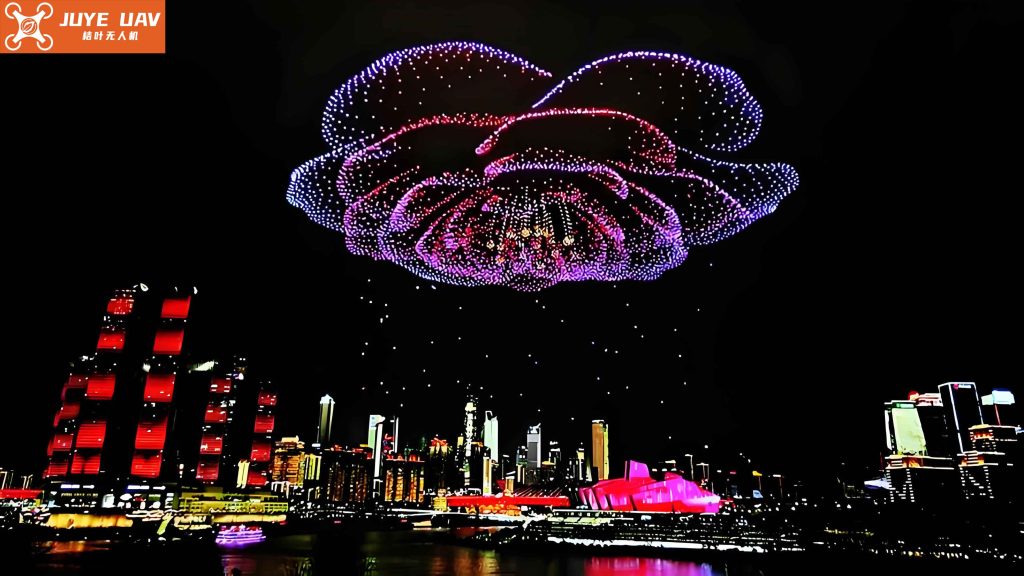
To illustrate the grandeur of a drone light show, consider the following image that captures a typical display during a sports event. This visual exemplifies how drones can transform the night sky into a canvas of light, blending technology with artistry:
The coordination of a drone light show relies heavily on algorithms for swarm intelligence. Each drone follows a set of rules to maintain formation, avoid collisions, and adapt to environmental changes. One common approach uses the Boids model, where drones adjust their position based on neighboring drones. The equations for alignment, cohesion, and separation are: $$ \vec{v}_i(t+1) = \vec{v}_i(t) + \alpha \vec{A} + \beta \vec{C} + \gamma \vec{S} $$ where \( \vec{v}_i \) is the velocity of drone \( i \), and \( \vec{A} \), \( \vec{C} \), \( \vec{S} \) represent alignment, cohesion, and separation vectors, respectively, with weights \( \alpha, \beta, \gamma \) tuned for smooth motion. This ensures that the drone light show remains cohesive even under wind or other disturbances. Furthermore, the energy consumption of drones is a critical factor; the power required for flight and lighting can be estimated with: $$ E = \sum_{i=1}^{n} \left( P_{flight,i} \cdot t + P_{light,i} \cdot t \right) $$ where \( E \) is the total energy, \( n \) is the number of drones, \( P_{flight,i} \) and \( P_{light,i} \) are the power draws for flight and lights of drone \( i \), and \( t \) is the show duration. Optimizing this helps in planning battery life and show length.
In terms of practical implementation, a drone light show involves meticulous planning. Pre-show preparations include 3D mapping of the venue, programming flight paths, and testing communication systems. During the show, real-time monitoring via ground stations allows for adjustments, such as altering patterns in response to live event developments. Post-show, data analytics can assess performance metrics like synchronization accuracy and audience engagement. The versatility of drone light shows means they can be tailored to different sports: for instance, in马拉松 events, drones might form encouraging messages along the route, while in帆船赛事, they could create aquatic-themed animations above the water. The adaptability of drone light shows makes them a valuable asset for enhancing the spectator experience.
Looking ahead, the future of drone light shows in sports is promising. Advances in AI and machine learning will enable more autonomous and interactive displays, where drones respond to crowd reactions or game outcomes in real time. Additionally, the integration of augmented reality (AR) could allow viewers to see enhanced visuals through their devices, blending physical and digital realms. However, challenges remain, such as regulatory compliance for airspace and ensuring safety in crowded venues. By addressing these through continued innovation, drone light shows will likely become a staple in sports entertainment, offering ever-more spectacular and immersive experiences. The keyword ‘drone light show’ encapsulates this fusion of technology and creativity, driving the evolution of sports media.
To summarize the advantages of drone light shows over traditional methods, here is a comparative table:
| Aspect | Drone Light Show | Traditional Fireworks |
|---|---|---|
| Environmental Impact | Low (electric-powered, no debris) | High (pollution from chemicals and waste) |
| Safety | Controlled via software, less fire risk | Inherent fire and explosion hazards |
| Customizability | High (programmable patterns and colors) | Limited (fixed pyrotechnic effects) |
| Reusability | Drones can be used multiple times | Single-use, requiring replenishment |
| Precision | Exact formation control with GPS | Less precise, subject to wind and conditions |
In conclusion, as an expert in this domain, I believe that drone light shows represent a significant leap forward in how we conceptualize and execute visual entertainment in sports. By leveraging aerial technology, synchronized lighting, and sophisticated choreography, drone light shows not only captivate audiences but also open new avenues for sponsorship, promotion, and artistic expression. The repeated emphasis on ‘drone light show’ throughout this article underscores its centrality to modern sports events. As technology continues to evolve, we can expect drone light shows to become even more integral, transforming skies into dynamic stages that celebrate athleticism and innovation alike.