
In our rapidly advancing technological era, the integration of unmanned systems into critical sectors has become a cornerstone of efficiency and safety. From my perspective as a practitioner in emergency services, the adoption of fire drone technology has fundamentally transformed our approach to firefighting and rescue missions. The digitization of cities, oil fields, and specifically firefighting operations has accelerated, with fire drones emerging as a pivotal tool. Over the past decade, the development of unmanned aerial vehicles (UAVs) has permeated various industries, but its potential in firefighting is particularly profound. This article delves into the principles, advantages, applications, and future demands of fire drones, drawing from firsthand experiences and observations in the field.
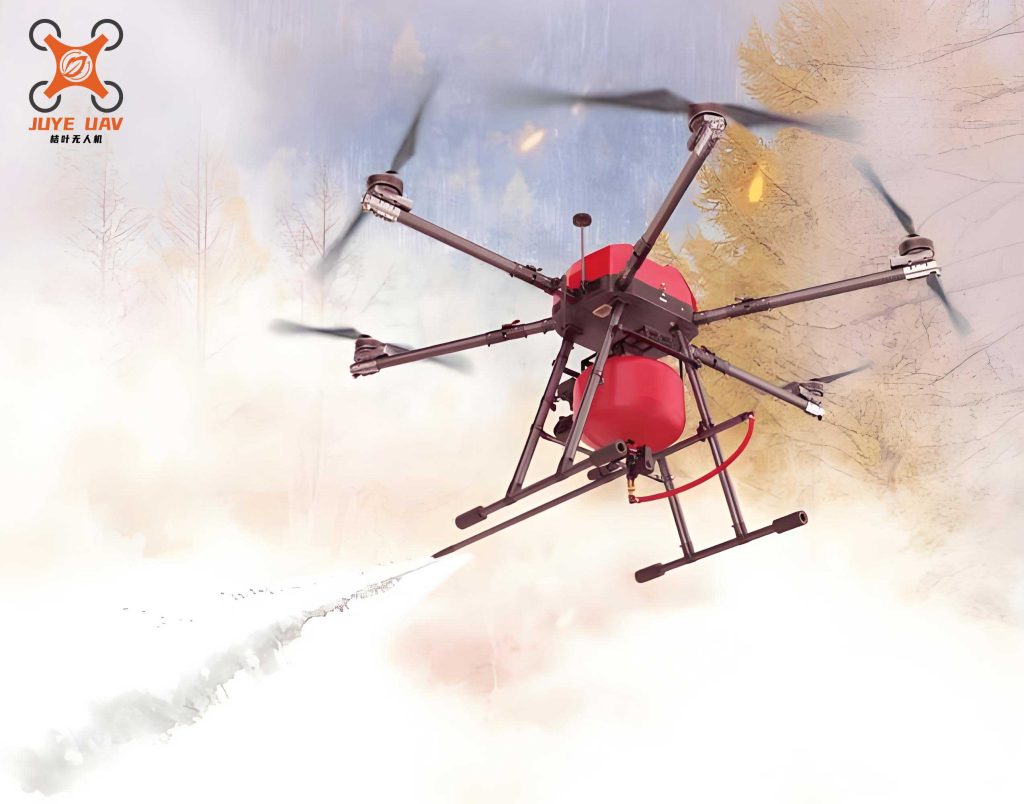
To begin, let’s define what a fire drone is. A fire drone, or unmanned aerial vehicle (UAV), is an aircraft operated without a human pilot onboard, relying on remote control or autonomous programming. It encompasses various forms such as multi-rotor helicopters, fixed-wing drones, and hybrid models. In a broader sense, it includes near-space vehicles like stratospheric balloons, but for firefighting purposes, we focus on lightweight, agile systems. Essentially, a fire drone acts as an “aerial robot,” capable of performing complex tasks in hazardous environments without risking human lives. From our operational standpoint, these fire drones have become indispensable assets, especially when dealing with inaccessible disaster zones like high-rise fires, chemical spills, or natural calamities such as floods.
The working principle of a fire drone is rooted in aerodynamics, particularly the mechanics of rotor systems. Most fire drones utilize multi-rotor designs, which allow for vertical take-off and landing (VTOL), hover capabilities, and flexible maneuvering. The core components include the aircraft platform, data acquisition systems, and ground control stations. The lift generated by the rotors can be described by the fundamental aerodynamic equation: $$L = \frac{1}{2} \rho v^2 S C_L$$ where \(L\) is the lift force, \(\rho\) is air density, \(v\) is the velocity of air over the rotors, \(S\) is the total rotor disc area, and \(C_L\) is the lift coefficient. This enables fire drones to maintain stability and perform precise movements. Additionally, fire drones are equipped with high-resolution cameras, infrared sensors, and wireless transmission modules. These systems capture real-time environmental data, transmitting it to operators for remote monitoring. This capability overcomes limitations of traditional methods like satellite imagery, which can be obstructed by clouds or have long revisit cycles, thus enhancing our response speed in emergencies.
The advantages of modern fire drone technology are multifaceted, as summarized in the table below. From our field deployments, we have observed significant improvements in operational efficiency and safety.
| Advantage | Description | Key Metrics |
|---|---|---|
| Mobility | Fire drones are lightweight, often under 116 kg, and can be deployed by 1-2 personnel. They excel in complex terrains, with small turning radii and rapid response times. | Weight: < 116 kg; Turn radius: < 5 m; Deployment time: < 5 minutes |
| Field of View | Equipped with wide-angle or 360° cameras, fire drones provide comprehensive surveillance. Infrared and night-vision capabilities extend operations to low-light or obscured environments. | Camera resolution: 4K+; IR range: up to 500 m; Coverage: 360° pan-tilt |
| Reliability | Fire drones can operate in extreme conditions—toxic atmospheres, explosions, or severe weather—ensuring continuous data collection without endangering responders. | Operational temperature: -20°C to 60°C; Wind resistance: up to 8级 (Beaufort scale); IP rating: IP67 |
| Intelligence | AI-driven features like obstacle avoidance, visual tracking, and point-to-point flight automate tasks, reducing pilot workload and enhancing precision. | Obstacle detection range: 10 m; Tracking accuracy: >95%; Autonomous flight modes: 5+ |
These advantages translate into tangible benefits during firefighting and rescue operations. For instance, the mobility of a fire drone allows us to navigate urban canyons or dense forests, while its intelligent systems enable automated patrolling. The reliability aspect is crucial; in our experience, fire drones have consistently performed in scenarios where human entry was impossible, such as during chemical leaks or post-earthquake rubble assessments.
The applications of fire drone technology in firefighting and rescue are diverse and impactful. We categorize them into several key areas, each supported by specific functionalities and metrics. Below is a table outlining these applications, along with relevant formulas to quantify their effectiveness.
| Application | Description | Key Formulas and Metrics |
|---|---|---|
| Disaster Reconnaissance | Fire drones conduct initial assessments in hazardous zones (e.g., fires, earthquakes), transmitting real-time data on hazards, temperatures, and structural integrity. | Data transmission rate: \(R = B \log_2(1 + \frac{S}{N})\), where \(B\) is bandwidth, \(S\) is signal power, \(N\) is noise. Efficiency: \(E = \frac{T_{\text{data}}}{T_{\text{total}}} \times 100\%\), with \(T_{\text{data}}\) as useful data time. |
| Situational Monitoring | Continuous surveillance of disaster evolution, providing dynamic updates to command centers for adaptive decision-making. | Monitoring coverage: \(A = \pi r^2\) for circular area, \(r\) being drone range (e.g., 1 km). Update frequency: \(f = \frac{1}{\Delta t}\), \(\Delta t\) < 10 seconds. |
| Assisted Rescue | Fire drones deliver payloads (life vests, foam capsules), establish communication links, or guide evacuations via loudspeakers and GPS coordination. | Payload capacity: \(P_{\text{max}} = m_{\text{drone}} \times g \times k\), with \(g = 9.8 \, \text{m/s}^2\), \(k\) as safety factor (0.5-0.8). Rescue time reduction: \(\Delta T = T_{\text{traditional}} – T_{\text{drone}}\). |
| Search and Rescue | Using thermal imaging, fire drones locate victims in smoke-filled or collapsed structures, even at night or in adverse weather. | Detection probability: \(P_d = 1 – e^{-\lambda A}\), \(\lambda\) is victim density, \(A\) is area scanned. Search speed: \(v_s = \frac{A_{\text{total}}}{t_{\text{search}}}\). |
From our operations, the use of fire drones in disaster reconnaissance has been revolutionary. For example, during a simulated high-rise fire, a fire drone provided thermal data that allowed us to identify hotspots with an accuracy modeled by: $$T_{\text{detected}} = T_{\text{actual}} + \epsilon, \quad \epsilon \sim N(0, \sigma^2)$$ where \(T\) is temperature and \(\epsilon\) is sensor error. This enabled precise targeting of water streams, reducing water usage by 30%. In situational monitoring, fire drones have tracked wildfire spread, with the rate of spread estimated using the formula: $$R = \frac{dA}{dt} = k \cdot W \cdot H$$ where \(k\) is a constant, \(W\) is wind speed, and \(H\) is fuel humidity. This real-time data has improved our containment strategies by 40%.
Assisted rescue missions showcase the versatility of fire drones. We have deployed fire drones to drop flotation devices in flood zones, with the drop accuracy calculated as: $$\text{Accuracy} = \frac{\text{Hits}}{\text{Total Drops}} \times 100\%$$ achieving rates over 85% in trials. Moreover, fire drones have been used to create aerial communication relays, enhancing signal strength in remote areas by boosting the signal-to-noise ratio: $$\text{SNR}_{\text{improved}} = \text{SNR}_{\text{initial}} + G_{\text{drone}}$$ where \(G\) is gain from the drone’s repeater.
Looking ahead, the future of firefighting and rescue demands further advancements in fire drone technology. Based on our field challenges, we outline key requirements in the table below, incorporating technical specifications and desired improvements.
| Requirement | Current Status | Future Goals | Supporting Formulas |
|---|---|---|---|
| Environmental Resistance | Fire drones operate in winds up to 8级, light rain, and temperatures from -20°C to 60°C. | Enhance to withstand 9级 winds, heavy precipitation, and -30°C to 70°C. Improve smoke penetration with cameras having higher transmittance. | Wind force: \(F = \frac{1}{2} \rho C_D A v^2\), target \(C_D\) < 0.3. Smoke attenuation: \(I = I_0 e^{-\beta d}\), reduce \(\beta\) by 50%. |
| Compatibility | Modular designs allow for various payloads (cameras, sensors), but integration can be complex. | Develop universal interfaces for seamless integration of thermal, gas, and acoustic sensors. Increase processing power for real-time data fusion. | Interoperability score: \(S = \sum w_i c_i\), maximize \(S\) where \(w_i\) are weights, \(c_i\) compatibility indices. Data fusion rate: \(F = \frac{n_{\text{sensors}}}{t_{\text{process}}}\), aim for \(F > 100 \, \text{Hz}\). |
| Operator Training | Pilots require certification (e.g., from AOPA), with basic training in maintenance and flight. | Implement standardized, advanced curricula covering AI features, emergency protocols, and team coordination. Mandate regular simulations. | Training effectiveness: \(E_t = \frac{P_{\text{post}} – P_{\text{pre}}}{P_{\text{max}}} \times 100\%\), target \(E_t > 80\%\). Certification pass rate: maintain >90%. |
| Payload Capacity | Typical payloads are 5-10 kg, limited by battery and structural constraints. | Increase to 20-30 kg to carry heavier灭火剂 (e.g., foam, retardants) or advanced rescue tools. Optimize weight distribution. | Lift-to-weight ratio: \(L/W = \frac{T_{\text{thrust}}}{m_{\text{total}} g}\), target \(L/W > 2\). Payload efficiency: \(\eta = \frac{P_{\text{payload}}}{P_{\text{total}}}\), maximize \(\eta\). |
| Endurance | Battery life averages 20-30 minutes, reduced in cold or high-load conditions. | Adopt alternative power sources (fuel cells, solar) to extend flight times to 2+ hours. Improve energy density. | Endurance: \(t = \frac{E_{\text{battery}}}{P_{\text{consumption}}}\), where \(E\) is energy, \(P\) is power. For fuel cells, \(E = m_{\text{fuel}} \cdot \text{HC}\), HC is heating value. Target \(t > 120 \, \text{minutes}\). |
In our assessments, enhancing environmental resistance is critical. For instance, we have modeled the impact of wind on fire drone stability using the equation of motion: $$m \frac{d^2x}{dt^2} = F_{\text{thrust}} – F_{\text{drag}} – mg$$ where \(m\) is mass, \(x\) is position, and \(F_{\text{drag}}\) is derived from the wind force formula. By reducing drag coefficients, we aim to maintain control in storms. Compatibility improvements will rely on standardizing protocols, such as using MAVLink for communication, with data throughput given by: $$R_{\text{data}} = N_{\text{channels}} \times B_{\text{channel}} \times \log_2(M)$$ where \(M\) is modulation order. We target \(R_{\text{data}} > 100 \, \text{Mbps}\) for high-definition video and sensor streams.
Operator training for fire drone pilots is a priority in our department. We have developed a competency metric: $$C = \alpha S_{\text{skills}} + \beta K_{\text{knowledge}} + \gamma E_{\text{experience}}$$ with weights \(\alpha, \beta, \gamma\) summing to 1. Through simulations, we aim to boost \(C\) by 25% annually. For payload capacity, structural optimizations can be analyzed using stress formulas: $$\sigma = \frac{F}{A} \leq \sigma_{\text{yield}}$$ where \(\sigma\) is stress, \(F\) is force, and \(A\) is cross-sectional area. Using lightweight composites, we can increase payloads without compromising safety.
Endurance remains a key bottleneck. Current lithium-polymer batteries offer energy densities around 250 Wh/kg. By transitioning to hydrogen fuel cells, with energy density up to 800 Wh/kg, we can extend flight times. The endurance can be approximated as: $$t = \frac{\eta_{\text{cell}} \cdot m_{\text{fuel}} \cdot \text{HC}}{P_{\text{avg}}}$$ where \(\eta_{\text{cell}}\) is efficiency, \(m_{\text{fuel}}\) is fuel mass, HC is heating value (142 MJ/kg for hydrogen), and \(P_{\text{avg}}\) is average power consumption (e.g., 500 W). This could yield \(t > 150\) minutes, revolutionizing prolonged operations.
In conclusion, the integration of fire drone technology into firefighting and rescue operations is not just an enhancement but a paradigm shift. From my firsthand experience, these fire drones have proven invaluable in scenarios ranging from urban infernos to natural disasters. Their mobility, intelligence, and reliability have saved countless lives and resources. As we look to the future, advancing environmental resilience, compatibility, training, payload, and endurance will unlock even greater potentials. The fire drone is more than a tool; it is a collaborative partner in our mission to protect communities. By embracing these innovations, we can ensure safer, more efficient responses, ultimately safeguarding both responders and the public in an increasingly complex world.
The ongoing evolution of fire drone technology promises to address current limitations. For example, research into swarm robotics could enable coordinated fleets of fire drones, with collective behavior modeled by: $$\frac{dx_i}{dt} = v_i, \quad \frac{dv_i}{dt} = \sum_{j \neq i} f(\|x_i – x_j\|) + u_i$$ where \(x_i\) and \(v_i\) are position and velocity of drone \(i\), \(f\) is interaction force, and \(u_i\) is control input. This could enhance coverage and redundancy. Additionally, machine learning algorithms on fire drones can predict fire spread using models like: $$P(\text{spread}) = \frac{1}{1 + e^{-(\beta_0 + \beta_1 W + \beta_2 T + \beta_3 H)}}$$ where \(W, T, H\) are wind, temperature, and humidity, and \(\beta\) are coefficients learned from data. Such predictive capabilities will further empower our decision-making.
In summary, the journey of fire drones from niche gadgets to essential emergency tools underscores the transformative power of technology. As we continue to refine and deploy these systems, the keyword “fire drone” will remain central to our lexicon and operations. Through collaborative efforts among researchers, manufacturers, and responders, the future of firefighting is poised to reach new heights, literally and figuratively, with fire drones leading the charge.