
The chemical industry, handling vast quantities of flammable, explosive, and toxic substances, is perpetually shadowed by the risk of catastrophic incidents. When fires or explosions occur, conventional response methods often struggle to rapidly and safely assess the full scope of the danger, potentially leading to delayed interventions and exacerbated losses. In this high-stakes arena, drone technology has emerged as a game-changer. As a firefighting professional, I have witnessed firsthand the paradigm shift brought about by the integration of unmanned aerial systems. Fire drones, with their unparalleled mobility, rapid deployment, and adaptability, offer a critical aerial perspective that fundamentally enhances situational awareness and operational efficacy. This article systematically explores the multifaceted application of fire drone technology in chemical incident response, detailing its core utilities, analyzing existing challenges, and proposing pathways for optimization to fully realize its life-saving and property-preserving potential.
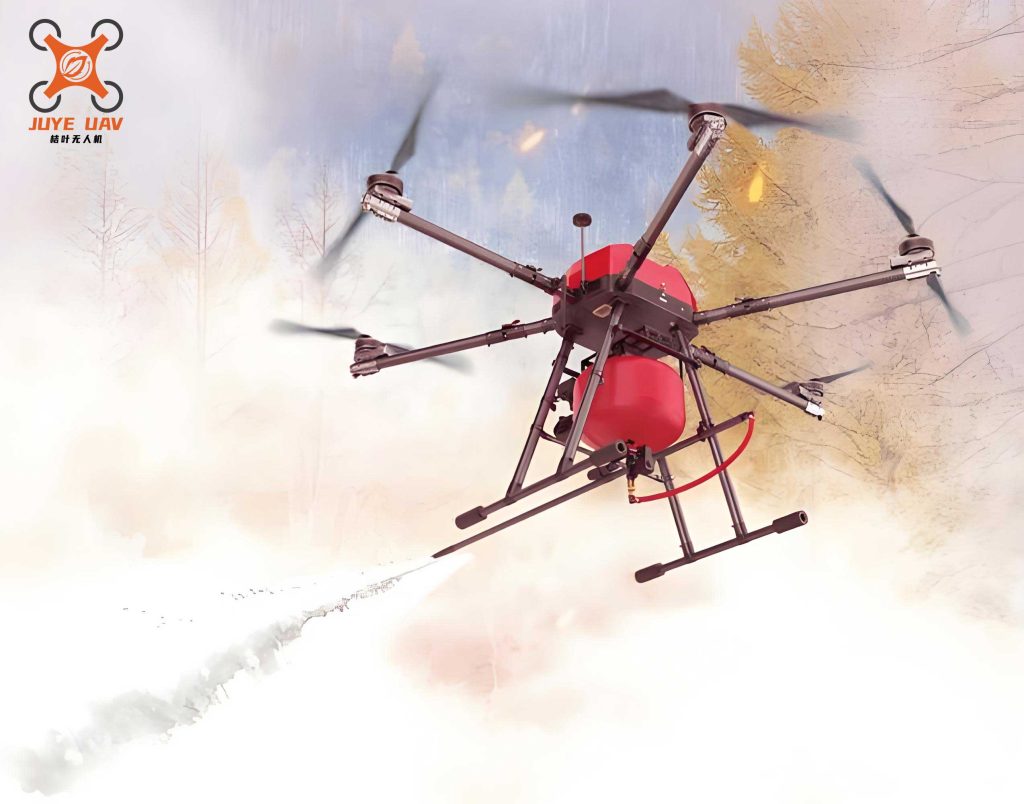
The importance of fire drone technology in chemical firefighting cannot be overstated. Traditional reconnaissance in the immediate aftermath of a chemical incident is perilously slow and dangerously exposes personnel to toxic atmospheres, thermal radiation, and potential secondary explosions. Fire drones circumvent these limitations. They can be airborne within minutes, penetrating smoke clouds and hovering over epicenters that are inaccessible to ground teams. Equipped with a suite of sensors—high-definition visible light, infrared (IR) thermal imaging, and multi-gas detectors—these aerial platforms deliver real-time, multi-dimensional intelligence. This immediate data stream on fire spread, structural integrity, chemical plume dispersion, and safe ingress/egress routes provides command centers with the foundational intelligence for sound decision-making. The enhanced timeliness, comprehensiveness, and, crucially, the safety of information acquisition provided by fire drones compared to manual reconnaissance is transformative, forming the bedrock for scientific risk assessment and optimal resource deployment.
The operational advantages of fire drones can be quantitatively conceptualized in terms of information gain and risk reduction. We can define an Operational Effectiveness Index (OEI) for a fire drone mission:
$$ OEI = \frac{\alpha \cdot I_{drone} + \beta \cdot (1 – R_{drone})}{T_{deploy} + C_{op}} $$
Where:
- $I_{drone}$ represents the normalized information fidelity (0 to 1) gathered by the drone’s sensors.
- $R_{drone}$ represents the normalized risk (0 to 1) to human personnel avoided by using the drone.
- $T_{deploy}$ is the deployment time in minutes.
- $C_{op}$ is a normalized operational complexity factor.
- $\alpha$ and $\beta$ are weighting coefficients for information and safety, respectively, with $\alpha + \beta = 1$.
A higher OEI signifies a more effective drone-assisted operation, highlighting the dual benefit of superior intelligence and enhanced personnel safety.
Core Application Domains of Fire Drones
The utility of fire drones in chemical firefighting extends across the entire incident lifecycle, from initial response to final mop-up and search operations.
1. Surveillance and Reconnaissance (ISR)
This is the most established and critical application. Fire drones act as flying sentinels and scouts. For pre-incident monitoring, they conduct routine inspections of pipelines, storage tanks, and process units, identifying potential leaks or hotspots using IR cameras before they escalate. During an active incident, their role becomes indispensable. They provide a stable, elevated platform for capturing panoramic views, mapping the extent of the incident. Thermal imaging cameras see through smoke, identifying the core heat sources and tracing the movement of heated gases or liquids. Furthermore, drones equipped with Integrated Pathfinder-type gas sensors can perform “sniffing” patrols downwind, creating real-time concentration maps of hazardous gases like VOCs, H2S, or NH3. This data is vital for establishing safety perimeters and guiding evacuation plans. Small, agile fire drones can navigate through complex industrial structures—between pipes, inside partially collapsed buildings—to inspect areas completely blind to ground crews.
| Sensor Type | Primary Function | Key Metrics/Output |
|---|---|---|
| Visible Light Camera (4K+/Zoom) | High-resolution imagery, damage assessment, visual tracking. | Spatial resolution (pixels), optical zoom power (e.g., 30x). |
| Radiometric Thermal Camera | Heat source detection, smoke penetration, temperature measurement. | Thermal sensitivity (< N mK), resolution, temperature range. |
| Multi-Gas Detector / Laser Spectroscopy | Identification and quantification of specific toxic/flammable gases. | Detection limits (ppm/ppb), response time, gas library. |
| LiDAR or Photogrammetry System | 3D mapping of the scene, volume calculation (e.g., for foam blanket). | Point cloud density, accuracy, scan rate. |
2. Logistics and Payload Delivery
When ground access is severed by fire, debris, or contamination, fire drones become vital aerial supply lines. Heavy-lift multirotor or fixed-wing hybrid fire drones can transport critical payloads directly to frontline responders or over barriers. These payloads include:
- Firefighting Agents: Specialized containers for fire suppressant gels, encapsulated dry chemical, or Class B foam concentrate for direct application or resupply.
- Emergency Equipment: Spare breathing apparatus (BA) cylinders, toolkits for emergency valve operation, chemical suits, and medical first-response kits.
- Sustenance: Water and supplies for isolated crews.
The logistics efficiency can be modeled by a simple delivery capacity formula for a drone fleet:
$$ Total\,Payload\,Mass\,(kg) = \sum_{i=1}^{n} (P_i \cdot \frac{T_{mission}}{T_{cycle_i}}) $$
Where for each drone $i$:
- $P_i$ is its usable payload capacity (kg).
- $T_{mission}$ is the total mission window (mins).
- $T_{cycle_i}$ is its round-trip cycle time (flight + load/unload) in minutes.
This highlights how increasing payload capacity and reducing cycle time (through faster drones or forward staging areas) exponentially increases total delivery throughput.
3. Direct Fire Suppression
Beyond observation, fire drones are evolving into active firefighting platforms. Dedicated large-scale fire suppression drones are equipped with integrated pump and nozzle systems, delivering water, foam, or dry chemical with precision. They can approach from angles impossible for ground apparatus—directly above a tank fire or into the heart of a pipe rack. Their key advantages include:
- Precision Targeting: Using their own camera feeds, they can direct a stream or droplet cloud precisely onto the base of a flame.
- Overhead Attack: Effective for combating pool fires or cooling exposed tank surfaces.
- Access: Reaching fires in elevated or structurally compromised areas.
The effectiveness of a suppression drone can be analyzed using fluid dynamics. The thrust required to maintain hover while expelling suppressant is critical:
$$ T_{hover} = W_{drone} + W_{payload} + \rho \cdot v_j \cdot Q $$
Where:
- $T_{hover}$ is the total thrust required.
- $W$ denotes weights of the empty drone and liquid payload.
- $\rho$ is the density of the expelled suppressant.
- $v_j$ is the exit velocity of the suppressant jet.
- $Q$ is the volumetric flow rate.
This equation shows the direct trade-off between firefighting flow rate ($Q$) and the drone’s power requirements and stability.
| Suppressant Type | Delivery Mechanism | Ideal Target | Advantages | Limitations |
|---|---|---|---|---|
| Water / Foam Solution | Integrated pump & nozzle, droplet cloud or stream. | Class A fires, cooling exposures, small Class B. | High cooling capacity, can be mixed with foam. | Heavy, requires pump power, limited chemical resistance. |
| Dry Chemical (ABC/BC) | Pressurized vessel with expellant gas. | 3D running fuel fires, electrical fires, metal fires. | Rapid knock-down, interrupts chain reaction. | Limited quantity, messy, no cooling effect. |
| Encapsulator Agent | Droplet dispersion from tank. | Hydrocarbon pool fires, spill fires. | Forms a vapor-sealing membrane, long-lasting. | Specialized agent, higher cost. |
4. Search and Rescue (SAR)
In the chaotic aftermath of an explosion, locating missing personnel is urgent and perilous. Fire drones significantly accelerate and secure this process. Equipped with high-zoom cameras and thermal imagers, they can swiftly scan large areas of rubble. Thermal imaging is particularly effective at night or in smoke, detecting human body heat signatures. Advanced drones may carry acoustic sensors (parabolic microphones) to detect faint calls for help or even deploy two-way communication modules to establish contact with survivors. They can also deliver small survival kits—water, radios, light sources—to trapped individuals while heavy extraction is organized.
Persistent Challenges and Technical Bottlenecks
Despite their promise, the operational deployment of fire drones in extreme chemical environments faces significant hurdles.
1. Hostile Flight Environment
Chemical incident sites present a confluence of extreme conditions that challenge drone integrity and functionality.
- Thermal Effects: Intense radiant heat can soften composite airframes, degrade electronic components, and create severe thermal updrafts, destabilizing flight control. The performance degradation of electronics with temperature can be approximated by the Arrhenius equation:
$$ \lambda(T) = A e^{-E_a / (k_B T)} $$
Where $\lambda$ is the failure rate, $E_a$ is the activation energy, $k_B$ is Boltzmann’s constant, and $T$ is the absolute temperature. High $T$ exponentially increases failure risk.
- Atmospheric Obscurants: Dense smoke and particulates attenuate both visible and IR radiation, degrading camera performance and hindering visual navigation algorithms.
- Chemical Corrosivity & ESD: Acidic or caustic gases can corrode sensitive components. More insidiously, charged particulate plumes (e.g., from smoke) can induce electrostatic discharges (ESD), frying avionics or causing ignition in flammable atmospheres.
- Complex Electromagnetics (EM): Dense metallic infrastructure causes multi-path fading and signal blockages for radio control (RC) and telemetry links, risking a loss-of-link (LOL) event.
2. Limited Endurance and Power
The energy density of current lithium-polymer (LiPo) batteries severely constrains mission duration. A typical heavy-lift fire drone may have only 15-25 minutes of effective hover time with a full firefighting payload. This necessitates a complex logistics chain of multiple batteries, charging stations, and rapid swap protocols, which breaks operational continuity. The fundamental limitation is expressed in the specific energy:
$$ E_{specific} = \frac{E}{m_{battery}} \quad \text{(Wh/kg)} $$
Current LiPo technology offers ~250 Wh/kg. For a mission requiring energy $E_{mission}$, the battery mass becomes:
$$ m_{battery} = \frac{E_{mission}}{E_{specific} \cdot \eta} $$
where $\eta$ is the total powertrain efficiency. Until $E_{specific}$ improves dramatically (e.g., through solid-state or hydrogen fuel cells), endurance remains a critical bottleneck. Furthermore, LiPo batteries themselves pose a fire risk if damaged.
3. Communication Vulnerability and Control Risks
Reliable command and control (C2) is non-negotiable. The EM chaos of a disaster site—from emergency vehicle radios to industrial machinery—creates a high-noise environment where standard RC frequencies (2.4 GHz, 5.8 GHz) are easily jammed or interfered with. A lost C2 link can result in a drone performing a pre-programmed maneuver (like return-to-home) that may be catastrophic in a dynamic fire scene, such as flying into an obstacle or through a toxic plume. Robust, frequency-hopping, encrypted datalinks and the development of autonomous “follow-me” or “hold-position” behaviors that are resilient to temporary signal loss are essential areas for advancement.
| Challenge Category | Specific Issues | Potential Mitigation Strategies |
|---|---|---|
| Environmental | High Thermal Load | Active/passive cooling systems; reflective/ablative coatings; high-temp materials (e.g., ceramics). |
| EM Interference & Signal Loss | Mesh networking; satellite backhaul (e.g., Iridium); AI-based signal prediction; tethered drones for critical tasks. | |
| Platform & Power | Short Flight Endurance | Hybrid gas-electric powertrains; hydrogen fuel cells; rapid-swap battery systems; tethered power. |
| Payload-Range Trade-off | Mission-specific optimization; modular payloads; cooperative drone swarms for distributed load. | |
| Operational | Pilot Skill & SA | Advanced simulation training; AI co-pilots for navigation and obstacle avoidance; standardized procedures. |
| Safety & Regulation | Airspace deconfliction; BVLOS regulations; fail-safe protocols for flock management. |
Strategies for Enhancing Fire Drone Efficacy
To overcome these challenges and unlock the full potential of fire drone technology, a multi-faceted approach focusing on platform design, human factors, and system integration is required.
1. Optimizing Drone Design and Performance
Future fire drones must be engineered from the ground up for resilience. This involves:
- Robustified Airframes: Using materials like titanium alloys or advanced composites with higher glass transition temperatures. Critical electronic bays should be sealed and positively pressured with clean, cool air.
- Advanced Propulsion: Pursuing alternative power sources. A hybrid model combining a small internal combustion engine (ICE) running a generator with battery buffers can offer multi-hour endurance. The power balance in such a system is:
$$ P_{required}(t) = P_{flight}(t) + P_{payload}(t) = P_{ICE} + \frac{dE_{battery}(t)}{dt} $$
Where $P_{ICE}$ is the constant generator output, and the battery buffers peak demands (like during firefighting discharge).
- Sensor Fusion and Autonomy: Integrating data from visual, thermal, LiDAR, and inertial sensors to create robust 3D maps of the environment, enabling autonomous navigation in GPS-denied, smoky conditions. AI algorithms can be trained to automatically identify fire fronts, leaking valves, or heat anomalies.
2. Comprehensive Operator Training and Protocol Development
The technology is only as good as its operator. Training must evolve beyond basic flight skills to encompass:
- Tactical Drone Employment: Understanding how to integrate fire drone data into incident command (ICS) decision cycles.
- Advanced Mission Planning: Planning flights considering thermal plumes, wind, obstructions, and communication shadows.
- Emergency Procedures: Drilling responses to sudden link loss, motor failure, or critical battery levels in a simulated high-stress environment.
- Maintenance and Logistics: Ensuring proficiency in field repairs, payload configuration, and battery management.
A standardized, tiered certification program is essential to build a cadre of proficient fire drone pilots and tactical coordinators.
3. Fortifying Communication and Control Security
Ensuring resilient C2 requires both technological and procedural solutions:
- Redundant, Multi-Modal Links: Employing a primary digital datalink (e.g., 4G/5G private network, LTE) with a secondary, distinct backup (e.g., licensed band radio, satellite).
- Onboard Intelligence: Implementing higher levels of autonomy so that in the event of a complete C2 loss, the fire drone can execute a pre-defined, context-aware safety routine (e.g., “hold last position and altitude for 60 seconds, then ascend to safe altitude X and loiter”) rather than a simple, potentially dangerous return-to-home.
- Swarm Technology: Developing decentralized swarm protocols where drones can maintain formation and execute a group mission plan using inter-drone communication even if the ground link to the leader is lost.
The integration of fire drone technology into chemical firefighting and rescue represents a monumental leap forward in emergency response capability. By providing an immediate, safe, and information-rich aerial perspective, drones are transforming hazardous material incident management from reactive to proactive and intelligent. While challenges related to endurance, environmental hardness, and communication persist, ongoing advancements in materials science, artificial intelligence, and power systems are steadily eroding these barriers. The future points towards collaborative swarms of heterogeneous fire drones—some for sensing, some for suppression, some for logistics—operating in concert with ground crews under a unified command interface. By continuing to optimize platform design, investing in specialized training, and developing robust operational doctrines, the fire service can fully harness this transformative technology, ultimately saving more lives and protecting both communities and responders from the devastating impacts of industrial chemical incidents.