
As a fire rescue professional, I have observed the rapid evolution of unmanned aerial vehicle (UAV) technology, which has permeated various sectors, including our own. The fire rescue department has been progressively developing and refining its fire drone application systems in recent years. This article, from my firsthand perspective, delves into the technical characteristics, summarizes multi-domain applications, proposes specific fire rescue scenarios, analyzes existing challenges, and envisions future prospects. The integration of fire drones is not just an enhancement but a transformative shift in how we approach emergencies, and I aim to explore this in depth, leveraging tables and formulas to encapsulate key insights.
The term “fire drone” specifically refers to UAVs tailored for fire rescue operations, and its repeated mention underscores its centrality in modern emergency response. Initially, drones were primarily military assets, but advancements in reliability, functionality, and cost-effectiveness have made them ubiquitous in civilian life. In fire rescue, we are harnessing these technologies to improve efficiency and safety, though the journey is still in its nascent stages. I will begin by outlining the categories and performance metrics of drones, as understanding these fundamentals is crucial for scaling applications.
Categories and Performance of Drones
From my operational experience, drones can be classified based on technology, purpose, and parameters, each with implications for fire rescue. These classifications help us select the right fire drone for specific tasks, whether it’s surveillance, payload delivery, or communication relay.
Technical Classification
Drones are categorized by their design and flight mechanisms. The following table summarizes the main types, with a focus on those relevant to fire rescue scenarios. Fire drones often derive from these base designs, adapted for harsh environments.
| Type | Description | Typical Use in Fire Rescue |
|---|---|---|
| Fixed-Wing UAV | Offers high performance and reliability, suitable for long-range reconnaissance and mapping. | Large-area fire monitoring and terrain assessment, though less common due to operational complexity. |
| Rotary-Wing UAV | Most common, with vertical take-off and landing, stable hovering, and ease of operation. | Ubiquitous in fire scenes for real-time surveillance and light payload delivery; the backbone of current fire drone fleets. |
| Tiltrotor UAV | Combines advantages of fixed-wing and rotary-wing, enabling vertical take-off and long-distance flight. | Potentially for extended missions in complex fire zones, but limited adoption due to cost and technical demands. |
| Unmanned Airship | Can hover for extended periods with significant payload capacity, often solar-powered. | Possible use as persistent communication relay or monitoring platform in large-scale disasters. |
| Parafoil UAV | Uses flexible wings for lift, allowing long-distance gliding with low energy consumption. | Rare in fire rescue; may be considered for supply delivery in remote areas, but weather-dependent. |
| Flapping-Wing UAV | Mimics biological flight, typically micro or lightweight for confined spaces. | Exploratory applications in indoor fire investigations or search operations in collapsed structures. |
In fire rescue, we often rely on rotary-wing fire drones for their versatility, but as technology advances, hybrid designs may become more prevalent. The performance of a fire drone can be modeled using formulas; for instance, the flight time $$T$$ of a battery-powered drone is given by: $$T = \frac{C \cdot V}{P}$$ where $$C$$ is battery capacity in ampere-hours, $$V$$ is voltage, and $$P$$ is power consumption in watts. This is critical for mission planning, as longer flight times allow sustained fire monitoring.
Classification by Purpose
Drones are broadly divided into military and civilian uses. Military drones, with superior technology, often inspire civilian adaptations. In fire rescue, we study military applications to anticipate future trends, such as autonomy and swarm intelligence. For example, military drones employ advanced sensors for reconnaissance, which we adapt for thermal imaging in fire scenes. The fire drone, as a civilian tool, must balance performance with affordability and regulatory compliance.
Parametric Classification
Based on weight, activity radius, and flight altitude, drones are categorized to standardize operations. The table below details these classes, which guide our procurement and deployment strategies for fire drones. A fire drone typically falls into the lightweight or small categories, but larger models are being explored for heavy payloads.
| Parameter | Category | Range | Relevance to Fire Drone |
|---|---|---|---|
| Weight (kg) | Micro UAV | ≤7 | Ideal for indoor inspections and quick deployments; common as handheld fire drones. |
| Light UAV | 7–116 | Most fire drones here, balancing payload and maneuverability for outdoor fires. | |
| Small UAV | 116–5700 | Used for carrying heavier equipment like water pumps or extended communication gear. | |
| Large UAV | >5700 | Rare in fire rescue; potential for large-scale supply transport in catastrophic events. | |
| Activity Radius (km) | Ultra-Close Range | ≤15 | Sufficient for most urban fire incidents; standard for fire drone operations at scene. |
| Close Range | 15–50 | Useful for suburban or industrial fires where distance is moderate. | |
| Short Range | 50–200 | Applicable for wildfire monitoring or cross-region support. | |
| Medium Range | 200–800 | Could enhance coordination in large disasters, but requires advanced control systems. | |
| Long Range | >800 | Beyond typical fire rescue needs; more relevant for national-level emergency management. | |
| Flight Height (m) | Ultra-Low Altitude | ≤100 | Common for fire drone operations near buildings or in confined spaces for detailed inspection. |
| Low Altitude | 100–1000 | Standard for aerial overview of fire scenes and thermal mapping. | |
| Medium Altitude | 1000–7000 | Rare in fire rescue; might be used for broad area assessment in mountain fires. | |
| High Altitude | 7000–18000 | Not typical; reserved for specialized atmospheric monitoring or communication relays. | |
| Ultra-High Altitude | >18000 | Irrelevant for fire rescue due to regulatory and practical constraints. |
From my viewpoint, these classifications help us optimize fire drone fleets. For instance, the payload capacity $$W$$ of a fire drone relates to its weight category and can be expressed as: $$W = k \cdot M$$ where $$M$$ is the drone’s mass and $$k$$ is a design factor (typically 0.2 to 0.5 for commercial drones). This formula aids in selecting fire drones for specific tasks, such as carrying fire extinguishers or sensors.
Applications of Drones Across Industries
Before delving into fire rescue, I find it valuable to review drone uses in other sectors, as they offer lessons for scaling our applications. The fire drone often borrows technologies from these domains, adapted to our unique challenges.
Military Applications
In the military, drones are used for reconnaissance, decoy, electronic warfare, communication relay, and combat roles. They are evolving towards autonomy and swarm operations. For example, swarm drones can coordinate attacks using algorithms that minimize collateral damage—a concept we might adapt for synchronized fire suppression. The fire drone could leverage similar swarm intelligence for distributed monitoring in large fires. A key formula in swarm dynamics is the alignment rule: $$\vec{v}_i(t+1) = \frac{1}{N} \sum_{j \in N_i} \vec{v}_j(t)$$ where $$\vec{v}_i$$ is the velocity of drone $$i$$, and $$N_i$$ is its neighbors. This ensures cohesive movement, which could be applied to fire drones for efficient area coverage.
Public Security Applications
In law enforcement, drones serve as “aerial police” for宣传, surveillance, and patrol. They use thermal imaging to locate suspects, which parallels our use of fire drones for detecting hot spots in fires. For instance, police drones employ pattern recognition algorithms to identify illegal activities; similarly, fire drones can use computer vision to assess fire spread. The effectiveness $$E$$ of such surveillance can be modeled as: $$E = \alpha \cdot S + \beta \cdot R$$ where $$S$$ is sensor accuracy and $$R$$ is real-time processing speed, with $$\alpha$$ and $$\beta$$ as weighting factors. This highlights the importance of advanced sensors on fire drones.
Professional Domain Applications
In agriculture, drones spray pesticides; in meteorology, they collect data; in construction, they perform 3D modeling. These applications emphasize payload versatility and data integration. For fire rescue, we can adapt agricultural spray systems for fire retardant dispersal, using a fire drone equipped with tanks. The discharge rate $$Q$$ of a fire drone’s extinguishing agent might follow: $$Q = \frac{V}{\tau}$$ where $$V$$ is tank volume and $$\tau$$ is mission time, optimizing for rapid response.
Current Applications of Fire Drones in Fire Rescue
In my daily work, I have seen fire drones gradually integrated into our operations, though scalability remains a challenge. The current uses primarily focus on information gathering and initial response, but there is immense potential for expansion.
Information Acquisition
Fire drones are used for periodic辖区 mapping and dynamic monitoring. However, due to limitations in flight distance, altitude, and time, the information collected is often insufficient for detailed analysis. We employ 3D modeling techniques to create precise maps for fire pre-planning. During major fires, fire drones conduct initial reconnaissance and real-time monitoring, with thermal imaging cameras identifying过热区域. The thermal detection capability can be quantified by the signal-to-noise ratio: $$\text{SNR} = \frac{P_{\text{signal}}}{P_{\text{noise}}}$$ where higher SNR allows better hotspot identification. In fire investigation, fire drones access hard-to-reach areas to capture overall scenes and collect evidence, reducing risks to investigators.
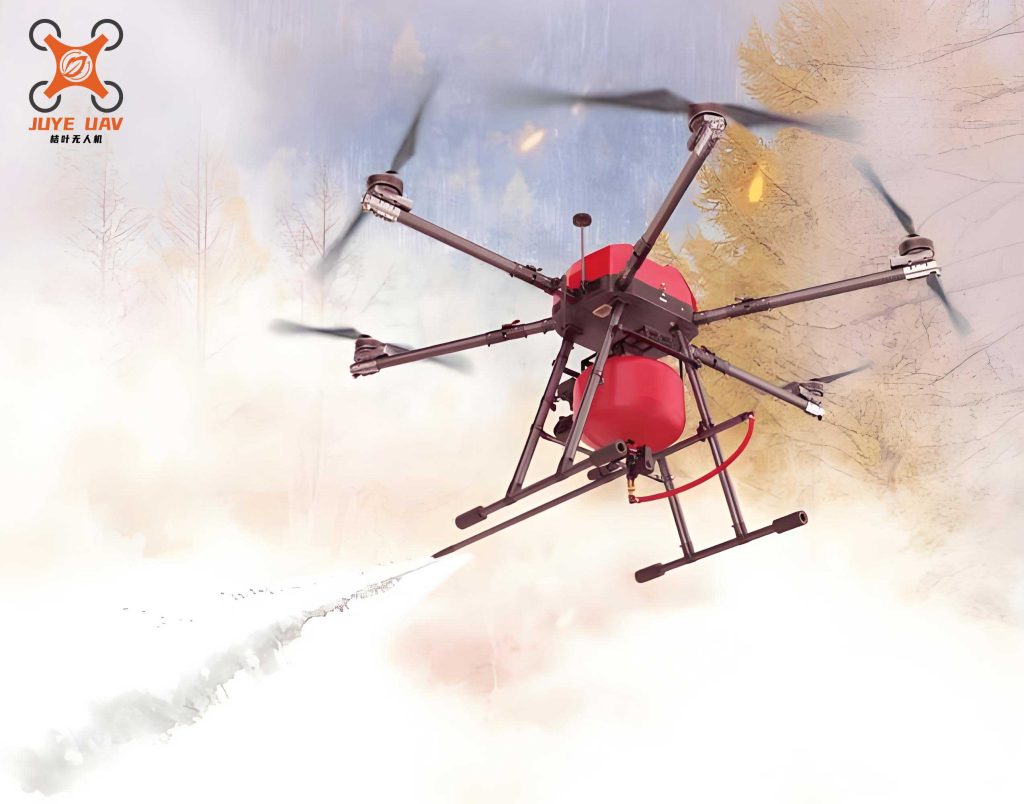
This image illustrates a typical fire drone in action, showcasing its compact design and potential for aerial surveillance. From my perspective, such visual aids help stakeholders understand the practical deployment of fire drones in emergency scenarios.
Fire Suppression and Rescue
Lightweight fire drones can carry fire extinguishing balls to high-rise buildings or open areas, but payload restrictions limit their effectiveness. They also deliver hoses to fire points for ground-supplied water, yet reaching超高层建筑 is challenging. Additionally, fire drones transport rescue equipment, such as ropes in water rescues, and provide aerial announcements for crowd evacuation. However, operational reliability in harsh environments—affected by flames, smoke, and turbulence—poses significant hurdles. The lift force $$L$$ required for a fire drone to hover in such conditions is given by: $$L = \frac{1}{2} \rho v^2 A C_L$$ where $$\rho$$ is air density, $$v$$ is velocity, $$A$$ is rotor area, and $$C_L$$ is lift coefficient. In fire scenarios, reduced air density due to heat can diminish lift, necessitating robust design for fire drones.
Future Directions for Fire Drones in Fire Rescue
Looking ahead, I believe fire drones must evolve to address current shortcomings. Our department faces issues like scarce专业人才, inadequate配置, and fragmented应用. By focusing on three core elements—airframe, control platform, and payload—we can drive innovation. Here, I outline potential applications and developments from my vantage point.
Three Elements of Fire Drones
Any fire drone comprises the airframe (body), control system (operation platform), and external devices (payload). Improvements in any element expand functionality. For instance, enhancing airframe materials for heat resistance allows fire drones to operate closer to flames. The structural integrity can be assessed using stress formulas: $$\sigma = \frac{F}{A}$$ where $$\sigma$$ is stress, $$F$$ is force, and $$A$$ is cross-sectional area. This informs the design of fire-resistant fire drones.
Specific Application Modes and Development Directions
I propose several avenues for scaling fire drone applications, each with technical considerations.
1. Public Education
While fire drones have been used for aerial announcements, this method is inefficient in noisy, populated areas. Instead, fire drones should complement digital media, serving as supplementary tools in specific contexts. For example, in rural regions, fire drones could broadcast fire safety messages, but their use must be optimized for safety and reach. The effective communication range $$R_c$$ can be modeled as: $$R_c = 10 \log_{10}\left(\frac{P_t G_t G_r \lambda^2}{(4\pi)^2 L}\right)$$ where $$P_t$$ is transmission power, $$G_t$$ and $$G_r$$ are antenna gains, $$\lambda$$ is wavelength, and $$L$$ is loss factor. This guides the design of fire drone communication systems for education.
2. Communication Assurance
Fire drones can act as signal relays in极端灾害, ensuring connectivity when infrastructure fails. In earthquakes or floods, deploying a fire drone swarm could establish临时通信 networks. The network capacity $$C$$ for such a swarm is: $$C = B \log_2\left(1 + \frac{S}{N}\right)$$ where $$B$$ is bandwidth and $$S/N$$ is signal-to-noise ratio, emphasizing the need for robust fire drone-based systems.
3. Regional Surveying
Current fire drones are limited in efficiency for large-area surveys. We should adopt advanced drones with high-resolution sensors and integrate AI for data processing. For instance, using LiDAR-equipped fire drones, the point cloud density $$D$$ for 3D建模 can be expressed as: $$D = \frac{N}{A}$$ where $$N$$ is the number of points and $$A$$ is area covered. Higher $$D$$ enables precise fire risk assessment, making fire drones indispensable for proactive monitoring.
4. Fire Prevention Supervision
Inspired by police “aerial patrols,” fire drones can serve as空中警力 for dynamic hazard detection. By increasing fire drone numbers and training operators, we can enhance覆盖范围. The detection probability $$P_d$$ for a fire drone patrol is: $$P_d = 1 – e^{-\lambda t}$$ where $$\lambda$$ is the arrival rate of incidents and $$t$$ is patrol time. Scaling up fire drone fleets boosts $$P_d$$, improving early warning.
5. Alarm Warning
Early fire detection is critical. Current reliance on public reports and IoT has gaps. Fire drones, equipped with sensors and AI, could provide real-time alerts. However, this requires a unified platform for data integration. The预警 accuracy $$A_w$$ can be formulated as: $$A_w = \frac{TP}{TP + FP}$$ where $$TP$$ is true positives and $$FP$$ is false positives. Optimizing this for fire drones involves machine learning algorithms to reduce false alarms.
6. Ground Guidance, Hazard Reconnaissance, and Area Security
During response, fire drones can guide ground teams and conduct initial reconnaissance. Smaller, agile fire drones launched from fire trucks enable “air-ground integration.” The response time $$T_r$$ with fire drone support is: $$T_r = \frac{d}{v_d} + t_d$$ where $$d$$ is distance, $$v_d$$ is drone speed, and $$t_d$$ is deployment time. Minimizing $$T_r$$ enhances rescue efficiency, underscoring the value of车载 fire drones.
7. Material Supply
For prolonged operations in remote areas, fire drones offer cost-effective logistics. However, payload limits restrict them to light items. The transport efficiency $$\eta$$ is: $$\eta = \frac{W_{\text{payload}}}{E_{\text{consumed}}}$$ where $$W_{\text{payload}}$$ is weight delivered and $$E_{\text{consumed}}$$ is energy used. Improving $$\eta$$ through better battery tech or hybrid power will expand fire drone utility in supply chains.
8. Fire Fighting
To reduce risks to firefighters, fire drones should be deployed for external suppression,配合 ground robots. Current fire drones have limited extinguishing capacity, but scaling up size and numbers can help. The灭火效能 $$E_f$$ of a fire drone swarm is: $$E_f = n \cdot q \cdot \epsilon$$ where $$n$$ is the number of drones, $$q$$ is extinguishing agent per drone, and $$\epsilon$$ is effectiveness factor. Research into specialized fire drones with higher $$q$$ and heat resistance is vital.
9. Fire Investigation
Fire drones aid investigations by accessing compromised scenes without disturbing evidence. Compact, maneuverable fire drones are ideal for this. The data completeness $$C_d$$ for investigation is: $$C_d = \frac{V_{\text{collected}}}{V_{\text{total}}}$$ where $$V$$ represents volume of information. Using fire drones with high-resolution cameras and sensors maximizes $$C_d$$, supporting thorough analysis.
Conclusion
In my assessment, fire drones are at an early stage in fire rescue, but their potential is vast. To scale applications, we should focus on four areas: comprehensive informatization, systematic team building, specialized equipment, and standardized usage. First, integrating advanced communication, AI, and navigation into fire drone platforms will enable autonomous, coordinated operations. For example, swarm algorithms can optimize fire drone deployments using formulas like the potential field method: $$U_{\text{total}} = U_{\text{att}} + U_{\text{rep}}$$ where attractive forces guide fire drones to targets, and repulsive forces avoid obstacles. Second, cultivating fire drone operators through training programs and expert teams will build capacity. Third, collaborating with manufacturers to develop fire-resistant, high-payload fire drones will enhance performance. Finally, establishing regulations with aviation authorities will ensure safe, expanded airspace access for fire drones.
The journey ahead requires innovation and collaboration, but as we refine fire drone technologies, I am confident they will revolutionize fire rescue, making responses faster, safer, and more effective. The repeated emphasis on fire drone throughout this article reflects its growing centrality, and I look forward to witnessing its evolution in the years to come.