
In this comprehensive study, we delve into the design intricacies of multi-rotor agricultural drones, specifically focusing on plant protection applications. As the global agricultural sector faces challenges such as labor shortages and environmental concerns, the adoption of unmanned aerial vehicles (UAVs) has emerged as a transformative solution. Through firsthand analysis and practical exploration, we aim to elucidate the key aspects that define effective agricultural drone design, emphasizing functionality, usability, and sustainability. The term “agricultural drone” will be frequently referenced to underscore its centrality in modern farming practices.
The evolution of agricultural drones has been rapid, with multi-rotor variants becoming predominant in plant protection due to their versatility and ease of operation. These agricultural drones are characterized by three or more rotor axes, each driven by an electric motor to generate thrust. Unlike traditional helicopters, the rotor axes are fixed, and flight control is achieved by modulating the relative speeds of the rotors. This design allows for precise maneuvers, including vertical take-off, hovering, and targeted spraying. Currently, multi-rotor agricultural drones primarily include quadcopters, hexacopters, and octocopters, with quadcopters being less common in heavy-duty applications.
The advantages of multi-rotor agricultural drones are manifold, making them indispensable tools in precision agriculture. First, they offer operational simplicity: no runway is required, and they can take off and land vertically, hovering at will. Control is intuitive via remote controllers, enabling movements in all directions with minimal training. Second, reliability is high; with few moving parts, durability largely depends on brushless motors, reducing failure rates. The ability to hover enhances safety by confining flight ranges. Third, component replaceability is straightforward due to modular designs, facilitating quick repairs. Fourth, environmental benefits are significant; powered by lithium batteries rather than fossil fuels, these agricultural drones are eco-friendly and energy-efficient. Fifth, cost-effectiveness is notable, with prices often ranging from $7,000 to $15,000, making them accessible to farmers. Sixth, spraying efficacy is superior; the downwash generated by rotors improves pesticide penetration into crops, enabling quantitative and even single-plant application. These attributes collectively position agricultural drones as pivotal in advancing sustainable farming.
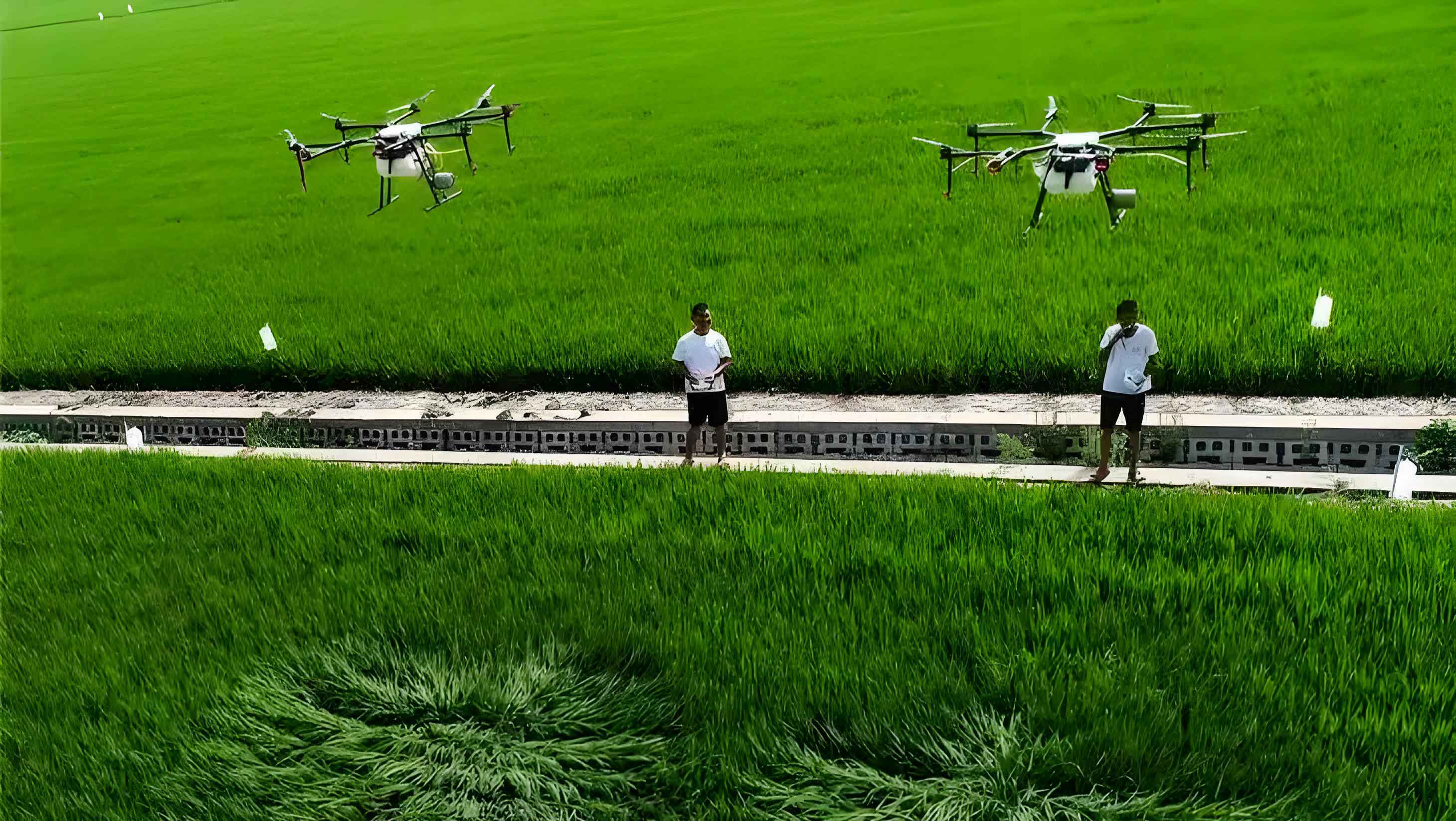
To contextualize our research, we examined several representative models of multi-rotor agricultural drones available in the market. The following table summarizes key parameters, highlighting the diversity in design and performance. This analysis informs our understanding of current trends and areas for improvement in agricultural drone technology.
| Model | Brand | Key Parameters |
|---|---|---|
| T16 | DJI | Max rotor span: 1883 mm; Dimensions (expanded): 2520 mm × 2212 mm × 720 mm; Payload capacity: 15.1-16 kg; Liquid tank volume: 15.1-16 L |
| JT1 M60Q-6 | Jiutian Intelligent | Expanded size: 2940 mm × 2940 mm × 705 mm; Folded size: 560 mm × 740 mm × 1560 mm; Max take-off weight: 80 kg; Max pesticide payload: 45 kg; Tank capacity: 30 L |
| FN30LA | Fengniao Damai | Number of rotors: 6; Tank volume: 30 L; Flight performance: over 60 L sprayed per battery set; Mapping methods: flight surveying, mapper surveying, map point selection |
| HYTX-E35X-A | Hongyu Tianxiang | Max flight height: 0-120 m; Optimal operation speed: 4.8-6 m/s; Max flight weight: 23 kg; Operation height: 2-4 m; Max wind resistance: level 6 |
Through disassembly and hands-on inspection, we identified the core structural components of a typical multi-rotor agricultural drone. The frame serves as the backbone, supporting all elements. The support components include landing gear and arms. The flight control system, often referred to as the “flight controller,” comprises a central processor, gyroscopes, accelerometers, and barometers, enabling stable navigation. The propulsion system consists of propellers and motors, regulated by electronic speed controllers (ESCs) and powered by lithium batteries. Additionally, a gimbal and camera may be integrated for imaging and mapping. The ground remote controller allows manual or automated operation. Crucially, what distinguishes an agricultural drone from other UAVs is the spraying module, which includes a pesticide tank, pump, hoses, and nozzles. During flight, the pump draws pesticide from the tank and disperses it through nozzles, leveraging the rotor downwash for enhanced penetration. This modular architecture underscores the adaptability of agricultural drones to various tasks.
However, our investigation revealed several design flaws in existing multi-rotor agricultural drones, which hinder their efficiency and safety. First, exposed wiring and liquid transmission hoses are common. In many models, cables and tubes are not concealed, leading to weathering, aging, and short circuits. This not only risks electrical hazards but also compromises pesticide delivery due to hose brittleness. Second, bulky body sizes prevail. Most agricultural drones are large and heavy, complicating transport and storage. They often require trucks for deployment, especially in uneven terrains, increasing logistical burdens for farmers. Third, frequent battery changes are necessary. With limited payload capacities (typically 5-15 L), battery life is short, necessitating multiple take-offs and landings. For instance, a 10 L agricultural drone might use 40 fully charged batteries for a 200-acre operation, with each flight lasting about 10 minutes. This inefficiency can be modeled using a battery endurance equation: $$E = \frac{C \cdot V}{P}$$ where \(E\) is endurance in hours, \(C\) is battery capacity in ampere-hours, \(V\) is voltage, and \(P\) is power consumption in watts. For agricultural drones, optimizing \(E\) is critical to reduce downtime. Fourth, the pesticide tank affects the flight center of gravity. As the tank empties, the shifting weight destabilizes the drone, impacting control accuracy. Fifth, pesticide sedimentation occurs. Solvents in the liquid may settle at the tank bottom when the agricultural drone is stationary, altering chemical efficacy and clogging spray systems. These issues highlight the need for refined design principles in agricultural drone development.
Based on these pain points and user feedback, we have distilled five core design principles for multi-rotor agricultural drones: functionality, understandability, durability, aesthetics, and safety. Each principle addresses specific shortcomings while enhancing overall performance. First, functionality mandates that agricultural drones minimize physical exertion and resource use. Designs should incorporate compact forms for easy transport and improved tank structures to prevent sedimentation and重心 shifts. For example, a conical tank design can reduce sediment accumulation, described by the sedimentation rate formula: $$v_s = \frac{2(\rho_p – \rho_f) g r^2}{9 \eta}$$ where \(v_s\) is settling velocity, \(\rho_p\) and \(\rho_f\) are particle and fluid densities, \(g\) is gravity, \(r\) is particle radius, and \(\eta\) is viscosity. By optimizing tank geometry, agricultural drones can maintain pesticide homogeneity. Second, understandability requires intuitive interfaces. Given that operators often have limited technical backgrounds, controls should feature clear labels, simple steps, and ergonomic battery swaps. Streamlined structures facilitate quick learning. Third, durability emphasizes robust components that withstand harsh field conditions, reducing replacement frequency. Fourth, aesthetics involve applying design elements like proportion, balance, and symmetry to create visually appealing agricultural drones that blend with rural environments. Fifth, safety entails concealing wires and hoses to prevent exposure, along with alert systems for low battery or pesticide levels. These principles guide our subsequent design实践.
In our design practice, we applied these principles to develop a novel multi-rotor agricultural drone. Starting with sketches, we iterated concepts to balance form and function. Using RHINO for 3D modeling and KEYSHOT for rendering, we produced a detailed prototype, complemented by an explosion diagram to illustrate assembly. The final方案 features several enhancements. Functionally, the agricultural drone measures 1800 mm × 1800 mm × 700 mm, offering portability for car transport and reducing costs. Understandability is achieved through a simplified structure with one-touch startup and automated route planning via GPS, enabling novice-friendly operation. Battery installation is top-down, avoiding propeller interference and speeding up swaps. Durability is ensured by high-quality materials and a rational frame that延长s component life. Aesthetically, the design employs smooth, tech-inspired curves with green and white coloring to harmonize with fields. Safety improvements include internal wiring and hose routing, a polytetrafluoroethylene (PTFE) corrosion-resistant tank, rubber anti-slip pads, and LED-audio alerts for low levels. This holistic approach exemplifies how agricultural drones can evolve to meet user needs.
To validate our design, we plan to build a concept model based on the 3D renderings, conducting iterative tests to refine imperfections. Eventually, a physical prototype will be fabricated, integrating technical specifications for real-world evaluation. The process underscores the importance of user-centered design in advancing agricultural drone technology.
The proliferation of agricultural drones is revolutionizing global agriculture, aligning with trends toward automation and sustainability. As a key driver of economic growth, the agricultural drone sector holds immense potential. In plant protection, these UAVs are becoming primary tools for pest and disease control, offering safe, efficient, and eco-friendly solutions. Although research is still nascent in some regions, increased investment and standardized protocols will spur wider adoption. Future advancements may include AI integration for smart spraying, enhanced battery technologies for longer endurance, and lightweight materials for greater agility. Our study contributes to this trajectory by outlining actionable design criteria and a practical framework. Ultimately, continued innovation in agricultural drone design will elevate farming practices, ensuring food security and environmental stewardship in the decades ahead.
In summary, this research provides a thorough examination of multi-rotor agricultural drones, from their fundamental advantages to design challenges and solutions. By emphasizing principles like functionality and safety, we offer a roadmap for developing more effective and user-friendly agricultural drones. As the industry progresses, such insights will be invaluable in shaping the next generation of agricultural drones, fostering a harmonious blend of technology and agriculture for a sustainable future.