
In recent years, the increasing severity of weed infestation in wheat fields, driven by adjustments in planting methods, optimization of crop varieties, and the implementation of full straw return policies, has become a critical factor limiting wheat yield. Concurrently, the aging rural population has led to a growing shortage of agricultural labor. Consequently, large-scale farmers are increasingly adopting advanced plant protection machinery, with the agricultural drone gaining widespread application due to its high operational efficiency. To evaluate the crop safety and weed control efficacy of pre-emergence herbicide application using an agricultural drone in wheat, a comparative field demonstration was conducted over three consecutive years from 2020 to 2022. The core objective was to assess the performance of the DJI T20 agricultural drone against traditional sprayers.
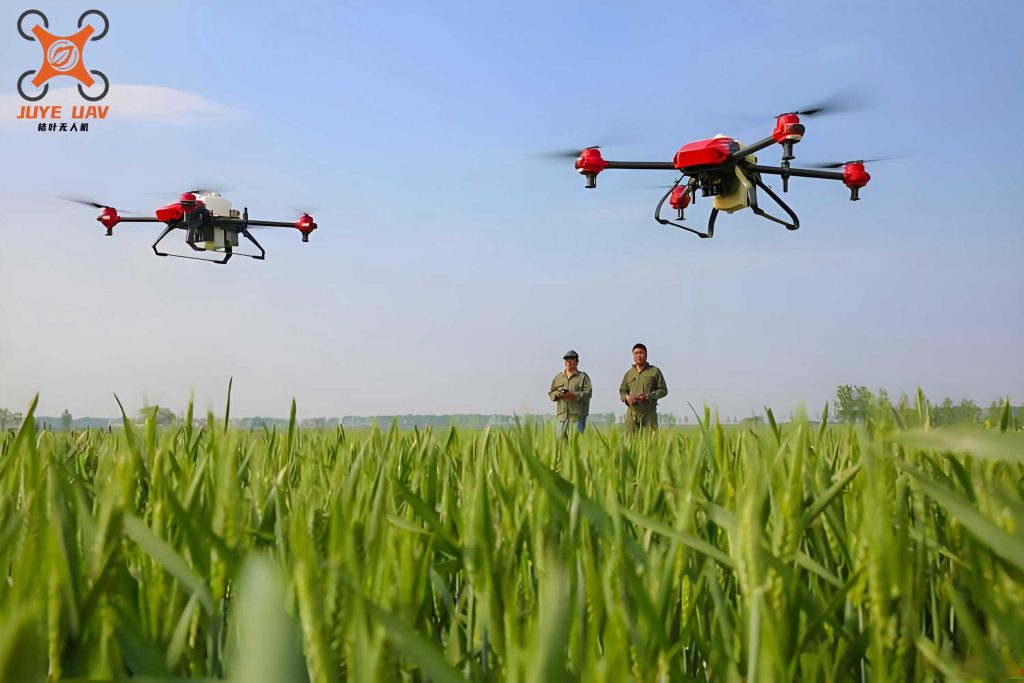
The foundational principle of using an agricultural drone for herbicide application involves the precise aerial delivery of a spray solution. The efficacy depends on factors like droplet size, distribution uniformity, and spray volume. The relationship between deposition and key parameters can be conceptually modeled. The volume median diameter (VMD) of droplets is a critical parameter influencing coverage and potential drift. While the exact VMD for the T20 under our settings was not measured, the effective swath width (W) at a flight height (H) of 1.8 m was 5.0 m. The application rate (AR) in L/ha is determined by the nozzle flow rate (Q in L/min), speed (V in m/s), and swath width.
$$ AR = \frac{Q \times 600}{V \times W} $$
Where 600 is a constant for unit conversion. For a target AR of 20 L/ha (2.0 L/667 m²), with V=4.0 m/s and W=5.0 m, the required total flow rate Q can be calculated. The drone’s system calibrates this based on the set parameters.
The demonstrations were established in a rice-wheat rotation field. The soil was clay loam with medium to high fertility and a pH of 7.3. The predominant weed species were Alopecurus aequalis (shortawn foxtail), Stellaria media (common chickweed), and Galium spurium (false cleavers). Wheat was sown by drill seeding in early to mid-November each year. The herbicide used was a 33% suspension concentrate of flufenacet, pyridate, and flurtamone (11% of each active ingredient).
The core comparison was between different application equipment and spray volumes. The primary equipment tested was the DJI T20 agricultural drone. For benchmark comparison, a self-propelled boom sprayer (SPBS) and a backpack electric sprayer (BES) were used. A critical operational detail for the agricultural drone was its use immediately after field irrigation (“Feng Shui” practice), while the ground equipment was used when the field surface was comparatively drier. The flight parameters for the T20 agricultural drone were set at a height of 1.8 m and a speed of 4.0 m/s. The treatments over the three years are summarized below.
| Year | Treatment Code | Application Equipment | Herbicide Dose (mL/667 m²) | Spray Volume (L/667 m²) | Application Timing |
|---|---|---|---|---|---|
| 2020 | 1 | Agricultural Drone (T20) | 80 | 1.0 | Nov 11 |
| 2 | Agricultural Drone (T20) | 80 | 1.5 | Nov 11 | |
| 3 | Agricultural Drone (T20) | 80 | 2.0 | Nov 11 | |
| 4 | Self-Propelled Boom Sprayer | 80 | 30.0 | Nov 14 | |
| 5 | Backpack Electric Sprayer | 80 | 30.0 | Nov 14 | |
| 6 | Untreated Control | – | – | – | |
| 2021 | A | Agricultural Drone (T20) | 80 | 2.0 | Nov 13 |
| B | Self-Propelled Boom Sprayer | 80 | 30.0 | Nov 16 | |
| C | Backpack Electric Sprayer | 80 | 30.0 | Nov 16 | |
| D | Untreated Control | – | – | – | |
| 2022 | ① | Agricultural Drone (T20) | 80 | 2.0 | Nov 17 |
| ② | Self-Propelled Boom Sprayer | 80 | 30.0 | Nov 20 | |
| ③ | Backpack Electric Sprayer | 80 | 30.0 | Nov 20 | |
| ④ | Untreated Control | – | – | – |
Crop safety was assessed by visual observation at 3, 5, 10, 25, and 150 days after treatment (DAT). Weed control efficacy was evaluated at 110 DAT (overwintering period) and 150 DAT (spring). For each plot, weed density (plants per square meter) and fresh weight were recorded from five randomly placed 0.2 m² quadrats. Control efficacy was calculated using the standard formulas:
Weed Density Reduction (WDR, %): $$ WDR = \left( \frac{D_c – D_t}{D_c} \right) \times 100 $$
Weed Fresh Weight Reduction (WWR, %): $$ WWR = \left( \frac{W_c – W_t}{W_c} \right) \times 100 $$
Where \( D_c \) and \( W_c \) are the weed density and fresh weight in the untreated control, and \( D_t \) and \( W_t \) are the corresponding values in the treated plot.
Results: Crop Safety and Herbicide Efficacy
Across all three years, the pre-emergence application of the herbicide mixture via all equipment, including the agricultural drone, showed good crop safety. Minor leaf whitening was occasionally observed 7-15 DAT under conditions of high humidity in 2020 and 2022, but this did not translate into any measurable negative impact on subsequent wheat growth or yield. This confirms the suitability of the agricultural drone for this application timing.
The efficacy data revealed clear trends. The performance of the agricultural drone was highly dependent on the applied spray volume. As shown in the 2020 data, increasing the spray volume from 1.0 L/667 m² to 2.0 L/667 m² significantly improved weed control across all species. The following table synthesizes the key efficacy results at 150 DAT, highlighting the comparison between the optimal agricultural drone setting (2.0 L/667 m²) and the traditional equipment.
| Year | Target Weed | Treatment (Spray Vol.) | Weed Density Reduction (%) | Weed Fresh Weight Reduction (%) |
|---|---|---|---|---|
| 2020 | Alopecurus aequalis | Drone (1.0 L) | 71.8 | 76.1 |
| Drone (2.0 L) | 93.3 | 95.5 | ||
| Boom Sprayer (30.0 L) | 97.1 | 98.8 | ||
| Stellaria media | Drone (1.0 L) | 74.1 | 77.3 | |
| Drone (2.0 L) | 98.5 | 99.1 | ||
| Boom Sprayer (30.0 L) | 100.0 | 100.0 | ||
| Galium spurium | Drone (1.0 L) | 55.1 | 60.9 | |
| Drone (2.0 L) | 88.8 | 89.8 | ||
| Boom Sprayer (30.0 L) | 93.3 | 94.8 | ||
| 2021 | Alopecurus aequalis | Drone (2.0 L) | 64.0 | 67.8 |
| Boom Sprayer (30.0 L) | 73.3 | 78.5 | ||
| Backpack Sprayer (30.0 L) | 64.4 | 69.7 | ||
| Stellaria media | Drone (2.0 L) | 77.5 | 82.1 | |
| Boom Sprayer (30.0 L) | 83.3 | 87.8 | ||
| Backpack Sprayer (30.0 L) | 80.4 | 85.1 | ||
| 2022 | Alopecurus aequalis | Drone (2.0 L) | 93.4 | 96.8 |
| Boom Sprayer (30.0 L) | 95.0 | 98.0 | ||
| Backpack Sprayer (30.0 L) | 92.3 | 97.6 | ||
| Stellaria media | Drone (2.0 L) | 95.2 | 94.9 | |
| Boom Sprayer (30.0 L) | 100.0 | 100.0 | ||
| Backpack Sprayer (30.0 L) | 98.1 | 97.6 |
The data from 2020 clearly demonstrates the volume effect for the agricultural drone. The control efficacy for all weeds at the 2.0 L rate was markedly superior to the 1.0 L rate. Comparing the optimized agricultural drone application (2.0 L/667 m²) against traditional methods reveals a consistent pattern: the weed control efficacy achieved by the agricultural drone was equivalent to that of the backpack sprayer (both density and fresh weight reduction), but was generally 2-5 percentage points lower than that achieved by the self-propelled boom sprayer at its high spray volume of 30.0 L/667 m².
The 2021 results require particular analysis. That season experienced a severe drought for 20 days following application. This lack of soil moisture likely inhibited the activation and soil mobility of the pre-emergence herbicide, leading to suboptimal performance across all application methods. The agricultural drone’s performance was comparable to the backpack sprayer but lower than the boom sprayer. In contrast, in 2020 and 2022, which received timely rainfall post-application (23.5 mm and 31.5 mm respectively within 20 DAT), the agricultural drone at 2.0 L performed excellently. This underscores that the success of pre-emergence applications, regardless of equipment, is critically dependent on sufficient soil moisture for herbicide activation.
Discussion and Operational Implications
The demonstration conclusively shows that pre-emergence weed control in wheat using a modern agricultural drone like the DJI T20 is not only feasible but can deliver agronomically acceptable results. The key finding is the necessity of using an adequate spray volume. The low volume of 1.0 L/667 m² resulted in inadequate coverage and poor efficacy, whereas 2.0 L/667 m² provided a dramatic improvement, bringing the agricultural drone‘s performance to a level comparable with conventional backpack sprayers.
The slight efficacy gap between the high-volume boom sprayer and the agricultural drone can be attributed to the fundamental differences in application physics. The boom sprayer delivers a large volume of spray directly downward, ensuring thorough wetting of the soil surface. The agricultural drone delivers much finer droplets from a height, which are more susceptible to canopy interception and micro-climatic conditions, potentially leading to a slightly less uniform deposition on the soil surface. This can be modeled by considering deposition efficiency (η).
$$ D_{soil} = AR \times \eta $$
Where \( D_{soil} \) is the actual dose deposited on the soil surface, AR is the application rate, and η is the deposition efficiency (0 < η ≤ 1). For a boom sprayer, η is typically closer to 1. For an agricultural drone, η is influenced by wind, evaporation, and crop residue, and may be slightly less than 1, explaining the minor efficacy difference under ideal conditions.
The operational advantage of the agricultural drone is not raw efficacy parity with the best ground equipment, but its unparalleled operational flexibility and timeliness. As noted in the method, the agricultural drone could be deployed immediately after field irrigation and drainage, when the soil surface was moist but not waterlogged—a condition ideal for pre-emergence herbicide activation. Heavy ground machinery like boom sprayers cannot enter fields at this time without causing soil compaction or getting stuck. The agricultural drone eliminates this timing constraint, allowing farmers to apply the herbicide at the agronomically optimal moment. Furthermore, in regions with frequent autumn rains, the agricultural drone provides a reliable application window when ground-based operations are impossible.
Conclusion and Future Perspectives
This three-year field demonstration validates the DJI T20 agricultural drone as a viable and effective tool for pre-emergence weed control in wheat. The primary conclusions are:
- Crop Safety: Application via the agricultural drone at the tested volumes posed no significant risk to wheat seedlings.
- Spray Volume is Critical: For the T20 agricultural drone, a spray volume of 2.0 L/667 m² (20 L/ha) is recommended as a minimum for reliable pre-emergence herbicide performance, significantly outperforming lower volumes.
- Comparative Efficacy: When using the 2.0 L/667 m² rate, the agricultural drone provides weed control efficacy equivalent to a standard backpack sprayer and slightly lower than a high-volume self-propelled boom sprayer under comparable moisture conditions.
- Operational Superiority: The key advantage of the agricultural drone lies in its ability to apply herbicides during critical, narrow windows post-irrigation or during wet field conditions, when ground machinery is unusable.
Future work should focus on optimizing adjuvants and droplet spectra for ultra-low volume agricultural drone applications to enhance soil deposition and rainfastness. Integration with real-time soil moisture sensors and weather forecasting could further refine application timing, maximizing the efficacy of every flight. As technology advances, the role of the agricultural drone in precise, timely, and efficient crop protection will only become more central to modern, sustainable wheat production systems.