
In recent years, drone formation has gained significant attention in both military and civilian applications, such as surveillance, search and rescue, and cooperative missions. However, maintaining a stable drone formation is challenging due to various faults and uncertainties. Specifically, topological faults in communication and formation structures, actuator failures, control surface damages, and environmental disturbances can compromise the safety and reliability of the drone formation. As a researcher in this field, I propose a comprehensive fault-tolerant control method that addresses these issues simultaneously. This article presents a detailed framework for modeling, designing, and validating a control system that ensures robust performance under multiple fault conditions. The key contributions include a novel topological fault reconstruction optimization algorithm and a backstepping fault-tolerant control law integrated with fault identification modules. Through extensive simulations, I demonstrate the effectiveness of this approach in achieving minimal communication costs, formation reconstruction costs, and stable tracking performance. The drone formation is emphasized throughout as the core focus, highlighting its importance in modern autonomous systems.
The drone formation operates in a leader-follower configuration, where a leader drone guides multiple follower drones. The motion of each drone is described using kinematic and dynamic models. For the leader drone, denoted as UAVL, the position dynamics are given by:
$$
\dot{x}_L = v_L \cos \gamma_L \cos \chi_L, \quad \dot{y}_L = v_L \cos \gamma_L \sin \chi_L, \quad \dot{z}_L = v_L \sin \gamma_L
$$
where \(x_L, y_L, z_L\) are coordinates, \(v_L\) is velocity, \(\gamma_L\) is flight path angle, and \(\chi_L\) is heading angle. Similarly, for follower drone UAVi:
$$
\dot{x}_i = v_i \cos \gamma_i \cos \chi_i, \quad \dot{y}_i = v_i \cos \gamma_i \sin \chi_i, \quad \dot{z}_i = v_i \sin \gamma_i
$$
The formation errors between UAVi and UAVL in longitudinal, lateral, and vertical directions are defined as:
$$
\tilde{f}_i = f_{iL} – f^d_{iL} = \tilde{x}_i \cos \chi_L + \tilde{y}_i \sin \chi_L + s \cos \tilde{\chi}_i – f^d_i
$$
$$
\tilde{l}_i = l_{iL} – l^d_{iL} = \tilde{x}_i \sin \chi_L – \tilde{y}_i \cos \chi_L – s \sin \tilde{\chi}_i – l^d_i
$$
$$
\tilde{z}_i = z_{iL} – z^d_i
$$
with \(\tilde{x}_i = x_i – x_L\), \(\tilde{y}_i = y_i – y_L\), \(\tilde{\chi}_i = \chi_i – \chi_L\), and \(s\) as the distance from engine nozzle to center of mass. The desired distances are \(f^d_i, l^d_i, z^d_i\). Differentiating yields the error dynamics:
$$
\begin{bmatrix}
\dot{\tilde{f}}_i \\
\dot{\tilde{l}}_i \\
\dot{\tilde{z}}_i
\end{bmatrix}
=
\begin{bmatrix}
\cos \gamma_i \cos \tilde{\chi}_i & -s \sin \tilde{\chi}_i & 0 \\
-\cos \gamma_i \sin \tilde{\chi}_i & -s \cos \tilde{\chi}_i & 0 \\
0 & 0 & v_i
\end{bmatrix}
\begin{bmatrix}
v_i \\
\dot{\chi}_i \\
\sin \gamma_i
\end{bmatrix}
+
\begin{bmatrix}
-v_L \cos \gamma_L – l_i \dot{\chi}_L \\
f_i \dot{\chi}_L \\
-v_L \sin \gamma_L
\end{bmatrix}
$$
This model forms the basis for designing formation control laws. For individual drones, a nonlinear dynamic model accounts for faults. The general model is:
$$
\dot{v} = f(v) + G(v) \delta_p, \quad \dot{\Omega} = f_s(\Omega) + G_s(\Omega) \omega, \quad \dot{\omega} = f_f(\omega) + G_f(\omega) u + d
$$
where \(\Omega = [\chi, \gamma, \beta]^T\) represents attitude angles, \(\omega = [p, q, r]^T\) is angular rates, \(u = [\delta_a, \delta_e, \delta_r]^T\) are control surface deflections, \(\delta_p\) is throttle input, and \(d\) denotes uncertainties like wind gusts. Faults are modeled separately. Control surface faults, such as partial loss of effectiveness, are described by:
$$
\delta^R_i = r_i \delta_i, \quad r_i \in (0, 1]
$$
where \(\delta^R_i\) is the effective deflection and \(r_i\) is the fault parameter. Actuator faults, including lock-in-place and partial damage, are given by:
$$
\delta_i = \sigma_i k_i \delta_{ci} + (1 – \sigma_i) \bar{\delta}_i
$$
with \(\sigma_i \in \{0,1\}\) for lock failure, \(k_i \in (0,1]\) for damage, \(\delta_{ci}\) as commanded input, and \(\bar{\delta}_i\) as locked value. Combining these, the integrated fault model for a drone in the formation is:
$$
\dot{v} = f(v) + G(v) \delta_p, \quad \dot{\Omega} = f_s(\Omega) + G_s(\Omega) \omega, \quad \dot{\omega} = f_f(\omega) + G_f(\omega) R \Sigma K u_c + G_f(\omega) R (I – \Sigma) \bar{u} + d
$$
where \(R = \text{diag}([r_a, r_e, r_r, r_p])\), \(\Sigma = \text{diag}([\sigma_a, \sigma_e, \sigma_r, \sigma_p])\), \(K = \text{diag}([k_a, k_e, k_r, k_p])\), and \(u_c = [\delta_{ca}, \delta_{ce}, \delta_{cr}, \delta_{cp}]^T\). This model captures the complexities of a drone formation under faults.
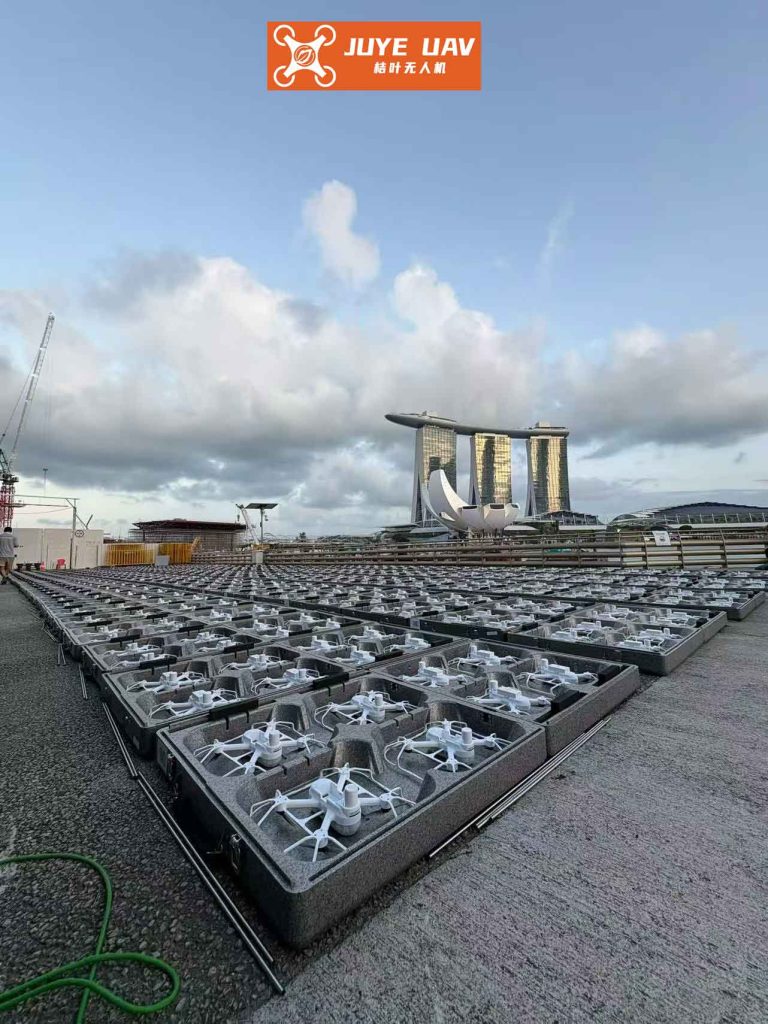
The drone formation control system is designed to handle topological faults, which include communication link failures and formation structure changes due to drone losses. I classify topological faults into six types: broadcast transmitter fault, broadcast receiver fault, unicast transmitter fault, unicast receiver fault, unicast transceiver fault, and drone loss or severe fault. A detection method is proposed based on assumptions: each drone can detect its own point-to-point and broadcast communication faults, and all drones have functional broadcast receivers. When a drone detects a unicast transceiver fault, it leaves the formation automatically. The detection process involves checking communication links and broadcast messages to identify faults. For instance, if a drone does not respond to broadcasts, it may be lost or have a broadcast transmitter fault. This method enables real-time monitoring of the drone formation health.
To reconstruct the formation after topological faults, I develop an optimization algorithm that minimizes communication and reconstruction costs. The formation topology is represented as a weighted directed graph \(D = (V, A, W, P)\), where \(V\) is the set of drones, \(A\) is communication links, \(W\) is link costs (e.g., distance), and \(P\) is position assignments. The goal is to find a minimum spanning tree for communication and optimal position reassignment. The algorithm steps are summarized in Table 1.
| Step | Description |
|---|---|
| 1 | Compute distance matrix \(C = [c_{ij}]_{m \times m}\) for drones to positions. |
| 2 | Transform \(C\) to \(C’\) by subtracting row and column minima. |
| 3 | Circle zero elements in \(C’\) to find optimal assignments. |
| 4 | Adjust \(C’\) if needed and repeat step 3. |
| 5 | Determine position assignments \(x_{ij} = 1\) for minimal cost. |
| 6 | Add virtual node \(v_0\) to graph \(D_0 = (V_0, A_0, W_0)\). |
| 7 | Construct link set with minimum communication costs. |
| 8 | Check for cycles; if found, contract nodes and repeat. |
| 9 | Expand contracted nodes to get minimum spanning tree \(T_0\). |
| 10 | Output optimal communication and formation topology. |
This algorithm ensures that the drone formation maintains connectivity with minimal overhead, which is critical for scalability and efficiency. For the control law, I design a backstepping fault-tolerant approach. The outer loop generates formation commands for each follower drone. The desired velocity, heading rate, and climb rate are:
$$
\begin{bmatrix}
v^d_i \\
\dot{\chi}^d_i \\
\sin \gamma^d_i
\end{bmatrix}
=
\begin{bmatrix}
\cos \gamma_i \cos \tilde{\chi}_i & -s \sin \tilde{\chi}_i & 0 \\
-\cos \gamma_i \sin \tilde{\chi}_i & -s \cos \tilde{\chi}_i & 0 \\
0 & 0 & v_i
\end{bmatrix}^{-1}
\begin{bmatrix}
-k_1 \tilde{f}_i + v_L \cos \gamma_L + l_i \dot{\chi}_L \\
-k_2 \tilde{l}_i – f_i \dot{\chi}_L \\
-k_3 \tilde{z}_i + v_L \sin \gamma_L
\end{bmatrix}
$$
with gains \(k_1, k_2, k_3 > 0\). This yields error dynamics that are input-to-state stable (ISS), ensuring that inner loop tracking leads to formation stability. The full command signals include sideslip angle \(\beta^d_i = 0\) to prevent slipping. The inner loop compensates for actuator and control surface faults. I design adaptive observers for fault identification. For actuator lock failure, the observer is:
$$
\dot{\delta}^s_i = -a_i \hat{\sigma}_i (\delta_i – \delta_{ci}) – n^s_i (\delta^s_i – \delta_i), \quad \dot{\hat{\sigma}}_i = \text{sgn}[a_i \tilde{\delta}^s_i (\delta_i – \delta_{ci})]
$$
where \(\tilde{\delta}^s_i = \delta^s_i – \delta_i\), \(a_i, n^s_i > 0\). For actuator damage, the observer is:
$$
\dot{\delta}^l_i = -a_i (\delta_i – \hat{k}_i \delta_{ci}) – n^l_i (\delta^l_i – \delta_i), \quad \dot{\hat{k}}_i = \text{Proj}_{\hat{k}_i}[\Gamma_i (-a_i \tilde{\delta}^l_i \delta_{ci})]
$$
with \(\tilde{\delta}^l_i = \delta^l_i – \delta_i\), \(\Gamma_i > 0\), and \(\text{Proj}\) as a projection operator to bound estimates. These observers ensure convergence: \(\lim_{t \to \infty} \tilde{\delta}^s_i = 0\) and \(\lim_{t \to \infty} \hat{\sigma}_i = 0\) for lock faults, and \(\lim_{t \to \infty} \tilde{\delta}^l_i = 0\) and \(\lim_{t \to \infty} \tilde{k}_i = 0\) for damage faults, where \(\tilde{k}_i = \hat{k}_i – k_i\).
For control surface faults and uncertainties, an auxiliary system is designed for angular rate dynamics:
$$
\dot{\hat{\omega}} = L \tilde{\omega} + f_f(\omega) + G_f(\omega) U \hat{r} + \hat{d}
$$
with \(\tilde{\omega} = \hat{\omega} – \omega\), \(L\) a positive definite matrix, \(\hat{r}\) as estimate of \(r\), and \(\hat{d}\) as estimate of \(d\). The adaptation law for \(\hat{r}\) is:
$$
\dot{\hat{r}} = \text{Proj}_{\hat{r}}\{\Gamma [-U^T G_f^T(\omega) P \tilde{\omega}]\}
$$
where \(\Gamma\) is positive definite, and \(P\) satisfies \(L^T P + P L = -Q\) for positive definite \(Q\). A high-order adaptive observer estimates \(d\):
$$
\hat{d} = z + p_0(\tilde{\omega}), \quad \dot{z} = -L_0(\tilde{\omega}) (\tilde{\omega} – \tilde{d}) + \hat{d}_1, \quad \dot{\hat{d}}_1 = L_1(\tilde{\omega}) \tilde{d}_1 + \hat{d}_2, \quad \dots, \quad \dot{\hat{d}}_{k-1} = L_{k-1}(\tilde{\omega}) \tilde{d}_{k-1}
$$
where \(k\) is the order, and \(L_i(\tilde{\omega})\) are gain matrices. This observer guarantees stability under conditions like \(Q_{\text{max}} > 0.5\) and \(L_0(\tilde{\omega})_{\text{min}} – P_{\text{max}} > 0.25\). The backstepping control law integrates these components. The velocity loop uses nonlinear dynamic inversion:
$$
\delta_p = G^{-1}(v) [k_v (v_c – v) – f(v)]
$$
with gain \(k_v > 0\). For attitude tracking, define error \(\Omega_e = \Omega – \Omega_c\) and virtual control \(\omega_d\):
$$
\omega_d = G_s^{-1}(\Omega) [-K_E \Omega_e – f_s(\Omega) + \dot{\Omega}_c]
$$
where \(K_E\) is positive definite. The angular rate error is \(\omega_e = \hat{\omega} – \omega_d\), and the control input \(u_c\) is:
$$
u_c = -[G_f(\omega) \hat{R} \hat{K} \hat{\Sigma}]^{-1} [K_\epsilon \omega_e + L \tilde{\omega} + f_f(\omega) + G_f(\omega) \hat{R} (I – \hat{\Sigma}) \bar{u} + \hat{d} – \dot{\omega}_c]
$$
with gain \(K_\epsilon > 0\). This law ensures asymptotic stability of the drone formation system. The Lyapunov function \(V(t) = \frac{1}{2} (\Omega_e^T \Omega_e + \omega_e^T \omega_e + \tilde{\omega}^T P \tilde{\omega} + \tilde{r}^T \Gamma^{-1} \tilde{r} + \tilde{d}^T \tilde{d} + \dots)\) has derivative \(\dot{V}(t) \leq 0\) under the observer conditions, proving fault-tolerant performance.
To validate the method, I conduct simulations with a drone formation of six drones. The initial formation topology is a leader-follower structure with positions labeled a to f. The simulation runs for 60 seconds with faults injected: at t=10s, drone 3 is lost; at t=20s, drone 2 has a 60% control surface fault on aileron; at t=30s, drone 2 has a unicast transmitter fault; at t=40s, drone 4 has a 70% actuator damage fault on rudder; at t=50s, drone 6 has an elevator actuator lock fault. Controller parameters are set as in Table 2.
| Parameter | Value | Parameter | Value |
|---|---|---|---|
| \(L\) | \([3, 8, 6]\) | \(\Gamma\) | \([3, 2, 7]\) |
| \(n^s_i\) | 6 | \(K_E\) | \([7, 9, 4]\) |
| \(L_0(\tilde{\omega})\) | \([12, 18, 25]\) | \(Q\) | \([2, 7, 3]\) |
| \(a_i\) | 30 | \(n^l_i\) | 5 |
| \(K_\epsilon\) | \([6, 3, 7]\) | \(k_1, k_2, k_3\) | 4 |
The topological fault reconstruction optimization algorithm is compared with an existing method from literature. Results show that my algorithm achieves lower communication and reconstruction costs, as summarized in Table 3. For instance, from 0-10 seconds, my algorithm has a cost of 2915 versus 3498 for the literature method. After drone loss at t=10s, the reconstruction cost is 583 versus 1290, demonstrating efficiency. The drone formation maintains connectivity throughout, validating the algorithm’s robustness.
| Time (s) | Proposed Algorithm Cost | Literature Algorithm Cost |
|---|---|---|
| 0–10 | 2915 | 3498 |
| t=10 (reconstruction) | 583 | 1290 |
| 10–30 | 2332 | 3498 |
| 30–60 | 2906 | 3498 |
For fault-tolerant control, I compare my backstepping law with a general control law without fault identification. The general law shows oscillations under uncertainties and severe deviations under faults, while my law ensures stable tracking within 4 seconds. Performance metrics are given in Table 4. The drone formation velocity, heading, climb, and sideslip angles all converge to desired values with minimal error. Fault identification results are accurate: for drone 2, the aileron fault parameter \(r_a\) is estimated at 0.4 (60% fault) after t=20s; for drone 4, the rudder damage \(k_r\) is 0.3 (70% fault) after t=40s; for drone 6, the elevator lock \(\sigma_e\) drops to 0 after t=50s. These confirm the effectiveness of the adaptive observers.
| Metric | General Control Law | Proposed Fault-Tolerant Law |
|---|---|---|
| Settling Time (s) | >10 | ≤4 |
| Overshoot (%) | 15–20 | <5 |
| Steady-State Error | Significant under faults | Negligible |
| Fault Compensation | Poor | Excellent |
The simulation underscores the importance of integrated fault management in drone formation. By combining topological optimization with adaptive control, the system achieves resilience against multiple fault types. The drone formation can reconfigure itself after losses, maintain communication under link failures, and compensate for actuator and control surface faults without performance degradation. This is crucial for real-world applications where drones operate in dynamic environments. Future work may extend this to heterogeneous drone formations or incorporate machine learning for fault prediction. Overall, the proposed method offers a comprehensive solution for reliable drone formation control.
In conclusion, I have presented a fault-tolerant control method for drone formation that addresses topological faults, actuator faults, control surface faults, and uncertainties. The topological fault reconstruction optimization algorithm minimizes costs while ensuring connectivity. The backstepping control law, enhanced with fault identification and auxiliary systems, provides robust tracking performance. Simulations validate the approach, showing superior results compared to existing methods. This work contributes to the advancement of autonomous drone formation systems, emphasizing safety and reliability. The drone formation paradigm is pivotal for future technologies, and this research lays a foundation for more resilient multi-agent systems.