
As a researcher deeply involved in the field of unmanned systems and countermeasures, I have witnessed the rapid evolution of drones as both tools and threats. In modern military conflicts, drones have become indispensable assets, but their proliferation also poses significant security challenges. The need for effective anti-drone technologies has never been more urgent. Among various countermeasures, navigation spoofing stands out as a sophisticated “soft-kill” method that offers versatility, adaptability, and cost-effectiveness. In this article, I will explore the development and application of anti-drone navigation spoofing techniques, drawing from technical principles, theoretical models, and practical implementations. My goal is to provide a comprehensive overview that highlights the critical role of spoofing in modern anti-drone systems.
The core idea of navigation spoofing is to deceive a drone’s Global Navigation Satellite System (GNSS) receiver by transmitting fabricated signals that mimic legitimate satellite broadcasts. By manipulating the drone’s perception of its position and time, spoofing can covertly alter its flight path, leading to diversion or capture. This approach is particularly valuable in anti-drone operations because it operates with low power, avoids physical destruction, and can be deployed stealthily. As drones increasingly rely on GNSS for autonomy, spoofing presents a potent vulnerability that can be exploited for defensive or offensive purposes. In the context of anti-drone warfare, understanding and mastering spoofing techniques is essential for safeguarding critical infrastructure and maintaining airspace security.
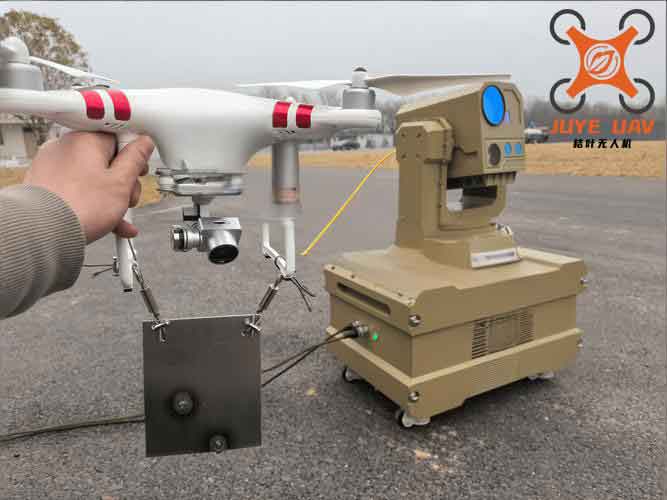
To appreciate how spoofing works, it is helpful to start with the fundamentals of GNSS simulation. GNSS signal simulators are instruments that replicate the entire satellite navigation system in a controlled environment, enabling testing and validation of receivers. These simulators generate signals that are indistinguishable from real satellite broadcasts in terms of modulation, content, and quality. The mathematical foundation involves modeling various components, including satellite orbits, atmospheric effects, and user dynamics. For instance, the user observation model simulates pseudorange measurements, which are fundamental to positioning. The pseudorange $$ \rho $$ can be expressed as:
$$ \rho = r + c \cdot \delta t + \epsilon_{\rho} $$
where $$ r $$ is the geometric distance between the satellite and receiver, $$ c $$ is the speed of light, $$ \delta t $$ represents clock errors, and $$ \epsilon_{\rho} $$ encompasses errors like ionospheric and tropospheric delays. In simulation, these parameters are carefully controlled to create realistic scenarios. The transition from simulation to spoofing occurs when these simulated signals are used not for testing but for deception. By adjusting parameters such as signal transmission times, a spoofer can induce false pseudorange values, thereby tricking the receiver into computing incorrect positions or times. This forms the basis of anti-drone spoofing, where the goal is to subtly corrupt the drone’s navigation solution.
The design of spoofing devices often follows a “receiver-spoofer” architecture, which has become prevalent due to advancements in software-defined radio (SDR) technology. In this setup, a receiver first monitors real GNSS signals to obtain accurate timing and positioning information. Then, a spoofer generates counterfeit signals that are synchronized with the genuine ones, gradually overpowering them to take control of the target receiver. This method allows for precise and covert spoofing, making it a powerful tool in anti-drone systems. Based on complexity, spoofers can be categorized into three levels: basic, intermediate, and advanced. Basic spoofers are essentially modified simulators with amplifiers; intermediate ones use the receiver-spoofer structure for portability and synchronization; and advanced systems employ multiple coordinated spoofers to defeat anti-spoofing measures like angle-of-arrival detection. The table below summarizes key characteristics of these categories:
| Spoofer Category | Design Approach | Advantages | Limitations |
|---|---|---|---|
| Basic | Modified signal simulator with amplifier | Simple to implement | Bulky, expensive, easily detected |
| Intermediate | Receiver-spoofer with SDR | Portable, synchronized, cost-effective | Vulnerable to multi-antenna detection |
| Advanced | Distributed spoofers with phase-locking | High stealth, robust against detection | Complex design, requires precise coordination |
In anti-drone applications, the effectiveness of spoofing hinges on sophisticated theoretical models that predict and control drone behavior. Two prominent models are the State Estimation and Control (SEC) model and the Particle Hypothesis and Planning (PHP) model. The SEC model focuses on the internal dynamics of the drone’s guidance, navigation, and control (GNC) system. It treats spoofing as an input that alters the drone’s state estimation, leading to erroneous control actions. For example, consider a linear quadratic estimator for the drone’s state. The gain matrix $$ L $$ can be derived from the algebraic Riccati equation:
$$ A_e^T P + P A_e – P C^T R^{-1} C P + Q = 0 $$
where $$ A_e $$ is the augmented system matrix, $$ C $$ is the observation matrix, $$ R $$ is measurement noise covariance, and $$ Q $$ is process noise covariance. By designing a proportional-derivative (PD) compensator, the spoofer can stealthily manipulate the drone’s trajectory. This model is instrumental in understanding how spoofing signals interact with the drone’s autopilot, a crucial aspect of anti-drone strategy.
Conversely, the PHP model adopts an external perspective, viewing the drone as a particle whose motion is governed by path-following algorithms. It emphasizes the relationship between spoofing signals and the drone’s observable behavior, such as heading angles and cross-track errors. In this model, spoofing strategies are formulated as path-planning problems. For instance, a regression model might relate the drone’s heading angle $$ \theta $$ to the spoof-induced cross-track error $$ e $$:
$$ \theta = \beta_0 + \beta_1 e + \beta_2 e^2 + \cdots + \epsilon $$
Using such models, spoofers can generate signals that guide the drone along a desired deceptive path. Both SEC and PHP models complement each other in anti-drone operations: SEC provides insights into the drone’s internal state, while PHP focuses on outward trajectory control. Integrating these approaches enables the development of robust spoofing techniques that can adapt to various drone types and mission profiles.
The practical application of navigation spoofing in anti-drone systems encompasses both defensive and offensive modes. Defensively, spoofing can create “no-fly zones” by continuously broadcasting deceptive signals that cause drones to deviate from protected areas. This is especially useful for securing military bases, public events, or critical infrastructure. Offensively, spoofing can lure hostile drones into predetermined traps for capture or destruction. A common tactic involves using radar or other sensors to track the drone, then dynamically adjusting spoofing signals to steer it toward a safe disposal zone. Once there, complementary anti-drone measures like jamming, netting, or directed-energy weapons can be employed. The synergy between spoofing and other countermeasures is vital for a layered anti-drone defense. Below, I outline typical steps in an anti-drone spoofing operation:
- Detection: Use radar, radio frequency scanners, or electro-optical sensors to identify and track the drone.
- Targeting: Analyze the drone’s GNSS usage and plan spoofing parameters based on its predicted path.
- Spoofing Execution: Transmit synchronized counterfeit signals to gradually corrupt the drone’s navigation.
- Monitoring: Continuously observe the drone’s response and adjust spoofing signals as needed.
- Termination: Employ additional anti-drone tools to neutralize the drone once it reaches the desired location.
From a technical standpoint, generating high-fidelity spoofing signals requires precise control over signal delays and phases. One advanced method involves multi-stage delay filters to achieve sub-sample resolution. For a signal $$ x(n) $$ with sampling period $$ T_s $$, the interpolated signal $$ x_M(n) $$ after upsampling by factor $$ M $$ can be expressed as:
$$ x_M(nM + m) = \sum_{k=-\infty}^{\infty} h(kM + m) x(n – k) $$
where $$ h(\cdot) $$ is the delay filter and $$ m $$ represents fractional delays. This technique allows spoofers to mimic authentic signal propagation with high accuracy, making deception difficult to detect. As anti-drone technologies evolve, spoofing devices are becoming more compact and intelligent. Future trends may include AI-driven spoofing strategies that learn from drone behaviors in real-time, enhancing the adaptability of anti-drone systems.
In conclusion, navigation spoofing is a pivotal component of modern anti-drone capabilities. Its ability to covertly manipulate drone trajectories offers a flexible and efficient means of countering aerial threats. Through continuous innovation in signal simulation, receiver-spoofer designs, and theoretical modeling, spoofing techniques are poised to play an even greater role in both military and civilian anti-drone applications. As I reflect on the progress made, it is clear that interdisciplinary collaboration—among industry, academia, and research institutions—will be key to advancing spoofing technology. By integrating spoofing with other anti-drone measures, we can build comprehensive defense systems that ensure security in an increasingly drone-populated world. The journey of anti-drone spoofing is far from over, and I am excited to contribute to its future development.