
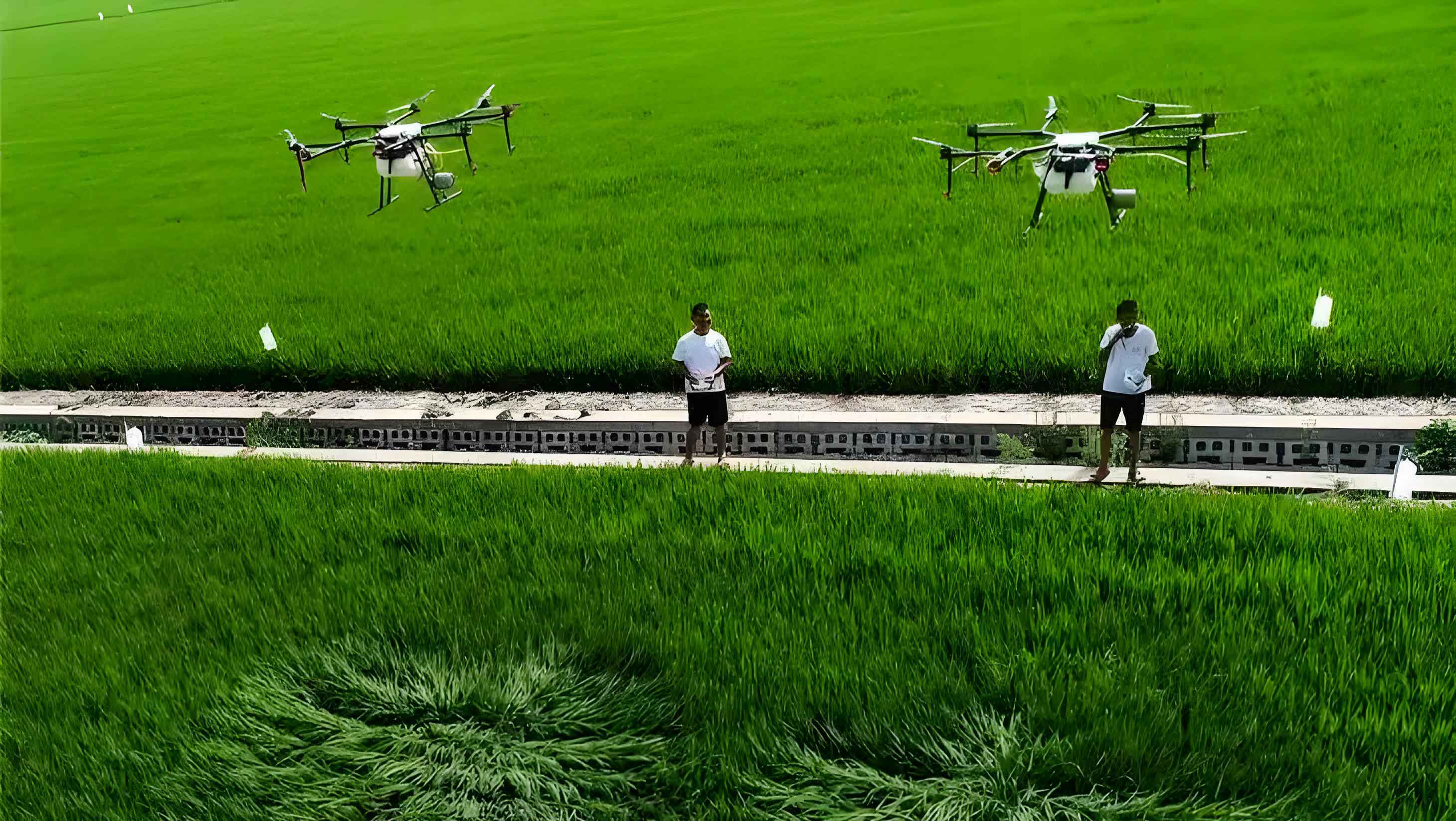
The widespread adoption of agricultural drone technology, or Unmanned Aerial Vehicles (UAVs), for plant protection represents a significant shift in modern crop management strategies. My research focuses on optimizing the application efficiency of these systems, particularly in complex cropping systems like cotton. The core challenge lies in ensuring that pesticide droplets effectively penetrate the dense canopy and deposit on target surfaces, especially lower leaves where pests like the cotton aphid (Aphis gossypii) often reside. A promising approach to overcome the inherent limitations of low-volume aerial spraying—such as droplet drift, evaporation, and poor canopy penetration—is the incorporation of spray adjuvants. These specialized additives are designed to modify the physicochemical properties of the spray solution, thereby influencing droplet formation, flight stability, and interaction with leaf surfaces.
In my field experiments, I evaluated the impact of six different adjuvants on the deposition characteristics of a spray mixture applied via a standard agricultural drone and the subsequent biological efficacy against cotton aphids. The adjuvants tested—Yaketou, Beidatong, Zhiwusancan, Nongjianfei, Qigong, and Beibeijia—represent different chemical classes, including alkylated/methylated vegetable oils, plant extracts, hyperbranched polymers, organosilicone-based surfactants, and fatty amines. The carrier pesticide was a combination insecticide, spirotetramat-buprofezin SC. The primary objective was to quantify how these additives alter the spray’s physical behavior and translate those changes into improved pest control, providing a data-driven basis for formulating more effective UAV spray solutions.
Experimental Methodology: Quantifying Spray Performance
The study was conducted in a cotton field during the squaring stage. A commercially available multi-rotor agricultural drone (DJI T30) was employed for all applications, with flight parameters standardized at a height of 3 m, a speed of 5.5 m/s, and a spray volume rate of 22.5 L/ha. To precisely measure deposition, I incorporated a tracer dye (Allura Red) into the spray tank mix at a known concentration. This allowed for the subsequent quantitative analysis of droplet deposition. The experimental layout was designed to capture spatial variability: sampling points were arranged across three transects perpendicular to the flight path. At each point, water-sensitive papers and mylar cards were positioned on the upper, middle, and lower strata of a cotton plant to collect droplet data.
The analysis of deposition characteristics involved several key metrics, which I systematically quantified:
- Droplet Size (Dv,0.5): The volumetric median diameter, measured in micrometers (µm) from water-sensitive paper scans.
- Droplet Density (N): The number of droplets per square centimeter (droplets/cm²).
- Droplet Coverage (C): The percentage of the sampled area covered by spray (%).
$$ C = \frac{A_{droplets}}{A_{total}} \times 100\% $$
Where \( A_{droplets} \) is the total area covered by droplets and \( A_{total} \) is the area of the sampling card. - Droplet Deposition Amount (D): The volume of spray solution deposited per unit area (µL/cm²), calculated from the tracer dye washed off the mylar cards. The dye concentration was determined spectrophotometrically against a calibration curve, and deposition was calculated as:
$$ D = \frac{C_e \times V}{S} $$
Where \( C_e \) is the concentration of the tracer in the wash solution (µg/mL), \( V \) is the wash volume (mL), and \( S \) is the surface area of the collection card (cm²).
Aphid populations were monitored pre-application and at 1, 3, 7, and 14 days post-application (DPA) on marked leaves from the upper, middle, and lower plant sections. Control efficacy (E) was calculated using Abbott’s formula, comparing the population reduction in treated plots to the natural change in the untreated control plot:
$$ E = \frac{R_t – R_c}{100 – R_c} \times 100\% $$
where \( R_t \) is the percent reduction in the treated plot and \( R_c \) is the percent reduction in the control plot.
Comprehensive Analysis of Adjuvant Effects on Deposition
The data reveals substantial and statistically significant differences in deposition characteristics attributable to adjuvant type. A holistic summary of the effects across all measured parameters at different plant heights is presented in Table 1.
| Treatment (Adjuvant) | Key Effect on Droplet Size | Primary Impact on Density & Coverage | Effect on Deposition Amount | Overall Deposition Ranking |
|---|---|---|---|---|
| Beibeijia | Significantly increased VMD at all levels (18.5-25.6%). | Highest or among highest density and coverage across all strata. | Highest or among highest deposit, especially in lower canopy. | 1 (Best) |
| Beidatong | Increased VMD in middle/lower canopy (≈9%). | Very high density and coverage, second only to Beibeijia. | Very high deposit, showing strong canopy penetration. | 2 |
| Qigong | Reduced VMD compared to control. | Increased density in upper/middle canopy; good lower coverage. | Increased deposit in upper/middle canopy. | 3 |
| Yaketou | Reduced VMD compared to control. | Increased upper density/coverage; moderate middle/lower effect. | Increased deposit in upper canopy. | 4 |
| Zhiwusancan | Reduced VMD. | Moderate increase in upper/middle density. | No significant increase in deposit. | 5 |
| Nongjianfei | Reduced VMD. | Minimal positive effect on density; no significant coverage gain. | No significant increase in deposit. | 6 |
| Control (No Adjuvant) | Baseline. | Baseline. Lowest density and coverage in lower canopy. | Baseline. Poor lower canopy deposition. | 7 |
The detailed quantitative data for droplet density, coverage, and deposit at each canopy level further elucidates the performance gradient. The results underscore the challenge of lower canopy penetration for the standard agricultural drone spray, a challenge that specific adjuvants effectively mitigated.
| Canopy Position | Parameter | Beibeijia | Beidatong | Control | Unit |
|---|---|---|---|---|---|
| Upper | Density | 37.3 a | 35.1 ab | 27.5 d | droplets/cm² |
| Coverage | 3.3 a | 3.0 ab | 2.1 d | % | |
| Deposition | 0.667 a | 0.626 a | 0.390 c | µL/cm² | |
| Middle | Density | 22.3 a | 19.8 ab | 15.3 c | droplets/cm² |
| Coverage | 2.2 a | 2.0 ab | 1.4 c | % | |
| Deposition | 0.358 a | 0.345 a | 0.224 c | µL/cm² | |
| Lower | Density | 14.7 a | 12.8 b | 6.4 d | droplets/cm² |
| Coverage | 1.3 a | 1.1 b | 0.7 c | % | |
| Deposition | 0.187 a | 0.164 a | 0.052 c | µL/cm² |
Note: Different letters within a row indicate significant differences (P < 0.05). Data for Qigong, Yaketou, Zhiwusancan, and Nongjianfei are omitted for clarity but followed the ranking in Table 1.
Translating Improved Deposition into Superior Aphid Control
The enhanced physicochemical deposition achieved with adjuvants directly correlated with improved biological efficacy. The control plots sprayed with only the insecticide (no adjuvant) showed moderate aphid suppression, but the adjuvant-containing treatments consistently outperformed them. The efficacy over time, stratified by canopy level, clearly demonstrates the value addition of adjuvants in a agricultural drone spraying program. The relationship between increased deposition amount (D) and control efficacy (E) can be conceptually modeled, showing a positive, non-linear correlation where efficacy gains are most pronounced once a minimum deposition threshold is exceeded.
$$ E \propto \frac{D^n}{K + D^n} $$
Where \( n \) is a coefficient and \( K \) is a constant related to the insecticide’s intrinsic toxicity and the pest’s susceptibility. The adjuvants effectively increase \( D \), thereby driving \( E \) higher.
| Days After Treatment | Canopy Level | Beibeijia | Beidatong | Qigong | Control (No Adjuvant) |
|---|---|---|---|---|---|
| 1 | Upper | 58.8 a | 52.1 b | 48.3 c | 41.2 d |
| Middle | 49.6 a | 43.5 b | 40.1 bc | 32.7 d | |
| Lower | 39.8 a | 34.2 b | 30.5 c | 22.1 d | |
| 3 | Upper | 76.8 a | 72.4 b | 68.9 c | 58.3 d |
| Middle | 66.4 a | 62.1 b | 57.8 c | 48.2 d | |
| Lower | 55.5 a | 52.3 a | 49.1 b | 40.7 c | |
| 7 | Upper | 92.2 a | 88.7 b | 85.4 c | 76.9 d |
| Middle | 83.0 a | 78.5 b | 74.2 c | 65.1 d | |
| Lower | 74.0 a | 70.3 a | 66.1 b | 56.4 c | |
| 14 | Upper | 85.1 a | 80.6 b | 76.3 c | 66.8 d |
| Middle | 74.3 a | 69.8 b | 64.9 c | 54.2 d | |
| Lower | 63.5 a | 59.7 ab | 55.4 b | 44.9 c |
Mechanistic Discussion and Practical Implications
The differential performance of the adjuvants can be explained by their distinct modes of action on the spray solution and droplet dynamics. The superior results from Beibeijia (fatty amine) and Beidatong (methylated vegetable oil) suggest a combination of beneficial effects critical for agricultural drone applications. Firstly, they likely increased the dynamic viscosity and elastic modulus of the spray mixture, leading to the formation of larger primary droplets (as recorded) that are more resistant to drift and evaporation during flight from the UAV to the canopy. Secondly, upon impaction, these adjuvants reduce the surface tension and contact angle, promoting rapid spreading and adhesion on the often difficult-to-wet hydrophobic surface of cotton leaves. This combination—larger, more stable droplets in flight and better spreading and retention on target—maximizes the amount of active ingredient delivered to both upper and lower leaf surfaces.
In contrast, adjuvants like Qigong (organosilicone), while excellent at maximizing spread on contact, may produce droplets too small for the aerial application context, increasing susceptibility to off-target loss. Others, like Nongjianfei, may not have sufficiently altered the key interfacial properties relevant to this specific agricultural drone and crop scenario. This highlights that adjuvant selection is not generic but must be tailored to the application method. The optimized deposition directly enhances the performance of systemic insecticides like spirotetramat by ensuring a sufficient initial dose is absorbed through the leaf cuticle.
From an integrated pest management (IPM) perspective, using adjuvants with agricultural drone sprays is a powerful tool for resistance management and environmental stewardship. By consistently improving the dose transferred to the pest, the effective field rate of the insecticide can potentially be maintained or even reduced, slowing the selection pressure for resistance. Furthermore, reducing off-target drift through better droplet physics minimizes environmental contamination. My findings provide clear empirical evidence that the strategic formulation of UAV spray tanks with purpose-selected adjuvants is a critical step towards achieving the precision and efficiency promised by agricultural drone technology, moving beyond mere application to truly optimized delivery.