
As an educator and researcher in the field of police technology, I have witnessed the rapid integration of unmanned aerial vehicles (UAVs), or drones, into law enforcement operations. In recent years, drones have become indispensable tools in traffic management, public security surveillance, counter-terrorism, crowd control, and emergency response. Their ability to provide aerial perspectives, real-time data, and enhanced situational awareness has revolutionized policing strategies. However, this technological advancement has also exposed critical gaps, particularly in the realm of drone training. The shortage of qualified drone pilots and the lack of standardized operational protocols hinder the effective utilization of drones in police work. Therefore, as a key institution for nurturing law enforcement professionals, police academies must take the lead in developing and refining drone training curricula. This article explores the necessity, current challenges, and potential pathways for building robust drone training programs in police academies, with a focus on integrating practical skills, theoretical knowledge, and innovative teaching methods.
The imperative for comprehensive drone training in police academies stems from several pressing issues. Firstly, there is a severe shortage of specialized personnel. Many current drone operators in police forces are transferred from other units or have self-taught experience, leading to inconsistent skill levels and a lack of systematic expertise. This gap is exacerbated by the rapid evolution of drone technology, which requires continuous learning and adaptation. Secondly, tactical applications of drones in law enforcement are still in their infancy. While drones are often used for video surveillance, their potential in areas like evidence collection, signal interception, and coordinated operations remains underexplored. Without advanced drone training, police forces risk underutilizing these tools, reducing their effectiveness in critical situations. To quantify the training needs, we can consider a simple model for skill acquisition: $$ S(t) = S_0 + \alpha \int_0^t T(\tau) d\tau $$ where \( S(t) \) represents skill level at time \( t \), \( S_0 \) is initial skill, \( \alpha \) is a learning coefficient, and \( T(\tau) \) is the training intensity. This highlights that sustained drone training is essential for skill growth.
To better understand the core components of drone training, the following table summarizes key skill domains and their importance in police work:
| Skill Domain | Description | Relevance to Policing | Training Priority (1-5) |
|---|---|---|---|
| Flight Operations | Basic piloting, navigation, and safety protocols | Fundamental for all drone missions; ensures safe and controlled flights. | 5 |
| Legal and Regulatory Compliance | Understanding airspace laws, privacy regulations, and departmental policies | Prevents legal issues and ensures ethical use of drones in surveillance. | 4 |
| Tactical Applications | Scenario-based training for traffic monitoring, crowd control, and search-and-rescue | Enhances operational effectiveness in real-world police tasks. | 5 |
| Data Analysis and Integration | Processing aerial imagery, using GIS tools, and integrating data with other systems | Supports evidence gathering and strategic decision-making. | 4 |
| Maintenance and Troubleshooting | Drone upkeep, repair, and software updates | Reduces downtime and ensures reliability in field operations. | 3 |
Moreover, the effectiveness of drone training can be modeled using a performance metric: $$ P = \frac{F \times A}{C} $$ where \( P \) is overall performance, \( F \) represents flight proficiency, \( A \) denotes application accuracy, and \( C \) is the cost of training. This formula emphasizes that balanced training in both technical and tactical aspects maximizes outcomes while managing resources. As police academies, we must address these domains systematically to produce competent drone operators.
Currently, drone training programs in police academies face significant hurdles.师资力量薄弱,教师队伍素质有待提高 is a common issue; many instructors lack hands-on experience in police drone operations, leading to a theory-practice gap. Additionally, curriculum content is often fragmented, with no standardized教材 or teaching materials across institutions. For instance, some academies focus solely on basic flight skills, neglecting advanced applications like 360° aerial reconnaissance or 3D mapping. This inconsistency hampers the development of a cohesive national standard for police drone training. To illustrate the variability, consider the following table comparing training hours across different modules in various academies:
| Training Module | Academy A (Hours) | Academy B (Hours) | Academy C (Hours) | Recommended Standard (Hours) |
|---|---|---|---|---|
| Basic Flight Training | 20 | 25 | 15 | 30 |
| Legal Framework | 5 | 10 | 8 | 15 |
| Tactical Scenarios | 10 | 15 | 12 | 25 |
| Data Management | 8 | 5 | 10 | 20 |
| Total Hours | 43 | 55 | 45 | 90 |
This disparity underscores the need for a unified curriculum. Furthermore, the lack of实战训练 facilities limits students’ exposure to real-life situations. As I have observed, without proper simulation environments or field exercises, drone training remains theoretical, reducing its impact on actual police work. To address this, we can employ a learning curve model: $$ L(n) = L_0 \cdot n^{-b} $$ where \( L(n) \) is the time per task after \( n \) repetitions, \( L_0 \) is the initial time, and \( b \) is the learning rate. This shows that repetitive, hands-on drone training accelerates proficiency, highlighting the importance of practical sessions.
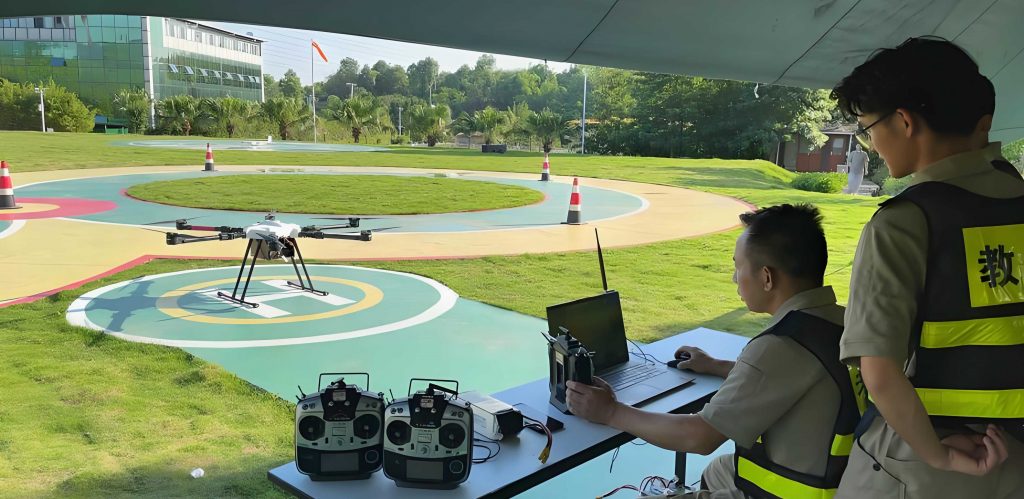
The image above depicts a typical drone training session, emphasizing the hands-on approach necessary for skill development. Integrating such visuals into training modules can enhance engagement and understanding. Moving forward, police academies must adopt multifaceted strategies to overcome these challenges and build effective drone training courses.
One critical pathway is deepening collaboration between academies and police departments, often termed “school-bureau cooperation.” This involves bidirectional exchanges: instructors should engage in regular fieldwork with police units to stay updated on practical drone applications, while experienced police drone operators can be invited as guest lecturers or embedded trainers. Such partnerships ensure that drone training remains relevant to evolving operational needs. For example, joint research projects on drone tactics can inform curriculum updates. To quantify the benefits, we can use a synergy formula: $$ S = \frac{I_a + I_p}{2} + \sigma_{a,p} $$ where \( S \) is the synergy score, \( I_a \) represents academy input, \( I_p \) denotes police department input, and \( \sigma_{a,p} \) is the covariance of their efforts. This illustrates how collaboration amplifies training outcomes.
Another key aspect is strengthening professional teams within academies. This includes recruiting specialized drone instructors, providing them with ongoing technical training, and establishing clear career pathways. A structured approach to team building can be summarized in the following table:
| Component | Actions | Expected Outcomes |
|---|---|---|
| Recruitment | Hire instructors with dual expertise in drone technology and policing | Enhanced teaching quality and practical relevance |
| Training | Regular workshops on new drone models, software, and tactics | Up-to-date knowledge and skills among staff |
| Incentives | Offer certifications, research opportunities, and field deployment chances | Increased motivation and retention of talent |
| Evaluation | Use peer reviews, student feedback, and performance metrics | Continuous improvement of training methods |
Furthermore, optimizing teaching content and innovating methods are vital for effective drone training. The curriculum should be modular, covering basics to advanced applications. For instance, after mastering flight controls, students can progress to modules on aerial photography for accident reconstruction or drone swarms for large-scale events. Incorporating active learning techniques, such as case studies, simulations, and project-based tasks, fosters deeper engagement. The effectiveness of different methods can be modeled using: $$ E_m = \beta_0 + \beta_1 M + \beta_2 P + \epsilon $$ where \( E_m \) is educational effectiveness, \( M \) represents method innovativeness, \( P \) denotes student participation, and \( \epsilon \) is error term. This underscores that interactive drone training yields better results.
To enhance tactical training, we can develop scenario-based exercises that mimic real police operations. For example, a drone-assisted search for a missing person involves coordinating flight patterns, analyzing thermal imagery, and integrating with ground teams. The complexity of such scenarios can be scaled using: $$ C_s = \sum_{i=1}^n w_i \cdot d_i $$ where \( C_s \) is scenario complexity, \( w_i \) are weights for factors like weather or terrain, and \( d_i \) are difficulty levels. By gradually increasing \( C_s \), drone training prepares operators for diverse challenges.
Additionally, the use of technology in drone training cannot be overstated. Virtual reality (VR) simulators allow risk-free practice of dangerous maneuvers, while data analytics platforms help assess performance. For instance, flight path accuracy can be measured with: $$ A_f = 1 – \frac{\sum |x_i – x_{target}|}{N \cdot R} $$ where \( A_f \) is accuracy, \( x_i \) are actual positions, \( x_{target} \) are desired positions, \( N \) is the number of points, and \( R \) is a reference distance. Such metrics enable objective evaluation in drone training programs.
Moreover, standardizing certifications is crucial. Police academies should work towards a national credentialing system for drone operators, similar to pilot licenses. This ensures uniformity in skills and facilitates inter-departmental collaboration. The certification process can include written exams, practical tests, and continuous assessments. A pass rate model might be: $$ P_c = \frac{T_h \cdot S_k}{D} $$ where \( P_c \) is certification probability, \( T_h \) is training hours, \( S_k \) is skill level, and \( D \) is difficulty factor. By aligning drone training with certifications, academies enhance workforce readiness.
In terms of curriculum design, I propose a tiered approach. The foundation tier covers basic drone operations and safety, intermediate tier focuses on police-specific applications, and advanced tier explores emerging technologies like AI-driven drones or counter-drone measures. Each tier should include both theoretical and practical components. For example, the intermediate tier might involve a capstone project where students use drones to map a simulated crime scene, applying photogrammetry techniques. The learning outcomes can be assessed using: $$ O = \int (K + S) dt $$ where \( O \) is overall outcome, \( K \) is knowledge gain, and \( S \) is skill acquisition over time \( t \). This integral approach ensures comprehensive drone training.
To address resource constraints, police academies can leverage partnerships with industry and other educational institutions. Sharing training facilities, co-developing online courses, and accessing grant funding can expand drone training capabilities. For instance, MOOCs (Massive Open Online Courses) on drone technology can supplement in-person training. The cost-effectiveness of such blended learning can be expressed as: $$ CE = \frac{B \cdot U}{C} $$ where \( CE \) is cost-effectiveness, \( B \) is benefits (e.g., number of trained personnel), \( U \) is utility per trainee, and \( C \) is total cost. This encourages efficient drone training investments.
Finally, continuous evaluation and adaptation are key. Regular feedback from graduates and police departments should inform curriculum updates. For example, if new drone regulations emerge, drone training must promptly incorporate them. A dynamic update mechanism can be modeled as: $$ U_{t+1} = U_t + \alpha (F_t – U_t) $$ where \( U_t \) is curriculum utility at time \( t \), \( F_t \) is feedback score, and \( \alpha \) is an adaptation rate. This ensures that drone training remains current and effective.
In conclusion, the development of robust drone training courses in police academies is essential for modernizing law enforcement. By addressing the need for specialized personnel, standardizing curricula, fostering collaborations, and embracing innovative teaching methods, we can build a sustainable ecosystem for police drone operations. As an educator, I believe that through persistent efforts in drone training, police academies will not only bridge existing gaps but also pioneer new tactical applications, ultimately enhancing public safety and operational efficiency. The journey requires commitment, but the payoff—a skilled cadre of drone operators ready for 21st-century policing—is immeasurable.