
In recent years, with the rapid advancement of technology, drone training has become increasingly prevalent across various fields, from aerial photography and mapping to emergency rescue operations. The expanding applications of drones underscore the growing importance of普及 education in this domain, particularly within community settings. The hands-on and technologically engaging nature of drone training effectively stimulates learning interest and innovation among community residents. As an active practitioner in continuing education, our institution has undertaken and led a quality improvement project for continuing education—the Drone Community Education Demonstration Base. This initiative aims to integrate drone科普 teaching into communities, fostering a synergy between higher vocational education and community education. Funded by relevant innovation and quality enhancement programs, this project represents our commitment to advancing community-based drone training.
The core of this endeavor lies in exploring how drone科普研学 education, as a representative of new quality productivity, can be融入 community education. Through a case study approach, we delve into the background, strategies, specific measures, and volunteer mechanisms of this project, emphasizing the integration of Party building leadership with innovative community education models. Our实践 demonstrates that the demonstration base, by organizing vocational college volunteer teams to conduct diverse activities such as科普 competitions, effectively enhances residents’ scientific literacy and participation, promotes community interaction, strengthens cohesion, and sparks innovation. This model exhibits strong replicability and scalability, offering valuable insights for similar research.
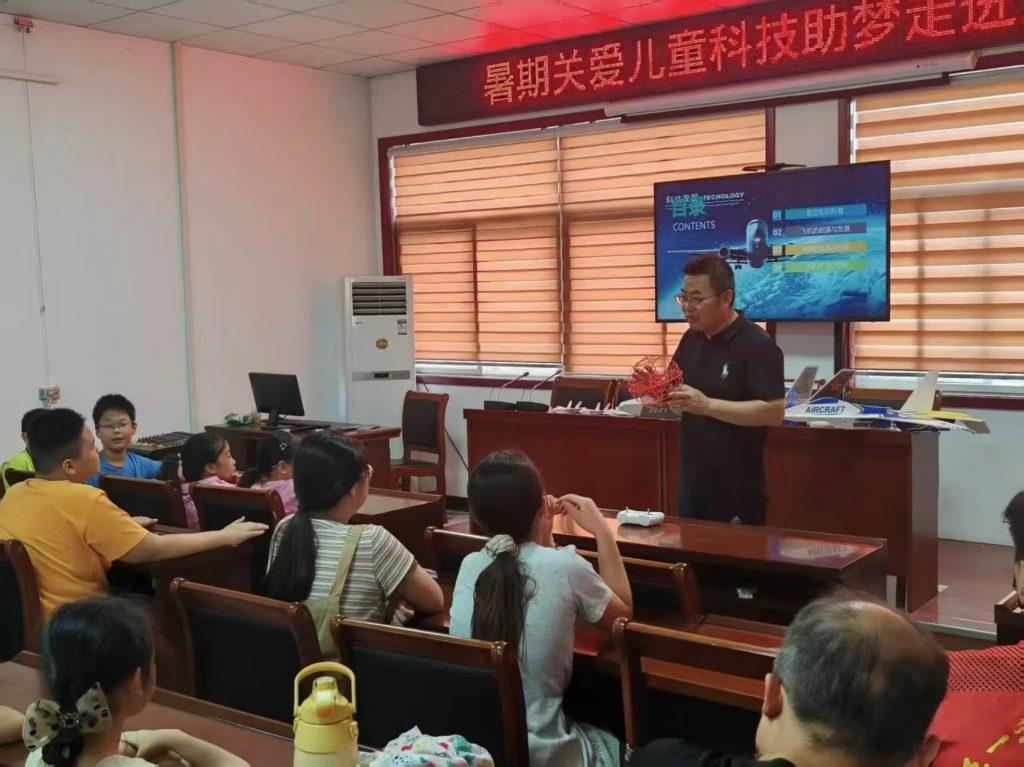
The importance of drone training in community education cannot be overstated. In the context of日益激烈的 global competition, community education has emerged as a key focus for national development. Driven by policy support, community education not only promotes educational equity and social harmony but also cultivates new quality productivity to meet contemporary demands, thereby aiding in大国 competition. Our project serves as a practical example of how drone training can be leveraged to achieve these goals. By incorporating drone科普研学 into community education, we aim to bridge the gap between technological advancement and public understanding, ultimately contributing to a more informed and innovative society.
To provide a comprehensive overview, this article is structured as follows: first, we examine the research background, covering the theory and practice of community education and the objectives of our demonstration base. Next, we detail the implementation strategies, including Party building leadership, innovative measures, volunteer collaboration, and宣传创新. We then present a case analysis, highlighting the project’s background and specific activities, such as青少年 drone technology competitions. Following that, we discuss the promotional value of this drone training model, exploring new pathways for vocational colleges to serve community education, enhance teacher skills, and foster student growth. Finally, we conclude with reflections on achievements and future directions. Throughout, we incorporate tables and formulas to summarize key aspects and enhance clarity.
Research Background
Community education is a模式 that operates at the grassroots level, encompassing non-formal education and lifelong learning to meet the diverse needs of residents. It typically falls into three categories: compensatory education, which addresses gaps in formal schooling; control-oriented education, which focuses on maintaining social order and stability; and emancipatory education, which promotes personal and societal进步 through learning. In practice, community education employs varied courses and activities to continuously提升 residents’ knowledge, skills, and social engagement. This not only drives individual development but also strengthens community cohesion and inclusivity, supporting the construction of a harmonious society.
With the swift evolution of technology and societal transformation, the content and形式 of community education are constantly innovating. By cultivating new quality productivity, utilizing digital learning resources, and integrating modern technological elements, community education can better cater to居民’ learning needs. The introduction of drone training, in particular, offers a breakthrough in technology-driven educational innovation. Drone training, with its practical applications and appeal, provides a unique avenue for engaging community members, especially youth, in STEM (Science, Technology, Engineering, and Mathematics) fields. This aligns with broader trends in educational reform, where hands-on, experiential learning is prioritized to foster critical thinking and problem-solving skills.
Our demonstration base is founded on the宗旨 of “cultivating new quality productivity and enhancing community scientific literacy.” Through drone科普 and研学, we seek to推动 innovation in community education. The project is led by our institution in collaboration with local街道 and communities, extending its辐射 to broader regions. We have established a多方协作机制 involving enterprises like Tianyi Aviation and associations such as the Guangdong Emergency Association and the Chinese Institute of Electronics. Key objectives include establishing a standardized community education demonstration base, developing community-oriented drone training courses, cultivating professional teaching teams, and enhancing residents’ scientific literacy and innovation capabilities through a series of科普 activities and practical projects. Expected outcomes encompass significant improvements in community scientific literacy, innovative推广 of community education models, and comprehensive effects on community harmony and development.
To quantify these goals, we have formulated several key performance indicators (KPIs) related to drone training. These can be summarized in the following table:
| Objective | Target Metric | Measurement Method |
|---|---|---|
| Standardize community education | Develop base management measures | Document review and implementation reports |
| Establish learning spaces | Construct venues ≥500 m² | Site inspections and area calculations |
| Build expert and volunteer teams | Recruit ≥50 professionals | Database records and participation logs |
| Create digital resources | Develop ≥30 course modules | Resource库 audits and usage statistics |
| Enhance community engagement | Engage ≥800 residents in activities | Attendance records and survey feedback |
In terms of theoretical underpinnings, drone training in community education can be modeled using learning curves and technology adoption frameworks. For instance, the learning effectiveness of drone training can be expressed as a function of practice time and instructional quality. Let \( L(t) \) represent the learning outcome at time \( t \), which can be modeled by a differential equation:
$$ \frac{dL}{dt} = \alpha \cdot I(t) \cdot (1 – \frac{L}{L_{max}}) – \beta \cdot L $$
where \( I(t) \) denotes the intensity of drone training instruction, \( \alpha \) is a learning rate constant, \( L_{max} \) is the maximum achievable skill level, and \( \beta \) is a forgetting rate. This equation highlights how sustained drone training with quality instruction can lead to progressive skill acquisition, crucial for community education outcomes.
Implementation Strategies
Party building leadership is the核心特色 of our demonstration base. We leverage the organizational strengths of the Party to deeply integrate educational policies into community实践. Drawing from prior experience in grassroots Party building, such as research on enhancing Party-led urban governance, we incorporate红色 education into youth programs. Guided by the principle that “revolutionary traditional education should start from a young age,” we blend红色 themes with drone training activities, fostering scientific literacy and social responsibility among students. Our university教师 team and the “Drone Flight驾驶 Association” volunteer team collaborate to implement projects, translating Party理念 into action and driving innovation in educational content and形式. Through Party building empowerment, we enhance the cohesion and social responsibility of grassroots organizations, significantly improving the effectiveness of community education and achieving deep integration of drone training with community education, thereby promoting sustainable development.
In terms of举措创新, we have innovated in curriculum design and teaching modes. Tailoring to learners of different ages and backgrounds, we developed diverse drone training modules, including basic drone knowledge, simulation flight, and intelligent flight operations. These courses are designed to be closely linked to real-life scenarios, enabling learners to acquire practical skills through hands-on practice. Moreover, by utilizing digital platforms like “Chaoxing Learning通,” we employ a “online learning + offline experience” teaching model. Learners can easily access丰富的 online resources and reinforce theoretical knowledge through offline simulation training and actual flight operations, enhancing learning outcomes. To illustrate the curriculum structure, consider the following table outlining key drone training modules:
| Module Name | Target Audience | Key Content | Duration (hours) | Learning Outcomes |
|---|---|---|---|---|
| Drone Basics | Beginners, all ages | Introduction to drone components, safety protocols, regulations | 10 | Understand fundamental concepts and safety measures |
| Simulation Flight | Teens and adults | Virtual flight practice using simulators, control techniques | 15 | Develop basic piloting skills without physical risk |
| Intelligent Flight | Advanced learners | Programming drones for autonomous missions, sensor integration | 20 | Gain skills in automation and applied problem-solving |
| Community Applications | Residents, local groups | Real-world uses in surveying, emergency response, photography | 12 | Apply drone training to community needs and projects |
Learning activities have also been innovated. We regularly organize drone technology competitions and青少年 whitelist events to激发 participation热情, cultivate innovative thinking, and teamwork. These activities effectively提升 the attractiveness and engagement of community education, encouraging residents to actively participate in scientific literacy enhancement. The impact of such activities can be quantified using participation metrics and skill improvement scores. For example, the effectiveness of a drone training competition can be evaluated through pre- and post-test scores, modeled as:
$$ \Delta S = S_{post} – S_{pre} = k \cdot N \cdot \int_{0}^{T} A(t) dt $$
where \( \Delta S \) is the skill improvement, \( k \) is a competition efficacy constant, \( N \) is the number of participants, \( A(t) \) represents the activity intensity over time \( T \), and \( S_{pre} \) and \( S_{post} \) are pre- and post-competition skill assessments. This emphasizes how structured drone training events can drive measurable gains.
Volunteer协同参与创新 is a key strategy for integrating higher education with community education. We fully utilize volunteer resources from the vocational college’s “Drone Flight驾驶 Association,” combining the advantages of drone training专业 to achieve seamless theory-practice integration. This optimizes resource allocation between学历 education and community continuing education, promoting social sharing of educational outcomes. In project implementation, volunteer teams play crucial roles in course assistance, practical guidance, course development, and activity planning, demonstrating active innovation and injecting vitality. This mode not only enriches the content and形式 of community education, enhancing residents’ scientific literacy and激发青少年’ interest in science, but also provides valuable practical opportunities for student volunteers, improving their professional skills and social实践 capabilities. The synergy can be expressed as a resource optimization function:
$$ R_{total} = \sum_{i=1}^{n} (V_i \cdot E_i) + C $$
where \( R_{total} \) is the total educational resource output, \( V_i \) represents volunteer contributions, \( E_i \) denotes educational effectiveness per volunteer, \( n \) is the number of volunteers, and \( C \) signifies institutional resources. This highlights how volunteer-driven drone training amplifies community education impact.
宣传创新 is vital in the information age. We have built a融媒体宣传阵地 to overcome traditional宣传 limitations. Establishing a dedicated website and actively using platforms like Douyin and WeChat, we employ videos, graphics, and live streams to showcase educational achievements, enhance interaction with residents, and attract participation. Our宣传策略 focuses on creativity and interactivity, hosting online activities and主题 discussions to deepen community connections. This全方位 approach promotes the普及 of community education and lays a foundation for long-term project sustainability, achieving educational resource sharing and提升 overall community education quality. The reach of such宣传 efforts can be modeled using diffusion equations, where the adoption rate of drone training programs \( A(t) \) follows:
$$ \frac{dA}{dt} = \gamma \cdot A \cdot (1 – \frac{A}{M}) + \delta \cdot P(t) $$
where \( \gamma \) is a growth rate, \( M \) is the maximum potential adoption, \( \delta \) is a宣传 impact coefficient, and \( P(t) \) represents宣传 intensity over time. This underscores how innovative宣传 accelerates the uptake of drone training in communities.
Case Analysis and Implementation Effectiveness
The background of our drone community education project centers on promoting drone technology knowledge and cultivating innovation and practical skills among residents. Key targets included formulating “Community Education Training Base Management Measures” to standardize activities, constructing standardized educational venues of at least 500 m², building expert, teacher, and volunteer databases with over 50 professionals, and developing a digital learning resource库 with不少于 30 course modules. By integrating our institution’s educational resources and collaborating with industry partners like the Guangdong Emergency Association and Tianyi Aviation, we successfully established venues meeting these targets, created professional teams and resource库, and built diversified educational platforms. To date, the demonstration base has conducted over 20 public科普 lectures and more than 10 public flight training sessions. Through organizing drone technology competitions and interactive displays, we have engaged over 800 residents across age groups. The implementation benefits from Party building leadership, volunteer collaboration, and multi-channel宣传, effectively enhancing the influence of community education and gaining wide recognition from residents and partners.
A specific case of drone training in community education is the社区青少年 Drone Technology Competition, jointly organized with the Chinese Institute of Electronics. Based on the nationally recognized “National Youth Drone Technology Level Examination,” this公益 activity for youth covers drone assembly, debugging, programming control, and more, aiming to激发科技兴趣 and innovation potential. The process includes pre-competition科普 lectures and technical training, real-time guidance and strategy adjustments during the competition, and post-competition showcases and awards. These elements test technical abilities while enhancing teamwork and problem-solving skills, making it a highlight of community education. So far, this competition has significantly提升ed residents’素养, particularly青少年’科技素养, and generated positive community反响. Through互动交流, students share and learn knowledge, demonstrating their skills and creativity. For instance, in one community, students nurtured by this event won 12 awards in municipal and provincial drone competitions from 2023 to 2024, with three students leveraging technological “strengths” to gain admission to top secondary schools. These outcomes enhance community cohesion and participation, provide valuable experience for other community education activities, and effectively promote community harmony and progress.
To quantify the effectiveness, we can analyze participation data and learning outcomes from drone training activities. The table below summarizes key metrics from our implementation:
| Activity Type | Number of Sessions | Total Participants | Average Skill Improvement (%) | Community Feedback Score (out of 10) |
|---|---|---|---|---|
| Public科普 Lectures | 20 | 400 | 25 | 8.5 |
| Flight Training | 10 | 200 | 40 | 9.0 |
| Drone Competitions | 5 | 150 | 50 | 9.5 |
| Interactive Displays | 8 | 250 | 30 | 8.0 |
The skill improvement is calculated based on pre- and post-activity assessments, using a standardized test for drone training proficiency. The feedback score is derived from participant surveys. These results indicate that hands-on drone training, especially competitions, yields the highest gains, aligning with our emphasis on experiential learning. We can model the overall effectiveness \( E \) of our drone training initiatives as a weighted sum:
$$ E = \sum_{j=1}^{m} w_j \cdot \left( \frac{\sum_{i=1}^{n_j} \Delta S_{ij}}{n_j} \right) $$
where \( w_j \) is the weight for activity type \( j \), \( n_j \) is the number of participants in that type, \( \Delta S_{ij} \) is the skill improvement for individual \( i \) in activity \( j \), and \( m \) is the number of activity types. This allows us to optimize future drone training programs based on empirical data.
Promotional Value of Drone科普研学 Models
Our demonstration base’s success explores new pathways for vocational colleges to serve community education. This model ingeniously integrates校内 and校外 resources, leveraging the professional advantages of higher education to combine educational services with technological applications. It provides rich drone training科普 and practical activities for community members, especially youth. Through this, we not only enhance community scientific literacy but also promote social sharing of educational resources, contributing to a learning society. The replicability and adaptability offer valuable references for other regions and institutions, showcasing the potential and responsibility of vocational colleges in推动 community education development. The drone training approach can be adapted to various contexts, such as rural areas or underserved communities, by customizing modules to local needs.
Moreover, participation in this drone training project has significantly提升ed teachers’ skills and teaching abilities. By engaging in design, implementation, and feedback processes, teachers deepen their understanding of educational technology and strengthen their identification with vocational education through interactions with residents. Accumulating practical cases forms a良性循环 of “service-teaching-research,” providing实践案例 for the comprehensive construction of “post-course-competition-certification + social service” in专业建设, driving innovation and development in专业建设, and offering useful insights for teaching reform in vocational colleges. The professional growth of teachers can be expressed as a learning curve:
$$ T_{growth}(t) = T_0 + \int_{0}^{t} \lambda \cdot M(\tau) d\tau $$
where \( T_{growth}(t) \) is teacher competency over time \( t \), \( T_0 \) is initial competency, \( \lambda \) is a growth rate, and \( M(\tau) \) represents engagement in drone training projects at time \( \tau \). This emphasizes the long-term benefits of involving educators in community-based drone training.
The drone training demonstration base also搭建 a多元化 platform for student volunteers, serving as a摇篮 for skill enhancement and professional素养 cultivation, as well as a crucial venue for technical application and social实践能力提升. Through锻炼 in科普教培 course development and activity planning and execution, students’ comprehensive素质 is全面提升, and their职业 competitiveness is显著增强. For example, in the Computer Application Technology (Drone Technology Application)专业, student volunteers participating in community科普教培 services greatly improved professional skills and素养. Over two sessions, volunteers achieved second prize in 2023 and first prize in 2024 in the Guangdong Provincial Vocational Skills Competition’s “Intelligent Flight器 Application Technology” event. This underscores how drone training initiatives can simultaneously benefit communities and students, creating a win-win scenario. The student development can be modeled as:
$$ S_{dev} = \alpha_s \cdot V_h + \beta_s \cdot C_p + \gamma_s \cdot I_t $$
where \( S_{dev} \) represents student development score, \( V_h \) denotes volunteer hours in drone training, \( C_p \) is project complexity, \( I_t \) is instructional quality, and \( \alpha_s, \beta_s, \gamma_s \) are coefficients. This formula helps quantify the impact of drone training on student成长.
Conclusion
Our demonstration base, through innovative educational models and多方协作 mechanisms, has successfully integrated drone training科普研学 education into communities, significantly enhancing residents’ scientific literacy and technical capabilities. This project has achieved notable results in推动 community education standardization and promoting community harmonious development, while exploring a replicable and scalable new path for vocational colleges to serve community education. In summary, by leveraging Party building leadership, volunteer participation, and innovative learning activity design, we have effectively strengthened community cohesion, cultivated new quality productivity, and provided valuable experience for future educational实践. Looking ahead, we will continue to explore and refine the integration pathways of drone training科普 education into communities, further推动 the construction of a lifelong learning education system, and offer beneficial references for similar research,助力 the development and innovation of community education.
The broader implications of this work extend to policy and practice. As drone training becomes more accessible, community education can serve as a vital conduit for disseminating cutting-edge technologies, fostering inclusive growth. We encourage other institutions to adopt similar models, adapting drone training programs to local contexts while maintaining core principles of engagement and practicality. By doing so, we can collectively advance the goal of全民终身学习 and build more resilient, innovative communities. The journey of integrating drone training into community education is ongoing, and we remain committed to refining our approaches based on feedback and evolving technological landscapes.