
In recent years, the integration of drone technology into media production has revolutionized aerial photography, displacing traditional methods like helicopters and hot air balloons. As an educator in this field, I have witnessed firsthand how drone training has shifted from mere piloting skills to cultivating comprehensive航拍导演 (aerial photography director) capabilities. This transformation underscores the need for innovative teaching approaches that address the unique challenges of drone operation, including safety, technical proficiency, and creative application. Our team has embarked on a journey to redefine drone training through virtual simulation and hybrid learning models, emphasizing the keyword “drone training” throughout our curriculum to foster expertise among media students.
The proliferation of drones in filmmaking, television advertising, news coverage, and live broadcasting has created a demand for skilled professionals who can seamlessly blend飞行 (flight) and拍摄 (shooting) skills. Unlike ground-based camera operation, drone aerial photography requires the叠加 (superposition) of two distinct skill sets:无人机飞行 (drone piloting) and空中云台拍摄 (aerial gimbal camera work). This duality introduces technical特殊性 (specificity),应用专有性 (application exclusivity), and操控安全性 (operation safety) concerns, necessitating a rigorous drone training framework. Our approach prioritizes holistic职业素养 (professional competency), encompassing skill development, theoretical knowledge, procedural awareness, and safety protocols. Given the limitations of physical实践条件 (practice conditions), such as restricted flight zones and resource constraints, we have turned to online教学 (teaching) solutions, particularly virtual仿真 (simulation), to enhance accessibility and effectiveness in drone training.
In professional影视拍摄 (film and television shooting) settings,航拍 (aerial photography) is typically a collaborative effort between a飞手 (pilot) and a云台手 (gimbal operator). The pilot focuses on flight safety and route design, while the gimbal operator manages camera movements for framing and composition, known as运镜 (lens movement). This synergy demands precise coordination, as the gimbal operator must constantly adjust to the pilot’s joystick inputs. Consequently,基础训练 (basic training) in drone training must emphasize flight操控训练 (control training) under安全前提 (safety prerequisites). The necessity of this foundation stems from three core aspects:规程性 (procedural nature),复杂性 (complexity), and特殊性 (peculiarity).
Drone training规程性 involves strict adherence to protocols to mitigate飞行风险 (flight risks). Regulatory bodies, such as the Civil Aviation Administration of China, define drone operators as individuals essential to无人机运行 (drone operation) during flight. Our drone training curriculum incorporates comprehensive规程训练 (procedural training), including takeoff/landing drills, flight原理 (principles), battery maintenance,图传通信 (image transmission communication),监看设备 (monitoring equipment),航空气象 (aviation meteorology), and legal regulations. Any oversight in these areas can compromise safety and拍摄结果 (shooting outcomes). Moreover, drones’ mobility raises隐私 (privacy) and物权 (property rights) concerns, mandating职业化 (professionalization) through drone training to prevent violations.
The复杂性 of drone training arises from the decomposition into飞行 (flight) and拍摄 (shooting) skills, further divided into “航” (flight), “拍” (shoot), and “航拍” (aerial shoot) phases. Both pilots and gimbal operators use remote controllers, requiring the gimbal operator to master joystick manipulation for smooth camera work. For instance, when tracking fast-moving objects like cars, inept gimbal control can lead to丢失拍摄目标 (lost subjects). Additionally, signal disruptions may cause图传信号丢失 (image transmission loss), necessitating quick communication between operators to adjust flight parameters or initiate返航 (return-to-home) procedures. The gimbal operator must also manage exposure, shutter speed, frame rate, and other camera settings efficiently, as limited battery续航能力 (endurance) impacts拍摄效率 (shooting efficiency).
特殊性 in drone training underscores safety as the paramount concern. Effective footage acquisition is the goal, but安全飞行 (safe flight) is the foundation. For beginners, repetitive flight训练 (training) is the most reliable method to ensure safety. Without solid飞行基础 (flight fundamentals), gimbal operators cannot effectively collaborate with pilots on optimal航线 (routes),拍摄角度 (angles),拍摄光线 (lighting), or合理构图 (composition). Thus, our drone training philosophy integrates flight skill development with虚拟仿真软件 (virtual simulation software) to facilitate线上线下混合式实践教学 (online-offline hybrid practical teaching).
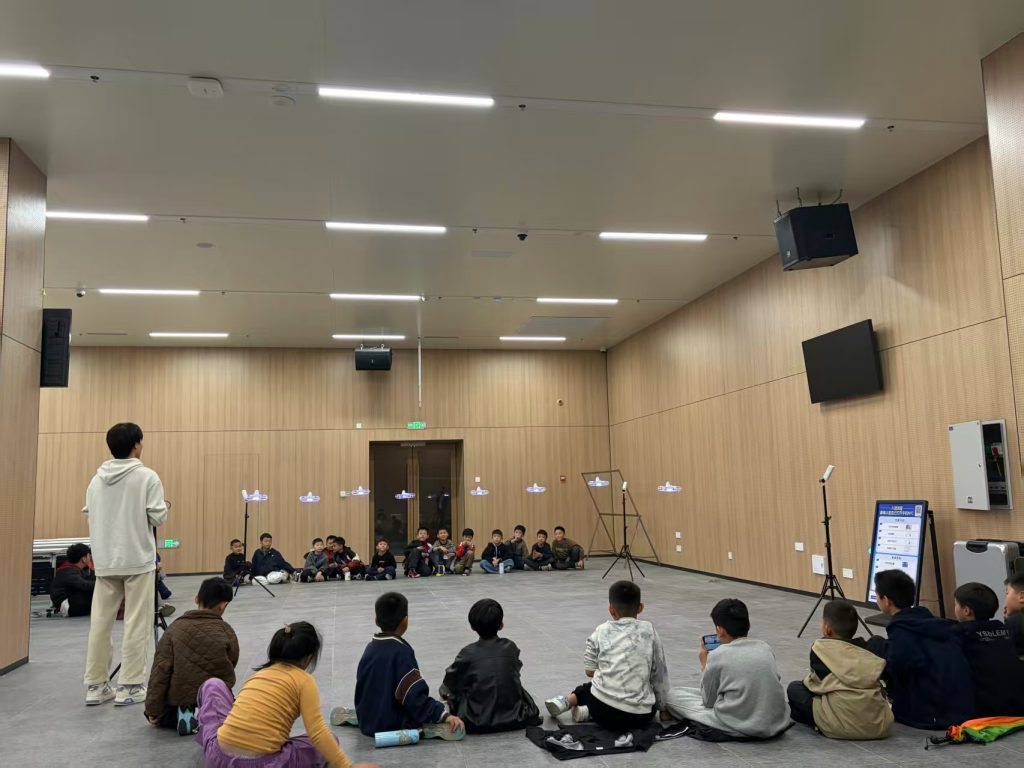
Our path exploration centers on the Aero Sports Federation of China (ASFC) training system, which offers a梯级训练系统 (graded training system) for various drone models like multi-rotors, fixed-wing, helicopters, and FPV drones. By aligning我们的 drone training with ASFC standards, we have重构教学内容 (restructured teaching content) to foster innovation and规范操作 (standardized operation). The ASFC’s Remote Control Aeronautical Model Pilot Technical Grade Standards, particularly for multi-rotor aircraft (Class X), provide clear skill indicators. For example, training requires manual operation without GPS or ultrasonic aids, compelling students to practice intensively for proficiency. The初级 (primary) and中级 (intermediate) ASFC maneuvers, such as hover and horizontal displacement, directly correlate with aesthetic aerial shots like绕点飞行 (orbit flying) and匀速位移 (uniform displacement).
To illustrate, we have developed a comparison table summarizing ASFC skill indicators and our university’s drone training content:
| Item | ASFC Technical Requirements | University Drone Training Content |
|---|---|---|
| 1. Pilot Grades | Junior, Primary, Intermediate, Advanced | Not graded, but structured into progressive modules |
| 2. Model Specifications | Multi-rotor with wheelbase ≥400mm for intermediate/advanced; stable devices allowed; no external reference or pre-programmed flight | Multi-rotor with wheelbase ≥400mm; stable devices allowed; manual flight emphasis in drone training |
| 3. Primary Assessment | Takeoff/hover, four-position hover, horizontal shift | Safe takeoff/landing in 50m×50m area; four-position hover within 2m×2m range; horizontal displacement exercises |
| 4. Intermediate Assessment | Rectangle, vertical triangle with rotation, bidirectional horizontal 8-figure, takeoff/landing route | Orbit flying around static targets; shot scale transitions (e.g., close-up to全景 (full shot)) |
| 5. Advanced Assessment | Vertical横8字 (horizontal 8-figure) with reverse rotation, inward spiral ascent,酒杯 (wineglass),平移4位飞行 (translation four-position flight),急停着陆 (emergency stop landing),限距绕标飞行 (limited-distance绕标 (marker)飞行) | Parallel tracking of moving targets (≈20 km/h); orbit flying around moving targets (≈10 km/h) |
In drone training, we model flight paths using mathematical equations to enhance understanding. For instance, a hover position can be represented as: $$ \vec{p}_{\text{hover}} = (x_0, y_0, z_0) $$ where \( z_0 \) is the target altitude. The deviation from ideal hover is minimized through practice, quantified by: $$ \text{Hover Error} = \sqrt{(\Delta x)^2 + (\Delta y)^2 + (\Delta z)^2} $$ where \( \Delta x, \Delta y, \Delta z \) are positional offsets. This formula helps students grasp precision in drone training.
To address实践条件 limitations, we have developed proprietary virtual simulation software based on AR增强现实 (augmented reality) technology. This software includes four skill modules:基本航拍操控 (basic aerial control),云台手能力提升 (gimbal operator skill enhancement),场景适应练习 (scene adaptation practice), and AR飞手操作训练 (AR pilot training). It covers 8实验内容 (experimental contents), such as drone assembly, and 11训练步骤 (training steps) across pre-, mid-, and post-flight phases. Unlike commercial 3D simulators, our software uses实景VR (real-scene VR) environments to provide immersive drone training that mirrors real-world operations. The software integrates拍摄参数 (shooting parameters) adjustment, with exposure calculated as: $$ \text{Exposure Value} = \log_2\left(\frac{N^2}{t}\right) $$ where \( N \) is the aperture number and \( t \) is the shutter speed. This allows students to experiment with settings virtually, reinforcing drone training concepts.
Our teaching evaluation follows a “能实不虚 虚实结合” (real when possible, virtual when necessary, combining both) approach, exploring a混合式教学模式 (blended teaching model). Drawing on Ralph Tyler’s目标评价模式 (objective evaluation model), we assess drone training through three progressive stages:模拟飞行 (simulated flight),真机飞行 (real drone flight), and空中拍摄 (aerial shooting). Each stage has specific evaluation criteria aligned with ASFC standards.
In the simulated flight stage, evaluation focuses on joystick familiarity and parameter adjustment. We use a skill retention metric: $$ R_{\text{skill}} = e^{-\lambda t} \cdot S_{\text{initial}} $$ where \( \lambda \) is the forgetting rate, \( t \) is time, and \( S_{\text{initial}} \) is the initial skill score. Repeated virtual practice in drone training enhances \( R_{\text{skill}} \).
The real drone flight stage involves笔试 (written tests) on aviation theory and practical考核 (assessments) in a 50m×50m outdoor area. Students perform maneuvers with a 450mm wheelbase multi-rotor drone, evaluated on熟练度 (proficiency),正确度 (accuracy),动作完成度 (maneuver completion), and安全意识 (safety awareness). We compute a composite score: $$ \text{Flight Score} = 0.3 \cdot P + 0.3 \cdot A + 0.2 \cdot C + 0.2 \cdot S $$ where \( P, A, C, S \) represent proficiency, accuracy, completion, and safety scores, respectively. This quantitative approach standardizes drone training assessments.
The aerial shooting stage evaluates gimbal operator competencies. Our virtual software includes static and dynamic shooting tasks, requiring students to submit footage for review. A creativity score is incorporated: $$ \text{Shooting Score} = 0.5 \cdot T_{\text{technical}} + 0.5 \cdot T_{\text{creative}} $$ where \( T_{\text{technical}} \) measures adherence to guidelines and \( T_{\text{creative}} \) assesses artistic merit. This holistic evaluation fosters comprehensive drone training for media roles.
Reflecting on our drone training, we aim to cultivate航拍导演 (aerial photography directors) who transcend technical操作 (operation) to embrace影像艺术 (visual artistry). This involves pre-flight分镜脚本 (shot script) design, considering factors like飞行场地 (flight site),环境 (environment),天气 (weather),光线 (lighting), and设备选择 (equipment selection). We teach students to plan飞行平台 (flight platforms), routes, altitudes, and camera settings systematically. For example, battery life constrains flight time, modeled as: $$ t_{\text{flight}} = \frac{C_{\text{battery}}}{P_{\text{drone}}} $$ where \( C_{\text{battery}} \) is battery capacity and \( P_{\text{drone}} \) is power consumption. Such calculations are integral to advanced drone training.
Our教学实践 (teaching practice) shows high student engagement, especially with platforms like DJI Phantom 4 Pro, Mavic 2 Pro, and Inspire 2. The urgency of drone training is palpable, given its prevalence in media. Emerging trends, such as FPV drones with lightweight cameras, enable innovative shots like “空中翻滚” (aerial rolls) and “自由落体” (free-fall), expanding航拍美学语言 (aerial photography aesthetic language). As these technologies evolve, our drone training must adapt, incorporating new视觉表达方式 (visual expression methods) to meet creative demands.
In conclusion, drone training is a dynamic field requiring continuous innovation. Our approach, grounded in ASFC standards and enhanced by virtual simulation, provides a scalable model for media education. By emphasizing safety, skill integration, and creative导演能力 (directorial能力), we prepare students for evolving industry needs. Future drone training may explore AI-assisted flight or advanced cinematography techniques, but the core remains: rigorous, immersive, and holistic education. Through ongoing refinement, we strive to set benchmarks in drone training, ensuring that media professionals are equipped to harness the full potential of aerial photography.