
In my extensive research and practical involvement in the field of low-altitude economy, I have witnessed firsthand the transformative power of unmanned aerial vehicle (UAV) technology. The integration of drones into our urban fabric and economic systems is not merely an incremental improvement; it is a paradigm shift. This article, drawn from my professional observations and analysis, delves into the core mechanisms through which drone technology drives low-altitude economic development, the significant challenges it faces, and the comprehensive strategies required for its sustainable future. I will structure this exploration around key application platforms, systemic hurdles, and proactive solutions, emphasizing throughout the critical, yet often underestimated, role of systematic drone training.
The concept of the low-altitude economy, formally elevated to national strategic importance, represents a new frontier for growth, innovation, and efficient governance. From my perspective, drones are the indispensable workhorses of this frontier. Their versatility in data acquisition, logistics, surveillance, and emergency response creates unprecedented opportunities. However, the journey from technological potential to widespread, secure, and efficient application is fraught with complexities. Through this first-person account, I aim to synthesize theoretical insights with practical lessons learned from platform deployments, underscoring the necessity of holistic development encompassing technology, policy, infrastructure, and human capital.
1. The Evolution and Policy Landscape of Drone Technology
My analysis begins by contextualizing the current state of drone technology within a global and domestic policy framework. Internationally, nations have aggressively pursued first-mover advantages. The United States, through regulatory frameworks like Part 107, has systematically integrated small drones into the national airspace while pioneering Urban Air Mobility (UAM) concepts. The United Kingdom’s focus on Beyond Visual Line of Sight (BVLOS) standards and Germany’s investment in eVTOL and air traffic management systems highlight a strategic, technology-driven race. Domestically, the formal designation of the low-altitude economy as a strategic emerging industry, culminating in the establishment of dedicated administrative bodies, has unleashed a wave of supportive policies. Regulations like the “Interim Regulations on Flight Management of Unmanned Aircraft” aim to standardize the lifecycle management of drones. However, in my assessment, the policy environment, while rapidly evolving, still grapples with the intricacies of real-time safety oversight, cross-departmental data sharing protocols, and the integration of drones into dense urban airspace. The projected market value reaching trillions underscores the economic stakes, but realizing this potential demands more than just ambition; it requires meticulously crafted systems.
2. Practical Applications: Drone-Centric Platform Architectures
My work has centered on the design and implementation of integrated drone platforms, which I believe are the tangible manifestations of the low-altitude economy’s value proposition. These platforms move beyond isolated drone operations to create synergistic, intelligent systems.
2.1 The Low-Altitude All-Domain Perception Platform
This platform, based on a “1+3+1” core architecture, represents a significant leap in urban management. The architecture unifies a central command dashboard with three core operational systems—Integrated Operations Management, Event Analysis and Disposal, and 3D Intelligent Scenario Simulation—all supported by a comprehensive user center. In my experience, the fusion of AI algorithms, 3D modeling, and real-time data streams enables seamless city-wide low-altitude cruising, from equipment monitoring to emergency response. The platform’s efficacy can be summarized by its ability to transform raw data into actionable intelligence. For instance, the event analysis system employs machine learning models to automatically detect anomalies, initiating a closed-loop management process from discovery to resolution.
The network architecture of this platform is fundamental to its operation. It employs a multi-layered communication strategy:
- Drone-to-Ground Station Link: Utilizing 2.4GHz bands with mesh networking for robust, short-range control and data offloading.
- Drone-to-Platform Remote Link: Leveraging 4G/5G mobile networks or dedicated internet lines to stream standardized video and telemetry data to the cloud-based platform in real-time.
The data flow efficiency in such a system can be conceptually modeled. If we consider the data rate required for HD video streaming and sensor data, the minimum bandwidth \( B_{min} \) must satisfy the platform’s analytical needs. A simplified model for total data throughput \( D_{total} \) from a fleet of \( n \) drones is:
$$ D_{total} = \sum_{i=1}^{n} (R_{video,i} + R_{telemetry,i} + R_{control,i}) $$
where \( R_{video} \) is the video stream bitrate, \( R_{telemetry} \) is the telemetry data rate, and \( R_{control} \) is the uplink command rate. Ensuring \( D_{total} \) remains within the available network capacity \( C_{network} \) (where \( C_{network} = B \cdot \log_2(1 + SNR) \) per Shannon’s theorem) is a constant engineering challenge I have encountered.
| Module | Key Functions | Primary Output/Value |
|---|---|---|
| Integrated Operations Management | Device config, route planning, mission control, flight logging, comprehensive monitoring. | Unified control panel for city managers; real-time data for traffic, environment, security. |
| Event Analysis & Disposal | AI-powered anomaly detection, automatic report generation, workflow dispatch. | Closed-loop incident management; reduced response time for urban issues. |
| 3D Intelligent Scenario Simulation | Digital twin creation, scenario modeling, predictive analysis for planning and emergencies. | Scientific basis for urban planning and drill simulations; enhanced preparedness. |
2.2 The Integrated Police Aviation Command Platform
In the realm of public safety, I have observed how dedicated command platforms revolutionize police work. This platform unifies the management and dispatch of police UAV fleets. A central command center aggregates all visual and positional data onto a situational map, while remote flight centers enable officers to control drones for patrols, evidence collection, and crowd monitoring. The maintenance management module ensures fleet readiness. The key insight from my analysis is the platform’s role in breaking down operational silos within police departments, enabling aerial units to support ground operations with real-time intelligence, a capability that is exponentially enhanced by rigorous, scenario-based drone training for police pilots.
2.3 The Low-Altitude Traffic Scheduling Platform
Adopting a “1 Platform, 4 Capabilities, N Applications” framework, this platform automates road inspection and traffic management. An inspection management center handles automated route planning and mission execution for infrastructure checks. An operations monitoring center provides a big-screen visualization of traffic flow and drone activities. Most crucially, an intelligent analysis center uses computer vision algorithms to detect traffic incidents, violations, and infrastructure defects from aerial footage. The platform’s effectiveness \( E_{platform} \) in improving traffic management can be thought of as a function of several factors:
$$ E_{platform} = f(A_{coverage}, S_{accuracy}, \Delta T_{response}, Q_{data}) $$
where \( A_{coverage} \) is the area monitored, \( S_{accuracy} \) is the algorithm’s detection accuracy, \( \Delta T_{response} \) is the reduction in incident response time, and \( Q_{data} \) is the quality and integration level of the collected data. Maximizing \( E_{platform} \) requires continuous optimization of each variable.
3. Systemic Challenges: Barriers to Scalability
Despite the promising applications, my research and field engagements have consistently highlighted several entrenched challenges that threaten to stifle growth.
| Challenge Category | Specific Manifestations | Direct Consequences |
|---|---|---|
| Data Management & Silos | Incompatible data formats across platforms; lack of unified standards; departmental resistance to sharing. | Inefficient decision-making; duplicated efforts; inability to perform cross-domain analytics. |
| High Infrastructure Cost | Expensive vertiports/charging networks; high-performance computing for data processing; robust communication backbone. | High barrier to entry for municipalities; unsustainable operational expenditure (OPEX). |
| Technical Bottlenecks | Limited flight endurance (\( T_{flight} \)); vulnerability to interference; immature autonomous decision-making AI. | Restricted operational range and reliability; need for constant human supervision. |
| Regulatory & Safety Gaps | Laws lag behind technology; inconsistent enforcement; risks of “rogue flights” and privacy breaches. | Operational uncertainty; public distrust; potential for accidents and conflicts. |
| Acute Talent Shortage | Lack of certified pilots, data analysts for aerial data, AI engineers for drone-specific algorithms, and maintenance technicians. | Projects stalled due to lack of skilled personnel; increased operational risks from inadequate drone training. |
The talent shortage, in particular, is a pervasive issue I have confronted. The demand for skilled personnel far outstrips supply. Effective drone training is not just about learning to fly; it encompasses airspace regulation, data ethics, mission planning, maintenance, and specific application-domain knowledge (e.g., agricultural sensing, search and rescue patterns). The deficit in such comprehensive drone training pipelines is a critical bottleneck.
4. Strategic Countermeasures for Sustainable Development
To navigate these challenges, I propose a multi-pronged strategy based on systemic thinking and long-term planning.
4.1 Accelerating Core Technological Innovation
Investment must be prioritized in overcoming fundamental limitations. For endurance, research into high-energy-density batteries and hybrid power systems is crucial. We can model the required energy \( E_{req} \) for a mission as:
$$ E_{req} = P_{avg} \cdot T_{mission} + E_{margin} $$
where \( P_{avg} \) is the average power draw and \( E_{margin} \) is a safety buffer. Innovations must aim to increase the specific energy \( e_{bat} \) (Wh/kg) of onboard storage. Similarly, advancing secure, low-latency communication protocols (e.g., 5G-A/6G for UAVs) and developing robust AI for swarm coordination and obstacle avoidance in dynamic environments are non-negotiable research frontiers.
4.2 Building Unified Data Ecosystems
A top-down mandate for common data standards (e.g., for telemetry, video metadata, geographic information) is essential. I advocate for the establishment of open, API-accessible data marketplaces or lakes specifically for low-altitude data, governed by clear protocols on privacy (e.g., anonymization techniques) and security. This would transform data from a proprietary asset into a shared resource that amplifies value for all stakeholders.
4.3 Optimizing Infrastructure via Smart Investment
Infrastructure planning must be demand-driven and scalable. Public-Private Partnerships (PPPs) can distribute financial risk and spur innovation. Furthermore, the operational cost can be optimized through predictive maintenance models. The maintenance cost \( C_{maint} \) over time \( t \) can be reduced by using IoT sensors for health monitoring:
$$ C_{maint}(t) = C_{reactive} \cdot P_{failure}(t) + C_{preventive} \cdot I_{schedule}(t) $$
By moving from scheduled (\( I_{schedule} \)) to predictive maintenance (where \( P_{failure} \) is estimated in real-time), \( C_{maint}(t) \) can be significantly minimized.
4.4 Making Human Capital a Cornerstone: The Imperative of Drone Training
This is, in my firm opinion, the most critical pillar. The solution lies in a dual approach: reforming formal education and expanding professional drone training. Universities must integrate UAV technology into engineering, computer science, and data science curricula, offering degrees and certifications in UAS operations and management. More importantly, continuous professional drone training programs must become ubiquitous. These programs should be tiered:
| Tier | Target Audience | Core Curriculum Components |
|---|---|---|
| Tier 1: Basic Operator | New pilots, hobbyists transitioning to commercial work. | Flight fundamentals, national regulations, basic safety procedures, manual flight proficiency. |
| Tier 2: Advanced Application Specialist | Pilots for specific sectors (agriculture, inspection, public safety). | Advanced mission planning, sensor operation (LiDAR, multispectral), data capture protocols, sector-specific regulations, BVLOS operations. |
| Tier 3: Data & System Expert | Data analysts, AI developers, fleet managers, maintenance engineers. | Aerial data processing/analysis (using tools like Pix4D, DroneDeploy), machine learning for drone data, UTM (UAS Traffic Management) concepts, maintenance diagnostics. |
| Tier 4: Strategic Manager & Policy Maker | Corporate decision-makers, city planners, regulatory officials. | Economic modeling of drone deployments, risk assessment, policy design, airspace integration strategies, ROI analysis for drone projects. |
High-quality, accessible drone training is the bridge between technological possibility and operational excellence. It ensures safety, boosts productivity, and fosters innovation. To visualize the immersive and practical nature of modern training, consider the following scene which is becoming standard in advanced programs:
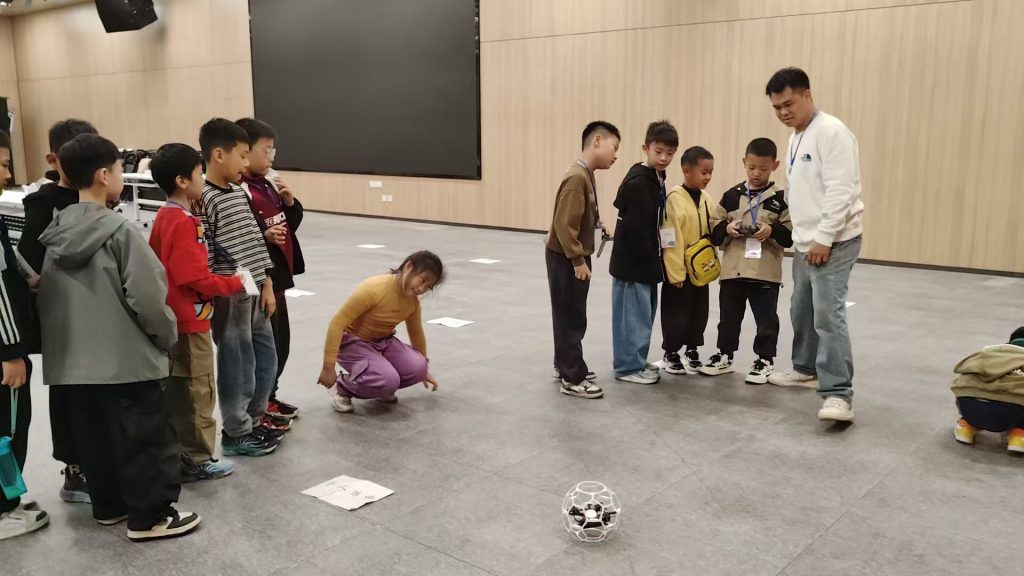
Such hands-on, simulation-augmented drone training environments are essential for developing the muscle memory and decision-making skills required for complex operations in the national airspace.
4.5 Refining the Regulatory and Safety Framework
Regulations must evolve from restrictive to enabling. This involves creating performance-based rules, implementing digital identification and tracking systems for all drones (like remote ID), and developing dynamic airspace management tools (UTM). A risk-based regulatory model \( R_{op} \) for authorizing a flight could be formalized as:
$$ R_{op} = \frac{H_{severity} \cdot P_{occurrence}}{M_{mitigation}} $$
where \( H_{severity} \) is the potential harm, \( P_{occurrence} \) is the probability of an incident, and \( M_{mitigation} \) represents mitigation factors like pilot certification level (a direct output of drone training), equipment airworthiness, and operational safeguards. Lower \( R_{op} \) scores would permit more complex operations, incentivizing investment in safety and training.
5. Concluding Synthesis and Future Trajectory
My investigation leads me to conclude that drone technology is unequivocally the central driver for realizing the low-altitude economy’s vast potential. The application platforms discussed demonstrate tangible efficiency gains in urban governance, public safety, and traffic management. However, the path forward is not merely one of technological refinement. The interdependent challenges of data fragmentation, costly infrastructure, regulatory ambiguity, and most pressingly, the human capital gap, require concerted, systemic action.
The formula for success, as I see it, is a balanced equation: Advanced Technology + Unified Data Standards + Smart Infrastructure + Comprehensive Drone Training + Adaptive Regulation = Sustainable Low-Altitude Economic Growth. Neglecting any element, especially the human element nurtured through relentless drone training, will result in suboptimal outcomes or even systemic failure.
Looking ahead, I anticipate the convergence of drones with artificial intelligence, the Internet of Things, and advanced air mobility (AAM) vehicles. This will create an even more complex and rich low-altitude ecosystem. Preparing for that future starts today, by building the technological foundations, the regulatory frameworks, and—above all—a highly skilled workforce through lifelong, adaptive drone training programs. The low-altitude economy is not just about machines in the sky; it is about the people on the ground who design, operate, regulate, and derive value from them. By investing in all these dimensions, we can securely unlock this new layer of our economy and society.