
I have observed that the rapid proliferation of unmanned aerial vehicles (UAVs) in recent years has brought transformative benefits to sectors such as aerial photography, logistics, agriculture, and public safety. However, this technological revolution also introduces unprecedented security challenges. The increasing number of unauthorized flights, often termed “black flights” or “random flights,” has exposed severe vulnerabilities in current drone regulation frameworks. These incidents threaten not only aviation safety and personal privacy but also national security and social stability. In this paper, I present a systematic analysis of the security risks posed by civilian drones and propose a multi-layered drone regulation strategy that integrates legal reform, technical countermeasures, industry collaboration, and enhanced operator accountability. By grounding my discussion in empirical evidence and logical reasoning, I aim to provide a practical roadmap for balancing innovation with public safety.
1. Security Risks Associated with Unmanned Aerial Vehicles
From a public safety perspective, the hazards of UAVs range from minor privacy violations to catastrophic events that endanger lives and critical infrastructure. I categorize these risks into five primary dimensions, as summarized in the following table.
| Risk Category | Description | Example Incidents | Potential Impact |
|---|---|---|---|
| National Security | Unauthorized surveillance of military bases, government facilities, or restricted zones | 2018桂林军事基地偷拍; 俄罗斯基地遭无人机袭击 | Leakage of state secrets; terrorism; political instability |
| Aviation Safety | Interference with commercial aircraft, especially during takeoff and landing | 2017成都双流机场多起黑飞; 2020博鳌机场入侵 | Flight delays, diversions, potential mid-air collisions, economic losses |
| Personal Safety | Physical injury from falling or malfunctioning drones (e.g., rotor blade cuts, crashes) | 2016杭州西湖景区 “炸机”砸伤游客 | Injury or death; property damage |
| Privacy & Commercial Secrets | Covert photography/videography using high-resolution cameras | 明星婚礼偷拍; 上海迪士尼拍摄 | Violation of personal privacy; industrial espionage |
| New Criminal Tools | Use of drones for smuggling, drug trafficking, weapon delivery | 2018深圳无人机走私手机1.5万部; 英国监狱运输毒品 | Undermining law enforcement; societal disorder |
These risks are not isolated; they often compound each other. For instance, a “black flight” near an airport not only endangers aviation safety but also may be exploited by malicious actors to commit crimes. Therefore, robust drone regulation must address the full spectrum of these threats.
2. Root Causes of Security Vulnerabilities in Current Drone Regulation
To design effective drone regulation, I must first understand why existing measures have fallen short. I identify three fundamental causes:
| Cause | Details | Consequences |
|---|---|---|
| Lack of Unified Legal Framework | No national-level dedicated law for civilian drones; fragmented regulations from different departments; low legal precedence of existing provisions. | Legal gray areas; difficulty in prosecuting “black flights”; inconsistent penalties. |
| Absence of Harmonized Technical Standards | Over 400 manufacturers with varying quality; no common classification, communication protocols, or safety requirements. | Unreliable products; interoperability issues; inability to enforce technical constraints like geofencing. |
| Ambiguous Regulatory Authorities and Weak Enforcement | Multiple agencies (civil aviation, police, sports administration) with overlapping or unclear responsibilities; lack of dedicated enforcement teams. | Regulatory gaps; delayed response to violations; limited deterrence. |
I also note that the rapid pace of UAV technology outruns the slow legislative process. For example, while local governments such as Sichuan Province enacted pioneering regulations in 2017, these remain regional and cannot substitute for a comprehensive national statute. Moreover, the absence of a unified drone regulation framework creates confusion among operators and undermines compliance.
3. A Multi-Pronged Approach to Strengthen Drone Regulation
Based on the risk analysis and causal factors, I propose a holistic drone regulation strategy that spans the entire lifecycle of a UAV—from manufacturing to disposal—and involves all stakeholders. The following table outlines the key components.
| Dimension | Specific Measures | Expected Outcome |
|---|---|---|
| Legal Reform | Enact a dedicated “Civil UAV Management Law”; amend existing aviation laws to differentiate drones; establish clear penalties and liability. | Legal certainty; deterrent effect; clear rights and obligations. |
| Manufacturing & Sales Control | Production license system; mandatory unique serial numbers; real-name registration coupled with background checks for buyers. | Traceability; prevention of sales to criminals; quality assurance. |
| Operator Certification | Compulsory training and licensing for all drones above 250g; periodic re-certification; theory and practical exams. | Improved operational skills; increased awareness of drone regulation. |
| Real-Time Monitoring & Geofencing | Integration of electronic geofences; remote identification (Remote ID); mandatory flight data logging and sharing with authorities. | Detection of unauthorized flights; immediate intervention. |
| Counter-Drone Technology | Deployment of radar, RF jammers, GPS spoofers, net guns, and directed energy in sensitive areas. | Neutralization of threats without collateral damage. |
| Industry Self-Regulation | Empower associations like the Shenzhen UAV Association to set standards, conduct audits, and mediate disputes. | Complement government oversight; promote best practices. |
| Public Education | Campaigns through media; warning signs near restricted zones; integration of drone regulation into school curricula. | Voluntary compliance; reduced unintentional violations. |
I emphasize that legal reform is the cornerstone. Without a clear legal mandate, all other measures lack authority. The new law should define drone categories (micro, light, small, medium, large) and assign corresponding obligations. For example, micro drones (under 250g) might only require registration, while larger drones demand full flight plans and continuous monitoring. I propose a risk-based classification system where the regulatory burden scales with the potential harm. This concept can be expressed mathematically as follows.
Let $$R$$ denote the risk score of a drone operation, calculated as:
$$
R = w_1 \cdot M + w_2 \cdot V + w_3 \cdot S + w_4 \cdot H
$$
where:
- $$M$$ = mass of the drone (kg),
- $$V$$ = maximum speed (m/s),
- $$S$$ = maximum altitude (m),
- $$H$$ = whether the drone carries hazardous materials (0 or 1),
- $$w_1, w_2, w_3, w_4$$ are weighting factors determined by regulatory authorities.
Operations with $$R$$ above a certain threshold would require pre-authorization, onboard transponders, and real-time tracking. This quantitative approach transforms drone regulation from a one-size-fits-all model to a differentiated, efficient system.
4. Technical Countermeasures and Early Warning Systems
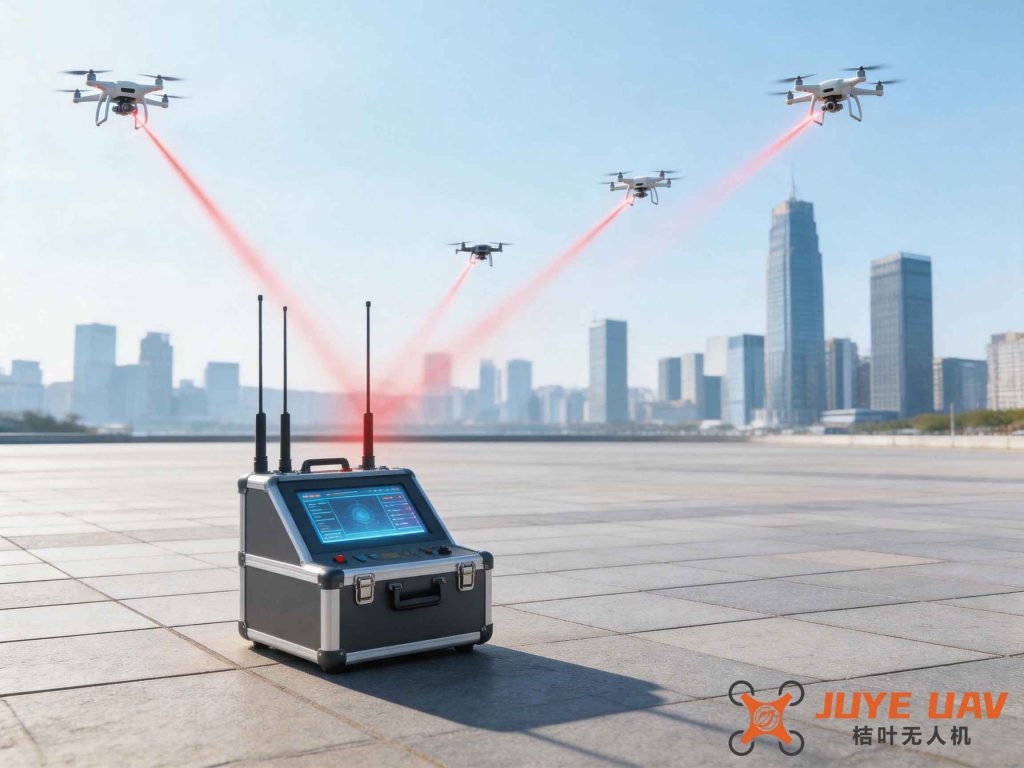
Despite legal and administrative efforts, some violators will still attempt illegal flights. Therefore, I advocate for the deployment of advanced technical countermeasures in key locations such as airports, military zones, and government compounds. A layered detection and mitigation system is essential. The following table compares common counter-drone techniques.
| Method | Mechanism | Advantages | Disadvantages | Best Use Case |
|---|---|---|---|---|
| Radar Detection | Active radio wave reflection | Long range; day/night operation | Difficulty detecting small, slow drones; high cost | Perimeter surveillance |
| RF Jamming | Broad-spectrum interference on control/ GPS signals | Non-destructive; portable | May affect other communication; limited effectiveness against autonomous flight | Temporary disruption |
| GPS Spoofing | Forged GPS signals to mislead navigation | Can force drone to land or return | Requires precise timing; risk of hijacking | Controlled takeover |
| Net Capture | Firing net from another drone or ground launcher | Physically captures drone intact | Short range; requires accurate targeting | Forensic evidence collection |
| Directed Energy | High-power laser or microwave to disable electronics | Instantaneous; no collateral debris | Very high cost; safety concerns for bystanders | Critical infrastructure |
I recommend a hybrid approach that combines detection (radar, acoustic, optical) with soft-kill measures (jamming, spoofing) first, and only resorting to hard-kill when imminent threat exists. For example, at an airport, the system might first send an alert to the drone’s operator via radio, then gradually escalate to signal jamming and ultimately to net capture if the drone does not comply. This graded response minimizes unintended damage while ensuring effective drone regulation enforcement.
5. The Role of Industry Associations and Collaborative Governance
Government alone cannot manage the entire drone ecosystem. I strongly support the involvement of industry associations such as the Shenzhen UAV Association, which was established in 2015. These organizations can develop technical standards, conduct ethical audits, and provide training certification. In my proposed model, the regulatory structure is a three-tiered hierarchy:
- Government Authorities: Set legal boundaries, issue licenses, and enforce penalties.
- Industry Associations: Translate legal requirements into operational guidelines, monitor member compliance, and offer dispute resolution.
- Individual Operators and Manufacturers: Adhere to standards, participate in self-regulation, and report violations.
This cooperative drone regulation framework can be represented by a compliance index $$C$$ for each operator:
$$
C = \alpha \cdot L + \beta \cdot T + \gamma \cdot R
$$
where:
- $$L$$ = score of legal compliance (e.g., number of violations),
- $$T$$ = score of technical safety (e.g., software updates, geofencing activation),
- $$R$$ = score of regulatory reporting (e.g., timely flight logs submission),
- $$\alpha, \beta, \gamma$$ are weights determined by policy.
Operators with low $$C$$ would face increased scrutiny or license suspension. Such a quantitative self-regulation mechanism encourages proactive compliance and reduces the burden on public authorities.
6. Enhancing Operator Competence and Public Awareness
Human factors are often the weakest link in drone regulation. I have found that many “black flight” incidents stem from ignorance rather than malice. Therefore, I propose mandatory training programs that cover not only flight skills but also legal knowledge, privacy ethics, and emergency procedures. The curriculum should be standardized and delivered by accredited institutions. Periodic re-examination ensures that operators stay updated on evolving drone regulation.
Public awareness campaigns should target both drone users and the general population. Warning signs in prohibited areas, social media advertisements, and collaboration with influencers can effectively communicate the consequences of illegal flights. For instance, a simple message like “Flying a drone near an airport is a criminal offense” can deter casual violators. Additionally, the media should report prosecutions to create a deterrent effect.
7. Conclusion
In summary, the safe integration of UAVs into society demands a robust, adaptive, and multi-stakeholder drone regulation framework. I have demonstrated that current risks—national security, aviation safety, personal safety, privacy, and criminal misuse—are not inevitable but can be mitigated through coordinated action. My proposed strategy encompasses legal unification, technical standards, real-time monitoring, countermeasure systems, industry self-governance, and operator education. Crucially, drone regulation must balance security with innovation; overregulation could stifle a promising industry, while underregulation invites catastrophe. By adopting a risk-based approach, as exemplified by the mathematical model $$R = w_1M + w_2V + w_3S + w_4H$$, authorities can allocate resources efficiently. I am confident that with political will and technological ingenuity, we can create a safe sky for both manned and unmanned aircraft, ensuring that UAVs remain a force for good in our society.
The path forward is clear: we must act now to implement comprehensive drone regulation that safeguards public safety without stifling progress. Only through such a balanced approach can we turn the challenge of drone security into an opportunity for sustainable development.