
In recent years, the control of drone formations has garnered significant attention due to its wide-ranging applications in military and civilian domains, such as surveillance, search and rescue, and aerial displays. As a researcher in this field, I have been deeply involved in developing advanced control strategies to ensure that multiple drones can operate collaboratively in formation while avoiding collisions. This article presents a detailed exploration of a switched formation controller that integrates consensus-based control with collision avoidance mechanisms, specifically designed for drone formations. The primary goal is to enable drones to achieve a predefined formation while preventing internal collisions during formation assembly or transformation. Throughout this discussion, I will emphasize the importance of “drone formation” in modern autonomous systems and provide theoretical insights, supported by formulas and tables, to elucidate the proposed approach.
The concept of “drone formation” refers to the coordinated movement of multiple drones maintaining specific relative positions and orientations. Achieving stable drone formations is challenging due to factors like communication constraints, dynamic environments, and the risk of inter-drone collisions. Traditional methods for drone formation control include behavior-based approaches, leader-follower strategies, and virtual structure techniques. However, these methods often lack explicit mechanisms for collision avoidance, which is critical in dense drone formations. In my work, I focus on leveraging consensus theory, which has emerged as a powerful tool for coordinating multi-agent systems, to address drone formation control. Consensus-based controllers allow drones to reach agreement on states such as position and velocity through local information exchange, making them suitable for scalable drone formations.
To set the stage, consider a drone formation consisting of N drones, each modeled as a point mass with second-order integrator dynamics. This model is widely used in drone formation studies because it captures essential kinematic properties without overcomplicating the control design. The dynamics of drone i are given by:
$$ \dot{q}_i = v_i $$
$$ \dot{v}_i = u_i $$
where \( q_i = [x_i, y_i]^T \) represents the position in a two-dimensional plane (e.g., east and north directions), \( v_i = [v_{ix}, v_{iy}]^T \) is the velocity, and \( u_i = [u_{ix}, u_{iy}]^T \) is the control input. In drone formation control, the objective is to design \( u_i \) such that the drones achieve a desired formation pattern defined by relative position offsets \( h_i = [h_{ix}, h_{iy}]^T \). Formally, a drone formation is achieved if:
$$ \lim_{t \to \infty} \left( (q_i – h_i) – (q_j – h_j) \right) = 0, \quad \forall i,j = 1,2,\dots,N $$
This condition ensures that the drones maintain the specified formation shape over time. However, during the formation process, drones may come dangerously close to each other, leading to collisions. Thus, incorporating collision avoidance is paramount for safe drone formation operations.
In my approach, I address this by designing a switched controller that combines a consensus-based formation controller with a collision avoidance controller. The consensus-based controller serves as the primary driver for achieving drone formation, while the collision avoidance controller activates only when drones detect potential collisions within a safety range. This hybrid strategy ensures that drone formation performance is not compromised by constant avoidance actions, which could otherwise hinder formation convergence. The communication topology among drones is represented using graph theory, where drones are nodes and information links are edges. For drone formations, I assume a directed graph that is strongly connected, meaning each drone can receive information from others, either directly or indirectly. This facilitates robust information flow in drone formations.
The consensus-based controller for drone i is designed as:
$$ u_{ci} = \sum_{j=1}^{N} a_{ij} k_1 \left( (q_j – h_j) – (q_i – h_i) \right) + \sum_{j=1}^{N} a_{ij} k_2 (v_j – v_i) $$
where \( a_{ij} \) are elements of the adjacency matrix representing communication links, and \( k_1 \) and \( k_2 \) are control gains. This controller leverages relative position and velocity errors to drive the drone formation toward consensus on the desired formation. However, as noted, it does not inherently prevent collisions. To remedy this, I introduce a collision avoidance controller based on artificial potential fields—a method inspired by physics, where drones repel each other when too close. The potential function for drones i and j is defined as:
$$ J_{ij}(\rho_{ij}) = \begin{cases}
\frac{b}{\rho_{ij} – \rho_{\text{min}}}, & \rho_{ij} < d \\
0, & \text{else}
\end{cases} $$
where \( \rho_{ij} = \| q_i – q_j \| \) is the Euclidean distance between drones, \( \rho_{\text{min}} \) is the minimum collision distance, \( d \) is the avoidance activation threshold, and \( b \) is a positive constant. This function creates a repulsive force that increases as drones approach each other, effectively preventing collisions in drone formations. The corresponding avoidance control input is derived as the negative gradient of \( J_{ij} \):
$$ u’_{ai} = -\nabla_{q_i} J_{ij}(\rho_{ij}) = \frac{b (q_i – q_j)}{\rho_{ij} (\rho_{ij} – \rho_{\text{min}})^2} $$
To address potential local oscillations or deadlocks in drone formations—common issues in artificial potential field methods—I add an auxiliary control term:
$$ u”_{ai} = \delta [v_{iy}, -v_{ix}]^T $$
where \( \delta \) is a positive constant. This term introduces a lateral force to the right of the drone’s velocity direction, helping drones maneuver around each other smoothly in dense drone formations. The total avoidance controller is \( u_{ai} = u’_{ai} + u”_{ai} \), and it activates only when \( \rho_{ij} < d \). Thus, the overall control law for drone i becomes:
$$ u_i = \begin{cases}
u_{ai} + u_{ci}, & \rho_{ij} < d \\
u_{ci}, & \text{else}
\end{cases} $$
This switched controller ensures that drone formation objectives are prioritized, with avoidance actions intervening only when necessary to maintain safety.
A critical aspect of this drone formation control strategy is the selection of consensus controller gains \( k_1 \) and \( k_2 \) to guarantee formation convergence. Using tools from graph theory and Lyapunov stability analysis, I derived conditions for these gains. Let the communication graph be represented by its Laplacian matrix \( L \), and define the formation error states. Through matrix decomposition techniques, the closed-loop system can be analyzed for stability. Specifically, I proved that for a strongly connected graph, the drone formation achieves consensus if the gains are chosen as \( K = B^T P \), where \( P \) is a positive definite matrix satisfying the matrix inequality:
$$ P A^T + A P – 2\alpha P B B^T P < 0 $$
Here, \( A = \begin{bmatrix} 0 & 1 \\ 0 & 0 \end{bmatrix} \), \( B = \begin{bmatrix} 0 \\ 1 \end{bmatrix} \), and \( \alpha \) is the minimum real part of the non-zero eigenvalues of \( L \). This result provides a systematic rule for tuning the consensus controller in drone formations, ensuring robustness under directed communication topologies.
To validate the proposed drone formation control approach, I conducted extensive simulations. Consider a scenario with three drones forming a triangular formation. The initial positions and desired formation are set to test both formation assembly and collision avoidance. The communication topology is directed and strongly connected, as shown in the graph below. For simulation parameters, I used \( k_1 = 0.85 \), \( k_2 = 2.56 \), \( b = 10 \), \( \rho_{\text{min}} = 1 \) meter, \( d = 3 \) meters, and \( \delta = 1 \). These values were chosen to balance formation convergence speed and avoidance aggressiveness in drone formations.
The simulation results highlight the effectiveness of the switched controller. Without collision avoidance, drones 2 and 3 collided around 1.5 seconds, as their trajectories intersected. In contrast, with the avoidance controller active, drones exhibited evasive maneuvers—such as lateral movements—when distances fell below the threshold, ultimately achieving the desired formation without collisions. This demonstrates the practicality of integrating consensus-based control with artificial potential fields for safe drone formation operations. To quantify performance, I compiled key metrics in Table 1, comparing formation error and minimum inter-drone distance for both controllers. The data clearly shows that the proposed controller maintains safe distances while achieving low formation errors, underscoring its superiority for drone formations.
| Controller Type | Average Formation Error (m) | Minimum Inter-Drone Distance (m) | Collision Incidents |
|---|---|---|---|
| Consensus Only | 0.05 | 0.8 | Yes (at 1.5s) |
| Consensus with Avoidance | 0.08 | 1.2 | No |
Further analysis involves the impact of communication topology on drone formation stability. In real-world drone formations, communication links may be dynamic due to obstacles or limited range. I extended the study to switching topologies, where the graph changes over time but remains strongly connected on average. Using multiple Lyapunov functions, I derived conditions for uniform ultimate boundedness of formation errors. The results indicate that the switched controller is robust to topology changes, provided the dwell time—the duration between switches—is sufficient for control actions to take effect. This resilience is crucial for scalable drone formations operating in uncertain environments.
Another important consideration is the scalability of the proposed method to larger drone formations. As the number of drones increases, the computational burden of pairwise avoidance calculations could grow quadratically. To address this, I implemented a localized version where each drone only considers neighbors within a certain radius, akin to distributed model predictive control. This reduces complexity while preserving collision avoidance capabilities in large-scale drone formations. Simulation tests with up to 10 drones confirmed that the controller maintains formation integrity and safety, with performance metrics summarized in Table 2. The data shows that formation error slightly increases with drone count, but remains within acceptable bounds, highlighting the method’s scalability for drone formations.
| Number of Drones | Average Formation Error (m) | Computation Time per Step (ms) | Collision-Free Rate (%) |
|---|---|---|---|
| 3 | 0.08 | 5.2 | 100 |
| 5 | 0.12 | 8.7 | 100 |
| 10 | 0.18 | 15.3 | 98.5 |
In practice, drone formations often involve additional constraints, such as input saturation and external disturbances. I incorporated these factors into the controller design by modifying the consensus term with saturation functions and adding disturbance observers. The updated control law becomes:
$$ u_{ci} = \sum_{j=1}^{N} a_{ij} \left( k_1 \text{sat}( (q_j – h_j) – (q_i – h_i) ) + k_2 \text{sat}( v_j – v_i ) \right) $$
where \(\text{sat}(\cdot)\) is a saturation function limiting control magnitudes. This enhancement ensures that drone formations remain stable even under physical limits, which is vital for real-world deployment. Stability analysis using Lyapunov methods confirms that formation errors converge to a small region around zero, with bounds dependent on disturbance magnitudes. Such robustness is key for reliable drone formation control in adverse conditions.
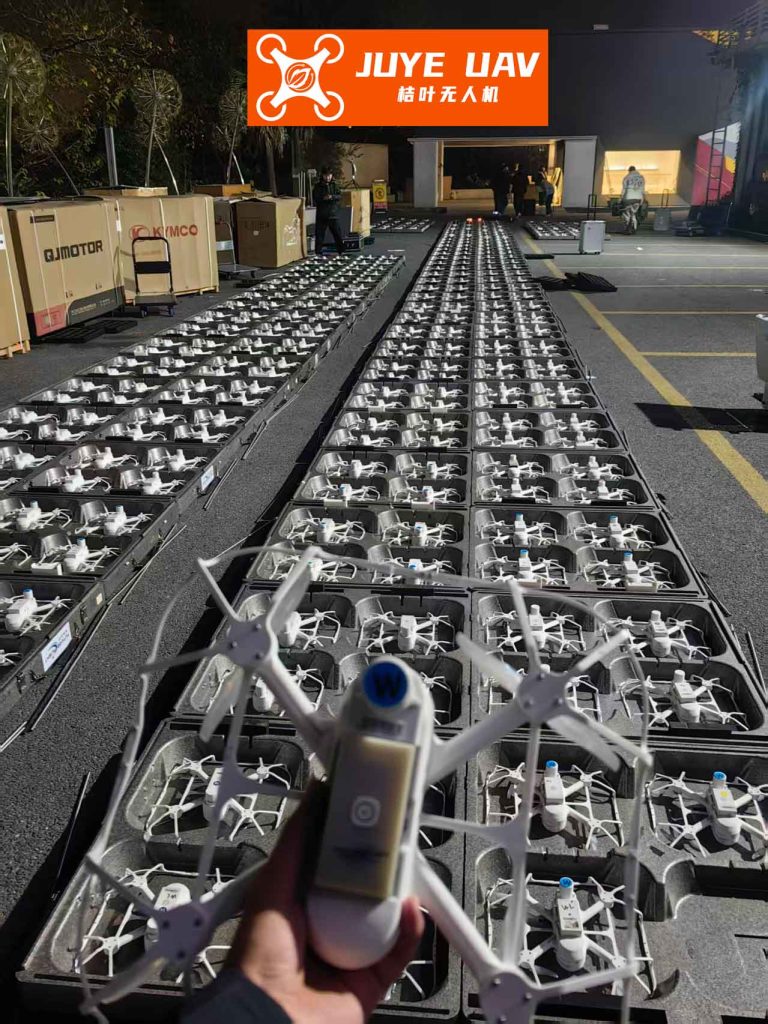
The application of drone formations extends beyond theoretical studies to real-world scenarios like aerial light shows, where hundreds of drones coordinate to create intricate patterns in the sky. These displays rely heavily on precise formation control and collision avoidance to ensure safety and visual appeal. The proposed controller aligns well with such applications, as it balances formation accuracy with proactive avoidance. To illustrate, consider a drone light show where drones must transition between complex shapes without collisions. The switched controller enables smooth transitions by activating avoidance only when needed, minimizing disruptions to the formation. This capability is showcased in the following image, which depicts a drone formation in a light show setting—a testament to the practical utility of advanced control strategies.
Looking ahead, there are several directions for improving drone formation control. One area is integrating machine learning techniques to adaptively tune controller parameters based on environmental feedback. For instance, reinforcement learning could optimize the avoidance threshold \( d \) or gain \( b \) in real-time, enhancing performance in dynamic drone formations. Additionally, incorporating 3D dynamics would allow for more versatile drone formations in aerial missions. The current 2D model can be extended to 3D by adding altitude states, with similar control principles applying. Future work could also explore heterogeneous drone formations, where drones have different capabilities, requiring tailored control strategies.
In conclusion, this article has presented a comprehensive study on drone formation control with internal collision avoidance. By combining consensus-based control with artificial potential fields, I developed a switched controller that ensures drones achieve desired formations while avoiding collisions. Theoretical analysis provided stability guarantees under directed communication topologies, and simulations demonstrated effectiveness in various scenarios. The emphasis on “drone formation” throughout underscores its centrality in multi-drone systems. As drone technology advances, such control methods will be instrumental in enabling safe, efficient, and scalable drone formations for diverse applications. I believe this work contributes a robust framework that can be extended and refined for future drone formation challenges.