
In recent years, quadrotor drones have gained widespread application due to their simple structure, high flexibility, and ease of maintenance. These unmanned aerial vehicles are often tasked with high-precision tracking of specific trajectories to accomplish missions such as surveillance, delivery, and inspection. However, the quadrotor drone is a nonlinear, multi-input multi-output coupled system, inherently susceptible to various disturbances during flight, including internal parameter perturbations, unmodeled dynamics, and external wind fields. These challenges make the design of robust trajectory tracking control systems exceptionally difficult. Therefore, researching anti-disturbance trajectory tracking control for quadrotor drones under multi-source interference environments is of significant importance.
To address these issues, numerous methods have been proposed by researchers globally. Traditional approaches, such as PID algorithms combined with command filtering compensation, achieve attitude stabilization and error linearization for trajectory tracking. However, linear methods often struggle to guarantee global stability and exhibit poor performance against external disturbances. Adaptive control methods have been employed to achieve attitude stabilization and displacement tracking, yet steady-state errors persist. Robust compensation combined with PD controllers in inner and outer loops has been implemented for trajectory tracking and hovering, but tracking accuracy remains limited. These passive anti-disturbance methods rely on feedback regulation based on tracking errors, which can be slow in response under multi-source disturbances. Recently, active disturbance rejection control schemes have emerged, aiming to estimate or compensate for unmodeled system parts and external disturbances, ensuring steady-state tracking of desired trajectories. For instance, third-order sliding mode observers have been designed to enhance tracking speed and accuracy, but high-order sliding mode algorithms suffer from complexity and chattering in control outputs, limiting attitude loop control capabilities. Full-distributed observers enable reference signal generation based on local information for ideal formation states, while adaptive sliding mode control with disturbance observers addresses actuator faults and sudden disturbances. However, these methods perform well for slow-time-varying disturbances but are less effective against periodic signals. Harmonic observers have been proposed for high-precision estimation of periodic disturbances. Furthermore, nonlinear control methods often provide excellent steady-state performance but lack constraints on transient performance, which is crucial for quadrotor drones due to their reliance on control system response speed for maneuverability. Prescribed performance control methods have been introduced to constrain tracking performance within predefined bounds, coordinating steady-state and dynamic requirements. Fixed-time control combined with prescribed performance ensures error and disturbance convergence within fixed time and predefined bounds, while generalized proportional-integral observers with dynamic prescribed performance sliding mode control maintain tracking errors within preset ranges. For quadrotor drone formation systems, prescribed performance control constraints errors from internal collisions, and disturbance observers estimate lumped disturbances, ensuring safety and stability. Nonetheless, most methods assume slow-varying or constant disturbances, leaving periodic disturbance issues unresolved.
In this article, I propose a full-loop active anti-disturbance control scheme based on prescribed performance for quadrotor drones affected by periodic disturbances, considering tracking error convergence characteristics. The trajectory tracking problem is transformed into a command tracking problem through analysis of the quadrotor drone dynamics model. Harmonic disturbance observers and higher-order sliding-mode disturbance observers are designed for the position and attitude loops, respectively, to estimate lumped disturbances and unmeasured states. Based on disturbance estimation information and the prescribed performance method, composite dynamic inverse controllers with prescribed performance are designed for the position loop, and composite dynamic inverse controllers are designed for the attitude loop. This approach effectively suppresses periodic disturbances and ensures that trajectory tracking errors converge according to prescribed performance. The quadrotor drone, as a versatile platform, exemplifies the need for robust control in dynamic environments.
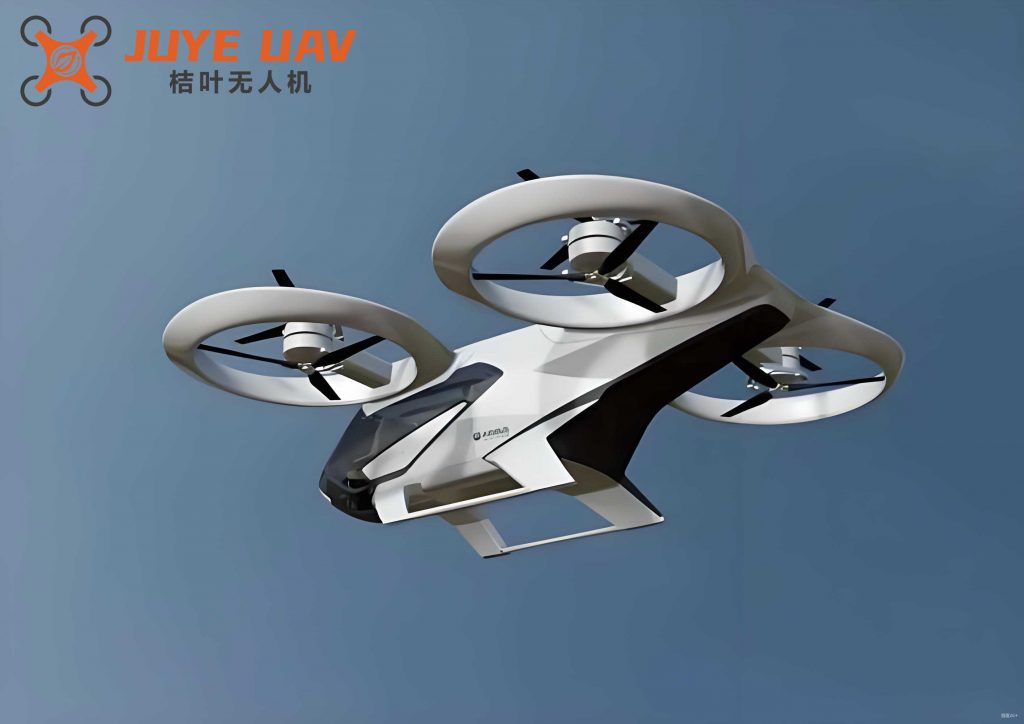
The dynamics of a quadrotor drone are derived from its rigid-body model, with four rotors generating lift and torque. Let the rotor speeds be denoted as $\omega_1$, $\omega_2$, $\omega_3$, $\omega_4$. The total lift along the body $Z_b$-axis is $Y_L$, and the rotational moments around the body axes $X_b$, $Y_b$, $Z_b$ are $\tau_\phi$, $\tau_\theta$, and $\tau_\psi$, respectively. These are given by:
$$Y_L = C_L (\omega_1^2 + \omega_2^2 + \omega_3^2 + \omega_4^2)$$
$$\tau_\phi = r C_L (\omega_2^2 – \omega_4^2)$$
$$\tau_\theta = r C_L (-\omega_1^2 + \omega_3^2)$$
$$\tau_\psi = b(\omega_1^2 – \omega_2^2 + \omega_3^2 – \omega_4^2)$$
Here, $C_L$ is the lift coefficient, $r$ is the distance from each rotor’s center of mass to the drone’s center of mass, and $b$ is the anti-torque coefficient. The quadrotor drone’s position in the inertial frame is defined by coordinates $(x, y, z)$, and its attitude is described by Euler angles $(\phi, \theta, \psi)$ representing roll, pitch, and yaw, respectively. The kinematic and dynamic equations are derived under the assumption of a rigid body. The attitude kinematics are:
$$\dot{\phi} = \omega_x + \omega_y \sin\phi \tan\theta + \omega_z \cos\phi \tan\theta$$
$$\dot{\theta} = \omega_y \cos\phi – \omega_z \sin\phi$$
$$\dot{\psi} = \frac{1}{\cos\theta} (\omega_y \sin\phi + \omega_z \cos\phi)$$
where $\omega_x$, $\omega_y$, $\omega_z$ are the angular velocities about the body axes. The attitude dynamics are:
$$\dot{\omega}_x = \frac{1}{I_x} [(I_y – I_z) \omega_y \omega_z + \tau_\phi] + \tau_{d\phi}$$
$$\dot{\omega}_y = \frac{1}{I_y} [(I_z – I_x) \omega_x \omega_z + \tau_\theta] + \tau_{d\theta}$$
$$\dot{\omega}_z = \frac{1}{I_z} [(I_x – I_y) \omega_y \omega_x + \tau_\psi] + \tau_{d\psi}$$
Here, $I_x$, $I_y$, $I_z$ are the moments of inertia, and $\tau_{d\phi}$, $\tau_{d\theta}$, $\tau_{d\psi}$ are external disturbance torques. The position dynamics are:
$$\ddot{x} = -\frac{Y_L}{m} (\cos\phi \sin\theta \cos\psi + \sin\phi \sin\psi) – \frac{\eta_x}{m} \dot{x} + \frac{F_d^x}{m}$$
$$\ddot{y} = -\frac{Y_L}{m} (\cos\phi \sin\theta \sin\psi – \sin\phi \cos\psi) – \frac{\eta_y}{m} \dot{y} + \frac{F_d^y}{m}$$
$$\ddot{z} = -\frac{Y_L}{m} \cos\phi \cos\theta + g – \frac{\eta_z}{m} \dot{z} + \frac{F_d^z}{m}$$
where $m$ is the mass, $g$ is gravitational acceleration, $\eta_x$, $\eta_y$, $\eta_z$ are drag coefficients, and $F_d^x$, $F_d^y$, $F_d^z$ are external disturbance forces. To simplify control design, virtual control inputs are introduced:
$$a_{xu} = -\frac{Y_L}{m} (\cos\phi \sin\theta \cos\psi + \sin\phi \sin\psi)$$
$$a_{yu} = -\frac{Y_L}{m} (\cos\phi \sin\theta \sin\psi – \sin\phi \cos\psi)$$
$$a_{zu} = -\frac{Y_L}{m} \cos\phi \cos\theta + g$$
The desired roll angle $\phi_E$, pitch angle $\theta_E$, and lift $Y_L^E$ can be derived from these virtual inputs:
$$\phi_E = \arcsin\left(m \frac{a_{yu} \cos\psi – a_{xu} \sin\psi}{Y_L}\right)$$
$$\theta_E = \arctan\left(m \frac{a_{xu} \cos\psi + a_{yu} \sin\psi}{Y_L}\right)$$
$$Y_L^E = m \sqrt{a_{xu}^2 + a_{yu}^2 + (a_{zu} + g)^2}$$
This transformation reveals that the quadrotor drone adjusts its attitude angles to control position loop accelerations for trajectory tracking. Defining position tracking errors as $e_x = x – x_E$, $e_y = y – y_E$, $e_z = z – z_E$, where $(x_E, y_E, z_E)$ are desired positions, the error dynamics become:
$$\dot{e}_x = a_{xu} – \frac{\eta_x}{m} \dot{x} + \frac{F_d^x}{m} – \dot{x}_E$$
$$\dot{e}_y = a_{yu} – \frac{\eta_y}{m} \dot{y} + \frac{F_d^y}{m} – \dot{y}_E$$
$$\dot{e}_z = a_{zu} – \frac{\eta_z}{m} \dot{z} + \frac{F_d^z}{m} – \dot{z}_E$$
Similarly, attitude tracking errors are defined as $e_\phi = \phi – \phi_E$, $e_\theta = \theta – \theta_E$, $e_\psi = \psi – \psi_E$, with error dynamics derived as:
$$\ddot{e}_\phi = \tau_1 + f_{A1} + D_{A1}$$
$$\ddot{e}_\theta = \tau_2 + f_{A2} + D_{A2}$$
$$\ddot{e}_\psi = \tau_3 + f_{A3} + D_{A3}$$
where $\tau_1, \tau_2, \tau_3$ are transformed control inputs, $f_{A1}, f_{A2}, f_{A3}$ are known nonlinear functions, and $D_{A1}, D_{A2}, D_{A3}$ are lumped disturbances encompassing external disturbances and unmodeled dynamics. Thus, the full-loop trajectory tracking problem is transformed into stabilizing position and attitude error dynamics.
To handle periodic disturbances, I design observers for both position and attitude loops. For the position loop, assume external disturbance forces $F_d^x$, $F_d^y$, $F_d^z$ satisfy periodic dynamics with known frequencies $\varpi_x$, $\varpi_y$, $\varpi_z$. A harmonic disturbance observer is designed for each channel. For the X-channel, the observer is:
$$\dot{z}_{x1} = -\frac{\eta}{m} \dot{x} – \dot{x}_E + a_{xu} + z_{x2} – l_{px1}(z_{x1} – \dot{e}_x)$$
$$\dot{z}_{x2} = \varpi_x z_{x3} – l_{px2}(z_{x1} – \dot{e}_x)$$
$$\dot{z}_{x3} = -\varpi_x z_{x2} – l_{px3}(z_{x1} – \dot{e}_x)$$
$$\hat{F}_d^x = m z_{x2}$$
where $l_{px1}, l_{px2}, l_{px3}$ are positive constants chosen such that the polynomial $s^3 + l_{px1} s^2 + (l_{px2} + \varpi_x^2)s + l_{px1} \varpi_x^2 + l_{px3} \varpi_x$ is Hurwitz. Similar observers are designed for Y and Z channels. The estimation errors converge asymptotically, ensuring accurate disturbance estimation for the quadrotor drone.
For the attitude loop, assume external disturbance torques are differentiable with bounded derivatives. A higher-order sliding mode observer is designed for each attitude channel. For the roll channel, the observer is:
$$v_{11} = -3 l_{Ao1}^{1/3} |z_{11} – e_\phi|^{2/3} \text{sign}(z_{11} – e_\phi) + z_{12}$$
$$v_{12} = -1.5 l_{Ao1}^{1/2} |z_{12} – v_{11}|^{1/2} \text{sign}(z_{12} – v_{11}) + z_{13}$$
$$\dot{z}_{11} = v_{11}, \quad \dot{z}_{12} = \tau_1 + f_{A1} + v_{12}$$
$$\dot{z}_{13} = -1.1 l_{Ao1} \text{sign}(z_{13} – v_{12})$$
$$\hat{\dot{e}}_\phi = z_{12}, \quad \hat{D}_{A1} = z_{13}$$
where $l_{Ao1}$ is a positive gain. Similar observers are designed for pitch and yaw channels. These observers ensure finite-time convergence of estimation errors, providing robust disturbance estimates for the quadrotor drone’s attitude control.
Next, I design controllers based on the estimated disturbances and prescribed performance. Prescribed performance ensures that tracking errors converge within predefined bounds. For position errors, the performance requirement is:
$$-\rho_i(t) < e_i(t) < \rho_i(t), \quad i = x, y, z$$
where $\rho_i(t)$ is a prescribed performance function, typically chosen as:
$$\rho_i(t) = (\rho_{0i} – \rho_{\infty i}) e^{-h_i t} + \rho_{\infty i}$$
with $\rho_{0i} > \rho_{\infty i} > 0$ and $h_i > 0$. To transform this inequality constraint, define $\lambda_i(t) = e_i(t) / \rho_i(t)$ and relate it to a transformed error $\varepsilon_i(t)$ via a hyperbolic tangent function:
$$\lambda_i(t) = \frac{e^{\varepsilon_i(t)} – e^{-\varepsilon_i(t)}}{e^{\varepsilon_i(t)} + e^{-\varepsilon_i(t)}}$$
which yields $\varepsilon_i(t) = \frac{1}{2} \ln\left(\frac{1 + \lambda_i(t)}{1 – \lambda_i(t)}\right)$. The dynamics of $\varepsilon_i(t)$ are derived as:
$$\dot{\varepsilon}_i = r_i [\dot{e}_i(t) – e_i(t) v_i]$$
$$\ddot{\varepsilon}_i = \dot{r}_i (\dot{e}_i – e_i v_i) + r_i (\ddot{e}_i – \dot{e}_i v_i – e_i \dot{v}_i)$$
where $r_i = 1 / [(1 – (e_i / \rho_i)^2) \rho_i]$ and $v_i = \dot{\rho}_i / \rho_i$. Based on this, composite dynamic inverse controllers with prescribed performance are designed for the position loop. For the X-channel:
$$a_{xu} = \frac{\eta}{m} \dot{x} – \frac{\hat{F}_d^x}{m} + \dot{x}_E + \dot{e}_x v_x + e_x \dot{v}_x – \frac{k_{dx} \dot{\varepsilon}_x + k_{px} \varepsilon_x + \dot{r}_x (\dot{e}_x – e_x v_x)}{r_x}$$
where $k_{dx}$ and $k_{px}$ are positive constants, and $\hat{F}_d^x$ is from the harmonic observer. Similar controllers are designed for Y and Z channels. For the attitude loop, composite dynamic inverse controllers are designed without prescribed performance but with disturbance compensation:
$$\tau_1 = -f_{A1} – \hat{D}_{A1} – k_{A11} \hat{\dot{e}}_\phi – k_{A12} e_\phi$$
$$\tau_2 = -f_{A2} – \hat{D}_{A2} – k_{A21} \hat{\dot{e}}_\theta – k_{A22} e_\theta$$
$$\tau_3 = -f_{A3} – \hat{D}_{A3} – k_{A31} \hat{\dot{e}}_\psi – k_{A32} e_\psi$$
where $k_{A11}, k_{A12}, etc.,$ are positive constants, and $\hat{D}_{A1}, \hat{\dot{e}}_\phi, etc.,$ are from the higher-order sliding mode observer. The actual rotor speeds are computed from $Y_L$ and $\tau_\phi, \tau_\theta, \tau_\psi$ using the inverse of the force-torque mapping.
Stability analysis shows that the closed-loop system ensures asymptotic convergence of tracking errors while satisfying prescribed performance bounds. For the position loop, considering the estimation error dynamics and transformed error dynamics, the augmented system matrix is Hurwitz, guaranteeing convergence. Since $\varepsilon_i(t)$ is bounded, $e_i(t)$ remains within $(-\rho_i(t), \rho_i(t))$. For the attitude loop, the controllers with disturbance compensation ensure error convergence. Thus, the proposed scheme robustly handles periodic disturbances for the quadrotor drone.
To validate the approach, simulations are conducted comparing the proposed method (PPC+NDIC+HDO) with baseline methods: basic nonlinear dynamic inverse control (BNDIC), composite dynamic inverse control with extended state observer (NDIC+ESO), and composite dynamic inverse control with harmonic disturbance observer (NDIC+HDO). The quadrotor drone parameters are listed in the table below, with perturbations applied to simulate model uncertainties.
| Parameter | Value | Unit |
|---|---|---|
| Mass, $m$ | 0.8 | kg |
| Drag coefficient, $\eta$ | 0.09 | N·s/m |
| Lift coefficient, $C_L$ | 2.98e-5 | N·s² |
| Anti-torque coefficient, $b$ | 2e-6 | N·m·s² |
| Arm length, $r$ | 0.1652 | m |
| Moment of inertia, $I_x$ | 5.445e-3 | kg·m² |
| Moment of inertia, $I_y$ | 5.445e-3 | kg·m² |
| Moment of inertia, $I_z$ | 1.089e-2 | kg·m² |
The desired trajectory is a cylindrical helix: $x_E = \sin(0.5t)$, $y_E = \cos(0.5t)$, $z_E = -0.5 – 0.1t$, with yaw angle $\psi_E = 15^\circ \cos(0.5t)$. Periodic disturbances are applied: $F_d^x = -1.6 \sin(0.3\pi t)$, $F_d^y = 1.6 \sin(0.3\pi t)$, $F_d^z = -0.8 \sin(0.3\pi t)$, $\tau_{d\phi} = -I_x \sin(0.2\pi t)$, $\tau_{d\theta} = -I_y \sin(0.2\pi t)$, $\tau_{d\psi} = -2I_z \sin(0.2\pi t)$. Controller and observer gains are tuned via pole placement and trial methods.
Simulation results demonstrate that the proposed PPC+NDIC+HDO method achieves high-precision trajectory tracking for the quadrotor drone. The tracking errors remain within prescribed bounds, e.g., position errors stay between $-0.01$ m and $0.01$ m in steady state. Comparative analysis shows superior performance over other methods, as summarized in the table below.
| Method | Max Position Error (m) | Steady-State Error Bound (m) | Disturbance Rejection | Transient Performance |
|---|---|---|---|---|
| BNDIC | 0.5 | ±0.05 | Poor | Slow convergence |
| NDIC+ESO | 0.1 | ±0.02 | Moderate | Moderate chattering |
| NDIC+HDO | 0.05 | ±0.015 | Good | Smooth |
| PPC+NDIC+HDO | 0.02 | ±0.01 | Excellent | Prescribed bounds |
The harmonic disturbance observer provides accurate estimation of periodic disturbances, with estimation errors converging rapidly. The higher-order sliding mode observer effectively estimates attitude loop disturbances and unmeasured states. Control inputs remain within feasible limits, ensuring practical implementation for the quadrotor drone. The prescribed performance function guarantees that tracking errors decay exponentially within the envelope defined by $\rho_i(t)$, enhancing transient and steady-state performance.
In conclusion, I have presented a full-loop active anti-disturbance control scheme for quadrotor drones under periodic disturbances, incorporating prescribed performance constraints. By transforming the trajectory tracking problem into error dynamics, designing harmonic and higher-order sliding mode observers for disturbance estimation, and developing composite dynamic inverse controllers with prescribed performance, the approach ensures robust tracking with guaranteed transient and steady-state behavior. Simulations validate the effectiveness, showing that the quadrotor drone achieves high-precision tracking while suppressing periodic disturbances. Future work may extend this method to multi-agent systems or incorporate adaptive parameters for unknown disturbance frequencies, further enhancing the versatility of quadrotor drones in complex environments.
The proposed control strategy highlights the importance of integrated observer-controller designs for nonlinear systems like the quadrotor drone. By leveraging prescribed performance, designers can explicitly define error convergence characteristics, improving safety and reliability in real-world applications. This research contributes to advancing autonomous flight technologies, enabling quadrotor drones to perform demanding tasks in dynamic and uncertain environments.