
The proliferation of unmanned aerial vehicles (UAVs) across the battlespace represents one of the most significant and asymmetric challenges to modern military forces. From small commercial drones used for reconnaissance to coordinated swarms designed for saturation attacks, the UAV threat spectrum is broad, evolving, and dangerously cost-effective. Traditional air defense systems, optimized for larger, faster, and more predictable aircraft and missiles, often struggle against low, slow, and small (LSS) UAVs and are economically unsustainable when engaging cheap drone swarms. In this contested environment, Directed Energy Weapons (DEWs)—specifically High-Energy Lasers (HELs) and High-Power Microwaves (HPMs)—have emerged as a pivotal technological countermeasure, offering a revolutionary approach to anti-UAV defense.
The core advantage of DEWs in the anti-UAV role lies in their fundamental physics. Unlike kinetic interceptors, they engage targets at the speed of light, providing a true “see-and-kill” capability that negates the need for complex lead calculations. Their engagement cost per shot is often negligible, being primarily the price of electrical power from a generator or ship’s grid, which creates a decisive economic asymmetry against low-cost drone threats. Furthermore, their effects are scalable and tailored. Laser weapons can deliver precision physical destruction (hard kill) through thermal ablation or act as a non-lethal dazzler to sensor optics (soft kill). HPM weapons, by contrast, project a broad beam capable of disabling the electronic subsystems of multiple UAVs within a cone of effect simultaneously, making them uniquely suited for counter-swarm operations. This combination of speed, low cost per engagement, and versatile effects makes DEWs not merely an additional tool, but a potential cornerstone of future layered anti-UAV architectures.
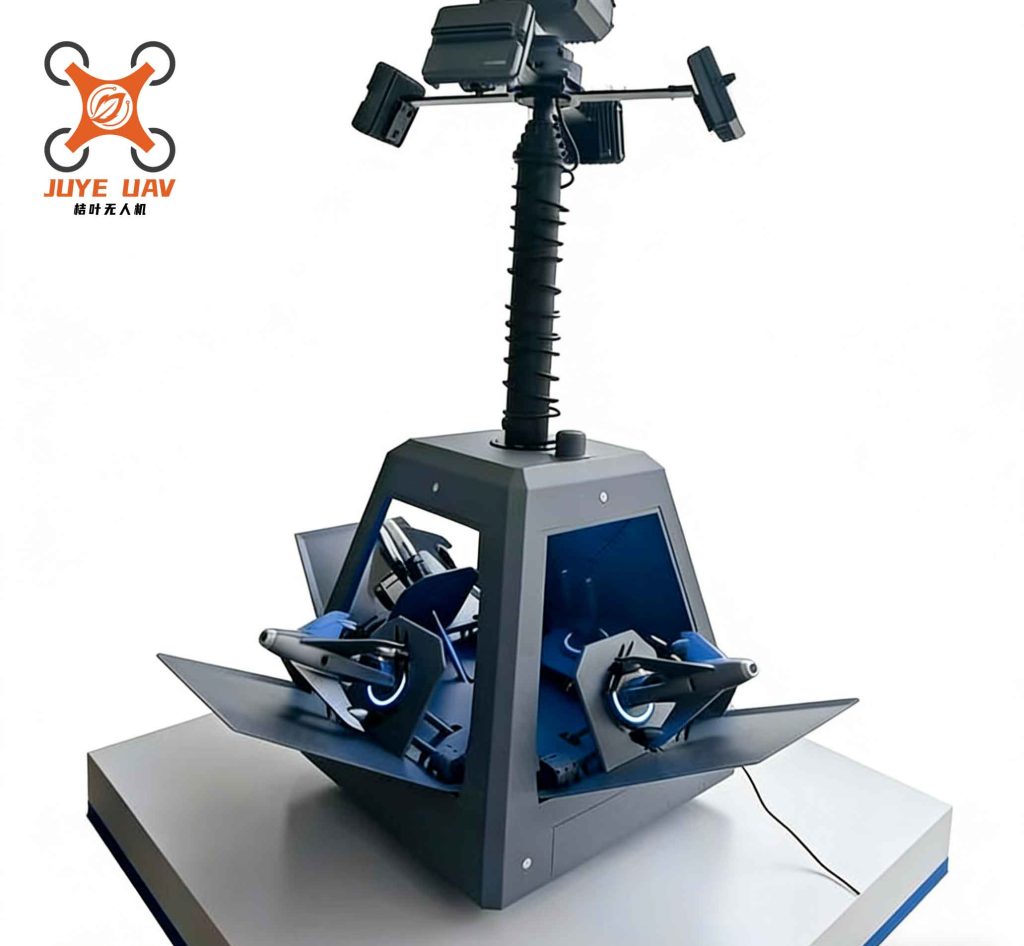
My analysis of recent progress indicates a concerted push by the U.S. military to transition these technologies from laboratory demonstrations to tactically relevant, fieldable systems. The development paths for laser and microwave weapons, while sharing the common anti-UAV mission, highlight different technical philosophies and operational applications.
High-Energy Laser (HEL) Systems: The Scalable Precision Kill
High-energy laser systems function by generating a coherent, collimated beam of light and focusing it onto a small spot on a target. The intense power density, measured in kilowatts per square centimeter ($kW/cm^2$), induces rapid heating, leading to material melt-through, structural failure, or ignition of fuels and batteries. The key metrics for an HEL system are its output power (in kilowatts or megawatts), beam quality (which affects focusability), and the efficiency of its electrical-to-optical power conversion. The time-to-effect ($t_{kill}$) on a target can be approximated by considering the power ($P$), beam quality factor ($BQ$), atmospheric transmission ($\tau_{atm}$), range ($R$), and target material properties. A simplified energy balance for ablation is given by:
$$E_{required} = m \cdot [C_p \cdot (T_{melt} – T_{ambient}) + L_{melt}]$$
Where $m$ is the mass of material to be ablated, $C_p$ is specific heat, $T$ is temperature, and $L_{melt}$ is latent heat of fusion. The delivered power density ($PD_{target}$) at the target dictates the kill time:
$$PD_{target} = \frac{P \cdot \tau_{atm} \cdot BQ}{\pi \cdot ( \theta \cdot R / 2 )^2}$$
$$t_{kill} \approx \frac{E_{required}}{PD_{target} \cdot A_{spot}}$$
Here, $\theta$ is the beam divergence angle and $A_{spot}$ is the area of the focused beam spot. Modern solid-state lasers, particularly Fiber Laser and Spectral Beam Combined (SBC) architectures, have enabled the robust, scalable power needed for mobile platforms.
The following table summarizes key U.S. tactical HEL programs with clear anti-UAV applications, showcasing the trend towards higher power and greater mobility.
| Program Name | Platform / Context | Stated Power / Capability | Primary Role & Status |
|---|---|---|---|
| MEHEL (Mobile Expeditionary High-Energy Laser) | Stryker armored vehicle | 2 kW (2016) → 5 kW (2017) → 18 kW (2018) → Goal: 50 kW | Army indirect fire protection & counter-UAV. Successfully engaged dozens of Class 1/2 UAVs. |
| HELWS-MRZR (High-Energy Laser Weapon System) | Polaris MRZR ultra-light tactical vehicle | ~5-10 kW class | Special Operations Forces mobile counter-UAV system. Demonstrated against small quadcopters. |
| HEL TVD (High-Energy Laser Tactical Vehicle Demonstrator) | Family of Medium Tactical Vehicles (FMTV) | Goal: 100 kW class | Army program for defeating rockets, artillery, mortars, and UAVs. Critical step to operational 100-kW class weapon. |
| Athena (Advanced Test High Energy Asset) | Heavy truck (ground test bed) | 30 kW class | Technology demonstrator. Successfully engaged 5 wing-borne drones in a single test. |
| HELIOS (High Energy Laser with Integrated Optical-dazzler and Surveillance) | U.S. Navy Destroyers (DDG) | 60 – 150 kW | Multi-function: Hard-kill vs. small boats/UAVs, sensor dazzle, and ISR. Scheduled for shipboard installation. |
| CLaWS (Compact Laser Weapons System) | Tripod or vehicle-mounted | 2, 5, or 10 kW variants | Marine Corps interim solution. Designed for rapid deployment against Group 1 UAVs. |
| SHIELD (Self-protect High-Energy Laser Demonstrator) | Pod on tactical aircraft (e.g., F-15) | Goal: ~100 kW class | Air Force program for airborne platform self-defense against missiles and UAVs. |
The progression is evident: from 2-kW systems on light vehicles capable of downing small drones, to 100-kW+ systems designed for ships and trucks to handle larger, more robust threats at greater ranges. The beam control and tracking systems for these platforms have also matured significantly, allowing them to maintain a lethal focus on small, maneuvering UAVs.
High-Power Microwave (HPM) Systems: The Wide-Area Counter-Swarm Solution
While lasers offer pinpoint precision, High-Power Microwave weapons provide a complementary, area-effect capability crucial for the anti-UAV swarm challenge. HPM systems generate extremely powerful, short pulses of microwave energy (often in the GHz range) and direct them via an antenna. The radiated electromagnetic field induces high voltages and currents in the target’s electronic circuits—flight controllers, navigation systems, data links, and sensors—overloading and permanently damaging them. This is known as functional or front-door coupling. There can also be “back-door” coupling through seams and apertures.
The critical parameters for HPM effectiveness are the peak radiated power ($P_{rad}$), the pulse width ($\tau$), the pulse repetition frequency (PRF), and the antenna gain ($G$) which determines the power density at range ($R$). The power density ($S$) in the far field is given by the equation:
$$S = \frac{P_{rad} \cdot G}{4 \pi R^2}$$
The energy coupled into a target’s electronics depends on this power density, the target’s effective aperture for capture ($A_{eff}$), and the polarization match. The effect is often non-linear; a slight increase in incident power density can mean the difference between temporary disruption and permanent burnout. The key tactical advantage is that a single HPM pulse, covering a wide conical area, can potentially disable every UAV within its beam pattern simultaneously, making it the most promising direct-energy solution for dense anti-UAV swarm defense.
| Program / System Name | Platform / Context | Key Characteristics | Demonstrated Anti-UAV Role |
|---|---|---|---|
| Phaser | Containerized / mounted on military trucks | Phased-array radar for track/cue; HPM effector. Employs “destroy” vs. “disrupt” settings. | Engaged and downed multiple individual and swarmed UAVs in tests (e.g., 33 drones in a 2017 demonstration). |
| THOR (Tactical High-power Operational Responder) | Transportable shelter (C-130 transportable) | Designed specifically for base defense. Rapid slewing, wide-area cone of effect. | Publicly demonstrated to defeat multiple drones simultaneously, claimed capability against drone swarms (>50). |
| Counter-UAS HPM (various) | Ground-based, fixed-site or mobile platforms | Often uses magnetron or vircator sources. Focus on scalable, lower-cost systems. | Multiple industry systems demonstrated in military exercises, focusing on disabling commercial and tactical UAV electronics. |
| Distributed RF Power Concept | Future networked systems (e.g., UAV/USV swarms) | Theoretical concept using coherent combination of emissions from many distributed nodes. | Envisioned to create extremely high effective radiated power for long-range electronic attack, including against UAV clusters. |
The operational narrative for HPM is one of area denial and swarm negation. Systems like THOR and Phaser represent the first generation of tactically deployable HPM systems whose primary stated mission is base protection and point defense against unmanned systems. Their development signals a clear recognition that defeating drone swarms requires an effector whose cost and engagement mechanics are as asymmetric and scalable as the threat itself.
Comparative Analysis and Synergistic Employment
Choosing between laser and microwave for an anti-UAV mission involves fundamental trade-offs. The following table contrasts their core attributes:
| Feature | High-Energy Laser (HEL) | High-Power Microwave (HPM) |
|---|---|---|
| Engagement Speed | Speed of light (~$3 \times 10^8$ m/s) | Speed of light (same) |
| Engagement Physics | Thermal ablation / melting (Hard-Kill), Dazzle (Soft-Kill) | Induced current/voltage burnout of electronics (Functional Kill) |
| Beam Propagation | Narrow, line-of-sight. Severely degraded by fog, rain, smoke, clouds. | Wider cone, less affected by weather, but follows line-of-sight and standard diffraction. |
| Target Engagement | Single target at a time (sequential). Requires precise, sustained track. | |
| Effect on Target | Physical destruction (burn hole, structural failure). | Electronic disablement (craft may fall intact). |
| Ideal Threat Scenario | Individual or small numbers of high-value UAVs; clear atmospheric conditions. | Defending against swarms of low-cost UAVs; all-weather capability. |
The most effective future anti-UAV architecture will not rely on a single technology but will synergistically integrate both DEW types with kinetic and electronic warfare systems. A notional layered defense might employ:
- Long-range detection & tracking: Radar and electro-optical/infrared (EO/IR) sensors.
- Outer layer engagement: HPM systems to degrade or disable leading elements of a swarm.
- Inner layer precision engagement: High-power HELs to physically destroy any UAVs that penetrate the HPM envelope, particularly those carrying explosive payloads.
- Final barrier: Kinetics (micromissiles, guns) and net-based systems for very close-range leakers.
This combination leverages the strength of each system, creating a resilient and cost-imposing defense network for critical assets.
Future Trajectories and Strategic Implications
The trajectory of DEW development for anti-UAV missions points toward several key trends that will shape their operational impact.
1. Power Scaling and System Consolidation: The relentless drive for higher power in smaller packages continues. For lasers, the shift from 10-kW to 100-kW class weapons is a pivotal threshold, dramatically increasing effective range and reducing engagement times against hardened targets. The formula for lethal range ($R_{lethal}$) is heavily dependent on power ($P$), atmospheric conditions ($\tau_{atm}(R)$), and beam control ($\theta$):
$$R_{lethal} : \text{where } PD_{target}(R) = PD_{threshold}$$
As power increases and beam quality improves, $R_{lethal}$ increases significantly, allowing platforms to defend larger areas. For HPM, the focus is on increasing radiated energy per pulse and developing more agile, higher-gain antennas to extend the effective range of counter-swarm engagements.
2. Multi-Mission and Adaptive Effects: Systems are evolving beyond single-purpose tools. The Navy’s HELIOS program exemplifies this, combining hard-kill, soft-kill (dazzling), and ISR capabilities in one weapon system. Future DEWs will likely feature dynamically selectable output modes, allowing an operator to choose between permanently destroying a hostile UAV or temporarily neutralizing its sensors for a non-kinetic effect. This adaptability is crucial for operating in complex environments where collateral damage must be minimized.
3. Integration with AI and Battle Networks: Effectively countering agile drones and swarms requires automation. Artificial Intelligence (AI) and Machine Learning (ML) are being integrated into fire control loops to autonomously classify threats, prioritize targets in a swarm (e.g., target the lead or control node), and manage engagements. DEW systems will not operate in isolation but as nodes in a larger Integrated Air and Missile Defense (IAMD) battle network, receiving cues from distributed sensors and coordinating effects with other weapons.
4. Platform Diversification and Ubiquity: The miniaturization seen in systems like HELWS-MRZR and CLaWS is a precursor to wider deployment. We can expect DEW effectors on a vast array of platforms: ground vehicles (from JLTVs to tanks), naval vessels (from destroyers to littoral combat ships), fixed ground sites for base defense, and eventually on aircraft and large unmanned platforms themselves. This ubiquity will reshape the anti-UAV fight from a few dedicated points of defense to a pervasive, networked capability.
5. Strategic Cost Imposition: Ultimately, the strategic promise of DEWs in the anti-UAV role is one of cost imposition. An adversary investing in massive, low-cost drone swarms to overwhelm traditional defenses faces a dilemma when those swarms can be negated by a weapon whose marginal cost per shot is dollars of electricity. This rebalances the economic calculus of saturation attacks and forces adversaries to develop more sophisticated, expensive, and likely fewer UAVs, which are then easier to counter with traditional means.
In conclusion, the advancement of directed energy weapons for anti-UAV warfare is transitioning from a promising technological prospect to an operational reality. High-Energy Lasers provide the scalable, precision hard-kill, while High-Power Microwaves offer the essential wide-area counter-swarm solution. Their development paths are converging on deployable, multi-mission systems that will be integrated into the force structure across all services. As these systems mature in power, shrink in size, and become smarter through AI integration, they are poised to fundamentally alter the dynamics of air defense, providing a persistent, affordable, and effective shield against the proliferating threat of unmanned aerial systems. The future of anti-UAV defense is not just brighter—it is increasingly coherent and electrically powered.