
In recent years, the application of drones has expanded from military to civilian domains, driven by technological advancements and supportive policies. China has implemented numerous policies to encourage, support, and regulate the development of the civilian drone industry, gaining a certain first-mover advantage globally. The industrial system for civilian drones is gradually becoming完备, with要素 such as talent, technology, and capital日益完善. Cross-industry integration has有力推动 the new development of the civilian drone industry. China holds leading positions in some areas globally. All parties should coordinate planning, increase policy support, innovate development ideas, improve development quality, base on internal circulation, adhere to open integration, and create an environment conducive to the orderly development of the civilian drone industry, promoting its healthy growth during the “14th Five-Year Plan” period.
From a first-person perspective, as an observer and analyst in this field, I will delve into the current state, challenges, and future trajectory of China’s civilian drone industry. The term ‘civilian drones’ will be frequently emphasized throughout this discussion, reflecting their growing significance.
Current Development Status of the Civilian Drone Industry
Robust Growth Momentum
The civilian drone industry in China has demonstrated strong growth. In 2020, the output value of drone products exceeded 20 billion yuan, with approximately 1.1 million units delivered, and new orders surpassing 5 million units. By the end of 2021, there were 110,000 drone pilot licenses nationwide, with 846,000 registered civilian drones. The annual total operational hours reported through the Civil Aviation Administration of China’s Unmanned Aircraft Traffic Management Information Service System (UTMISS) reached 18.615 million hours.
To summarize the growth trend, we can model the annual output value \( P(t) \) over time \( t \) (in years) using an exponential growth formula, reflecting the industry’s rapid expansion:
$$ P(t) = P_0 \cdot e^{rt} $$
where \( P_0 \) is the initial output value and \( r \) is the growth rate. For instance, if we take 2020 as a base year with \( P_0 = 200 \) (in hundred million yuan), the projected growth can be estimated.
| Year | Registered Drones | Growth Rate (%) |
|---|---|---|
| 2019 | 62.0 | – |
| 2020 | 78.5 | 26.6 |
| 2021 | 84.6 | 7.8 |
The increase in registered civilian drones underscores the expanding adoption and regulatory compliance. The growth rate can be expressed as:
$$ \text{Growth Rate} = \frac{N_t – N_{t-1}}{N_{t-1}} \times 100\% $$
where \( N_t \) is the number of registered civilian drones at time \( t \).
Expanding Share of Industrial Applications
From a market size structure perspective, consumer drones’ share has been逐年下降, yet they remain dominant. In contrast, industrial application drones’ share in the civilian drone market is逐年上升, and it is expected to continue growing. Key application scenarios include agricultural plant protection, power inspection, geographic surveying, security monitoring, emergency firefighting, and快递物流. Among these, agricultural plant protection, power inspection, and geographic surveying collectively account for over 70% of the market size. Geographic surveying has seen rapid development, with its application scale占比逐年上升, becoming a significant component of the civilian drone market.
| Sector | 2015 | 2016 | 2017 | 2018 | 2019 | 2020 |
|---|---|---|---|---|---|---|
| Agricultural Plant Protection | 5.2 | 8.7 | 12.5 | 16.8 | 20.1 | 25.0 |
| Power Inspection | 3.8 | 5.3 | 7.1 | 9.4 | 11.5 | 14.2 |
| Geographic Surveying | 2.5 | 4.0 | 6.0 | 8.5 | 11.0 | 15.0 |
| Security Monitoring | 1.2 | 1.8 | 2.5 | 3.3 | 4.0 | 5.0 |
| Emergency Firefighting | 0.8 | 1.2 | 1.7 | 2.2 | 2.8 | 3.5 |
| Logistics & Delivery | 0.5 | 0.9 | 1.4 | 2.0 | 2.6 | 3.3 |
The market share \( S_i(t) \) for sector \( i \) at time \( t \) can be calculated as:
$$ S_i(t) = \frac{M_i(t)}{\sum_{j} M_j(t)} \times 100\% $$
where \( M_i(t) \) is the market size of sector \( i \). For example, the share of consumer drones has been declining, which can be modeled as a linear decrease: \( S_{\text{consumer}}(t) = a – bt \), while industrial applications show an increase: \( S_{\text{industrial}}(t) = c + dt \).
1. Agricultural Plant Protection: The保有量 of agricultural plant protection civilian drones has been不断增加. In 2020, China had 70,779 agricultural plant protection drones, a year-on-year increase of 77.52%. Since 2017, the Ministry of Agriculture and Rural Affairs initiated subsidy pilots to standardize应用, leading to annual sales growing from less than a thousand units in 2017 to 15,300 units in 2020, with a market size of 2.5 billion yuan, up 44.5%, and annual operational area nearing 300 million mu.
2. Emergency Rescue: Civilian drones have become “anti-pandemic” aerial guardians, conducting tasks such as broadcasting, disinfection, and物资运输, aiding pandemic control. In April 2021, the Ministry of Emergency Management called on drone enterprises to assist in fire rescue in Sichuan. Cases like the “Wing Loong” drone providing communication services in Henan disaster areas and drones searching for lost survey personnel in Ailao Mountains have garnered social attention.
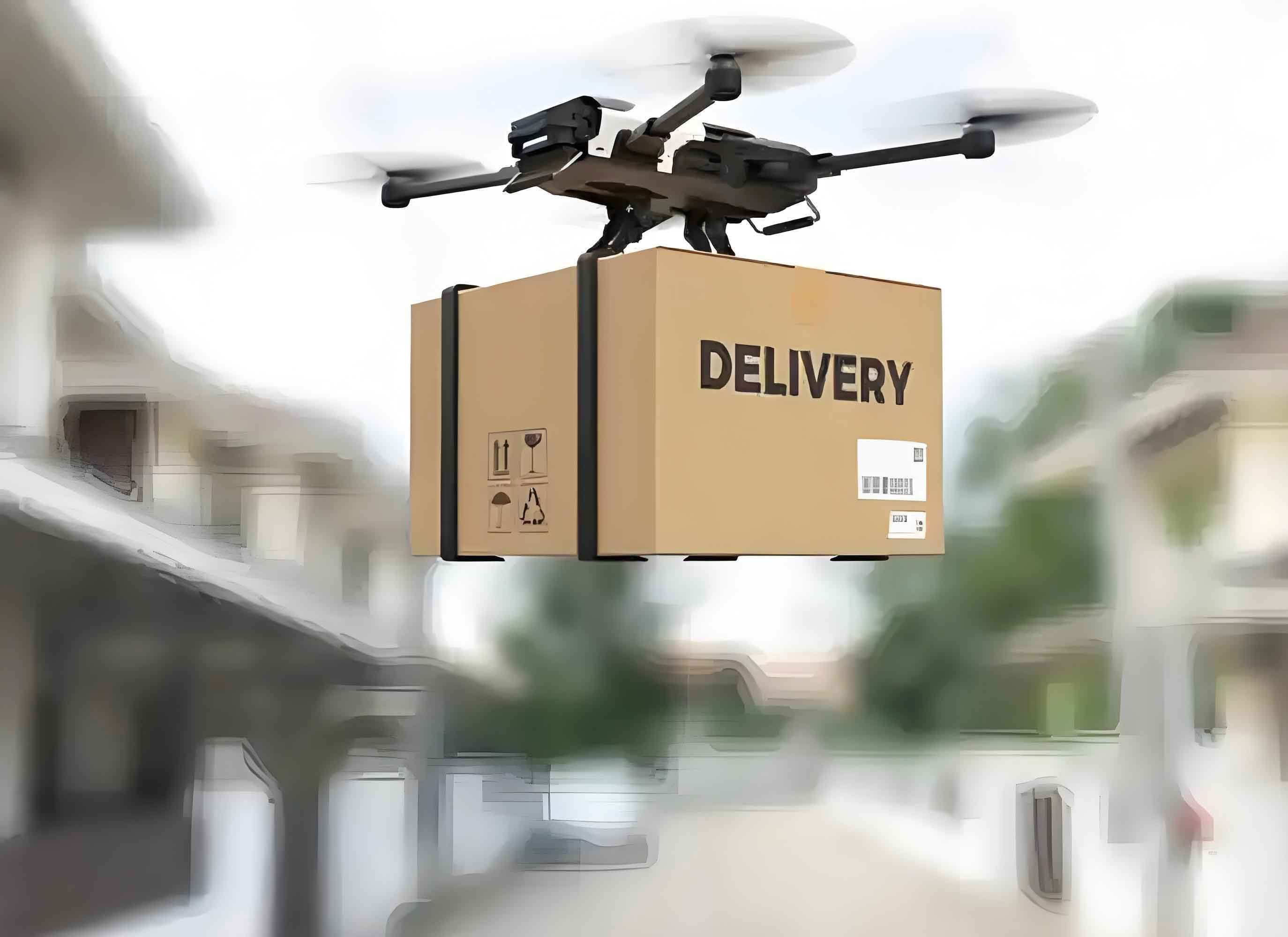
3. Logistics and Delivery: Drone logistics is still in commercial exploration. Companies like顺丰,京东, and美团 leverage the rapid development of e-commerce logistics to advance drone logistics. For instance,京东 has conducted regular drone delivery operations in Jiangsu, Shaanxi, and Hainan, obtaining commercial permits for large-scale drone logistics in Shaanxi. By the end of October 2021,顺丰累计飞行 over 114,000 sorties in Jiangxi Ganzhou logistics pilot zone, covering 453,000 kilometers, and established a支线航空 logistics network in Shaanxi Yulin辐射 Shaanxi, Gansu, Ningxia, and Qinghai.
The growth in logistics civilian drones can be expressed with a logistic growth model to account for saturation:
$$ L(t) = \frac{K}{1 + e^{-r(t-t_0)}} $$
where \( L(t) \) is the number of logistics drone sorties, \( K \) is the carrying capacity, \( r \) is the growth rate, and \( t_0 \) is the inflection point.
4. Urban Air Mobility (UAM): Concepts like Urban Air Mobility (UAM), electric vertical take-off and landing (e-VTOL), and flying cars have become among the hottest innovation and investment areas in aviation. Multiple enterprises have received large-scale financing, becoming热点. Automakers like吉利,一汽,长城, and小鹏, along with tech firms like亿航智能,峰飞航空, and玮航科技, are actively engaged in flying car research projects.亿航智能 has developed multiple products under airworthiness certification, and峰飞航空 has completed initial flight tests.
| Company | Time | Round | Amount | Investors |
|---|---|---|---|---|
| Boundary Intelligence | May 20 | Angel | 20 million yuan | Sequoia China Seed Fund, Oriental Fortune Capital |
| ShiDe Technology | Sep 6 | Angel | Ten million USD | BlueRun Ventures, Decent Investment |
| Volant | Sep 16 | Seed | Several million USD | Shunwei Capital, Ventech China |
| Fengfei Aviation Technology | Sep 18 | Series A | 100 million USD | International Aviation Capital |
| Xpeng Heitech | Oct 19 | Series A | 500 million USD | IDG Capital, 5Y Capital, Xpeng Motors领投, Sequoia China, Zhongding Capital, GGV Capital, Gaorong创投, Yunfeng Capital |
| Weihang Technology | Nov 8 | Seed | Several tens of million yuan | Shunwei Capital, Variable Capital, Weizhong Technology |
| Watt Technology | Nov 19 | Seed | Undisclosed | Deep Acceleration, Weichuang Capital |
Accelerated Development of Leading Civilian Drone Enterprises
Civilian drone enterprises have achieved cluster式 development in regions like the Pearl River Delta, Yangtze River Delta, Beijing-Tianjin-Hebei, and Chengdu-Chongqing,显示强劲的发展动能和巨大的产业活力. Companies like大疆创新,广东极飞,中航(成都)无人机,四川腾盾, and成都纵横 have seen their innovation and profitability enter the first tier internationally. By the end of September 2021,大疆农业无人机作业面积突破 1 billion mu次, a year-on-year increase exceeding 50%.极飞科技’s technology and products have reached 42 countries and regions, with annual sales over 1 billion yuan. After成都纵横 officially landed on the科创板, becoming the first domestic “drone stock,” in September and November 2021,中航(成都)无人机 and极飞科技 had their科创板 IPO applications accepted by the Shanghai Stock Exchange, accelerating the listing of civilian drone enterprises.
The revenue growth of these enterprises can be modeled as:
$$ R(t) = R_0 (1 + g)^t $$
where \( R_0 \) is initial revenue and \( g \) is the annual growth rate. For instance, if a company’s revenue grows at 50% annually, after \( t \) years, it becomes \( R_0 \times 1.5^t \).
Rapid Evolution of Civilian Drone Technology
Integrating emerging热点 technologies like urban mobility, new energy power, and artificial intelligence remains a focus for investment and capital. Gradually丰富ing application scenarios drive technology toward high-altitude, long-range, autonomous, long-endurance, and heavy-payload directions. Products like the运五 general-purpose无人机,亿航载人无人机, and customized industrial application drones are融入各行各业. Beyond整机 sales, data, industry整体解决方案, training, and other service models have become new profit growth points. Infrastructure areas like “drone airports,”通信, power, and监管 will become development热点.
The technological advancement can be represented by a Moore’s Law-like formula for performance metrics such as flight time \( T \) or payload \( W \):
$$ T(t) = T_0 \cdot 2^{t/k} $$
where \( T_0 \) is the initial flight time, \( t \) is time in years, and \( k \) is the doubling period.
Dense Issuance of Civilian Drone Policies
The government高度重视 the civilian drone industry,规范化管理, encouraging development and innovation, providing a clear and broad market前景. Ministries like工信部 and科技部 have released multiple支持 policies to promote technological innovation, industrial chain construction, and产业化 development from aspects like artificial intelligence and market-adaptive modification. Departments such as农业农村部,应急管理部,交通运输部, and人社部 have issued documents encouraging drone use in law enforcement, evidence collection, clarifying drone配备标准,完善ing personnel standards, and optimizing the development environment. The民航局 has released multiple regulation drafts for comment, accelerating the完善ion of民用无人机运行监管制度. As 2021 marked the start of the “14th Five-Year Plan,” over ten provinces and cities including Beijing, Tianjin, and Hebei released plans for technological innovation, high-quality manufacturing development, and digital economy development, with the civilian drone industry as a key support focus.各地依托科研院所, universities, and leading enterprises to布局 core technology R&D and key technology application,打造ing the民用无人机产业链.
Main Challenges Currently Faced
First, safety imposes new requirements on the civilian drone industry. The迅猛发展 of civilian drones has led to管理滞后 issues, and drone safety监管 is a common难题 for governments worldwide. The “Unmanned Aircraft Flight Management Temporary Regulations” have not yet been issued, and existing inter-departmental coordination mechanisms and legal frameworks尚不能满足产业发展需求. There is a need to切实加强无人机安全监管, promote innovation in management systems and手段, and achieve safe industry development.
Second, the technological level of civilian drones needs improvement. Although China’s civilian drone industry发展迅速, development is不平衡, and the industry is still in its early stages with an overall不高 technical level. Electric drones have明显的短板 in payload, range, and endurance, while fuel-powered drones demand higher操控者 skills, hindering application expansion. Most enterprises are small-scale, with insufficient product development and quality control capabilities.
The performance gap can be quantified as a shortfall \( \Delta \) from desired benchmarks:
$$ \Delta_{\text{payload}} = W_{\text{target}} – W_{\text{current}} $$
where \( W_{\text{target}} \) is the target payload for specific applications.
Third, market demand拉动作用不足. Currently, civilian drone products and services in sectors like surveying, plant protection, and emergency are in early development, with demand primarily来自各级政府 and企事业单位, highly dependent on财政资金, and尚未形成稳定的市场. Some drone enterprises片面偏重技术研发, focusing on improving one aspect of performance while lacking understanding of real market needs, leading to供需循环不畅阻挡产业快速发展.
Fourth, the supporting system for civilian drones needs完善. On one hand, products and services难以满足用户需求. Taking agricultural plant protection drones as an example, since operational time is高度集中 in busy farming seasons,故障设备如果不能得到及时维修 will严重影响用户体验. On the other hand, infrastructure like air traffic management, surveillance, communication, and identification is滞后, causing authorities to adopt “一刀切” no-fly measures for public safety, hindering market expansion for civilian drones.
Trend Analysis and Projections
Overall Judgment
1. The civilian drone industry will maintain growth. China’s civilian drone market is日益成熟, driven by快速增长 demand from industrial application scenarios, the产业规模将持续扩大. It is estimated that by 2022, the output value of civilian drones in China will reach approximately 30 billion yuan. Industrial application drones in sectors like agricultural plant protection, power inspection, geographic surveying, security monitoring, and logistics will see deeper and more refined application. Due to the ongoing COVID-19 pandemic, the “non-contact” and “unmanned” advantages of civilian drones will further凸现,预计需求仍将快速提升. In contrast, consumer drones will continue to grow, but their market share is预计将进一步减少. Additionally, factors like U.S. government pressure on China’s high-tech industries pose uncertainties that require预案应对.
The projected output value can be forecasted using a time series model:
$$ \hat{P}_{2022} = P_{2021} \times (1 + \bar{r}) $$
where \( \bar{r} \) is the average growth rate from historical data.
2. Drone industry监管将继续加强. In November 2021, the drone bomb attack on the Iraqi Prime Minister’s residence deepened concerns about无人技术, highlighting urgent needs to address issues like illegal drone flights and干扰航行. Regulatory空白 is a major factor hindering sustainable development of the civilian drone industry. On November 11, 2021, the Ministry of Transport released the “Transportation ’14th Five-Year’立法规划,”明确提出推动 the “Civil Aviation Law of the People’s Republic of China (Revision)” and “Unmanned Aircraft Flight Management Temporary Regulations”颁布实施, exploring research on establishing unmanned载运工具管理制度 in relevant立法项目. With the出台 of上位法 like the “Unmanned Aircraft Flight Management Temporary Regulations,” related配套部门规章,实施细则, and management手段 will follow,加强ing无人机行业管理.
Key Sectors
1. Agricultural plant protection will continue to hold a large share. In 2020, China’s comprehensive mechanization rate for crop cultivation reached 71%, yet植后管理 (post-planting operations like pesticide application, fertilization, pest control, and irrigation), which占据总体生产劳动主要工作量, still relies heavily on labor and personal experience, with a mechanization rate of only 8.4%. Coupled with issues like减少ing agricultural labor and加剧ing rural aging, unmanned agricultural equipment has广阔渗透空间 in植后管理环节,预计未来农林植保无人机将继续保持较大市场份额.
The potential market size \( M_{\text{agri}} \) can be estimated based on arable land area \( A \) and penetration rate \( p \):
$$ M_{\text{agri}} = A \times p \times c $$
where \( c \) is the cost per unit area for drone services.
2. The emergency rescue market迎来机遇. Civilian drones can perform tasks like reconnaissance, surveying, command dispatch, communication relay, emergency lighting, firefighting, delivery, and search救援 in emergencies, with极其广阔前景. In 2021, over ten provinces and cities including Tianjin, Inner Mongolia, Heilongjiang, Jiangsu, Zhejiang, and Guangdong released相关规划 to strengthen drone equipment配备,完善 emergency communication networks, and promote常态化 drone use in disaster relief. With the全面整合建设 of China’s emergency rescue forces, civilian drones have迎来ed a major strategic机遇期.
3.快递物流应用发展潜力巨大. China has entered a window期 for upgrading the circulation system, building a modern circulation system成为构建新发展格局的一项重要战略任务. During COVID-19防控,无人机运送物资的作用得到了充分体现, and in some偏远地区,无人机物流的优势也十分明显. Following the民航局’s development path of “先载货后载客、先隔离后融合” for民用无人驾驶航空, commercial application of drone logistics will更快走向现实. Indeed, reviewing各地 “14th Five-Year”规划, regions like天津,江苏,浙江,重庆,四川, and云南 have made具体部署安排 to expand无人机物流应用.
4. Urban air mobility concept热度或将降低. Although flying car R&D enterprises have初步完成ed product design and陆续开展飞行测试, multiple难题待破解 for true commercialization. Technologies, standards, and management for flying cars are still in early stages, involving more complex safety issues compared to other applications, leading to谨慎 and漫长制定出台过程. Moreover, note that there is较大不确定性 in the direction of key technologies for urban air mobility. While相关企业被资本热捧给市场带来惊艳之感, vigilance is needed against过度涌入资本影响行业长期发展.
Policy Measures Recommendations
First, strengthen the management of the civilian drone industry. Continuously promote the完善及落实 of civilian drone management regulations, advance the现代化建设 of drone监管手段 and infrastructure, form a全过程、可追溯的监管体系, and promote规范化 development环境. Continue to推进标准制定, encourage企事业单位结合应用需求 to actively develop standards, further improving the internationalization level of China’s drone standards.
Second, vigorously support drone R&D innovation. Encourage enterprises to collaborate with users, research institutions, etc., to strengthen key core technology攻关, meeting行业应用需要. Establish and improve利益共享机制 to promote科研成果转化. Encourage the construction of行业 “共用共享” innovation platforms, accelerating technological innovation in safety监管,行业应用, and产品质量.
Third, encourage the development of the entire drone industry chain. Promote全产业链发展 of civilian drones, strengthen cooperation among government, enterprises, and research institutions,完善上下游产业链, and带动 platform projects and operational services. Guide the construction of civilian drone service systems, accelerate the cultivation of无人机相关专业人才.
Fourth, expand the application demand for civilian drones. Continue to conduct民用无人机应用试点示范,宣传推广典型案例. Fully发挥社会组织、智库机构作用 to搭建供需对接和行业交流平台,通过需求牵引推动企业精准研发产品, accelerating technological innovation and application of civilian drones, and speeding up商业化应用变革.
In summary, the future of China’s civilian drone industry appears promising, with significant growth potential across various sectors. However, addressing challenges related to safety, technology, market demand, and infrastructure is crucial for sustainable development. By implementing effective policies and fostering innovation, China can further solidify its position as a global leader in the civilian drone market. The repeated emphasis on ‘civilian drones’ throughout this analysis underscores their integral role in shaping the future of technology and industry in China and beyond.