
As a critical payload in unmanned aerial vehicle systems, electro-optical pods for military UAVs have evolved rapidly alongside advancements in drone technology. In this article, we explore the development, composition, trends, and key technologies of small electro-optical pods specifically designed for military UAVs. These pods, typically weighing under 20 kg, are integral to small tactical UAVs that perform missions such as reconnaissance, surveillance, target acquisition, and strike guidance. The integration of optics, mechanics, electronics, servos, software, and imaging disciplines has propelled these systems forward, enabling enhanced capabilities in modern warfare. We will delve into the system architecture, highlight typical products, analyze future trends, and discuss pivotal technologies that drive innovation in this field. Throughout, we emphasize the role of military UAVs in shaping these advancements, ensuring that the keyword ‘military UAV’ is prominently featured to underscore its importance.
Small electro-optical pods for military UAVs consist of two main components: the stabilization platform and the electro-optical payload (sensors). The stabilization platform isolates vibrations from the UAV and enables precise pointing and tracking through gyro-stabilization mechanisms. It typically includes gimbals and transmission shaft systems, with more frames offering better stability but increasing weight and complexity. The electro-optical payload integrates multiple sensors, such as cooled mid-wave infrared thermal imagers, high-definition color visible/near-infrared cameras, and laser rangefinders or designators. Advanced pods may also incorporate IMU/GPS units, short-wave infrared cameras, low-light cameras, and laser illuminators. These sensors are mounted on a rigid optical bench (or optical mount) and aligned during manufacturing to ensure co-axial consistency, crucial for accurate targeting and imaging in military UAV operations.
To illustrate the state-of-the-art in small electro-optical pods for military UAVs, we present a comparison of typical foreign products in Table 1. These examples demonstrate the push toward miniaturization, lightweight design, and high integration, which are essential for enhancing the operational efficiency of military UAVs. The table summarizes key specifications, including size, weight, sensor configurations, and additional features like IMU/GPS integration. Such products, developed by companies like Flir, L3-Wescam, and Hoodtech, set benchmarks for performance in military UAV applications, driving competition and innovation globally.
| Product Name | Star-safire-230 | MX-10 | 11 EOIR4 |
|---|---|---|---|
| Manufacturer | Flir (USA) | L3-Wescam (Canada) | Hoodtech (USA) |
| Volume (Swing Diameter) / mm | 229 | 260 | 254 |
| Mass / kg | ≤19 | ≤16.8 | ≤4 |
| Visible Light Camera | Pixels: 1,280 × 720, FOV: 1.2°–12°, Continuous zoom | Pixels: 3,072 × 1,728, FOV: 1°–36.3°, Continuous zoom | Pixels: 1,280 × 720, FOV: 1.1°–31.5°, Continuous zoom |
| Low-Light Camera | Pixels: 811 × 580, FOV: 1.2°–12°, Continuous zoom | Pixels: 640 × 480, FOV: 2.38°–40.8°, Continuous zoom | N/A |
| Thermal Imager (Mid-wave Cooled) | Pixels: 640 × 512, FOV: 1.2°–21.7°, Continuous zoom | Pixels: 640 × 512, FOV: 1.8°–30°, Continuous zoom | Pixels: 640 × 480, FOV: 1.6°–22°, Continuous zoom |
| Laser Rangefinder (Eye-safe) / km | Max range: 20 | Max range: 20 | Max range: 5 |
| Laser Illumination | Yes | Yes | No |
| IMU/GPS | Yes | Yes | No |
The evolution of small electro-optical pods for military UAVs is driven by future combat requirements, leading to several clear trends. First, miniaturization and lightweight design are paramount, as military UAVs must carry multiple payloads within limited space, improving endurance and mission flexibility. Second, detector performance is continuously enhanced, with infrared detectors moving toward multi-band, large-format, and high-sensitivity designs. For instance, HgCdTe detectors offer high responsivity and tunable response bands, though challenges like material uniformity and dark current persist. CMOS sensors are replacing CCDs in visible imaging due to their low power consumption, high integration, and improved sensitivity, with recent chips achieving 16-megapixel resolution at 25 frames per second over a 400–1,200 nm spectrum. Third, multi-sensor integration and modularity enable versatile configurations; for example, pods can include short-wave infrared, low-light cameras, and laser designators, supporting image fusion for broad-spectrum detection. Modular designs, like the POP200 plug-and-play pod, allow rapid sensor swaps to adapt to different military UAV missions. Fourth, advanced image processing capabilities are evolving toward multi-source fusion and perceptual-based enhancement, aiding target identification in complex environments. Fifth, intelligence is becoming central, with military UAVs using networked pods for collaborative operations, integrating data from radar and other systems for smart reconnaissance and decision-making. Sixth, cost reduction is critical, as small tactical military UAVs often face high-risk missions, necessitating affordable, domestically produced components to ensure sustainability and autonomy.
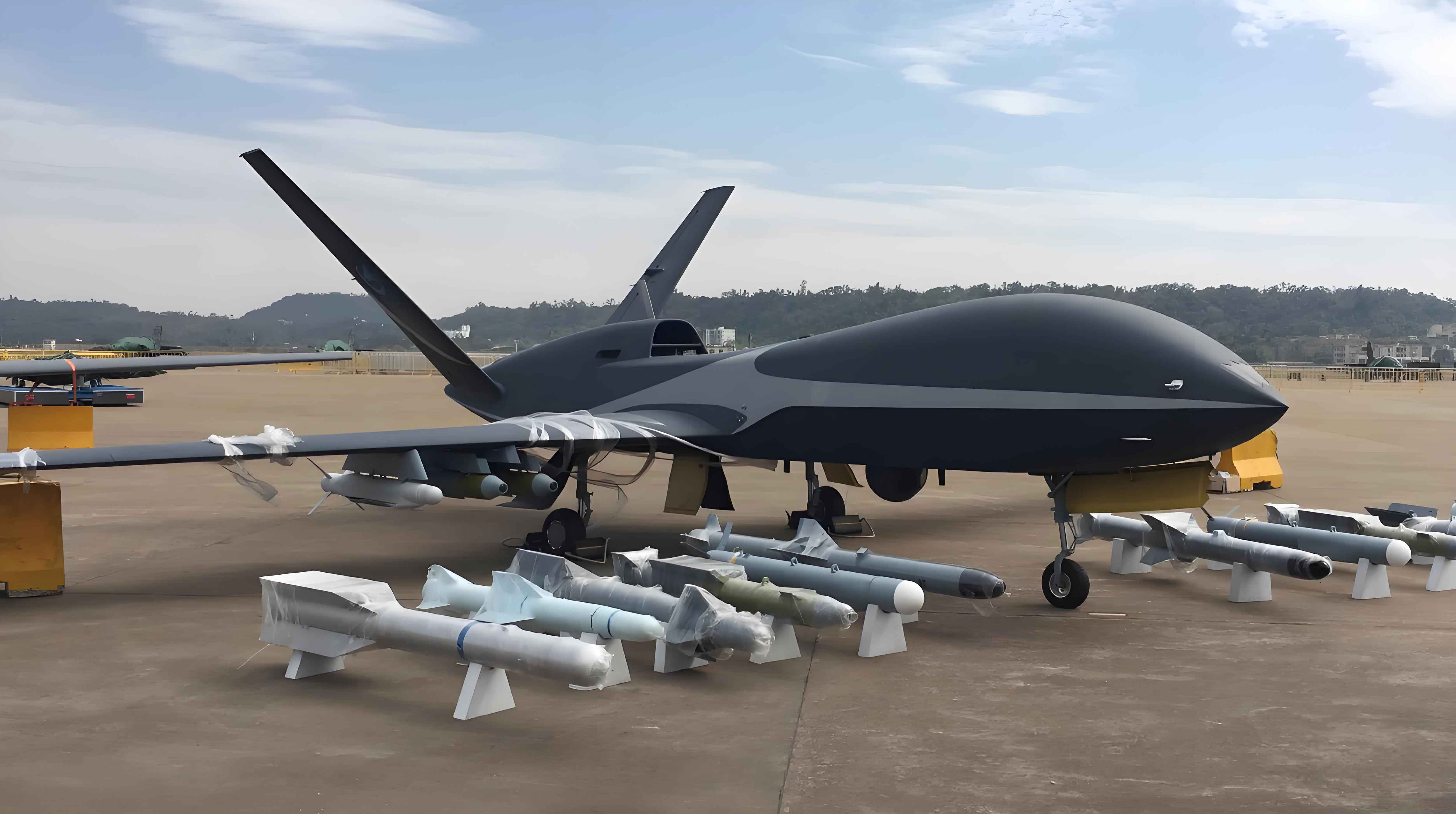
Key technologies underpinning the development of small electro-optical pods for military UAVs encompass structural, control, and integration aspects. We analyze these in detail below, using formulas and tables to summarize principles and challenges. These technologies are essential for achieving the performance metrics required in modern military UAV applications, from stability and vibration isolation to sensor alignment and image fusion.
First, platform structural lightweight design focuses on minimizing gimbal and shaft system mass. Techniques include using thin-walled structures with reinforcements for stiffness, and selecting high-specific-stiffness materials like magnesium-lithium alloys. Topology optimization is increasingly applied to reduce weight without compromising integrity. The relationship between mass reduction and stability can be expressed through the moment of inertia, where minimizing mass lowers the torque required for actuation, enhancing responsiveness. For a gimbal system, the torque $\tau$ needed for angular acceleration $\alpha$ is given by:
$$\tau = I \alpha$$
where $I$ is the moment of inertia, which scales with mass distribution. Lightweight designs aim to reduce $I$, thereby improving the dynamic performance of military UAV pods.
Second, high-precision stabilization is crucial for clear imaging, especially as sensor resolutions increase. Stabilization accuracy depends on vibration damping, precise transmission, control algorithms, and gimbal characteristics. For small pods, gyro-stabilization with two-axis, four-frame configurations can achieve accuracies around 20 μrad. The control system often employs PID (Proportional-Integral-Derivative) or advanced methods like Linear Extended State Observer (LESO) to compensate for disturbances. The error signal $e(t)$ in a stabilization loop might be modeled as:
$$e(t) = \theta_{target}(t) – \theta_{actual}(t)$$
where $\theta_{target}$ and $\theta_{actual}$ are desired and actual pointing angles, respectively. Minimizing $e(t)$ through feedback control ensures stable targeting for military UAV missions.
Third, vibration isolation is challenging due to external mounting on military UAVs, which can couple linear vibrations into angular motions. Solutions include wire-rope isolators in disk arrangements or parallelogram mechanisms to decouple degrees of freedom. The transmissibility $T$ of a vibration isolator, representing the ratio of output to input acceleration, is given by:
$$T = \frac{1}{\sqrt{(1 – r^2)^2 + (2\zeta r)^2}}$$
where $r$ is the frequency ratio and $\zeta$ is the damping ratio. Designing isolators with low $T$ at operational frequencies mitigates vibration effects on pod performance.
Fourth, multi-sensor integration design requires compact packaging of diverse sensors within a limited optical bay. This involves sensor miniaturization, strategic layout planning, and thermal management to prevent deformation from heat stress. The rigidity of the optical bench is critical; deflection $\delta$ under load $F$ can be approximated for a beam as:
$$\delta = \frac{F L^3}{3 E I}$$
where $L$ is length, $E$ is Young’s modulus, and $I$ is the area moment of inertia. Using high-stiffness materials and optimized geometries minimizes $\delta$, preserving optical alignment in military UAV pods.
Fifth, multi-sensor image fusion combines data from visible, infrared, and other sensors to enhance target detection. Algorithms range from pixel-level methods like wavelet transforms to feature-level approaches using neural networks. A common fusion metric is the peak signal-to-noise ratio (PSNR), calculated for fused image $F$ relative to reference $R$ as:
$$\text{PSNR} = 10 \log_{10}\left(\frac{MAX^2}{\text{MSE}}\right)$$
where $MAX$ is the maximum pixel value and MSE is mean squared error. Higher PSNR indicates better fusion quality, aiding military UAVs in discerning targets under varied conditions. Table 2 summarizes key fusion techniques and their applications in military UAV contexts.
| Technique | Description | Advantages | Challenges |
|---|---|---|---|
| Wavelet Transform | Decomposes images into frequency bands for fusion | Preserves edges, multi-resolution | Computationally intensive |
| Pyramid-Based | Uses image pyramids (e.g., Laplacian) for blending | Simple, effective for multi-scale data | Sensitive to registration errors |
| Neural Networks | Learns fusion rules from data via deep learning | Adaptive, high performance | Requires large datasets |
| Bayesian Estimation | Probabilistic fusion based on statistical models | Robust to noise | Complex parameter tuning |
Sixth, boresight alignment technology ensures that laser, visible, and infrared axes remain parallel despite thermal and mechanical stresses. Field alignment methods include using collimators or integrated alignment units with corner cubes. The misalignment error $\Delta \theta$ can be corrected by measuring offsets and applying compensations in software. For a laser designated to a target, the boresight error $\epsilon$ affects targeting accuracy, and minimizing it is vital for military UAV strike missions. Regular calibration maintains $\epsilon$ within acceptable limits, typically a few microradians.
In conclusion, the advancement of small electro-optical pods for military UAVs is pivotal for modern warfare, with trends toward lightweight, intelligent, and cost-effective systems. By mastering key technologies such as lightweight design, high-precision stabilization, vibration isolation, sensor integration, image fusion, and alignment, developers can enhance the capabilities of military UAVs for diverse missions. We anticipate continued innovation in this field, driven by the growing demand for versatile and reliable payloads in military UAV operations. As these technologies mature, they will further empower military UAVs to perform complex tasks, from reconnaissance to coordinated strikes, shaping the future of aerial combat and surveillance.