
In recent years, the rapid advancement of unmanned aerial vehicle (UAV) technology and its widespread application in modern battlefields have posed significant challenges to air defense systems protecting strategic points such as airports, military bases, command centers, and industrial hubs. As an observer and analyst in defense technology, I have witnessed how traditional air defense systems struggle against low, slow, and small (LSS) UAVs, which are increasingly used for reconnaissance, surveillance, and even attack missions. This article aims to explore the evolution of anti-UAV weapons for strategic point defense, with a focus on integrated missile and artillery systems like the Russian Pantsir series. By examining UAV threats, comparing anti-UAV technologies, and analyzing real-world cases, I will provide insights into future developments and recommendations for enhancing defensive capabilities. Throughout this discussion, the term “anti-UAV” will be emphasized to highlight the centrality of countering UAV threats in modern warfare.
The proliferation of UAVs, ranging from commercial drones to military-grade systems, has transformed the aerial threat landscape. According to various defense reports, over 55 countries now operate UAVs, and non-state actors have leveraged low-cost models for asymmetric warfare. This shift necessitates a reevaluation of strategic point defense, which traditionally focused on countering manned aircraft, helicopters, and cruise missiles. UAVs, especially LSS types, can bypass conventional radar detection due to their small radar cross-section (RCS), low altitude flight profiles, and slow speeds, making them elusive targets. In my analysis, I categorize UAVs based on their weight, altitude, and speed to better understand their threat characteristics, as shown in Table 1.
| Type | Takeoff Weight | Operating Altitude | Speed | Representative Models | Threat Forms | Counter Strategies |
|---|---|---|---|---|---|---|
| Class 1 | < 9.5 kg | < 360 m | < 185 km/h | Consumer multi-rotor drones, small reconnaissance UAVs | Unintentional intrusion, surveillance, swarm attacks | Communication/navigation jamming, deception, microwave/laser disablement, dense artillery fire |
| Class 2 | 9.5–25 kg | < 1060 m | < 460 km/h | Small tactical UAVs, mini suicide drones | Tactical reconnaissance, targeted strikes, swarm attacks | Jamming, deception, kinetic energy weapons, integrated missile-artillery systems |
| Class 3 | 25–600 kg | < 5500 m | Varies | Medium-altitude long-endurance (MALE) UAVs, tactical reconnaissance drones | Tactical reconnaissance, precision strikes, swarm operations | Anti-aircraft missiles, electronic warfare, directed energy weapons |
| Class 4 | > 600 kg | < 460 km/h | Varies | Large MALE UAVs, high-altitude platforms | Strategic reconnaissance, targeted eliminations | Surface-to-air missiles, integrated air defense systems |
| Class 5 | Heavyweight | > 5500 m | High speeds | Strategic UAVs, advanced reconnaissance systems | Strategic strikes, deep surveillance | Long-range interceptors, layered defense networks |
From this classification, it is evident that Classes 1-3 UAVs, particularly LSS types, present unique challenges for anti-UAV operations. Their low cost and ease of deployment enable swarm tactics, where multiple drones attack simultaneously, overwhelming traditional defenses. In my assessment, the probability of detecting such UAVs can be modeled using the radar equation, where the RCS (σ) plays a critical role. For instance, the detection range (R) for a radar system is given by:
$$ R = \sqrt[4]{\frac{P_t G^2 \lambda^2 \sigma}{(4\pi)^3 P_{min}}} $$
Here, \(P_t\) is transmitted power, \(G\) is antenna gain, \(\lambda\) is wavelength, and \(P_{min}\) is minimum detectable signal. For small UAVs with σ < 0.1 m², R decreases significantly, complicating early warning. This mathematical insight underscores the need for enhanced sensor fusion in anti-UAV systems.
Traditional air defense systems, which rely on radar-guided missiles and guns, face several technical issues when engaging UAVs. First, detection methods are often单一, with radar being the primary sensor. However, UAVs incorporate stealth materials, such as radar-absorbing composites, reducing their RCS to levels below 0.1 m². Additionally, their low infrared and acoustic signatures make tracking difficult. Second, reaction times for interception are prolonged due to the “track-identify-aim-fire-assess” chain, which may take tens of seconds—insufficient for fast-moving, low-altitude threats. Third, defending against swarm attacks requires multi-target engagement capabilities, which many conventional systems lack. Fourth, the cost-effectiveness imbalance is stark: using expensive missiles to shoot down cheap drones is economically unsustainable. To quantify this, consider the cost ratio (C) between interceptor and target:
$$ C = \frac{C_{interceptor}}{C_{UAV}} $$
For typical anti-aircraft missiles costing millions of dollars versus UAVs costing thousands, C can exceed 1000, highlighting the inefficiency. Thus, developing specialized anti-UAV technologies is imperative.
In response to these challenges, various anti-UAV technologies have emerged, which I group into three categories: monitoring and control, direct destruction, and interference and denial. Each has distinct advantages and limitations, as summarized in Table 2.
| Category | Countermeasure | Advantages | Disadvantages |
|---|---|---|---|
| Monitoring and Control | Intrusion into control links, takeover | Safe, avoids collateral damage | Technically complex, limited range, ineffective against autonomous UAVs |
| Direct Destruction | Missiles, artillery, lasers, microwaves, counter-UAV drones | High kill probability, versatile, long-range for missiles | High cost for missiles, collateral risk, atmospheric attenuation for directed energy |
| Interference and Denial | Communication jamming, GPS spoofing | Low cost, minimal collateral damage, mature technology | Ineffective against pre-programmed UAVs, limited range, evolving countermeasures |
Among these, integrated missile and artillery systems represent a promising anti-UAV solution, combining hard-kill capabilities with cost-effective engagement. The Russian Pantsir series, a leading example, has been deployed in conflicts like Syria, demonstrating both successes and shortcomings. In my view, such systems are crucial for strategic point defense because they offer layered interception: missiles for distant targets and rapid-fire guns for close-range threats. The effectiveness of an integrated system can be expressed through an engagement probability model:
$$ P_{kill} = P_{detect} \times P_{track} \times P_{engage} $$
Where \(P_{detect}\) depends on sensor performance, \(P_{track}\) on tracking accuracy, and \(P_{engage}\) on weapon reliability. For the Pantsir system, upgrades in radar and electro-optical sensors have improved \(P_{detect}\) and \(P_{track}\), while the dual missile-gun approach enhances \(P_{engage}\) across different ranges.
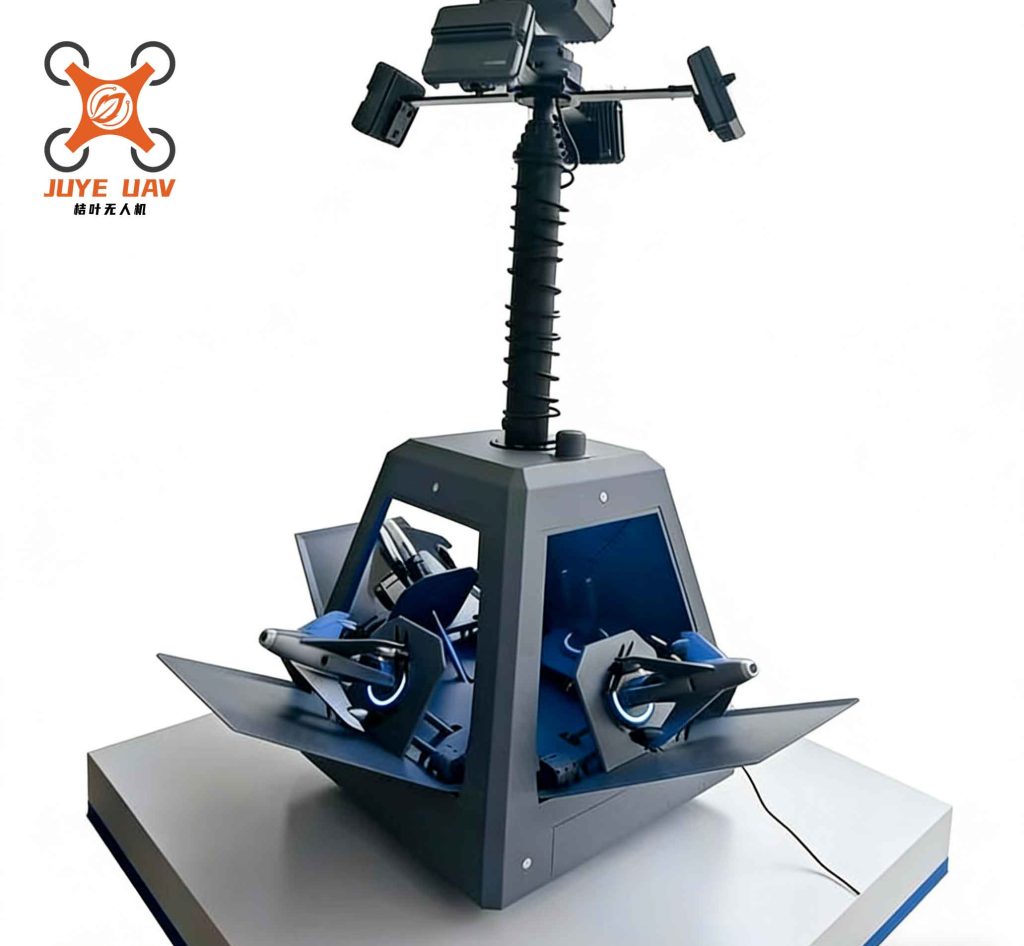
The Pantsir system, developed by Russia’s Tula Instrument Design Bureau, exemplifies the evolution of anti-UAV weapons. Since its introduction in 2012, it has undergone continuous improvements, with variants like Pantsir-S1, S2, SM, and naval versions. Key features include integrated search and tracking radars, electro-optical targeting, and a mix of missiles and auto-cannons. For instance, the Pantsir-S1 uses 12 surface-to-air missiles and two 30mm guns, capable of engaging targets from 0.5 to 20 km. In anti-UAV operations, it has intercepted numerous drones, including Israeli Heron and Turkish Bayraktar TB2 models. However, incidents like the 2020 loss of a Pantsir-S1 to a drone strike reveal vulnerabilities, particularly against swarms or advanced countermeasures. From my analysis, the Pantsir’s strengths lie in its autonomy—it can operate independently without external support—and its modular design, allowing for incremental upgrades. The system’s cost-effectiveness for anti-UAV roles can be assessed using a value metric (V):
$$ V = \frac{N_{engagements} \times P_{kill}}{C_{system} + C_{munitions}} $$
Where \(N_{engagements}\) is the number of UAV engagements, and costs include system procurement and ammunition. For swarm defense, high \(N_{engagements}\) with low-cost gun ammunition boosts V, justifying its use in strategic points.
Real-world case studies highlight the Pantsir’s anti-UAV performance. In 2017, Russian forces in Syria shot down Israeli Heron UAVs at ranges up to 16 km, showcasing missile precision. In 2018, during a swarm attack on Russian bases in Syria, Pantsir systems downed 7 drones and forced 6 to land, demonstrating gun-based swarm suppression. These successes underscore the importance of multi-layered defense. Yet, failures indicate needs for better detection against stealthy drones and faster reaction times. I believe that integrating artificial intelligence for target recognition and autonomous engagement could enhance future anti-UAV systems. For example, an AI-driven tracker might improve \(P_{track}\) by filtering clutter and predicting UAV trajectories, modeled as:
$$ \hat{x}_{k+1} = F \hat{x}_k + K(z_k – H \hat{x}_k) $$
Where \(\hat{x}\) is the state estimate, F is the dynamics matrix, K is the Kalman gain, z is measurement, and H is observation matrix. Such algorithms can reduce latency in the engagement chain.
Based on these insights, I propose several recommendations for developing anti-UAV weapons for strategic point defense. First, embrace the fusion of traditional weapons with new technologies. Systems like Pantsir show that upgrading existing platforms with advanced sensors and cheaper interceptors can quickly enhance anti-UAV capabilities. For instance, incorporating laser dazzlers or microwave emitters alongside guns and missiles creates a hybrid system that addresses cost-effectiveness gaps. Second, implement multi-domain surveillance networks. Relying solely on onboard radar is insufficient; instead, strategic points should deploy layered sensors—including ground-based radars, airborne early warning, and satellite feeds—to improve early detection. The detection probability in a network can be approximated as:
$$ P_{detect}^{network} = 1 – \prod_{i=1}^{n} (1 – P_{detect}^i) $$
Where \(P_{detect}^i\) is the probability for sensor i, and n is the number of sensors. This multiplicative model shows how redundancy boosts overall performance. Third, adopt a “soft-hard kill” combined approach. While direct destruction is necessary for high-threat UAVs, interference and deception methods offer low-cost alternatives for nuisance drones. For example, GPS spoofing can divert UAVs to safe zones, reducing engagement costs. The effectiveness of such a combined strategy can be measured by a composite score (S):
$$ S = \alpha \cdot E_{hard} + \beta \cdot E_{soft} $$
Where \(E_{hard}\) and \(E_{soft}\) are efficacy metrics for hard and soft kills, and α and β are weighting factors based on threat level. Finally, foster modular and scalable designs. Anti-UAV systems should be adaptable to different environments, such as urban areas or polar regions, much like the Pantsir variants. This flexibility ensures readiness against evolving UAV threats.
In conclusion, the rise of UAVs has fundamentally altered strategic point defense, demanding innovative anti-UAV solutions. Integrated missile and artillery systems, exemplified by the Pantsir series, provide a robust foundation due to their versatility and proven track record. However, to counter LSS drones and swarms effectively, future developments must integrate advanced sensors, AI, and cost-effective engagement methods. By leveraging traditional weapons alongside emerging technologies, and by building comprehensive surveillance networks, defenders can achieve the “absolute denial” required for strategic point security. As UAV technology continues to evolve, so too must our anti-UAV strategies, ensuring that defensive capabilities remain ahead of the threat curve. This ongoing effort is critical for maintaining air superiority in an era of ubiquitous drones.