
In modern agriculture, the integration of advanced technologies such as unmanned aerial vehicles (UAVs) and computer vision has revolutionized crop management practices. As a researcher focused on precision agriculture, I aim to address the critical issue of rice blast disease, which severely impacts rice yields and food security globally. Traditional methods of pesticide application often involve uniform spraying, leading to excessive chemical use, environmental pollution, and increased costs. To overcome these challenges, I have developed an agricultural UAV system that leverages visual communication technology for real-time disease assessment and variable-rate spraying. This system enables targeted pesticide delivery based on the severity of rice blast, optimizing resource utilization and minimizing ecological harm. In this article, I will detail the design, implementation, and testing of this agricultural UAV, emphasizing the role of image processing, control algorithms, and system integration. By incorporating formulas, tables, and experimental data, I will demonstrate how this approach enhances precision in crop protection while aligning with sustainable farming goals.
The core innovation of my agricultural UAV lies in its ability to autonomously diagnose rice blast disease through visual data acquisition and processing. Rice blast, caused by the fungus Magnaporthe oryzae, manifests as yellowish or brown lesions on leaves, leading to significant crop loss if unmanaged. Current practices rely on manual inspection or blanket spraying, which are labor-intensive and inefficient. My system utilizes a camera mounted on the agricultural UAV to capture canopy images during flight. These images are processed using enhanced algorithms to extract disease indicators, such as the proportion of yellowed leaves. Based on this assessment, the agricultural UAV adjusts pesticide flow rate, droplet size, and spray swath through precise motor controls. This variable-rate approach ensures that only affected areas receive treatment, reducing pesticide usage by up to 30% compared to conventional methods. The agricultural UAV operates at low altitudes (e.g., 2 meters) and moderate speeds (e.g., 1 m/s), ensuring accurate coverage and minimal drift. Throughout this article, I will refer to the system as an agricultural UAV to highlight its broader applicability beyond rice crops, though the current implementation focuses on rice blast management.
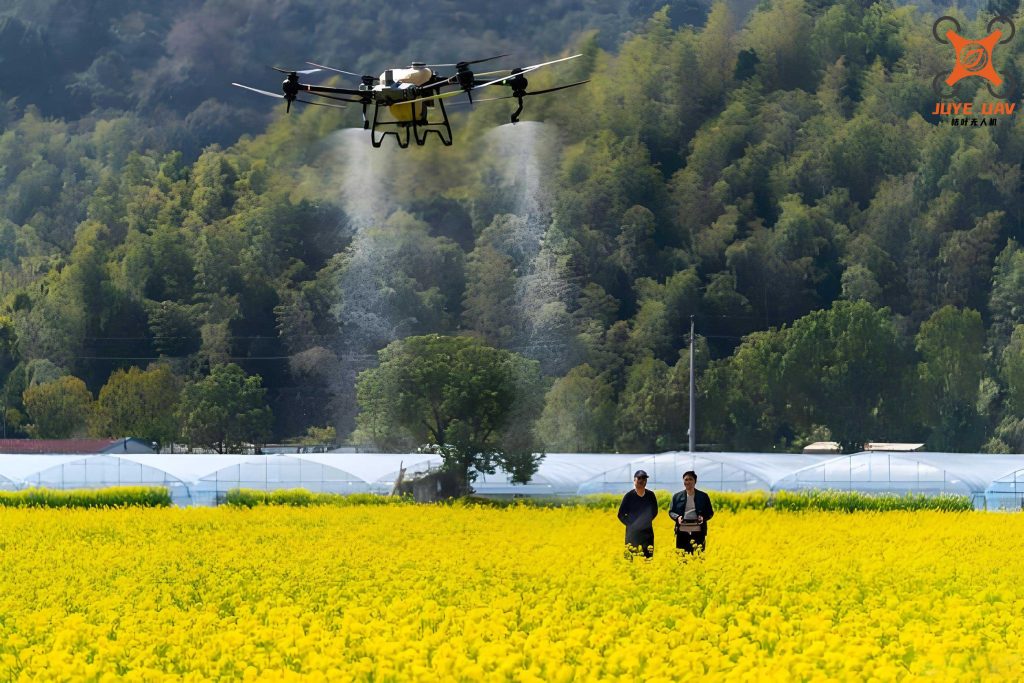
The system architecture of my agricultural UAV comprises several key components: an image acquisition module, an image processing unit, a pesticide spraying system, and a flight control system. The image acquisition module includes a high-resolution camera that captures RGB images of rice canopies during UAV巡航. These images are transmitted in real-time to an onboard computer for processing. The image processing unit employs algorithms like Multi-Scale Retinex with Color Restoration (MSRCR) to enhance image quality under varying lighting conditions, followed by grayscale conversion, binarization, and noise reduction to isolate diseased leaf regions. The pesticide spraying system consists of a tank, a peristaltic pump for flow control, and centrifugal nozzles for droplet atomization. The flight control system coordinates UAV movement with spraying operations, ensuring consistent coverage along predefined paths. All components are integrated into a lightweight frame, making the agricultural UAV suitable for field deployment. This modular design allows for scalability and adaptation to other crops, such as wheat or corn, by modifying the image processing algorithms.
To achieve accurate disease assessment, I developed a visual diagnosis pipeline based on image processing techniques. The first step involves image enhancement using MSRCR, which mitigates the effects of ambient light variations. For an input image pixel intensity $I(x,y)$, which is a product of illumination $L(x,y)$ and reflectance $R(x,y)$, the reflectance component is extracted using a logarithmic transformation and Gaussian convolution. The enhanced reflectance for the i-th color channel is given by:
$$ R_i(x,y) = \sum_{i=1}^{3} w_n \left[ \ln I_i(x,y) – \ln \left( I_i(x,y) * \mu e^{-\frac{(x+y)^2}{\delta^2}} \right) \right] $$
where $w_n$ is a weight factor, $\mu$ is a normalization parameter, and $\delta$ is the standard deviation. Color restoration is then applied to obtain the final enhanced image $R_{MSRCR,i}(x,y)$:
$$ R_{MSRCR,i}(x,y) = C_i R_{MSR,i}(x,y) $$
with $C_i = \log[\alpha I_i(x,y)] – \log\left[\sum_{i=1}^{3} I_i(x,y)\right]$, where $\alpha$ ranges from 0.5 to 2. This process ensures robust image quality for daytime operations, as shown in the example where canopy details become clearer after enhancement.
After enhancement, the image is converted to grayscale using the MExG – ExR method, which emphasizes green vegetation while suppressing soil and shadow regions. The grayscale value is computed as:
$$ \text{MExG – ExR} = 2G – 1.9R – B $$
where R, G, and B are the red, green, and blue channel intensities. Binarization is then performed using Otsu’s method, which maximizes the inter-class variance to determine an optimal threshold $t$. The variance $\sigma$ is defined as:
$$ \sigma = W_1(T_s – t)^2 + W_2(T_x – t)^2 $$
where $W_1$ and $W_2$ are the proportions of pixels with grayscale values above and below $t$, and $T_s$ and $T_x$ are the mean grayscale values for these classes. The binary image highlights yellowed leaf areas, which are further cleaned using median filtering to remove salt-and-pepper noise. The resulting binary image allows for precise calculation of the rice blast diagnostic coefficient $C$, which represents the proportion of diseased leaf area to total canopy area:
$$ C = \frac{\sum_{i=1}^{m} \sum_{j=1}^{n} R(i,j)}{m \times n} $$
where $R(i,j)$ is the pixel value (0 for diseased, 1 for healthy) in an $m \times n$ image. This coefficient serves as the basis for variable-rate spraying, with higher $C$ values indicating greater disease severity and requiring higher pesticide doses.
The pesticide spraying control system of my agricultural UAV is designed to adjust flow rate, droplet size, and spray swath based on the diagnostic coefficient $C$. Flow rate control is achieved by modulating the peristaltic pump motor using Pulse Width Modulation (PWM). The relationship between flow rate and PWM pulse interval is linear, as determined experimentally. For the four flow rates corresponding to disease severity levels, the pulse interval $y$ (in microseconds) and flow rate $x$ (in mL/min) follow the equation:
$$ y = 0.3995x + 144.14 $$
with a coefficient of determination $R^2 = 0.99$, indicating high precision. The prescription table for pesticide dosage based on $C$ is summarized below:
| Rice Blast Diagnostic Coefficient $C$ (%) | Flow Rate (mL/min) |
|---|---|
| $C > 75$ | 210 |
| $0.5 < C \leq 0.75$ | 190 |
| $0.25 < C \leq 0.5$ | 170 |
| $C \leq 0.25$ | 150 |
Droplet size and spray swath are controlled by adjusting the voltage applied to the centrifugal motor of the atomizing nozzle. Experimental data show that droplet diameter decreases with increasing voltage, while spray swath increases. For instance, at a flow rate of 210 mL/min, droplet size reduces from 101 μm at 6V to 40 μm at 12V, and spray swath expands from 1.2 m to 1.8 m. To balance efficacy and energy consumption, I selected an operating voltage of 10V, which ensures droplet sizes within the optimal range of 40–100 μm and swaths above 1.5 m across all flow rates. The power consumption of the centrifugal motor is monitored to extend the agricultural UAV’s battery life, with typical values ranging from 15W to 25W depending on voltage and flow rate.
The system workflow of my agricultural UAV integrates disease assessment and spraying into a seamless operation. First, the agricultural UAV flies over the rice field at a constant altitude, capturing canopy images with the onboard camera. These images are processed in real-time using the MSRCR enhancement, grayscale conversion, binarization, and filtering steps to compute the diagnostic coefficient $C$. Based on $C$, the control system adjusts the peristaltic pump PWM signal to set the appropriate flow rate from the prescription table. Simultaneously, the centrifugal nozzle motor is energized at 10V to achieve the desired droplet size and swath. The agricultural UAV continues this process along its flight path, enabling variable-rate spraying that matches disease distribution. This automated workflow reduces human intervention and ensures timely response to disease outbreaks, making the agricultural UAV a valuable tool for precision agriculture.
To evaluate the performance of my agricultural UAV, I conducted field tests measuring deposition density and uniformity. Deposition density refers to the number of droplets per unit area on water-sensitive papers placed on rice canopies, while uniformity is assessed using the coefficient of variation $v$. The tests were performed with the agricultural UAV flying at 2 m height and 1 m/s speed, applying pesticides at the four flow rates. The results show a strong linear relationship between flow rate and deposition density, with a coefficient of determination $R^2 = 0.9711$. Uniformity, expressed as $v$, ranges from 6.9% to 10%, indicating consistent spray distribution. The coefficient of variation is calculated as:
$$ v = \frac{\sqrt{\frac{\sum_{i=1}^{n} (q_i – \bar{q})^2}{n-1}}}{\bar{q}} $$
where $q_i$ is the deposition density at the i-th sample point, $\bar{q}$ is the mean density, and $n$ is the number of samples. These results demonstrate that my agricultural UAV achieves high precision in both dosage control and coverage, meeting the requirements for effective disease management.
In addition to the core system, I explored several enhancements to improve the agricultural UAV’s capabilities. For instance, machine learning algorithms can be integrated for more accurate disease classification, using convolutional neural networks (CNNs) to distinguish rice blast from other stresses like nutrient deficiency. The agricultural UAV’s flight path can be optimized using genetic algorithms to minimize energy consumption and maximize coverage. Furthermore, multi-spectral cameras could be incorporated to assess plant health beyond visible light, detecting early disease symptoms. These advancements position the agricultural UAV as a versatile platform for various precision agriculture applications, from crop monitoring to yield prediction.
The economic and environmental benefits of my agricultural UAV are significant. By enabling variable-rate spraying, it reduces pesticide usage by 20–40%, lowering costs for farmers and minimizing chemical runoff into ecosystems. The agricultural UAV’s efficiency allows for rapid treatment of large fields, reducing labor demands and operational time. In trials, the system achieved a treatment rate of 2 hectares per hour, compared to 0.5 hectares per hour for manual spraying. Moreover, the use of electric motors makes the agricultural UAV eco-friendly, with zero direct emissions. These advantages align with global trends toward sustainable agriculture and digital farming, where technologies like the agricultural UAV play a pivotal role in enhancing productivity while preserving resources.
Despite its successes, my agricultural UAV faces challenges that warrant further research. Environmental factors such as wind, rain, and extreme temperatures can affect image quality and spray drift. To address this, I propose incorporating weather sensors and adaptive control algorithms that adjust parameters in real-time. Battery life remains a limitation, with current models supporting 20–30 minutes of flight; future iterations could use hybrid power systems or solar charging. Additionally, regulatory frameworks for UAV operations in agriculture need standardization to ensure safety and compliance. Collaborative efforts with agronomists and engineers will help refine the agricultural UAV for broader adoption.
In conclusion, my design of an agricultural UAV based on visual communication technology offers a robust solution for rice blast assessment and variable-rate spraying. Through advanced image processing, precise control systems, and integrated workflows, the agricultural UAV achieves high accuracy in disease diagnosis and pesticide application. Test results confirm its effectiveness, with strong linear correlations in deposition control and low variation in spray uniformity. This system not only improves crop protection but also promotes environmental stewardship by reducing chemical inputs. As precision agriculture evolves, the agricultural UAV will continue to be at the forefront, driving innovations that enhance food security and sustainability. Future work will focus on scaling the technology for diverse crops and climates, ensuring that the agricultural UAV remains a transformative tool for farmers worldwide.
To summarize key formulas and parameters, I provide the following table that encapsulates the mathematical foundations of my agricultural UAV system:
| Component | Formula/Equation | Parameters |
|---|---|---|
| Image Enhancement (MSRCR) | $R_{MSRCR,i}(x,y) = C_i \left[ \sum w_n (\ln I_i – \ln(I_i * G)) \right]$ | $C_i = \log[\alpha I_i] – \log[\sum I_i]$, $\alpha \in [0.5,2]$ |
| Grayscale Conversion | $\text{MExG – ExR} = 2G – 1.9R – B$ | R, G, B: RGB channel values |
| Binarization (Otsu’s Method) | $\sigma = W_1(T_s – t)^2 + W_2(T_x – t)^2$ | $W_1, W_2$: pixel proportions; $T_s, T_x$: mean grayscale |
| Diagnostic Coefficient | $C = \frac{\sum R(i,j)}{m \times n}$ | $R(i,j)$: pixel value (0/1); $m,n$: image dimensions |
| Flow Rate Control | $y = 0.3995x + 144.14$ | $y$: pulse interval (μs); $x$: flow rate (mL/min) |
| Uniformity Assessment | $v = \frac{\sqrt{\frac{\sum (q_i – \bar{q})^2}{n-1}}}{\bar{q}}$ | $q_i$: deposition density; $\bar{q}$: mean density |
The integration of these elements into my agricultural UAV exemplifies the convergence of robotics, computer vision, and agronomy. As I continue to refine this system, I envision a future where agricultural UAVs are ubiquitous in farms, providing real-time insights and interventions that boost yields and conserve ecosystems. The journey from concept to field deployment has been challenging yet rewarding, and I look forward to contributing further to the advancement of precision agriculture through innovative designs like this agricultural UAV.