
In the pursuit of lightweight, high-performance, and high-precision micro aerial vehicles, we have developed a novel bio-inspired butterfly drone that emulates the flapping-wing kinematics of real butterflies. This design addresses key challenges in flapping-wing flight by replacing traditional gear-driven mechanisms with a dual servo direct-drive system, enabling asymmetric wing motion and superior dynamic response. The entire aircraft is built around a carbon fiber skeleton and P31n wing membrane, achieving a wingspan of 41.4 cm and a total mass of only 30 g. In this article, we present the systematic design process, including biomimetic analysis, structural optimization, control system architecture, and experimental validation. The resulting butterfly drone demonstrates stable flight at flapping frequencies between 8 and 12 Hz, with agile maneuvering capabilities. Our work provides a practical reference for the miniaturization and efficiency enhancement of future flapping-wing drones.
1. Design Background and Motivation
The development of bio-inspired flapping-wing aircraft has gained significant momentum in recent years, driven by their unique advantages in energy efficiency, maneuverability, and stealth compared to fixed-wing or rotary-wing platforms. Among natural fliers, butterflies exhibit remarkably efficient flight with exceptional agility, making them ideal models for micro drones. Early prototypes such as Festo’s eMotionButterflies demonstrated the feasibility of lightweight carbon-fiber structures and electric actuation, but their control precision and system integration remained limited. Our goal was to create a butterfly drone that not only mimics the morphological features but also achieves high-fidelity motion control using off-the-shelf micro servos and a compact avionics suite.
We began with a thorough study of butterfly wing morphology and kinematics. Real butterflies possess two pairs of membranous wings supported by a network of veins, allowing passive deformation during flapping. By replicating this flexible structure with carbon fiber rods and P31n kite fabric, we achieved a balance between strength and weight. The key innovation lies in the actuation: instead of a single motor driving a complex linkage, we employ two independent micro digital servos (AF D30T-3.3-MG) mounted symmetrically on the fuselage. Each servo directly drives one wing, enabling programmable phase differences and amplitude variations. This dual-servo architecture simplifies the mechanical transmission and significantly improves the responsiveness and accuracy of the butterfly drone.
Table 1 summarizes the design specifications of our butterfly drone compared to existing platforms. As shown, our design achieves a lower mass-to-wingspan ratio while maintaining high flapping frequency control.
| Parameter | Our Butterfly Drone | Festo eMotionButterflies | ASN-211 (bird-like) |
|---|---|---|---|
| Wingspan (cm) | 41.4 | 50 | 60 |
| Mass (g) | 30 | 32 | 220 |
| Flapping frequency (Hz) | 8–12 | ~10 | 6–10 |
| Actuation mechanism | Dual servo direct-drive | Single motor + linkage | Single motor + gear |
| Flight time (min) | 4.5 | 3–4 | ~15 |
2. Overall Structural Design
2.1 Wing Structure
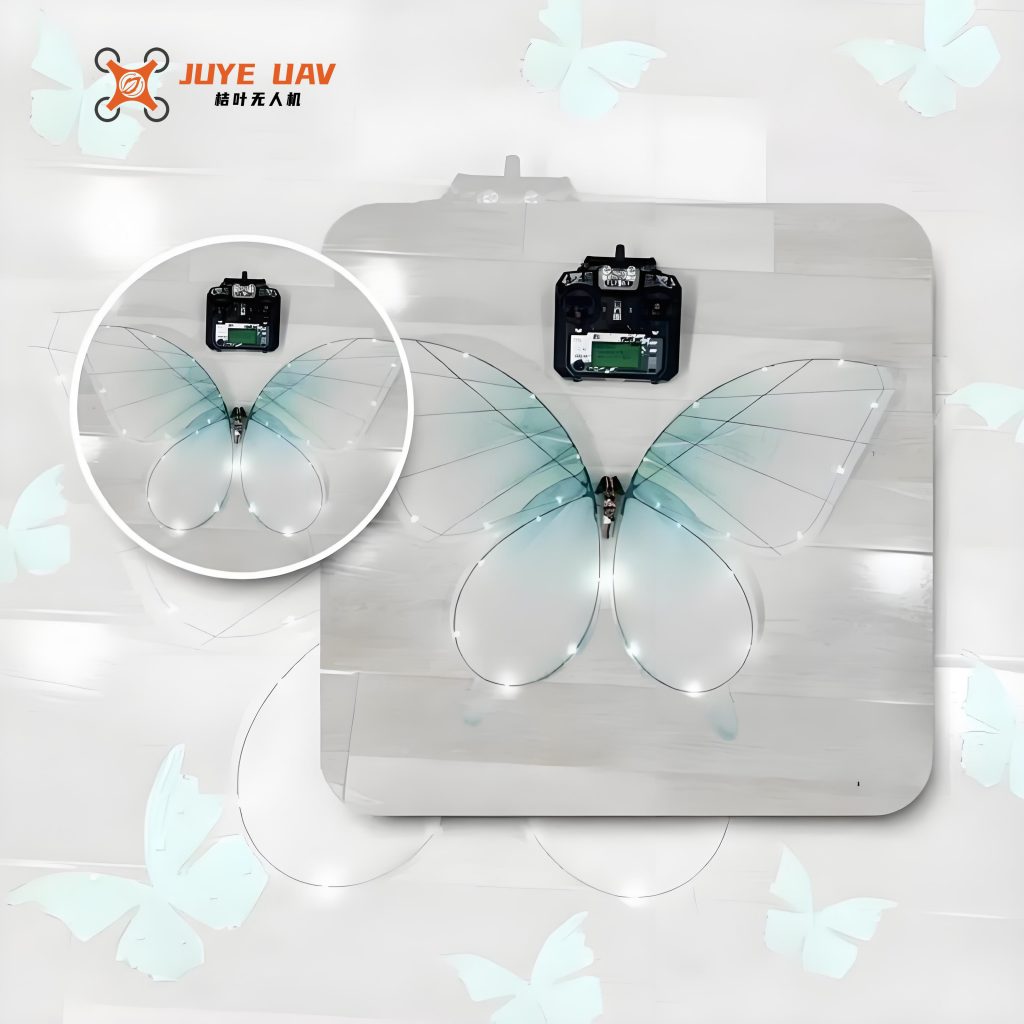
The wings of our butterfly drone are designed as flexible membranes reinforced by a branching carbon fiber skeleton. Each wing consists of a main wing and a secondary wing, mimicking the forewing and hindwing of real butterflies. The skeleton uses 0.8 mm diameter high-strength carbon fiber rods arranged in a fractal pattern to simulate the vein network. The membrane material is P31n kite fabric, which offers high tensile strength and flexibility while being extremely lightweight (areal density ~0.05 g/cm²). This combination allows passive camber change and twist during flapping, enhancing aerodynamic efficiency. The total wing area is approximately 0.12 m², producing sufficient lift at typical flapping speeds.
Table 2 lists the mechanical properties of the wing materials used.
| Component | Material | Density (g/cm³) | Tensile Strength (MPa) | Young’s Modulus (GPa) |
|---|---|---|---|---|
| Skeleton rods | Carbon fiber | 1.6 | 3500 | 230 |
| Wing membrane | P31n kite fabric | 0.05 (areal) | 80 (per cm width) | 0.5 |
| Fuselage main beam | Carbon fiber tube (3 mm OD) | 1.6 | 3000 | 210 |
2.2 Fuselage and Actuator Mounting
The fuselage is built around a single 3 mm diameter carbon fiber rod that serves as the main spar, providing high bending stiffness and low mass. Two AF D30T-3.3-MG digital servos are mounted in a custom 3D-printed polylactic acid (PLA) housing, which weighs only 2.1 g. Each servo has a form factor of 23.2 mm × 12.0 mm × 29.0 mm and a mass of 3.3 g, with a rated torque of 0.18 N·m at 7.4 V and a transit time of 0.06 s per 60° rotation. The servos are driven by pulse-width modulation (PWM) signals from a micro receiver (XR502, 2.4 GHz). A 200 mAh LiPo battery (7.4 V) provides power, with a total weight of 12 g including wiring. The avionics are integrated into the fuselage to minimize drag and maintain the center of gravity near the wing pivot.
The entire butterfly drone, including battery, has a measured mass of 30.0 g, achieving a wing loading of 2.5 g/dm², which is comparable to real butterflies. Table 3 provides a detailed mass breakdown.
| Component | Mass (g) | Percentage (%) |
|---|---|---|
| Wings (pair, with skeleton) | 8.5 | 28.3 |
| Fuselage rod + servo housing | 3.2 | 10.7 |
| Servos (2 units) | 6.6 | 22.0 |
| Receiver + controller PCB | 3.6 | 12.0 |
| Battery (200 mAh, 7.4 V) | 8.1 | 27.0 |
| Total | 30.0 | 100 |
3. Control System Design
3.1 Dual Servo Actuation and Wing Kinematics
The core of our butterfly drone is the dual servo direct-drive mechanism. Each servo’s output arm is directly connected to the wing root via a short pushrod. Unlike conventional linkage-based systems, this design eliminates backlash and reduces mechanical losses. The servos are controlled independently using PWM signals with a resolution of 1 µs, allowing precise manipulation of flapping amplitude, frequency, and phase.
The wing motion follows a cosine trajectory, with the two wings operating in anti-phase (180° phase difference) for hover-like flight. The instantaneous pulse width for each servo is given by:
$$ P_L(t) = S + (A + \Delta) \cos(\omega t) $$
$$ P_R(t) = S + (A – \Delta) \cos(\omega t + \pi) $$
where \(P_L\) and \(P_R\) are the PWM pulse widths for left and right servos respectively, \(S\) is the center position (neutral), \(A\) is the base amplitude, \(\Delta\) is the differential term for yaw control, and \(\omega\) is the angular frequency related to flapping frequency \(f\) by \(\omega = 2\pi f\). The controller updates the setpoints at a loop rate of 200 Hz.
The angular velocity of the servo is controlled by stepping through 18 discrete angle increments per cycle, generating a smooth waveform. The flapping frequency is adjustable from 5 Hz to 15 Hz by modifying the cycle period. Table 4 lists the control parameters and their mapping from the remote control channels.
| Channel | Function | Input Range (µs) | Output Range (µs) |
|---|---|---|---|
| 1 | Yaw (differential steering) | 1000–2000 | −200 to +200 |
| 2 | Elevator (pitch offset) | 1000–2000 | −250 to +250 |
| 3 | Flapping frequency | 1000–2000 | 3500 to 10000 (cycle period in µs) |
| 4 | Amplitude | 1000–2000 | 400 to 700 |
| 5 | Differential bias | 1000–2000 | −100 to +100 |
| 6 | Mode switch (hover/cruise) | >800 µs → activate | ±200 offset |
3.2 Flight Control Algorithm
The control software is implemented on an Arduino platform (Arduino Nano clone) that reads the PWM inputs from the receiver and computes the instantaneous servo positions. The main loop runs at 100 Hz. The algorithm detects flight mode based on the flapping cycle period: if the period is less than 9600 µs (corresponding to about 10.4 Hz), the drone is considered in active flight mode, and the dual servo cosine generation is enabled. Yaw control is achieved by adding a differential offset \(\Delta\) to the amplitude of one wing while subtracting it from the other, creating an asymmetric lift distribution that induces a rolling moment and consequent yaw.
The theoretical lift generated by the butterfly drone can be approximated by:
$$ L_{\text{total}} = \frac{1}{2} \rho S C_L \overline{v^2} $$
where \(\rho = 1.225\, \text{kg/m}^3\) is air density, \(S = 0.12\, \text{m}^2\) is wing area, \(C_L \approx 0.5\) is the mean lift coefficient (estimated from quasi-steady blade element theory), and \(\overline{v^2}\) is the mean square wingtip velocity. For a sinusoidal flapping motion with amplitude \(A_{\text{stroke}}\) and frequency \(f\), the mean square tip velocity is:
$$ \overline{v^2} = \frac{1}{2} (2\pi f A_{\text{stroke}})^2 $$
With \(A_{\text{stroke}} = 0.15\, \text{m}\) (half-stroke amplitude) and \(f = 10\, \text{Hz}\), we obtain \(\overline{v^2} \approx (9.42)^2 \approx 88.8\, \text{m}^2/\text{s}^2\), leading to an estimated lift of:
$$ L_{\text{total}} \approx 0.5 \times 1.225 \times 0.12 \times 0.5 \times 88.8 \approx 3.26\, \text{N} $$
Since the drone’s weight is only \(0.030 \times 9.81 = 0.294\, \text{N}\), the predicted thrust-to-weight ratio is over 11, indicating that the design has ample margin for vertical takeoff and aggressive maneuvers. Actual flight tests confirmed stable ascent and hover.
3.3 Communication and Power Management
The communication module is built around an nRF24L01+ transceiver operating in the 2.4 GHz ISM band. It supports GFSK modulation with selectable data rates of 250 kbps, 1 Mbps, or 2 Mbps. The module measures 14 mm × 13 mm × 3 mm and includes an integrated PCB antenna. The receiver (XR502) demodulates the PWM signals and outputs them to the Arduino. A 200 mAh 2S LiPo battery powers the system via a 3.3 V regulator for the avionics. Typical current draw during flight is 0.8 A, giving a flight time of 4.5 minutes.
4. Prototype Fabrication and Flight Testing
We constructed a fully functional prototype using 3D printing for the servo housing and laser-cutting for the wing membrane. The carbon fiber rods were bonded using cyanoacrylate adhesive. After assembly, the total mass was verified as 30.0 g (with battery). The wingspan measured 41.4 cm as designed.
Flight tests were conducted in an indoor open space with no wind. The butterfly drone was hand-launched and controlled via a standard RC transmitter. The flapping frequency was set to 10 Hz for initial trim. The drone achieved stable level flight, with the ability to turn by applying differential amplitude (yaw channel). The flight was visually stable, with minimal pitch oscillation. Table 5 summarizes the flight performance metrics.
| Parameter | Measured Value |
|---|---|
| Flapping frequency range | 8–12 Hz |
| Max flight time (indoor hover) | 4 min 30 s |
| Average forward speed (level flight) | 1.5 m/s |
| Maximum turn rate (yaw) | 90°/s |
| Stall speed (minimum forward flight) | <0.5 m/s |
| Payload capacity (additional mass) | 3 g |
The butterfly drone demonstrated robust performance across multiple test sessions. The dual servo drive proved reliable, with no observable timing jitter. The lightweight structure showed good resilience to minor crashes. We attribute the success to the combination of precise servo control and the flexible wing design that passively adapts to aerodynamic loads.
5. Conclusion
We have successfully designed, built, and tested a bio-inspired butterfly drone that achieves lightweight construction (30 g total mass, 41.4 cm wingspan) and high-fidelity flapping-wing control using a dual servo direct-drive mechanism. The use of carbon fiber and P31n membrane ensures structural integrity while minimizing weight. The control system, based on an Arduino platform, enables independent adjustment of flapping frequency, amplitude, and differential steering, allowing the butterfly drone to perform stable level flight, hover, and turns. Our experimental results validate the effectiveness of the dual-servo approach for micro flapping-wing drones, offering a simpler and more responsive alternative to conventional linkage-driven designs.
Future work will focus on integrating onboard sensors (e.g., IMU) for autonomous stabilization, exploring higher-density battery chemistries to extend flight time, and optimizing wing planforms for enhanced aerodynamic efficiency. We believe that the design principles demonstrated here can be scaled to larger or smaller butterfly drones for applications in environmental monitoring, search and rescue, and entertainment.