
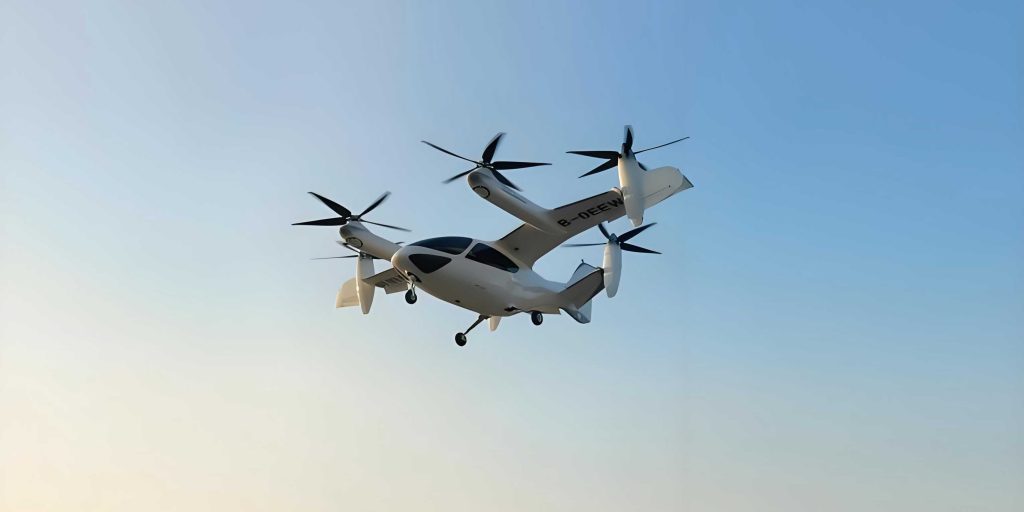
The demand for unmanned aerial vehicles (UAVs) capable of performing diverse missions has driven the development of hybrid platforms that combine the strengths of fixed-wing and rotary-wing aircraft. Traditional fixed-wing UAVs offer superior endurance and range but require runways, while rotary-wing UAVs provide vertical take-off and landing (VTOL) and hover capabilities at the cost of limited speed and efficiency. Current hybrid VTOL solutions, such as tilt-rotors or dedicated lift-plus-cruise configurations, often involve mechanical complexity, increased weight, and aerodynamic interference, hindering miniaturization and optimization. This paper presents the design, prototyping, and experimental analysis of a novel electric VTOL UAV employing a unique variable-rotor transformation mechanism. The core innovation lies in its pair of main wings that function as both rotary lifting surfaces and fixed wings, dynamically altering their aerodynamic mode of operation to enhance both maneuverability and flight endurance.
Conceptual Design and Aerodynamic Principles
The proposed VTOL UAV consists of a central fuselage and two primary wings connected via a servo-driven rotating shaft. Each wing is equipped with a control surface and a propeller mounted near the wingtip. The airfoil is symmetrical (NACA 0015) to perform efficiently at both positive and negative angles of attack. The operational modes are defined by the orientation and rotation of these main wings:
- Vertical Lift Mode: The wings are positioned at complementary angles of attack (e.g., +α and -α). Their propellers spin in opposite directions, generating torques that cause the entire wing pair to rotate around the central axis like a giant rotor. The incoming airflow over the rotating wings generates significant lift, enabling vertical ascent.
- Cruise Mode: The servo rotates both wings to align at the same, fixed angle of attack. The propellers are reoriented to provide forward thrust in the same direction. The wings now function as conventional fixed wings, providing lift from forward motion, enabling efficient high-speed cruise.
- Transition Mode: The wing angle is progressively adjusted from the vertical lift configuration to the cruise configuration. During this phase, lift generation transitions from being dominated by rotational wing lift to being dominated by propeller thrust and, finally, to conventional fixed-wing lift as forward speed increases.
The total lift in vertical lift mode ($L_{all}$) can be expressed as the sum of the aerodynamic lift from the rotating wings and the vertical component of the propeller thrusts:
$$L_{all} = (L_{left} + L_{right}) + (T_{left} + T_{right})\sin\alpha$$
where $L_{left/right}$ is the aerodynamic lift on each wing, $T_{left/right}$ is the thrust from each propeller, and $\alpha$ is the angle of attack of the wings.
Center of Mass and Aerodynamic Center Alignment
A critical design consideration for stability, especially in pitch, is the alignment of the Center of Mass (CoM) and the Aerodynamic Center (AC) along the pitch axis (the wing rotation shaft). Misalignment creates pitching moments that require constant control correction. The CoM is determined by the distribution of all components (battery, motors, structure). The AC for the wing pair, where the resultant aerodynamic force acts, must be calculated.
For a linearly tapered wing, the chord length $c_n$ at any spanwise station $r_n$ is given by:
$$c_n = c_\delta + \left(\frac{c_\gamma – c_\delta}{r_\gamma}\right) r_n$$
where $c_\delta$ is the root chord, $c_\gamma$ is the tip chord, and $r_\gamma$ is the wingspan.
The pitching moment about the rotational shaft must be zero for neutral stability. This involves balancing the moment from the wing’s own mass distribution and the moment from the mass of the propulsion system (motor and propeller). The condition for zero net moment about the pitch axis located at chord position $c_\tau$ is:
$$(\overline{c_n} – c_\tau)\rho_{wing}V + j(c_\phi – c_\tau) = 0$$
where $\overline{c_n}$ is the span-averaged chordwise position of the wing’s own CoM, $\rho_{wing}$ is wing material density, $V$ is wing volume, $j$ is the mass of the propulsion system, and $c_\phi$ is the chordwise location of the propulsion system.
Similarly, the aerodynamic forces (lift $dL_n$ and drag $dD_n$) on a wing section act at approximately its quarter-chord point. For the net aerodynamic moment about the pitch axis to be zero in steady flight, the integral of the lift force times its moment arm must vanish. Assuming a constant lift coefficient $C_L$ and freestream velocity $U$, this leads to:
$$\int_0^{r_\gamma} \left( c_\tau – \left( c_\delta + k r_n + \frac{3}{4}c_n \right) \right) U^2 c_n C_L \, dr_n = 0$$
where $k = (c_\gamma – c_\delta)/r_\gamma$. Solving these equations allows for the strategic placement of the pitch axis and the heavy propulsion components to achieve inherent pitch stability.
Configuration Selection and Gyroscopic Effect Management
In vertical lift mode, the rapidly spinning propellers act as gyroscopes. When the entire airframe rotates (as intended), gyroscopic precession induces torques. The gyroscopic moment $\vec{M}_g$ is given by:
$$\vec{M}_g = \vec{\omega}_{frame} \times \vec{K} = \vec{\omega}_{frame} \times (I_{motor} \vec{\omega}_{motor})$$
where $\vec{\omega}_{frame}$ is the airframe’s angular velocity vector, $\vec{K}$ is the angular momentum vector of the motor/propeller, $I_{motor}$ is the motor’s rotational inertia, and $\vec{\omega}_{motor}$ is the motor’s angular velocity vector.
The direction of $\vec{M}_g$ is perpendicular to both the spin axis of the propeller and the axis of airframe rotation. For stable and predictable behavior, the propeller rotation directions must be coordinated with the intended airframe rotation. Analysis shows that the optimal configuration is to have both propellers spinning in the same direction relative to the airframe, which is also the direction of the intended body rotation. This configuration produces gyroscopic moments that increase the effective angle of attack on both wings, thereby augmenting lift rather than destabilizing the vehicle.
Power Loading and Preliminary System Sizing
Initial sizing estimates for the VTOL UAV are crucial for component selection. Wing loading ($W/S$) and power loading ($P/W$) are key parameters. For cruise flight, the required power $P_B$ relates to weight $W$, wing area $S$, and aerodynamic coefficients. The power-to-weight ratio can be estimated from a constraint analysis equation that balances required thrust with available power:
$$\frac{P_B}{W} = \frac{1}{\eta_{prop}\eta_{motor}\eta_{esc}} \left[ \frac{1}{2}\rho U^3 C_{D0}\frac{S}{W} + \frac{2k W}{\rho U S} + U \sin\phi \right]$$
where $\eta$ terms represent propeller, motor, and electronic speed controller efficiencies, $\rho$ is air density, $U$ is cruise speed, $C_{D0}$ is zero-lift drag coefficient, $k$ is the induced drag factor, and $\phi$ is climb angle. Based on comparable aircraft, an initial wing loading was selected, and this equation was used to estimate the necessary power-to-weight ratio, guiding motor and battery selection.
Prototype Development and Experimental Setup
A prototype was constructed with a wingspan of 990 mm and a root chord of 200 mm. The wings were fabricated from EPP foam for its light weight and durability, while structural parts were 3D-printed or laser-cut from plywood. The propulsion system comprised T-MOTOR F40PRO IV motors, 5-inch three-blade propellers, and 45A ESCs. A high-torque servo (HITEC 5065MG) controlled the wing rotation.
Two test platforms were built:
- Propeller Thrust Test Stand: Isolated the propeller-motor system to measure its static thrust under different throttle settings, both in free air and within the simulated slipstream of the opposite propeller (to account for interference in the rotating configuration).
- Full-Aircraft Lift Test Stand: Measured the total vertical lift force and rotational speed of the entire prototype during simulated vertical lift mode. A cylindrical load cell connected the airframe to a fixed stand, and a laser tachometer measured rotational speed.
The data from both platforms were correlated via the Pulse Width Modulation (PWM) throttle signal to understand the relationship between propeller thrust, airframe rotation speed, and total generated lift at various wing attack angles ($\alpha$).
| Parameter | Value / Specification |
|---|---|
| Wingspan | 990 mm |
| Root Chord | 200 mm |
| Airfoil | NACA 0015 (Symmetric, 15% thickness) |
| Wing Material | Expanded Polypropylene (EPP) Foam |
| Motor | T-MOTOR F40PRO IV |
| Propeller | 5-inch, 3-blade |
| Wing Actuation | HITEC 5065MG Servo |
Experimental Results and Performance Analysis
The propeller thrust tests confirmed a significant effect of slipstream interference. The maximum isolated propeller thrust was 2.57 N, which reduced to approximately 2.02 N when operating in the opposing propeller’s slipstream, indicating non-negligible inter-propeller aerodynamic losses.
The full-aircraft lift tests revealed the core performance characteristic of the variable-rotor system. Lift increased with both throttle (propeller thrust) and wing angle of attack ($\alpha$), up to a point. The results for maximum throttle are summarized below, showing how the lift system efficiency ($\eta$) compares the total lift to the maximum available vertical thrust from the propellers alone ($2 \times T_{prop,max} \approx 4.04 N$).
| Wing Angle of Attack $\alpha$ (°) | Measured Total Lift $L_{all}$ (N) | Lift System Efficiency $\eta = L_{all} / 4.04N$ (%) | Rotational Speed $\omega$ (RPM) |
|---|---|---|---|
| 10 | 3.75 | 93% | 364 |
| 20 | 5.62 | 139% | 260 |
| 25 | 6.85 | 170% | 205 |
| 30 | 7.25 | 179% | 185 |
| 35 | 6.92 | 171% | 174 |
| 40 | 6.55 | 162% | 170 |
The data demonstrates that the optimal angle of attack for maximum lift lies between 25° and 30°. At 30°, the variable-rotor VTOL UAV system produces nearly 1.8 times the lift that would be available from the propellers’ vertical thrust alone. This represents a dramatic increase in lifting efficiency for the VTOL phase, which directly translates to lower power consumption and potentially longer hover endurance. The trade-off is a decrease in rotational speed as $\alpha$ increases due to higher aerodynamic drag on the wings and the reduced tangential component of propeller thrust ($T\cos\alpha$) driving the rotation.
Computational Fluid Dynamics Validation
To validate the experimental findings, a Computational Fluid Dynamics (CFD) simulation was performed for the 30° attack angle case. The simulation modeled the rotating wings using the Moving Reference Frame (MRF) approach within a larger stationary fluid domain, excluding the propeller’s aerodynamic effects (which were subtracted from the experimental data for a direct comparison of wing lift). The SST k-ω turbulence model was employed for accuracy in capturing flow separation at high angles of attack.
The comparison between the CFD-predicted lift from the rotating wings and the experimentally derived wing lift (total lift minus propeller vertical thrust component) showed good agreement, especially at lower rotational speeds. The deviation remained within 7% across the tested range, confirming the fidelity of the experimental setup and the fundamental soundness of the aerodynamic model for this novel VTOL UAV configuration.
Conclusion
This work successfully designed, prototyped, and tested a novel variable-rotor VTOL UAV concept. The design’s key innovation—using the same wing surfaces as both a rotating lift system and fixed wings—was proven feasible. The prototype demonstrated that this configuration can generate up to 80% more lift in the vertical flight mode compared to the thrust of its propellers alone, with an optimal wing angle of attack between 25° and 30°. Careful management of the center of mass and gyroscopic effects was integral to the design. CFD simulations provided validation, with results closely matching experimental data. This variable-rotor architecture presents a promising alternative to existing hybrid VTOL solutions, offering a mechanically simpler path toward efficient, long-endurance UAVs capable of true vertical operation and high-speed cruise, fulfilling a wide range of operational requirements for advanced VTOL UAV platforms.