
In recent years, law enforcement agencies, including police and armed police forces, have faced increasingly challenging tasks in handling突发性 events. To meet operational demands, various police UAV models have been developed and deployed, primarily categorized into three types: surveillance drones equipped with monitoring devices, anti-explosion屏蔽 drones with electromagnetic interference equipment, and offensive drones carrying weapons like riot grenades or rockets. While these police UAV systems perform well in specific roles, their design often focuses on单一 functionality, leading to poor integration and adaptability in complex scenarios. Therefore, there is an urgent need to design a高度集成化 police UAV attack platform that can be rapidly assembled and disassembled, enhancing mission flexibility.
Based on power sources,成熟的 police UAVs are mainly divided into two categories: rotor-based drones propelled by螺旋桨 and滑行式 drones relying on fixed wings and rotors. The latter offers longer endurance, higher energy efficiency, and greater range, making them suitable for reconnaissance. In contrast, rotor-based police UAVs provide superior flight stability,抗干扰能力, and reliable aerial hovering, which are critical for precision tasks. Thus, this paper selects a multi-rotor drone as the platform for the airborne attack system, emphasizing the advantages of police UAVs in稳定 operations.
Weapon systems deployable on police UAVs can be classified by ignition methods: firing pin击发式, rocket-launched, and laser-based. Laser systems face issues with power consumption and size, pending advancements in螺旋桨 and energy storage. Rocket-launched models have relatively low recoil but lack定点打击能力. Firing pin-based weapons, such as firearms, offer better precision and targeted打击能力 despite higher recoil, presenting greater development potential for police UAV applications.
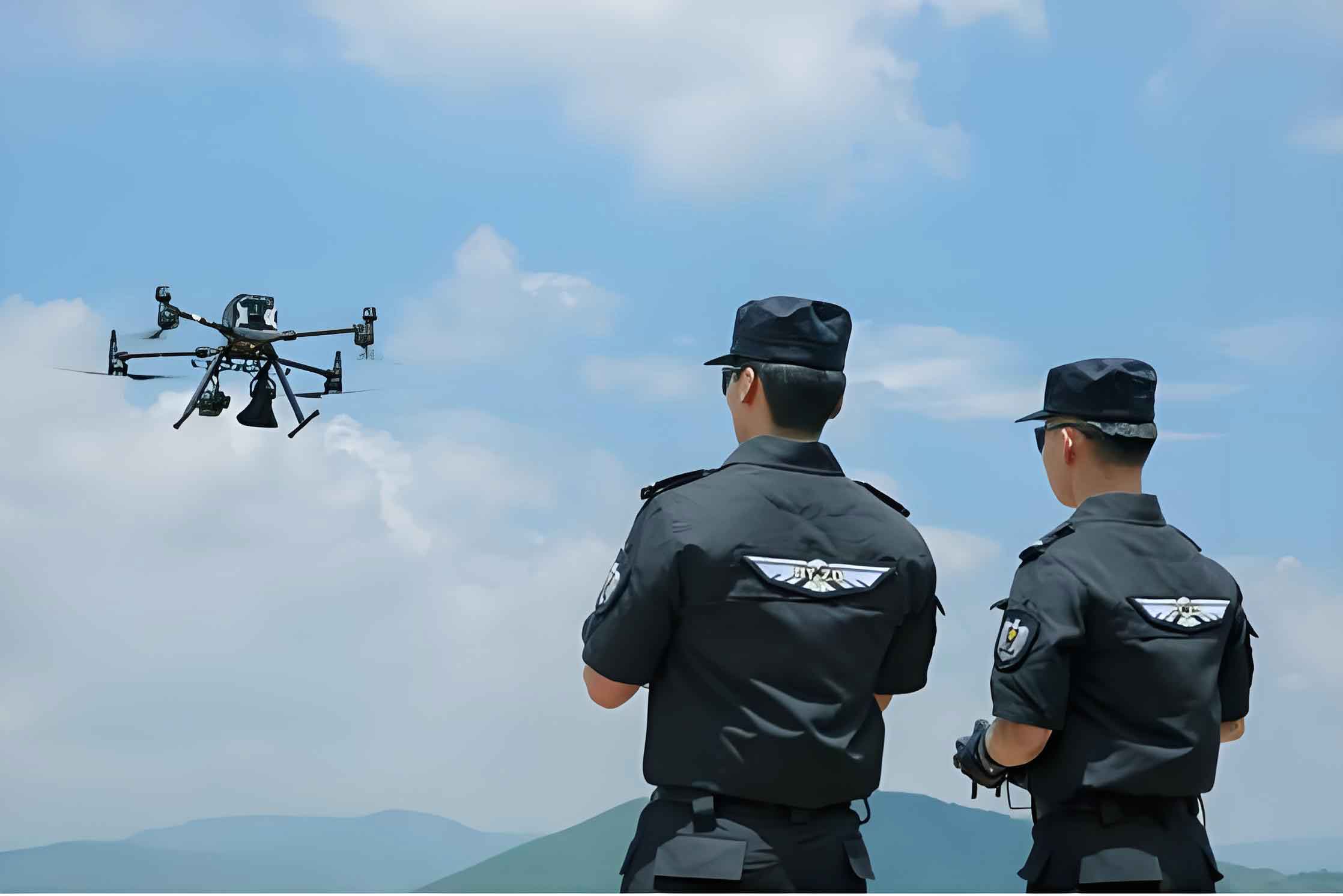
In this work, we optimize the structural design of an existing multi-rotor police UAV, incorporating a modular undercarriage mission舱 for versatility. The attack platform is designed to accommodate various payloads, and we investigate the internal ballistics膛压 of firearm barrels as挂载 weapons, which is crucial for stability studies during drone攻击. The integration of these elements aims to enhance the警察无人机’s role in维稳处突 operations.
Design of the Attack System
As noted, firing pin-based models excel in定点精确打击. To match this with a police UAV, we developed an attack system platform, as illustrated conceptually. This paper focuses on the weapon and drone interaction, excluding发射控制装置 and摄像头瞄准装置 effects.
Selection of Rotor-Based Police UAV
Choosing an appropriate police UAV is essential for virtual simulation modeling. Key considerations include payload capacity and体积. The target police UAV should meet the following criteria:
- High payload capacity: Influenced by螺旋桨, energy storage, and engine. Optimizing propeller数量, size, distribution, and aerodynamic shape, along with matching发动机 and储能装置, can improve负载. Estimated total mass exceeds 8 kg, with components detailed in Table 1.
- Compact size: For低空定点打击,隐蔽性 and机动性 are vital. Smaller police UAVs offer better portability while meeting负载需求.
| Component | Mass |
|---|---|
| Battery | 1.5 |
| Motor and Propeller | 1 |
| Avionics | 1 |
| Frame and Landing Gear | 1 |
| Effective Payload | 3.5 |
After evaluation, a hexacopter police UAV was selected as the研究 platform. Its parameters are summarized in Table 2.
| Parameter | Value |
|---|---|
| Maximum Takeoff Load | 8 kg |
| Effective Payload | 2.5 kg |
| Maximum Lift Force | >10 kg |
| Maximum Outer Diameter | <2 m |
| Flight Time | 30 min |
| Maximum Video Transmission Range | 5 km |
| Maximum Cruise Speed | 15 m/s |
| Effective Remote Control Range | 10 km |
This police UAV features high负载, compact size, ease of transport, quick deployment, stable flight姿态, and low maintenance, making it ideal for an空中攻击平台.
Design of the Police UAV Aerial Attack Platform
Using Pr/Engineer software, we created a 3D model of the police UAV for structural optimization. A rapidly detachable undercarriage module was designed at the底部 to accommodate different战斗模块, enhancing战场适用性 and集成性. The modular design allows for swift adaptation to varying operational needs, a key advantage for警察无人机 systems.
The侦察平台 includes components like舵机, cameras, and固定架, connected via bolts and axes. Ground operators can adjust the camera’s orientation via remote control, enabling全方位侦察 during hovering.减速齿轮 ensure smooth舵机 rotation, improving侦察 accuracy for police UAV operations.
This integrated approach allows the police UAV to serve multiple roles, from surveillance to打击, within a single platform, reducing the need for specialized drones and increasing cost-effectiveness.
Curve Fitting of Barrel Internal Pressure Based on MATLAB
In designing the police UAV attack platform,挂载 firearms present the most complex scenario. The recoil and vibrations during firing can destabilize the无人机空中攻击平台. Traditional internal ballistics studies focus on固定 conditions, but aerial shooting requires integrating枪械内弹道 with the drone platform to ensure accuracy and stability.
Thus, we conducted动力学研究 for the police UAV platform, using a Type 77 pistol as an example. The gas pressure curve inside the barrel was analyzed to model recoil effects.
Establishment of the Chamber Pressure Calculation Model
The gas pressure curve, obtained experimentally, can be divided into three phases:静力燃烧时期,内弹道时期, and后效期. The first two phases are critical for recoil analysis, as they involve high pressure impacting the弹筒底部. We assume the pressure function follows an exponential form:
$$ p(t) = A e^{-B t} – C e^{-D t} $$
where \(A\), \(B\), \(C\), and \(D\) are parameters to be determined. Key points on the curve, such as maximum pressure \(P_m\) and muzzle pressure \(P_u\), along with initial velocity \(v_0\) and barrel length \(L\), provide constraints. Using Newton’s second law and energy principles, we derive equations:
$$ S \int_0^{t_1} p(t) \, dt = m v_0 $$
$$ \frac{1}{2} m v_0^2 = S \int_0^{L} p(t) \, dx $$
where \(S\) is the base area, \(m\) is the bullet mass, and \(t_1\) is the time to exit the barrel. From the pressure curve, we have \(p(t_m) = P_m\) and \(p(t_u) = P_u\), where \(t_m\) and \(t_u\) are corresponding times.
For the Type 77 pistol, reference data includes: \(S = 1.89 \times 10^{-4} \, \text{m}^2\), \(m = 4.859 \times 10^{-3} \, \text{kg}\), \(v_0 = 970 \, \text{m/s}\), \(L = 0.1 \, \text{m}\), \(P_m = 260 \, \text{MPa}\), and \(P_u = 150 \, \text{MPa}\). These values are typical for police UAV挂载 weapons.
Curve Fitting via MATLAB Genetic Algorithm
With more unknowns than equations, we employed a multi-objective optimization approach in MATLAB. The objective function minimizes errors between calculated and measured pressures:
$$ f = \frac{1}{2} \left( |P_m – P_{m,\text{calc}}| + |P_u – P_{u,\text{calc}}| \right) $$
Using genetic algorithm optimization, we obtained best-fit parameters. The fitted curve, compared to experimental data, showed good agreement in the critical early phase (误差 around 5% before 0.2 ms), sufficient for virtual experiments on police UAV stability.
The resulting pressure function is:
$$ p(t) = 67.823 \times e^{-11.93 t} – 65.33 \times e^{-34.807 t} $$
where \(t\) is in milliseconds. This function characterizes the temporal pressure变化 for the police UAV攻击平台. The拟合曲线 illustrates the transition from静力燃烧时期 to内弹道时期, where recoil force peaks, impacting the无人机’s balance.
Analysis of the Pressure Function
From the pressure function, we compute average and maximum recoil forces over different intervals. Using Newton’s third law, the horizontal force on the police UAV attack system is derived. The function shows that pressure changes rapidly during the first two phases, with maximum force occurring at the transition, posing a significant stability challenge for the police UAV. In the后效期, pressure diminishes, reducing影响.
This analysis allows us to set appropriate冲击阈值 in the police UAV’s flight control program. By predicting horizontal force perturbations in real-time, the platform’s stability can be enhanced, improving mission capability for警察无人机 operations. For instance, the recoil force \(F(t)\) can be approximated as:
$$ F(t) = S \cdot p(t) $$
Integrating this over time gives impulse, which correlates with无人机 displacement. We can model the police UAV’s dynamic response using equations of motion:
$$ M \ddot{x} + C \dot{x} + K x = F(t) $$
where \(M\) is the drone mass, \(C\) is damping, \(K\) is stiffness, and \(x\) is horizontal displacement. Solving this helps design control algorithms to counteract recoil, a key aspect for警察无人机攻击平台.
Stability Enhancement and Future Directions
The designed police UAV attack platform has been fabricated and tested for侦察 and空中打击 functions, achieving expected results. Efforts are underway to develop a platform for projecting riot弹药, with preliminary experiments validating feasibility. However, limitations exist in horizontal and vertical stability due to recoil and重心 alignment issues.
Vertically, stability depends on aligning the重心 with the枪管 axis; deviations cause rotation倾向. Horizontally, recoil compensation is essential. Potential methods include:
- Energy抵消法: Using chemical substances that dissipate upon recoil generation to counteract force.
- Structural optimization of firearms to reduce后坐力, e.g., by modifying barrel design or adding recoil absorption mechanisms.
- Active control systems on the police UAV, such as adjusting propeller speeds或 using gyroscopes, to dynamically balance forces.
To quantify these, we can define stability metrics. For example, the angular deviation \(\theta\) due to recoil torque \(\tau\) is:
$$ \tau = F(t) \cdot d $$
$$ I \ddot{\theta} + b \dot{\theta} = \tau $$
where \(d\) is the moment arm, \(I\) is the drone’s moment of inertia, and \(b\) is rotational damping. Minimizing \(\theta\) is crucial for police UAV precision.
Further research will focus on integrating these methods into the police UAV platform, with simulations using software like ADAMS or ANSYS to model dynamics. Table 3 summarizes key parameters for stability analysis.
| Parameter | Symbol | Value | Unit |
|---|---|---|---|
| Drone Mass | M | 8.5 | kg |
| Moment of Inertia | I | 0.15 | kg·m² |
| Recoil Force Peak | F_max | 500 | N |
| Moment Arm | d | 0.05 | m |
| Damping Coefficient | b | 0.1 | N·m·s/rad |
By optimizing these parameters, the police UAV can maintain stability during攻击, ensuring reliable performance in law enforcement scenarios.
Conclusion
This paper presents the design and dynamic balance research of a police UAV attack platform. We optimized the structure of a multi-rotor police UAV, incorporating a modular undercarriage for versatile payloads. The attack system design emphasizes integration and adaptability, key for警察无人机 applications in complex missions. Through MATLAB-based curve fitting, we derived a pressure function for firearm barrels, enabling recoil analysis that informs stability enhancements for the drone platform.
The police UAV platform demonstrates potential in维稳处突 operations, with successful tests on侦察 and打击 modules. Future work will address stability limitations via recoil mitigation techniques and control algorithm refinements. Continued innovation in police UAV technology will expand their role in public safety, offering efficient solutions for aerial surveillance and precision engagement. The integration of advanced动力学研究 and modular design paves the way for next-generation警察无人机 systems that are robust, adaptable, and highly effective in diverse operational environments.
In summary, the police UAV attack platform represents a significant step toward高度集成化 systems, combining multiple functions into a single drone unit. By leveraging mathematical modeling and engineering design, we can overcome challenges like recoil management, ensuring that警察无人机 remain stable and accurate during critical missions. As technology evolves, further improvements in energy storage, propulsion, and materials will enhance the capabilities of police UAVs, solidifying their position as indispensable tools in modern law enforcement.