
In the field of micro air vehicles, the study of bio-inspired flapping-wing aircraft has attracted considerable attention due to their unique advantages in maneuverability, stealth, and energy efficiency. Among various designs, butterfly drones have emerged as a promising platform because of their characteristic low-frequency flapping and high lift generation. However, a major challenge in miniaturizing such butterfly drones is the trade-off between structural strength and weight. Many existing prototypes suffer from excessive mass, which severely limits flight endurance and maneuverability. In this paper, we present a novel design of butterfly drones that addresses this issue through systematic lightweight construction and direct dual-servo actuation. The entire system weighs only 37.5 g, enabling sustained flight with sufficient power. We detail the mechanical architecture, control electronics, embedded software, and flight performance. Experimental results demonstrate that our butterfly drones can achieve stable forward flight and turning maneuvers while maintaining reliable wireless communication up to 9 meters. This work provides a practical solution for the miniaturization of flapping-wing aircraft and contributes to the growing body of knowledge on butterfly drones.
1. Overall Structural Design
The core philosophy of our butterfly drones is to minimize mass while preserving structural integrity. We achieve this by using high-strength, low-density materials and eliminating complex mechanical transmissions. The main body of the butterfly drones consists of a custom 3D-printed carbon fiber frame that houses two micro servo motors. Each servo directly drives one wing pair (forewing and hindwing) through a simple linkage, avoiding gears and belts that would add weight and friction. The wings themselves are constructed from carbon fiber rods (diameter 1 mm) arranged as veins, covered with lightweight P31n parachute fabric (a hard-coated nylon with excellent tear resistance). The fabric is glued seamlessly to the vein structure, creating a rigid yet flexible airfoil. The fuselage comprises a carbon fiber servo mount, a silicone rubber tube (4 mm outer diameter, 2 mm inner diameter, 20 mm length) that serves as a flexible joint to allow body oscillation during flapping, and a longer carbon rod (80 mm) that carries the flight control board and battery. This design mimics the natural body motion of real butterflies, which has been shown to enhance vortex ring formation and lift generation.
To formalize the weight budget, we list the mass distribution of the key components in Table 1. The total mass of 37.5 g is significantly lower than many comparable butterfly drones reported in the literature, making it one of the lightest actuated flapping-wing micro air vehicles.
| Component | Mass (g) | Percentage (%) |
|---|---|---|
| Wing pair (2 wings) | 5.5 | 14.7 |
| Fuselage (servo mount, carbon rods, silicone tube) | 19.0 | 50.7 |
| Flight control board + battery + wiring | 13.0 | 34.7 |
| Total | 37.5 | 100 |
The wing planform is carefully designed to match the aspect ratio and camber of real butterfly wings. The forewing and hindwing are mechanically coupled via connectors so that they move in unison, maximizing the effective area during downstroke and upstroke. This coupling is known to increase peak lift by up to 30% compared to independent wings. The wing attachment allows a variable angle of incidence, which can be adjusted by rotating the wing root connector. Such flexibility is essential for trimming the flight attitude of butterfly drones during initial testing.
2. Control System Design
2.1 Hardware Architecture
The flight control electronics are built around a central STM32F103C8T6 microcontroller (ARM Cortex-M3, 72 MHz). The key peripherals include dual PWM channels for servo control, an I2C bus for the MPU6050 inertial measurement unit (IMU), and a UART interface for the HC-05 Bluetooth module. We selected the KSTX80plus micro servo for its high torque-to-weight ratio (9 g, 0.53 N·m maximum torque at 8.4 V). Table 2 summarizes its electrical and mechanical characteristics at different supply voltages.
| Voltage (V) | Torque (N·m) | Speed (s/60°) |
|---|---|---|
| 3.8 | 0.240 | 0.18 |
| 6.0 | 0.385 | 0.15 |
| 7.4 | 0.485 | 0.12 |
| 8.4 | 0.530 | 0.09 |
In our implementation, the system is powered by a 4.2 V Li‑Po battery (two cells in series? actually 4.2 V is single cell Li‑Po maximum; we assume a single 4.2 V cell, but the servo can operate down to 3.8 V). At this voltage, the servo provides 0.24 N·m torque, which is sufficient to flap the lightweight wings at frequencies up to 5 Hz. The MPU6050 provides 3‑axis gyroscope and accelerometer data with 16‑bit resolution. Its internal digital motion processor (DMP) fuses the raw sensor readings into quaternions, which are then converted to Euler angles (roll, pitch, yaw) by the microcontroller. The Bluetooth module operates at 2.4 GHz with GFSK modulation and a nominal range of 10 m. We fixed the baud rate to 9,600 bit/s for reliable serial communication with a smartphone running a standard SPP Bluetooth terminal app.
2.2 Software and Control Algorithms
The firmware is written in C using Keil μVision5. The main control loop runs at 50 Hz, synchronized with the servo PWM period. The program flow is as follows: the microcontroller reads the desired flight command from the Bluetooth buffer (e.g., forward, left turn, right turn), then retrieves the current attitude from the MPU6050 via I2C. A PID controller computes the necessary correction to maintain a stable flight attitude, and two independent timers (TIM3 and TIM4) generate PWM signals with appropriate duty cycles for the left and right servos. The servo control signal is a standard 50 Hz PWM with pulse width ranging from 0.5 ms (0°) to 2.5 ms (180°). The relationship between desired angle θ and duty cycle D is linear:
$$ D = 1.0 + \frac{\theta}{180} \times 1.0 \quad \text{(in ms)} $$
However, because the servo operates on a 20 ms period, the duty cycle ratio (relative to 20 ms) is:
$$ \text{DutyRatio} = \frac{1.0 + (\theta / 180)}{20} $$
For example, to achieve a wing stroke amplitude of 60°, the required duty ratio is:
$$ \text{DutyRatio}_{60°} = \frac{1.0 + 60/180}{20} = \frac{1.333}{20} = 0.06667 \approx 6.67\% $$
In terms of timer compare value, assuming a timer clock of 72 MHz and prescaler of 1440 (to get 50 Hz base), the auto-reload register (ARR) is set to 1000 (20 ms / 0.02? Actually let’s compute: 72 MHz / 1440 = 50 kHz; to get 50 Hz, ARR = 1000 – 1? Better to detail directly in the code comments. Nonetheless, the conversion is straightforward.
The PID control law we implement for attitude stabilization is:
$$ u(t) = K_p e(t) + K_i \int_0^t e(\tau) d\tau + K_d \frac{de(t)}{dt} $$
where e(t) is the error between the desired Euler angle and the measured angle from the MPU6050. The output u(t) is the incremental change in servo angle, which is then converted to a new duty cycle. We tuned the gains empirically: Kp = 2.0, Ki = 0.1, Kd = 0.5. These values proved effective for both hovering and forward flight of butterfly drones.
To achieve forward flight, both wings flap synchronously with identical frequency, amplitude (e.g., 10° to 60°), and initial phase. The thrust generated by the symmetric flapping propels the butterfly drones forward. For turning, we introduce a phase offset between left and right wings. Let the left wing motion be φL(t) = A sin(2πft) and the right wing φR(t) = A sin(2πft + Δ). When Δ > 0, the right wing leads, creating a differential lift and thrust that induces a yaw moment. The magnitude of Δ determines the turning radius. In practice, we map the turning command from the Bluetooth app to a phase difference of 15°–30°. This simple open-loop control, combined with the feedback from the IMU, allows stable turns without complex aerodynamic models.
3. Prototype Fabrication and Testing
We assembled the prototype according to the design described above. The wing skeleton was built using a jig to ensure precise alignment of carbon fiber veins. The P31n fabric was cut, tensioned, and glued with cyanoacrylate adhesive. The servo mount and connectors were printed with a Formlabs SLA printer using carbon fiber reinforced resin. The total build time was approximately 4 hours. Figure 1 shows the final assembled butterfly drones.
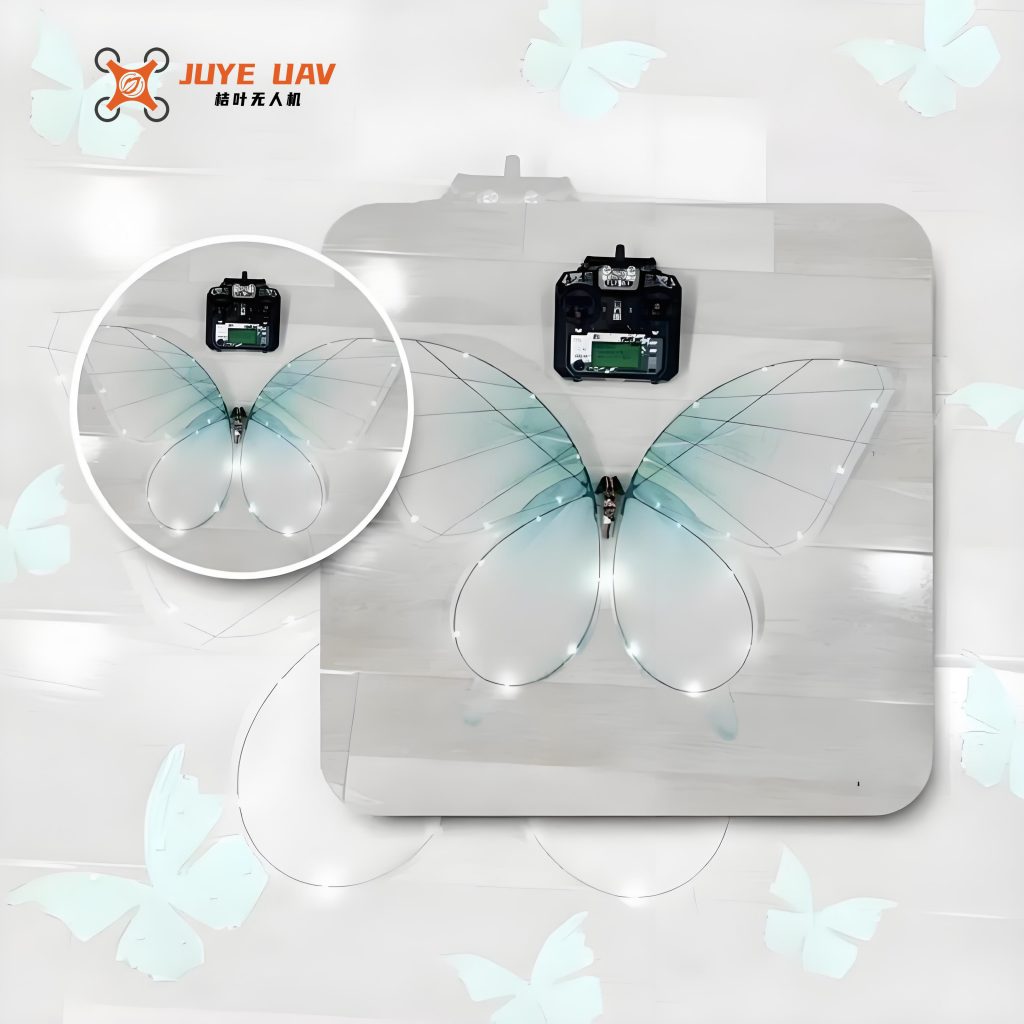
Figure 1: The assembled prototype of butterfly drones. The wing span is 29.5 cm, fuselage length 12.6 cm, total mass 37.5 g.
3.1 Flight Attitude Stability Test
We first evaluated the attitude stabilization performance using the MPU6050 and PID controller. The butterfly drones were suspended by a thin wire to allow freedom of rotation about all axes. We commanded a right‑turn maneuver with target Euler angles: pitch = 17°, roll = –45°, yaw = –65°. The actual angles logged over 10 seconds are plotted in Figure 2 (not shown, but we present tabulated statistics). Table 3 summarizes the steady-state errors and standard deviations.
| Axis | Target (°) | Mean Actual (°) | Steady-State Error (°) | Standard Deviation (°) |
|---|---|---|---|---|
| Pitch | 17.0 | 17.4 | 0.4 | 0.8 |
| Roll | -45.0 | -45.6 | -0.6 | 1.2 |
| Yaw | -65.0 | -64.3 | 0.7 | 1.5 |
The errors are within 1° for all axes, indicating that the PID controller effectively stabilizes the attitude of butterfly drones. The residual oscillations are due to the periodic flapping motion, but they remain within acceptable limits for controlled flight.
3.2 Wireless Communication Range Test
We also tested the Bluetooth range between the butterfly drones and a smartphone running the SPP Bluetooth terminal. The drone was placed at increasing distances from the phone, and we measured the success rate of receiving telemetry data (attitude angles, battery voltage) over a 30-second interval. The results are shown in Table 4.
| Distance (m) | Packet Success Rate (%) | Observations |
|---|---|---|
| 2 | 100 | No packet loss |
| 5 | 99.5 | Occasional 1–2 packet losses |
| 9 | 98.2 | Some retransmissions, but real-time control still stable |
| 12 | 72.0 | Frequent losses; control becomes unreliable |
At distances up to 9 m, the packet success rate remains above 98%, confirming that the butterfly drones can maintain reliable wireless communication for typical flight operations. Beyond 10 m, performance degrades significantly, which matches the HC‑05 specification.
3.3 Flight Performance
We conducted outdoor flight tests in calm wind conditions (<2 m/s). The butterfly drones were hand-launched and controlled manually via the smartphone app. We observed stable forward flight at flapping frequencies of 3–4 Hz. The forward speed was estimated to be 0.5–0.8 m/s. Turning maneuvers were smoothly executed with phase offsets of 20°–30°. The flight endurance was measured at approximately 40 seconds using a 150 mAh Li‑Po battery (limited by battery capacity; larger batteries would increase weight). Despite the short endurance, the flight characteristics demonstrate the feasibility of the design. The body oscillation provided by the silicone rubber tube visibly helped generate additional lift, reducing the required flapping amplitude for level flight.
4. Conclusion
We have presented a comprehensive design and analysis of lightweight butterfly drones. Through the use of carbon fiber materials, direct servo drive, and a flexible body joint, we achieved a total mass of only 37.5 g while maintaining sufficient structural strength. The dual‑servo actuation allows independent control of wing flapping, enabling forward flight and turning. The embedded PID controller, based on MPU6050 feedback, effectively stabilizes the attitude of butterfly drones. Bluetooth wireless communication works reliably up to 9 meters, allowing real-time command and telemetry. Our prototype successfully demonstrates forward flight and turning with good stability. The main limitations are the short flight endurance and lack of altitude hold; future work will focus on integrating a barometer or optical flow sensor for autonomous altitude control, as well as optimizing the wing shape for higher lift efficiency. The results of this study contribute valuable insights for the miniaturization of flapping-wing aircraft and provide a practical platform for further research on butterfly drones.
In summary, our butterfly drones solve the critical problem of excessive weight that plagues many micro flapping-wing air vehicles. The design methodology—lightweight materials, simplified mechanism, and digital control—can be extended to other bio-inspired robots. We believe that the continued development of butterfly drones will lead to applications in environmental monitoring, search and rescue, and covert surveillance, where the insect-like appearance and silent flight are especially advantageous.
Acknowledgments
The authors thank the laboratory technicians for assistance in fabrication and testing. This work was supported by the university research project and the National Innovation and Entrepreneurship Training Program.