
The rapid evolution of Unmanned Aerial Vehicles (UAVs) has catalyzed a transformative shift across numerous sectors, with agriculture standing as a primary beneficiary. The integration of agricultural UAV technology into routine farming practices, particularly in plant protection, offers substantial advantages: a reduction of over 20% in pesticide usage, savings of 70% to 90% in water consumption, and an increase of more than 30% in pesticide utilization efficiency. Consequently, national initiatives vigorously promote the advancement of these technologies. However, the widespread adoption of current agricultural UAV spray systems is hampered by several persistent limitations: functional singularity leading to a narrow operational scope, high seasonal dependency with peak use in spring/summer and minimal application in autumn/winter, consequent low annual utilization rates, and the practical difficulty of swapping spray systems. This article, from a first-person technical perspective, details a design aimed at resolving these challenges through an innovative, PWM-controlled dual-spray system.
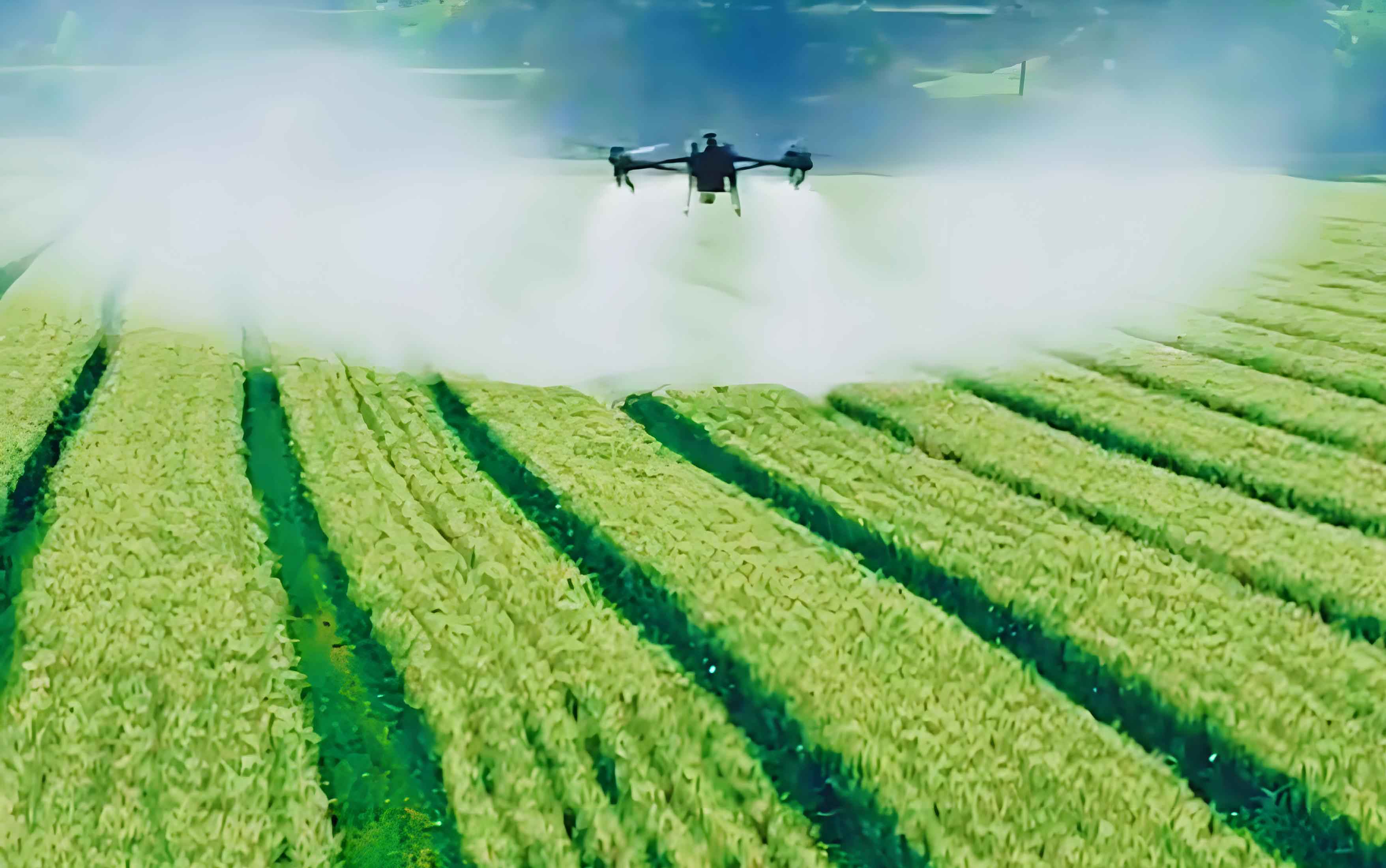
The efficacy of any agricultural UAV is fundamentally tied to its droplet application method. Market analysis reveals two predominant spray head technologies, each with distinct mechanisms and performance profiles.
Pressure Nozzle System: This system employs a pump to pressurize the liquid, forcing it through a nozzle to form a fan-shaped spray pattern. The resulting droplet spectrum is relatively coarse.
$$ Q_p = C_d \cdot A \cdot \sqrt{2 \cdot \frac{\Delta P}{\rho}} $$
Where $Q_p$ is the volumetric flow rate, $C_d$ is the discharge coefficient, $A$ is the orifice area, $\Delta P$ is the pressure differential, and $\rho$ is the fluid density. The droplet size ($D_{p}$) typically ranges from 60 to 130 μm. Its characteristics are summarized below:
| Advantage | Disadvantage |
|---|---|
| Lower cost system | Larger, less uniform droplet spectrum |
| Simple installation and use | High susceptibility to nozzle clogging |
| Wider effective spray swath | |
| Greater droplet kinetic energy for better canopy penetration | |
| Reduced droplet drift due to larger size | |
| Lower evaporation rate, suitable for hot/dry conditions |
Centrifugal (Rotary) Nozzle System: This system utilizes a high-speed electric motor to spin a disc or cage, using centrifugal force to atomize the liquid into fine droplets.
$$ D_c \propto \frac{1}{\omega} \cdot \sqrt{\frac{\gamma}{\rho \cdot r}} $$
Where $D_c$ is the Sauter Mean Diameter of the droplet, $\omega$ is the rotational speed, $\gamma$ is the surface tension, $\rho$ is the density, and $r$ is the radius of the rotating element. This typically produces droplets smaller than 100 μm. Its profile is complementary:
| Advantage | Disadvantage |
|---|---|
| Superior atomization and droplet uniformity | Higher system cost |
| Smaller droplet size for better coverage | More complex installation and maintenance |
| High resistance to clogging, can spray powders | Greater droplet drift potential |
| Rapid evaporation in hot/dry weather, reducing efficacy | |
| Minimal droplet kinetic energy, reliant on UAV downwash | |
| Narrower spray swath, lower operational efficiency |
The conclusion is evident: these systems are complementary. Optimal application requires matching the system to the specific agronomic and environmental context. For instance, a pressure system is preferable for dense crops (e.g., cotton), high-stature trees, or hot/dry conditions. A centrifugal system is ideal for uniform coverage on broadleaf crops (e.g., wheat, rice) or when applying powder formulations. The limitation of single-system agricultural UAVs is clear—they force a compromise. The logical solution is a versatile agricultural UAV capable of hosting both.
The proposed dual-spray system is engineered around the principle of maximal versatility with minimal operational burden. The core design tenets are: 1) Concurrent mounting capability for both systems on a single agricultural UAV airframe; 2) Rapid switching between active systems; 3) Easy dismounting of the inactive system to preserve flight endurance; 4) High compatibility with existing agricultural UAV platforms using a common control signal to minimize retrofit complexity and cost.
The control challenge is elegantly solved using a single Pulse-Width Modulation (PWM) signal source, ubiquitous in UAV remote control systems. PWM controls the duty cycle of power delivery:
$$ \text{Duty Cycle} = \frac{T_{on}}{T_{period}} \times 100\% $$
Where $T_{on}$ is the active signal time and $T_{period}$ is the total cycle time. In our system, both the pressure pump and the centrifugal motor are driven by Electronic Speed Controllers (ESCs) that interpret PWM signals for both on/off and speed/flow control.
The system architecture is as follows: A power source regulated by a 12V BEC supplies the dual-spray system. Two PWM signals originate from the flight controller. The first signal ($PWM_1$) acts as a master enable/disable for the entire spray system. The second signal ($PWM_2$) is the critical control variable. For the pressure system, it directly modulates the pump speed, varying pressure ($P$) and flow rate ($Q_p$). For the centrifugal system, the same $PWM_2$ signal is routed through a proportional scaling circuit before reaching the centrifugal motor ESC, adjusting its rotational speed ($\omega$) to achieve a flow rate ($Q_c$) that correlates with the pressure system’s output.
$$ Q_c = k \cdot f(PWM_2) $$
$$ \omega = g(Q_c) $$
Where $k$ is a experimentally determined proportionality constant linking the PWM input to the desired centrifugal flow rate, and $f$ and $g$ are transfer functions for the pump and motor, respectively.
A physical switching mechanism—comprising a selector valve for liquid flow and an electrical switch for signal routing—facilitates rapid changeover. When set for centrifugal operation, the pump outlet is connected to the centrifugal atomizer feed line, and the electrical switch closes the centrifugal control circuit. When set for pressure operation, the outlet connects to the pressure manifold, and the switch opens the centrifugal circuit. Both the pressure spray bars and centrifugal units mount via quick-release mechanisms, allowing the inactive hardware to be removed, negating any meaningful weight penalty for the agricultural UAV.
The operational superiority of this dual-system agricultural UAV is significant. The ability to select the optimal application method dramatically expands the viable operational envelope for a single machine. This directly addresses the core problems of seasonal dependency and low utilization. The following table synthesizes the decision-making framework for system selection:
| Operational Parameter | Recommended System | Technical Rationale |
|---|---|---|
| High Temperature / Dry Season | Pressure Nozzle | Larger droplets resist rapid evaporation. |
| Powder or Viscous Formulations | Centrifugal Nozzle | Rotary action prevents clogging. |
| Dense Canopy (e.g., Cotton, Late-stage Corn) | Pressure Nozzle | Higher kinetic energy improves penetration. |
| Broad-Acre Crops for Fungicide/Insecticide (e.g., Wheat, Rice) | Centrifugal Nozzle | Fine, uniform droplets enhance coverage on leaves. |
| Tall Trees or Vineyards | Pressure Nozzle | Droplet momentum aids in reaching lower canopy levels. |
| Windy Conditions | Pressure Nozzle | Larger droplets are less prone to drift. |
The benefits of this integrated approach are multifold:
- Enhanced Agronomic Adaptability: The agricultural UAV can now be precisely matched to crop phenology, canopy architecture, and pesticide formulation, optimizing efficacy for a wider range of crops.
- Increased Annual Utilization and ROI: By being effective across seasons and scenarios—from spring foliar sprays to autumn defoliation or desiccation—the same agricultural UAV asset works more days per year, improving return on investment and reducing the need for specialized, single-purpose machines.
- Lightweight, Modular Design: The quick-disconnect philosophy ensures the platform’s flight performance is not compromised. The inactive system’s weight is removed, and the core control electronics add negligible mass.
- High Compatibility and Low Retrofit Cost: Leveraging the existing PWM infrastructure of standard agricultural UAV flight controllers makes this system highly compatible. Retrofitting primarily involves mechanical mounting and simple electrical interfacing, not complex software integration or additional control channels.
In conclusion, the implementation of a PWM-controlled dual-spray system represents a pragmatic and powerful evolution in agricultural UAV design. It directly mitigates the key limitations of functional rigidity and seasonal idleness that hinder current platforms. By providing a single, adaptable tool that can leverage the strengths of both primary spray technologies, this design significantly broadens the operational scope of the agricultural UAV. The use of a unified control signal ensures the solution is accessible and cost-effective for retrofitting existing fleets or developing new platforms. Ultimately, this advancement promotes the more efficient, effective, and sustainable deployment of agricultural UAV technology, enabling growers to address diverse plant protection challenges with unprecedented flexibility and precision.