
The proliferation of Unmanned Aerial Vehicles (UAVs), particularly those categorized as Low, Slow, and Small (LSS), presents a significant and growing challenge for public security. The accessibility of these platforms has led to a surge in incidents ranging from the disruption of critical infrastructure like airports and power plants to more severe applications in smuggling and targeted attacks. To counter these threats, effective Police Anti-UAV systems have become an urgent necessity. This analysis delves into the operational requirements for such systems, synthesizing the threat profile, technological countermeasures, and the integrated workflow necessary for a robust defense.
The core of the threat lies in the LSS UAV’s mission profile and physical characteristics. A typical mission involves takeoff, climb, cruise to an operational area, loitering or task execution, and return. During this profile, the UAV maintains a communication link with its ground control station (GCS) for command uplink and data/video downlink. This dependency on the electromagnetic spectrum is a critical vulnerability for anti-UAV operations. Physically, these UAVs pose a severe detection challenge. Their Radar Cross Section (RCS) is minuscule, often on the order of 0.01 m² for a small quadcopter. Their operational altitude is typically low, between 20m and 1000m, with common mission altitudes around 100-300m, placing them within complex ground clutter environments. Their speed is relatively slow, but sufficient to cover distance quickly.
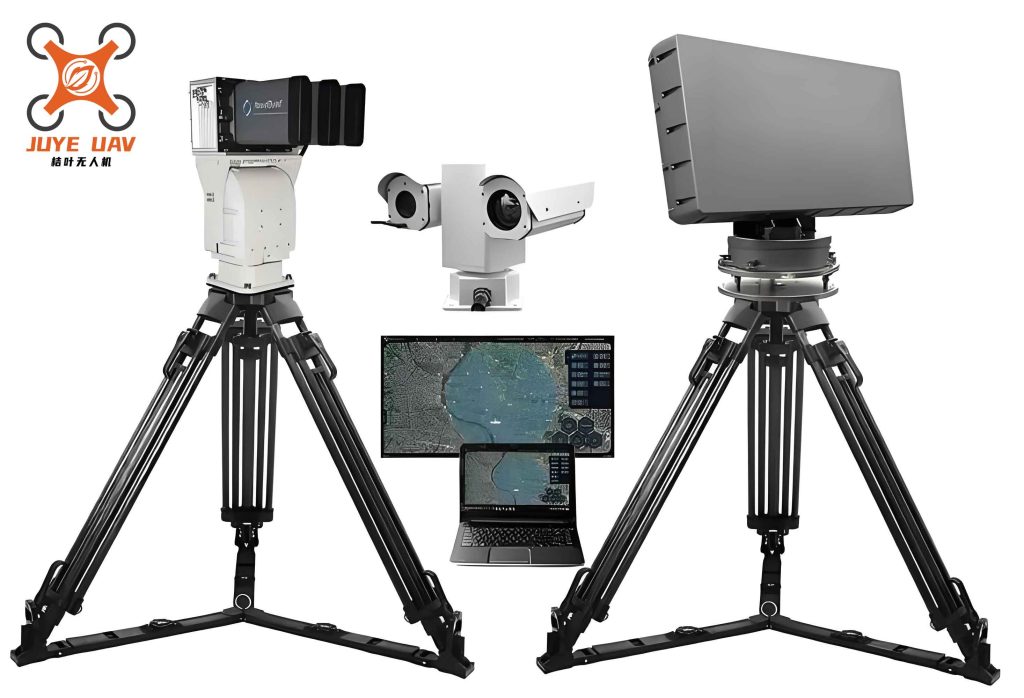
The primary objective of an anti-UAV system is to establish a defensive “no-fly” zone around a protected asset. The radius of this zone must be determined by the surveillance capability of the threat UAV itself. For instance, a common quadcopter with a high-definition camera can visually identify a human-sized target from approximately 400 meters in good conditions. Therefore, the anti-UAV system’s defensive radius, denoted as $R_{defense}$, must be greater than this observation range to prevent intelligence gathering or payload delivery.
$$R_{defense} \ge R_{UAV\_obs} + \Delta R_{buffer}$$
Where $R_{UAV\_obs}$ is the UAV’s effective observation/sensing range (e.g., 400m) and $\Delta R_{buffer}$ is an additional safety margin.
The operational workflow of a layered anti-UAV system follows a “Detect-Track-Identify-Neutralize” paradigm. Assuming co-located sensors, the process is as follows: first, a primary detection sensor (like radar) acquires the target and initiates a track. Concurrently, a passive Radio Frequency (RF) scanner detects the UAV’s communication signals for direction finding and early warning. Second, a Command and Control (C2) system fuses these data into a single track, assesses the threat level, and prioritizes targets. Third, based on cueing data, an electro-optical/infrared (EO/IR) system slews to the target for positive visual identification, and an electronic countermeasure system aligns itself. Finally, upon positive ID, a directed countermeasure is applied, and its effect is assessed via the EO/IR system. The timeline for this engagement is critical and dictates sensor performance requirements.
We can model the total system reaction time $T_{total}$ as the sum of sequential delays:
$$T_{total} = T_{detect} + T_{process} + T_{cue} + T_{ID} + T_{engage}$$
Where:
- $T_{detect}$: Time for primary sensor to detect and establish a stable track.
- $T_{process}$: Time for data processing, fusion, and operator decision-making (~5s).
- $T_{cue}$: Time for secondary sensors (EO/IR, jammer) to physically slew to the target azimuth/elevation (max ~6s for 180° turn).
- $T_{ID}$: Time for EO/IR system to fine-tune and for the operator to visually confirm the target (~5s).
- $T_{engage}$: Time for the countermeasure to take effect (e.g., ~2s for jamming to force UAV contingency behavior).
This timeline directly translates into minimum required detection ranges for each sensor layer. If a UAV approaches at its maximum speed $V_{UAV\_max}$ (e.g., 30 m/s), the system must detect it far enough away to complete the entire $T_{total}$ sequence before the UAV penetrates the defended zone $R_{defense}$.
$$R_{sensor\_min} \ge R_{defense} + (V_{UAV\_max} \times T_{sensor\_specific})$$
The variable $T_{sensor\_specific}$ differs. For the EO/IR system used for final identification, its range must cover the defense radius plus the engagement and identification time. For the primary radar, its range must cover the defense radius plus the *entire* reaction time, which is dominated by its own scan and track initiation period.
| Radar Scan Period $T_{scan}$ (s) | Track Initiation Time $T_{detect}$ (s)* | Estimated Min Radar Range $R_{radar}$ (m) for $V=30$m/s, $R_{defense}=400$m |
|---|---|---|
| 1 | 3 | $R_{radar} \ge 400 + (30 \times (3+5+6+5+2)) = 400 + 630 = 1030$ |
| 3 | 9 | $R_{radar} \ge 400 + (30 \times (9+5+6+5+2)) = 400 + 810 = 1210$ |
| 6 | 18 | $R_{radar} \ge 400 + (30 \times (18+5+6+5+2)) = 400 + 1080 = 1480$ |
| 10 | 30 | $R_{radar} \ge 400 + (30 \times (30+5+6+5+2)) = 400 + 1440 = 1840$ |
*Assuming 80% probability of detection and 3 hits for track initiation.
This analysis underscores that slower-scanning radars, while potentially more sensitive, require a much longer detection range, influencing system cost and deployment. The passive RF scanner, which detects communication signals, can often provide earlier warning than radar, as it does not rely on reflecting energy. Its effective range $R_{RF}$ should ideally exceed the radar’s minimum range: $R_{RF} > R_{radar\_min}$.
The angular coverage, particularly in elevation, is another key requirement for anti-UAV sensors. The threat UAV can operate at very low angles relative to the system. The required elevation coverage $\Phi_{sensor}$ for a sensor can be derived from the UAV’s altitude $H$ and the sensor’s required horizontal detection range $R_{sensor}$.
$$\Phi_{sensor} \ge \arctan\left(\frac{H}{R_{sensor}}\right)$$
For example, to detect a UAV at $H=200$m altitude at the radar’s minimum range of $R=1210$m (from Table 1), the radar must have an elevation coverage of at least $\arctan(200/1210) \approx 9.4°$. To engage a UAV hovering directly above at 400m, the EO/IR and jammer systems need near-zenith coverage ($\approx 90°$).
| UAV Altitude, H (m) | Min Horizontal Range, R (m) | Minimum Elevation Coverage $\Phi$ (degrees) | Sensor Type Requiring Coverage |
|---|---|---|---|
| 20 | 1210 | ~0.95° | Radar, RF Scanner |
| 200 | 1210 | ~9.4° | Radar, RF Scanner |
| 400 | 400 (Defense Radius) | ~45° | EO/IR, Jammer (for ID/Engagement) |
| 1000 | 1210 | ~39.6° | Radar, RF Scanner |
The electronic countermeasure component of an anti-UAV system targets the UAV’s primary vulnerabilities: its command and control (C2) link and its satellite navigation (GNSS). Jamming effectiveness is governed by the jam-to-signal ratio (J/S). The required J/S ratio at the UAV’s receiver must be high enough to overpower the legitimate signal from its Ground Control Station (GCS).
The fundamental power relation is given by the simplified one-way range equation, adapted for jamming. The power received by the UAV from the jammer $P_{rj}$ is compared to the power received from its own GCS $P_{rs}$.
$$ \frac{P_{rj}}{P_{rs}} = \frac{P_j G_j}{P_s G_s} \times \frac{R_s^2}{R_j^2} \times \frac{B_s}{B_j} $$
Where:
- $P_j, P_s$: Transmit power of jammer and GCS signal.
- $G_j, G_s$: Antenna gain of jammer (towards UAV) and GCS antenna (towards UAV).
- $R_j, R_s$: Distance from jammer to UAV, and from GCS to UAV.
- $B_s, B_j$: Bandwidth of the signal and the jammer.
For a successful anti-UAV jamming engagement, $\frac{P_{rj}}{P_{rs}}$ must exceed a certain threshold (e.g., 20 dB or a factor of 100 for digital links). This highlights a critical requirement: the effective jamming range $R_j$ against the C2 link is highly dependent on the unknown distance $R_s$ between the UAV and its hidden operator. The system must be designed with sufficient power-aperture product ($P_j G_j$) to achieve the necessary J/S ratio across the expected threat envelope, especially at the edge of the defended zone.
The frequency coverage of the RF detection and jamming subsystems is paramount. Consumer UAVs predominantly operate in license-free ISM (Industrial, Scientific, Medical) bands. A comprehensive anti-UAV system must cover, at a minimum, the following key bands for C2 link disruption:
- 2.400 – 2.483 GHz (Most common for video and control)
- 5.725 – 5.875 GHz (Increasingly common for HD video)
- Other potential bands between 900 MHz and 6 GHz
For GNSS jamming (targeting GPS, GLONASS, BeiDou, Galileo), coverage must include the primary civilian frequencies: L1 ( ~1.575 GHz), E1, and B1. Extreme caution must be exercised with GNSS jamming due to significant collateral effects on surrounding infrastructure and must be subject to strict operational controls, including spatial direction and temporal limits.
| Target System | Key Frequency Bands | Anti-UAV Subsystem | Operational Note |
|---|---|---|---|
| UAV C2 & Video Link | 2.4 – 2.483 GHz, 5.725 – 5.875 GHz, 900-6000 MHz sub-bands | RF Scanner / Direction Finder, C2 Jammer | Primary electronic attack vector. |
| Civilian GNSS (GPS, etc.) | ~1.575 GHz (L1/E1/B1), ~1.176 GHz (L5/E5) | GNSS Jammer | High risk of collateral damage. Use must be precisely targeted and authorized. |
Beyond the core detect-and-defeat cycle, a practical Police anti-UAV system has additional critical requirements. System Integration is non-negotiable; the radar, EO/IR, RF, and jammer cannot operate as isolated units. A unified C2 software platform is required for real-time sensor fusion, correlated track management, automated threat evaluation, and coordinated cueing of effectors. The system must have a low false alarm rate to maintain operator trust and efficiency in urban environments rich in birds, insects, and other clutter. Identification Friend-or-Foe (IFF) or cooperative identification capabilities are needed to avoid interfering with authorized UAV flights, such as those operated by first responders. The system must also be deployable and mobile, capable of being rapidly set up to protect temporary events or critical locations. Finally, a comprehensive training and doctrine package is essential for operators to understand system capabilities, limitations, and the legal framework governing its use.
In conclusion, designing an effective Police anti-UAV system is a complex systems engineering challenge that balances detection performance, reaction time, electronic warfare effectiveness, and operational practicality. The requirements are driven by a detailed understanding of the LSS UAV threat profile—its speed, altitude, RCS, and electromagnetic signatures. Key performance parameters include layered detection ranges (often exceeding 1-2 km), wide elevation coverage, broad-spectrum RF capabilities, and a tightly integrated workflow with minimal latency. The ultimate goal is to create a seamless defensive shield that can autonomously or semi-autonomously detect, identify, and mitigate unauthorized UAV incursions before they can compromise public safety and security. As UAV technology evolves, so too must the capabilities and adaptability of the anti-UAV systems designed to counter them.